The Colour of Frost
The air bit, sharp and clean, carrying the scent of wet earth and decaying leaves. Autumn was a slow, deliberate killer here, stripping the maples bare, turning the birches to bone. My boots crunched over frost-glazed moss, each step a dull report in the oppressive quiet of the boreal forest. The canopy, what remained of it, offered only fragmented glimpses of a sky the colour of unwashed tin. I pulled my worn wool scarf tighter, the coarse fibres scratching my chin, a familiar comfort against the biting wind. The small parcel nestled deep in my satchel felt heavy, not with its slight weight, but with the burden of its silent message. Another delivery, another thread woven into the fragile, unseen web. My route today had skirted the forgotten remains of what once was a logging road, now just a vague scar choked by new growth. The Ministry of Productivity had long since deemed such detours inefficient, unproductive. But inefficiency was where life, real life, often found purchase.
The air bit, sharp and clean, carrying the scent of wet earth and decaying leaves. Autumn was a slow, deliberate killer here, stripping the maples bare, turning the birches to bone. My boots crunched over frost-glazed moss, each step a dull report in the oppressive quiet of the boreal forest. The canopy, what remained of it, offered only fragmented glimpses of a sky the colour of unwashed tin. I pulled my worn wool scarf tighter, the coarse fibres scratching my chin, a familiar comfort against the biting wind. The small parcel nestled deep in my satchel felt heavy, not with its slight weight, but with the burden of its silent message. Another delivery, another thread woven into the fragile, unseen web. My route today had skirted the forgotten remains of what once was a logging road, now just a vague scar choked by new growth. The Ministry of Productivity had long since deemed such detours inefficient, unproductive. But inefficiency was where life, real life, often found purchase.
My breath plumed, a fleeting ghost in the cold. The chill seeped through my heavy coat, a constant companion. Years of this work, this clandestine ballet across the withered landscape, had honed my senses to a razor’s edge. Every snapped twig, every distant crow’s cry, every shift in the air pressure registered. They said the Conglomerate couldn’t monitor everywhere, not yet. But ‘not yet’ was a luxury we couldn’t afford. My fingers, numb even inside my worn gloves, traced the rough fabric of my satchel. The parcel. It was just a small, metallic cylinder, barely larger than my thumb, but it contained the seed of a frequency jammer, crucial for the next phase of our network’s communications.
I adjusted my course, veering off the faint path towards a cluster of stunted pines. The coordinates were precise, a dead drop near a half-buried culvert. The rendezvous point was always sterile, impersonal. That was the rule. Survival depended on it. But as I pushed aside a curtain of skeletal branches, something… shifted. A sudden, jarring visual, a burst of something utterly alien to this muted, dying landscape.
My breath caught, freezing in my throat. My hand instinctively went to the small, cold hilt of the blade tucked into my belt. It wasn’t a patrol, not a drone. It was… colour. An impossible, defiant smear of it, deep amongst the greys and browns of the autumn woods. A shock of ochre, cadmium red, and a startling, electric blue against the bark of a fallen spruce. My mind, trained for danger, for logic, for survival, stuttered. This was an anomaly. A mistake. Or something worse. Something I hadn’t prepared for.
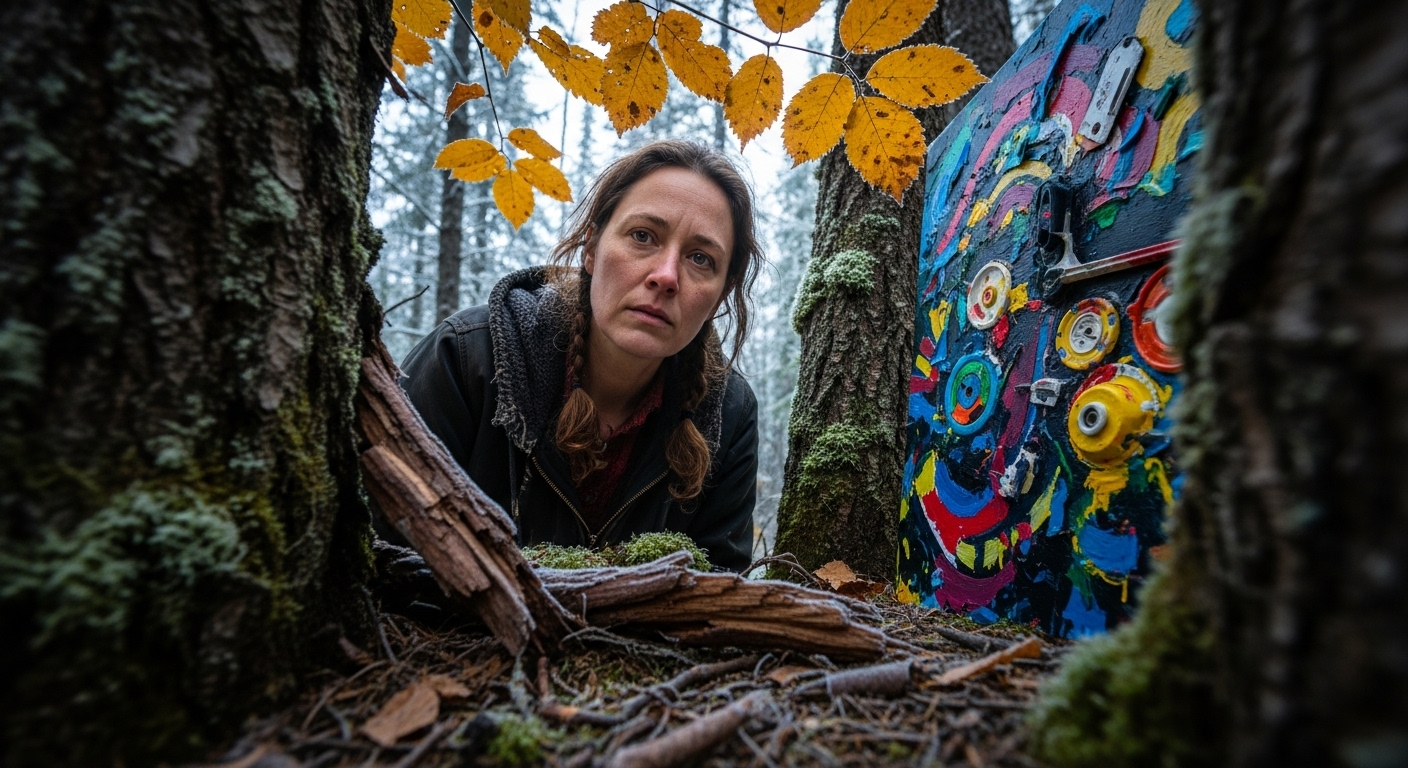
I moved closer, each step deliberate, hushed. The moss gave way to a thin layer of hoarfrost, crunching like shattered glass. What I saw was not a natural phenomenon. It was an arrangement. A canvas, crude and repurposed from what looked like a discarded tarpaulin, stretched taut between two ancient birches. Nailed, or perhaps lashed with scavenged wire. On it, painted with brutal, almost desperate strokes, was a visage. Not a face, not precisely, but a suggestion of one. Eyes, wide and raw, staring out from a swirl of violent colour. It was a cry. A scream. An act of rebellion.
My gaze swept the area, searching for the trap, the hidden sensor, the subtle sign of surveillance. There was nothing. Only the deep quiet of the forest, the rustle of leaves, the distant, indistinguishable hum of the world beyond. The painting wasn't just there; it was nestled, almost reverently, into a small natural alcove. Below it, on a smoothed stone, lay a single, carefully placed feather. Not a common crow or raven feather, but one from a jay, a vivid, improbable blue. It was an offering. A statement.
The sheer audacity of it left me cold, colder than the wind. Art was a relic, a rumour. The Ministry of Productivity had long since reclassified 'creative expression' as an 'inefficient diversion of societal resources.' All known public art had been dismantled, replaced by propaganda murals or efficient, bland architecture. Private collections had been 're-appropriated' for the greater good. To create, to display, even in this forgotten corner, was an act of treason. A death sentence, surely.
A branch snapped behind me. I spun, my hand on the blade, heart hammering a frantic rhythm against my ribs. A young man stood there, no older than thirty, his face obscured by a thick hood, but his posture radiating an odd mix of apprehension and fierce determination. His clothes were scavenged, like mine, but there was a streak of dried blue paint across the elbow of his jacket. His eyes, when they finally met mine through the shadow, were wide, startlingly bright. Too bright for this place, this time.
"You shouldn't be here," he said, his voice low, a rough whisper that barely carried on the wind. Terse. Minimalist. Just like everything else these days. He didn’t sound aggressive, merely stating a fact.
"Neither should this," I replied, gesturing with my chin towards the painting. My voice was steady, betraying none of the tremor that had started deep in my gut. I kept my hand on my blade. Habit.
He stepped forward, out of the deepest shadow. He had fine lines around his eyes, despite his age, the kind etched by constant vigilance or too much time squinting at distant horizons. His lips were chapped, raw from the cold, but a small, almost imperceptible smile played at the corners. He wasn't afraid. Not exactly. Resigned, maybe. Or just… determined.
"It’s meant to be seen," he said, his gaze flicking to the painting, then back to me. "Even here."
"It’s suicide." The words were out before I could censor them. Blunt truth. Anything else felt wasteful.
He didn't flinch. "Maybe. But what’s the alternative? Living… without this?"
I thought of the parcel in my satchel, the sterile, essential work. The hidden wires, the encrypted frequencies. The necessary, unsung labour of survival. This… this was different. This was reckless, beautiful defiance. My mind was a flurry of contradictory thoughts. The logic of my mission screamed danger. The buried part of me, the part that remembered brushstrokes and charcoal dust, felt a tremor of recognition.
"Who are you?" I asked, my voice still low, guarded.
"Jesse." He offered no more. Just the name. A slight tilt of his head. He didn't ask for mine, understanding the silent rules of this shadowed existence. The unspoken trust, or lack thereof, hung between us, thick as the morning mist.
"This… is yours?" I gestured to the painting.
He nodded. "One of them. There are others. Small spots. Little blazes in the dark. All over. Spread out. We find the quiet places."
My mind struggled to process this. A network. Not of communication, not of supplies. But of art. The inefficiency of it, the sheer, utter folly, was breathtaking. And terrifying. This wasn’t just a lone act of rebellion. This was an organized, clandestine movement of the soul.
"Others?" I repeated, my voice barely a whisper. The cold seeped deeper, but it wasn't just the autumn air. It was the chill of a vast, unprotected vulnerability. A whole generation, perhaps, refusing to let the light die.
"Younger ones. Older, too." Jesse’s gaze softened, a flicker of pride, or maybe just fierce protectiveness. "We make things. With what we find. Scrap metal, old wood. Paint from, well… anywhere we can get it."
My eyes drifted back to the painting, seeing it anew. The texture of the makeshift canvas, the rough, organic feel of the pigments. Not factory-made. Scavenged. Resourceful. The Ministry of Productivity would call it waste. I saw pure, unadulterated spirit.
"Why?" The question slipped out, unexpected even to me. I knew the 'why' of our network – the information, the coordination, the hope of a larger uprising. But art? In a world that had forgotten how to feel, beyond survival or fear, why risk everything for a splash of paint?
Jesse looked at me, really looked, his bright eyes cutting through my practiced neutrality. "Because if they take that too… if they take our colour… what's left? What are we fighting for then? Just grey?"
His words were a raw, unexpected strike. They resonated with a forgotten chord deep inside me, a place I had walled off years ago. The smell of turpentine, the rough feel of a charcoal stick in my own hand. The joy of creation, long buried under layers of pragmatism and fear. I had been a painter, once. Before the Ministry. Before the Purges. Before common sense dictated survival over self-expression.
He watched my face, a flicker of something in his eyes – recognition? Empathy? I quickly shuttered whatever emotion had betrayed me. This wasn't the time for sentimentality. This was a mission.
"You're alone here?" I asked, my voice regaining its steel edge. The shift was deliberate, a shield. A courier didn't get sentimental.
"For now. Others come and go. We share the sites." He kicked at a loose stone near his foot, a small, nervous gesture. The humanity of it. The slight, almost imperceptible tremor in his hands when he tucked them into his pockets. He wasn't fearless. He was just doing it anyway.
"My delivery… it's time sensitive." I reminded myself, and him, of the real world, the dangerous one, the one that swallowed dreamers whole.
"I know about your kind of deliveries," he said, a knowing look in his eyes. He didn't elaborate. Didn't need to. Our worlds, though seemingly disparate, were two sides of the same coin: resistance. One for survival, the other for soul.
He stepped closer to the painting, running a finger lightly over the rough surface. "We're planning something. Bigger. A collective piece. In the old Hydro facility. They don't use it anymore, not since the grid consolidation. Too remote."
My mind immediately calculated the risks. The Hydro facility. Massive, derelict, but still on some perimeter maps. High risk. Impossible. "That’s foolish," I stated, cold and hard.
He just shrugged, a small, defiant lift of his shoulders. "Maybe. But it's a statement. A big one. The young ones… they need to see it. See that it’s possible. Even here. Maybe especially here."
He turned to face me again, his gaze unwavering. "We need help. Not just hands. Materials. Small things. Scraps of metal, wires, anything that could become something else. And… knowledge. Of the quiet routes. The blind spots. You… you know them."
The request hung in the frosty air. It wasn't a question, but a proposition. A direct invitation into their reckless, vibrant world. My orders were clear: maintain separation, minimize exposure, deliver and retreat. To engage with this… this was to jeopardise everything. My own safety, the network's. But the painting, vibrant and stark against the dying forest, pulled at something ancient within me.
"I can't," I said, the word a struggle against an unexpected surge of longing. The part of me that wanted to create, to connect, to rebel, screamed louder than my rational, survivalist instincts.
Jesse didn't press. He just nodded slowly, his eyes still fixed on me. A shared understanding passed between us, a silent language of hardship and defiance. The air grew heavier, thick with unspoken thoughts.
"You have a way to communicate?" I asked, surprising myself. My training screamed. My gut, however, felt a strange, cold thrill.
He dug into a pocket, producing a small, smooth river stone. He flipped it over to reveal a crudely scratched symbol: a stylized tree with roots spreading wide. "This. If you see it, it's us. If you leave something… near it… we'll find it."
I looked from the stone to the painting, then back to Jesse's earnest, hopeful face. His determination was a physical force, stark against the fading light. My mission. The parcel. The frequency jammer. It was all so critical, so vital for the practical fight. But what was the point of winning a practical fight if the soul had already died?
A cold gust of wind tore through the trees, rattling the bare branches above us. The Ministry’s drones were a distant hum, a chilling lullaby in the encroaching twilight. The weight of his hand, the shared glance, the unspoken question – they hung in the sharp, autumn air. What was a single act of defiance worth, if it cost everything?
The Ministry’s drones were a distant hum, a chilling lullaby in the encroaching twilight. The weight of his hand, the shared glance, the unspoken question – they hung in the sharp, autumn air. What was a single act of defiance worth, if it cost everything?
Share This Story


