Grease Pencil on Glass
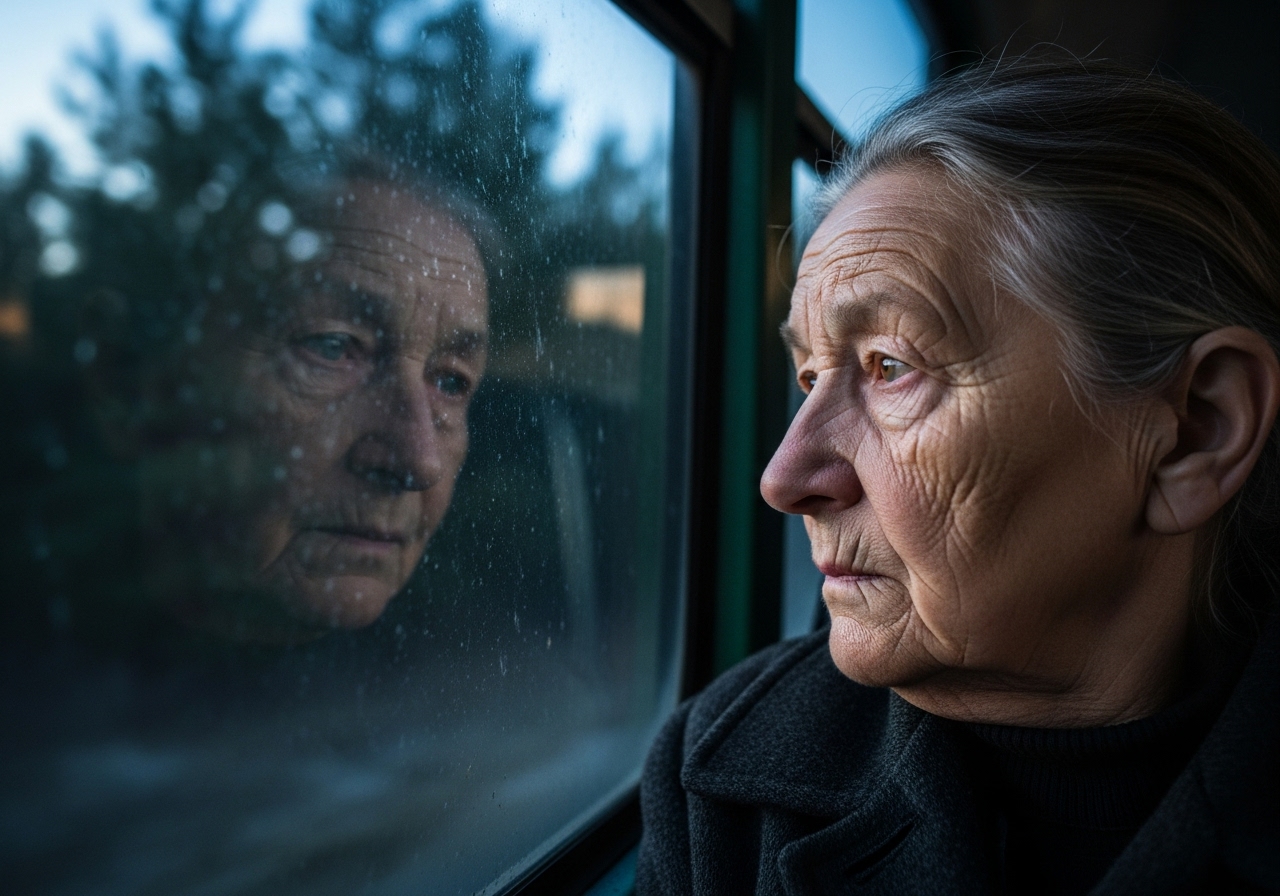
The vibration is the first thing you forget and the last thing you remember. It works its way up from the floorboards, through the cheap foam of the seat cushion, and settles deep in your teeth. Outside, the granite shields of Northern Ontario slide past, indifferent and immense. Sharon watches them, her reflection a faint, tired ghost superimposed over the blur of jack pine and swamp.
The bus smells of diesel fumes and the faint, sweet chemical scent of the blue water in the toilet. It’s a smell Sharon has known since she was a girl, taking this same Greyhound route to visit cousins in Kenora. A smell of temporary escape. Now, at sixty-eight, it just smells like running away, though she isn’t sure what from. Or who.
Her husband, Beaton, had hated this bus. He’d driven everywhere, his big Ford a shield against the world. ‘You see the country through a dirty window on that thing,’ he’d say. ‘You don’t feel it.’ But that was the point, wasn’t it? Not to feel it. To be a passenger, to let the humming engine and the endless, repeating scenery of rock-cut-muskeg-rock-cut erase thought.
She traces a line on the condensation with her finger. The glass is cold, a deep, cellular cold that sinks into her skin. Outside, the sun is getting low, hitting the tops of the white birch trees so they stand out like bleached bones against the dark spruce. Beaton would have called them ‘sentinels.’ He had a flair for the dramatic, a trait she’d found charming at twenty and exhausting by sixty.
A memory unspools, unbidden, tied to the particular slant of light. It was a picnic, not far from here. Or maybe it was a hundred kilometres back, it all looked the same. They were young, just married. Beaton had laid out a plaid blanket on a flat stretch of granite overlooking a lake so still it looked like black glass. He was talking about moving. To the city. Winnipeg, or maybe even Toronto.
‘There’s nothing here, Jan,’ he’d said, skipping a flat stone across the water. It made three perfect little leaps before sinking without a ripple. ‘Just this. Forever.’
She had agreed with him then. The silence of the woods felt like a weight, a pressure in her ears. She’d wanted the noise of traffic, the anonymity of crowds, the feeling that life was happening somewhere nearby. He’d promised her that. A life full of motion. And he’d delivered, in his way. A house in Charleswood, two children, a job at the hydro company for him, part-time at the library for her. A life measured in mortgage payments and report cards.
The bus lurches as it passes a logging truck, the gust of wind rocking the heavy vehicle. An infant a few rows ahead starts to cry, a thin, cutting sound. Sharon closes her eyes. The life he’d promised. But the man who’d skipped the stones wasn’t the man who’d retired from Manitoba Hydro. That man had grown quiet, his grand pronouncements shrinking until they were just complaints about the property taxes or the neighbour’s dog.
---
She pulls a worn paperback from her bag, but the words swim. She finds her own reflection in the darkening window more compelling. The lines around her eyes and mouth. The faint sag of her jaw. It’s the face of a woman who has lived a life. But was it her life? The question feels absurd, a luxury. Whose else could it have been?
The memory shifts. It wasn't just him wanting to leave. She remembers the feeling, sharp and clear, of wanting to run. She’d looked at the women in their town, their hands chapped from hard water, their conversations circling the same three topics: canning, church bake sales, and who was sick. She’d felt a kind of panic, a desperate need to not become them.
‘We’ll go,’ she had told him, her voice firmer than his. ‘We have to.’
So it was her choice, too. Maybe more her choice than his. He would have stayed, probably. Content to fish and fix things, to grow old in the same house he was born in. She was the one who had pushed. She had packed the boxes. She had looked at the map and circled a neighbourhood in Winnipeg. She was the architect of the cage.
The irony is a bitter lump in her throat. She spent forty years in the city dreaming of the silence she’d run from. She’d filled their suburban backyard with planters of scraggly pines and put up paintings of lonely lakes. A cheap imitation of the authenticity she’d demanded they leave behind.
The Shape of a Crack
There's a small star-shaped crack in the lower corner of the window, likely from a stray piece of gravel. It's almost invisible, but now that she’s seen it, she can’t look away. It has fractured the landscape into a dozen smaller, distorted versions of itself. A single birch tree becomes a shattered mess of white lines. A patch of sky is a blue mosaic.
That’s what memory is, she thinks. Not a clean sheet of glass, but a cracked one. You think you’re seeing the truth, but you’re only seeing the pieces you can fit together around the damage. She’d remembered Beaton as the restless one, the one who pulled her away. But the truth was splintered. She was the engine. He was the passenger.
The bus driver's voice crackles over the intercom, announcing a fifteen-minute stop in Dryden. A chance to stretch, to breathe air that doesn't smell of recycled humanity. As the bus slows, pulling into the fluorescent glare of a gas station and convenience store, Sharon feels a sudden, sharp pang of something that isn’t quite regret. It’s more complex. A kind of grief for the person she was, the girl who was so certain that the life she wanted was somewhere else. The girl who hadn't understood that you take yourself with you, no matter how many kilometres you put between you and home.
She doesn't move when the doors hiss open. She just sits, watching the other passengers shuffle off, their faces pale and drawn under the station lights. She stays with her ghost in the window, the old woman superimposed over the cracked reflection of a place she no longer recognizes as home.
She looks down at her ticket. The destination says Winnipeg, but for the first time, she considers what would happen if she simply got off here, in this fluorescent nowhere, and never got back on.
Share This Story


