Where the Granite Breathes
The rumble of the tires on the asphalt was a familiar drone, a song Old Bob had listened to for seventy years. Most people saw nothing out the window. Just trees. A boring, endless wall of green and grey. They didn't see the way the land breathed, the slow, geologic exhalation of the granite. They didn't see the figures that sometimes walked between the pines, their forms indistinct, ancient as the rock they trod upon.
A young woman slid into the seat beside him at the Thunder Bay terminal. She had a backpack clutched to her chest like a shield and the wide, nervous eyes of someone leaving home for the first time. She smelled of soap and anxiety. Bob nodded to her, a small, bird-like dip of his head.
‘Going far?’ he asked. His voice was gravelly, worn smooth by time.
‘Winnipeg,’ she said, barely a whisper. ‘University.’
‘Ah, the prairie,’ Bob said, turning his gaze back to the window as the bus lurched into motion. ‘Flat as a promise. You’ll miss the hills.’
‘I guess,’ she said, unconvinced. To her, the endless forest was probably just a cage she was finally escaping. She couldn’t see the life in it. Not yet.
As the bus picked up speed, Bob let his eyes unfocus. He wasn’t looking at the trees, but through them, into the country that lay beneath the road. He saw the old paths, the portage trails worn into the earth by generations of moccasins. He saw the shadows that weren't cast by anything physical. He was looking for the good spots.
About an hour out of Thunder Bay, he saw the first one. A sheer rock face, blasted by the highway department a lifetime ago. To the other passengers, it was just a wall of grey stone. To Bob, it was a canvas. As the bus sped past, faint red ochre symbols bloomed on the surface for a split second: a canoe, a thunderbird, a stick figure of a man with arms outstretched. They glowed with a soft, internal light, like embers stirred by a passing wind.
He smiled. They were still there. They remembered.
---
‘What are you looking at?’ the young woman, Gina, asked. She’d been watching him, he realized. Her book was closed in her lap.
‘Just the history,’ Bob said.
‘It’s just rocks and trees.’
‘That’s what history is,’ he replied, not taking his eyes from the window. ‘Just rocks and trees and the time that’s soaked into them. This road, it’s new. It’s a scratch on the surface. The real country is older. Deeper.’
She looked at him with a polite confusion that was a hair's breadth from pity. The look of the young for the old. He was used to it. He pointed a gnarled finger at the window.
‘Look there,’ he said, his voice dropping. ‘In that swamp. See him?’
Gina squinted, following his finger. She saw a bog, half-frozen, with skeletal tamaracks sticking out of the brackish water. Nothing else.
‘See what?’
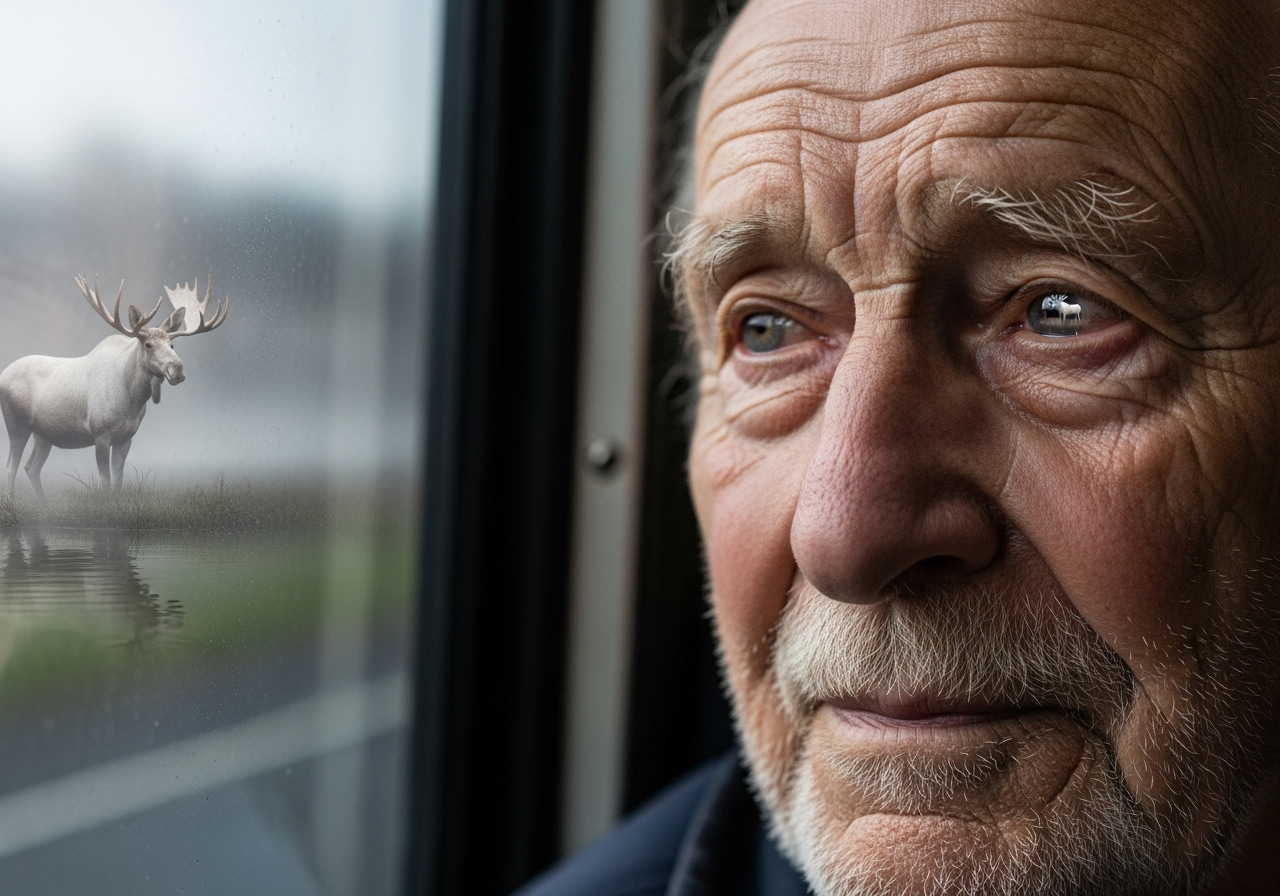
‘The big one. White as snow. He comes here sometimes, when the air gets cold.’
For a moment, Bob saw it as clearly as he saw the girl beside him. A moose, impossibly large, its coat the colour of winter fog. Its antlers were vast and intricate, like the branches of a dead oak. It stood motionless in the water, steam pluming from its nostrils. It turned its massive head and its dark, intelligent eyes seemed to lock onto Bob’s through the glass and the distance. Then the bus was past the swamp, and the vision was gone.
‘There was nothing there,’ Gina said softly, a little nervously.
‘Wasn’t there?’ Bob chuckled. ‘Depends on how you look.’
The Edge of the Woods
He didn't try to explain. You couldn't explain a thing like that. You either saw it or you didn't. Most people spent their lives looking at the surface, and that was fine. The world needed people to pay attention to the asphalt and the timetables.
But someone had to pay attention to the other things. Someone had to watch for the pictographs and the ghost moose and the faint shimmering in the air above a place where a great battle was fought a thousand years ago. That was his job. It had always been his job.
He and the girl, Gina, sat in silence for the next hour. She eventually opened her book again, but he noticed she kept glancing out the window, as if hoping to catch a glimpse of the world he saw. She wouldn't, of course. Not today. But the seed was planted. Maybe one day, on this same bus ride back home, she’d see more than just rocks and trees.
As they crossed the border into Manitoba, Bob felt a change. The air in the bus felt heavier, thicker. The visions began to fade. The Canadian Shield, with its ancient power and deep memory, was giving way to the flat, orderly grid of the prairies. The magic here was different. It was a magic of sky and wind, not of rock and shadow. It was a language he didn't speak as fluently.
The figures in the woods were gone. The pictographs no longer burned on the rock. He was just an old man on a bus, his joints aching, a faint smell of stale popcorn in the air. The journey was ending.
He looked over at Gina. She had fallen asleep, her head resting against the cold glass. She looked so young, so full of a future he could barely imagine. He felt a pang of sadness, not for himself, but for her. For all the things she would see on the surface, and all the things she might miss, swimming in the deep, quiet country just beneath.
As the lights of Winnipeg appeared on the horizon, a faint red light began to glow on the inside of Bob's wrist, a pictograph of a turtle, etched not on rock, but on his own skin. He covered it quickly with his sleeve, a silent promise to the land he was leaving behind.
Share This Story


