The Forest's Metallic Scar
The air, thick with the scent of decaying leaves and two-stroke exhaust, hung heavy over the autumn forest. Golden light struggled through a canopy already shedding its summer finery, illuminating motes of dust dancing in the chill. A rhythmic thud echoed, a testament to the unromantic, ceaseless labour of August, whose thoughts drifted through a fog of mild resentment and burgeoning absurdity as another Tuesday bled into the relentless, unyielding sameness of his early adulthood.
It was, August decided, the particular, damp stink of dying leaves mashed underfoot, combined with the acrid kiss of two-stroke engine exhaust, that truly defined his entry into respectable adult employment. A pungent, inescapable bouquet that clung to his work trousers like an unwanted relative. Another Tuesday. Another forest. Always autumn, it seemed, for these dreadful, noble tasks of 'resource management' or whatever bureaucratic nonsense the council had concocted this cycle. He swiped at a stray strand of mousy brown hair, thick with sap, that insisted on falling across his eyes, only to smear more grit onto his forehead. Twenty years old, and already he felt the existential dread of every Monday morning seeping into his very bones, manifesting as a dull ache behind his left knee. He glanced at the sky, a thin, watery grey, the sort that promised nothing but more grey. Not even the theatrical drama of a storm. Just… mild, persistent dreariness. The axe, heavy and cold in his gloved hands, felt less like a tool of honest labour and more like a cruel, oversized ornament, a testament to the utterly pointless endeavours humanity insisted upon. The sheer effort of swinging it, the way his shoulders screamed after only an hour, the endless thud of metal against wood – it was all a grand, elaborate joke, a performance for an audience that wasn't even watching. He could be doing anything else. He could be sketching grotesque caricatures of his lecturers, or perhaps, for a fleeting, desperate moment of fantasy, be on a small, fast ship, sailing towards… well, anywhere that didn't smell like this. Anywhere without a persistent, faintly metallic tang of burnt oil in the back of his throat.
Then Patti’s voice, a gravelly contraption that perpetually sounded as if she were recovering from a week-long shouting match, sliced through the drone of August’s self-pity and the distant whir of her own chainsaw. 'Still contemplating the profound philosophical implications of forestry, Witherbottom?'
He didn't look up, merely grunted, exhaling a puff of frosty air that instantly dissipated. The chainsaw, a brutal, efficient instrument of natural destruction, coughed into a higher register, a protest against the unforgiving density of the maple she was currently dismembering. He could hear the crack and tear of the fibres, a sound that, despite its violence, held a certain primal satisfaction that August found himself begrudgingly, secretly, acknowledging.
'Just marvelling at the sheer, unbridled joy of it all, Patti,' he finally offered, the words stiff with irony. He wiped a gloved hand across his brow, feeling the distinct grime of sawdust and dampness under the worn leather. The axe, a more ancient, brutal tool than her mechanical beast, felt like an extension of some ancestral grievance. Every swing was a negotiation with gravity, a battle against the stubborn, living resistance of the wood.
She killed her saw, the sudden quiet making the forest feel unnaturally vast, like a gaping maw. The only sound then was the rustle of the remaining leaves, the occasional chirp of a bird, and the distant, almost musical clinking of… something. August frowned. The sound was new. He hadn't noticed it before, perhaps drowned out by the constant mechanical gnash. Patti emerged from behind a particularly stout oak, a smudge of grease like a tribal marking on her cheek, her safety glasses pushed up onto a mop of dark, practical hair. Her hands, thick with calluses and the faint, ineradicable scent of petrol, were tucked into the pockets of her oversized, faded denim jacket. She looked less like a romantic heroine and more like a seasoned mechanic who’d just lost a fight with a stubborn engine, which, August supposed, was far more intriguing.
'You heard that, didn't you?' she said, tilting her head. She had a habit of cutting straight to the point, a refreshing, if occasionally alarming, characteristic. August simply nodded, swinging his axe back into his shoulder, the heavy head resting against the thick canvas of his jacket.
'Sounds like… someone dropped a crate of spanners down a well,' he mused, the image conjuring an absurd scenario. 'Repeatedly.'
Patti gave a short, humourless laugh, a quick, sharp expulsion of air. 'More like someone's been running a scrap metal concert out here. I've been hearing it for the last ten minutes. Thought it was just your brain short-circuiting.'
August felt a familiar prickle of annoyance, a constant, low-level thrum whenever Patti was in proximity. It was a comfortable annoyance, though, like a favourite, slightly itchy jumper. 'My brain, unlike some people's, is a finely tuned instrument of cynical observation, not a mere receptacle for engine oil and bad coffee.'
'Oh, absolutely. A veritable Stradivarius of gloom,' she retorted, pushing off the oak. She started walking in the direction of the strange clinking, her gait purposeful. August, with a sigh that felt older than his actual years, followed. He hated unexplored noise. It invariably led to unexpected effort.
They pushed through a thicket of young alders, their bark smooth and pale in the dappled light. The ground grew softer here, a spongy carpet of moss and sodden earth, the kind that sucked at the soles of his work boots. The clinking grew louder, accompanied now by a series of faint, guttural groans, as if a large, metallic beast were slowly, painfully, digesting something. August felt a flicker of something beyond annoyance – curiosity, perhaps, or merely the grim foreboding of administrative paperwork.
The scent shifted. Not just damp earth and pine, but something sharper. Coppery. Like a forgotten penny left out in the rain for a century, mixed with a faint, almost electrical tang. Not ozone, but something akin to static electricity before a storm, or perhaps the distant ghost of a forgotten spark. He paused, axe resting on a fallen birch log, its bark peeled back like a startled eye. The forest, until now a rich canvas of greens and russets, seemed to fray at the edges, giving way to an unexpected, grimy seam.
---
The Iron Coast
They emerged into a clearing that wasn't a clearing at all, but rather a yawning chasm of human neglect. The trees abruptly ceased, as if repelled by the sheer, industrial ugliness of what lay beyond. It was a junkyard, impossibly vast and impossibly old, sprawling across what must have once been a gentle slope leading down to a forgotten creek bed. A true monument to disposability, choked with decades of rusted ambition and discarded dreams. Car wrecks, skeletal and hollow-eyed, were stacked three high, their colours faded to a uniform, grim ochre. Washing machines, bellies ripped open, lay scattered like disembowelled robots. A jumble of pipes, corrugated metal, and unidentifiable machinery formed hillocks and valleys, all painted with the deep, visceral browns and oranges of advanced rust.
The groan they had heard earlier now resolved itself into the sound of metal shifting, settling under its own improbable weight, or perhaps just succumbing to the relentless pull of gravity. The clinking was the constant, low-grade protest of a thousand tiny pieces of decay, echoing across the silent, metal-choked landscape. August felt a strange, detached admiration for the sheer scale of the waste. It was a kind of anti-beauty, a testament to the fact that even garbage, given enough time and volume, could acquire a certain grotesque grandeur.
'Well, this is… unexpected,' Patti muttered, her voice devoid of its usual caustic edge, replaced by a genuine note of surprise. She stood for a moment, hands still in her pockets, surveying the wreckage. A crow, black as pitch, swooped low over a pile of what looked like ancient television sets, its caw a harsh, solitary declaration against the mechanical quiet. The autumn leaves, vibrant crimson and gold, lay scattered incongruously across the grey, oily ground, a fleeting, tender beauty amidst the desolation. They seemed to mock the industrial refuse, a stark contrast that highlighted the temporary nature of both human endeavour and the natural cycle.
August let the axe thud softly to the ground beside him, the metal ringing dull against the soil. 'Unexpected, yes. Surprising? Given humanity’s tireless commitment to generating rubbish, not at all.' He stepped forward, his boots crunching on something brittle – shattered glass, perhaps, or calcified plastic. The air here was colder, somehow, despite the weak sun. It carried the faint, pervasive scent of cold metal and ancient oil, a petroleum ghost. He looked at Patti, her profile etched against the backdrop of industrial ruin. He noticed, not for the first time, the way her hair, despite its practical cut, still managed to catch the light, a glint of deep auburn where it escaped her hat.
'So,' she began, pulling her hands from her pockets, 'do we report it? Or…?' She trailed off, gesturing vaguely at the mountainous piles of scrap. The question hung in the air, a bureaucratic burden in a place that seemed to actively defy regulation.
August scoffed. 'Report it to whom? The Department of Unsanctioned Rust Collections? It's probably been here since the last ice age, given the calibre of that '78 Impala over there.' He pointed a finger, thick with tree resin, towards a particularly flattened relic, its once-proud chrome now a mere memory, a whisper of past elegance. 'No, this is beyond official jurisdiction. This is… archaeology of the absurd.'
He began to pick his way through the rubble, his steps cautious but curious. The ground was treacherous, littered with sharp edges and unseen pitfalls. Patti, ever the more practical one, found a discarded length of rebar and used it as a makeshift walking stick, poking at obscure, half-buried objects. Their progress was slow, deliberate, each step a mini-excavation. August found himself examining a series of ancient, ceramic insulators, still attached to a splintered wooden cross-arm, a relic of a power line long since rerouted or forgotten. He pictured a farmer, perhaps, driving his Ford Model T along a dusty track, oblivious to the fact that in less than a century, his fields would become a vast, metallic graveyard.
He scraped his hand on a jagged piece of something that might have once been a car door, drawing a thin line of blood. He immediately sucked on it, tasting iron and the residual flavour of the forest. Patti, without looking, tossed him a surprisingly clean, albeit oil-stained, rag from her pocket. He caught it instinctively. A silent offering. Their partnership, though frequently adversarial, harboured these small, unexpected mercies. It was, August supposed, a form of low-grade, practical romance, suited to the cynical demands of their shared existence.
They spent the next hour, perhaps more, slowly traversing the junkyard’s outer fringes. The scale of it was deceptive. What looked like a small hillock of debris turned out to be a towering edifice of compressed metal, a monument to forgotten industry. They found a peculiar collection of old farm implements, their rusted blades and tines twisted into abstract sculptures by time and weather. A vintage plough, half-swallowed by persistent vines, stood like a forgotten guardian. Further in, amongst a tangle of copper piping and broken brick, Patti let out a small, almost imperceptible gasp.
'August,' she said, her voice unusually quiet, almost reverent. 'Come look at this.'
He picked his way over a chassis that had clearly seen better days, its engine block exposed like a gaping wound, and arrived at her side. She was crouched low, using her rebar to carefully scrape away at a small mound of earth and corroded metal. Beneath the surface, something glinted. Not silver or gold, but a dull, bronze-like sheen, impossibly intricate for a piece of junk. It looked… engineered, in a way that defied the crude functionality of the surrounding detritus. It had a series of tiny, almost microscopic gears, and what looked like a face, though not human, more like a constellation of tiny, polished lenses set within a frame of heavily worked, aged copper.
'What in the name of… corporate malfeasance… is that?' August breathed, kneeling beside her. He reached out, his finger tracing the cold, rough metal. The object was about the size of a human skull, heavily encrusted with rust and dirt, but its underlying form was undeniably complex, elegant even. It wasn't a car part, or a washing machine component, or even an agricultural tool. It had the aesthetic of something designed for a singular, obscure purpose, perhaps to measure the passage of time on a distant, forgotten planet, or to precisely calculate the precise point at which a bureaucracy became entirely self-serving.
'I don't know,' Patti whispered, brushing more dirt away. She tugged at it, a faint grating sound accompanying the movement. It was attached to something larger, something buried deeper within the earth. 'It feels… important. Like a really old, really bizarre pocket watch that fell off a giant’s chain.'
August grunted. 'More likely a discarded prototype for a particularly inefficient toaster. Or a device to measure one's enthusiasm for forestry work, in which case it would have long since exploded.' He peered closer, his cynicism momentarily eclipsed by genuine, if reluctant, fascination. The intricate details were astonishing. Tiny, almost invisible etchings adorned its surface, symbols that looked vaguely like simplified constellations or the schematics of an incomprehensible language. He could almost feel the weight of its antiquity, a silent, heavy presence amidst the cheerful, transient decay of autumn.
They worked in tandem, August using his axe to carefully prise away larger pieces of rusted sheeting, Patti meticulously clearing away the smaller debris with her rebar. The object was part of a larger mechanism, a complex tangle of gears, polished brass (where it wasn't corroded beyond recognition), and oddly shaped chambers. It took them another good half-hour of painstaking, dirt-caked labour before the main body of the apparatus was sufficiently exposed. It was a contraption of considerable size, perhaps a metre and a half tall, its primary structure a cylindrical casing of thick, corroded copper, adorned with more of those intricate, alien-looking etchings. From its top protruded the face with the tiny lenses that Patti had first uncovered, now revealed to be a complex array of dials and indicators, all frozen in some ancient, inscrutable configuration.
'It’s a… a clock,' Patti finally ventured, sitting back on her heels, a streak of dirt across her nose. 'Or a timer. For something really, really big.'
'Or a perpetually malfunctioning coffee grinder for a very specific type of bean,' August countered, wiping sweat and grit from his forehead. 'Look at this bit.' He pointed to a small, hinged panel near the base of the cylindrical casing. With a delicate prod of his finger, the panel, against all expectations of rust and decay, sprang open with a faint, surprising hiss. Inside, nestled amidst some preserved, desiccated wiring, was a small, ornate plaque. Its surface was remarkably clean, almost preserved, and etched into it were three words, in a florid, almost calligraphic script:
"The Chronometer of Unintended Consequences."
Patti read it aloud, a slow, disbelieving murmur. Then she looked at August, a glint of something akin to genuine alarm in her eyes, momentarily eclipsing her usual pragmatism. 'Unintended Consequences?'
August felt a cold, prickling sensation in his stomach. The cynicism, usually his most reliable defence, wavered. There was something about the sheer, grandiloquent absurdity of the name, inscribed on this impossibly old, impossibly complex, and utterly out-of-place machine, that spoke to a universe far more ridiculous and, therefore, far more dangerous, than his familiar world of tiresome forestry and predictable complaints. The faint, electrical tang in the air seemed to intensify. A shiver, not from the cold, ran down his spine. This was no ordinary junk.
And so, with a shared, exasperated glance, their faces dimly lit by the dying light and the faint, unsettling glow of the ‘Chronometer of Unintended Consequences’ (as August had already rather grandly, and quite ironically, named it), they knew. This wasn’t just a piece of junk. This was, as Patti put it with a sigh that tasted of metallic dust and future headaches, the beginning of something truly dreadful, and quite possibly, terribly, terribly important.
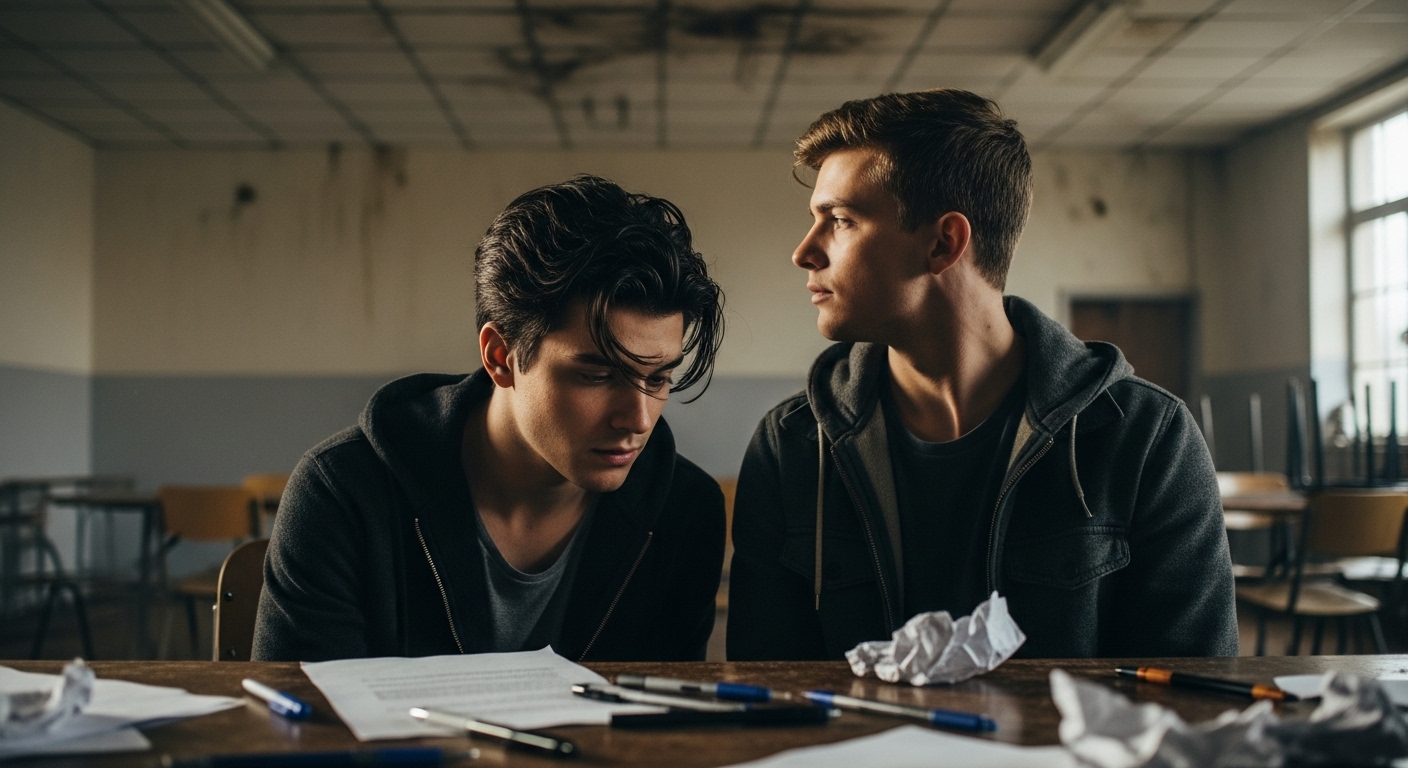
And so, with a shared, exasperated glance, their faces dimly lit by the dying light and the faint, unsettling glow of the ‘Chronometer of Unintended Consequences’ (as August had already rather grandly, and quite ironically, named it), they knew. This wasn’t just a piece of junk. This was, as Patti put it with a sigh that tasted of metallic dust and future headaches, the beginning of something truly dreadful, and quite possibly, terribly, terribly important.
Share This Story


