Humidity's Slow Pulse
The air hung heavy and still, thick with the smell of river silt and the faintest, almost imperceptible metallic tang. Early afternoon sunlight, filtered through a haze of summer humidity, bleached the usually vibrant green of the grass to a pale, tired yellow. Along the Red River's edge, the water moved with a sluggish, oily sheen, reflecting nothing but the muted, oppressive sky. A lone, persistent cicada scraped its song into the silence, a brittle, incessant sound that seemed to hum in the very bones of the city, a prelude to something unknown and deeply unsettling.
The heat was a shroud, clinging to my skin, pushing down on my chest. It was the kind of summer afternoon where the world seemed to hold its breath, waiting for a storm that might never come. My old runner's shirt, damp and sticking to my back, was more of a second skin than clothing. I kept my gaze mostly on the uneven path, scuffed earth mixed with loose gravel that crunched under my worn sneakers. The Forks, usually buzzing with tourists and families, felt strangely empty. Maybe it was the heat. Maybe it was just me, feeling the emptiness amplified inside my own head.
A half-eaten ice cream cone lay on a bench, a melted puddle around its base, the waffle cone itself slowly softening into a sad, sugary mess. Who just leaves an ice cream like that? The thought snagged, a burr under the skin of my mind. It was a small thing, inconsequential, but it caught my attention in a way that felt disproportionate. Everything felt a little off today, like a broadcast with a slight, almost undetectable delay.
I followed a lesser-used trail, the one that snaked closer to the river, where the tall, reedy grasses grew thick and unkempt. The Red River, usually a murky brown, seemed to absorb all colour today, a flat, greyish expanse. It didn't reflect the sky, not really, but rather swallowed it whole, a dull mirror of a duller day. I rubbed at my temples. The cicadas, those dry, insistent things, had started up again, a constant, grating hum that vibrated in my teeth. I wondered if anyone else heard it quite like that, or if it was just my own frequency, out of sync.
I tried to focus on the usual landmarks: the old stone railway bridge, the squat brick buildings of the market, the towering sign. But they looked… flatter. Less real. Like a stage set viewed from the wrong angle. The perspective kept shifting, not physically, but in my head. A tree that was clearly in the foreground moments ago seemed to recede, merging with the background, then popped forward again, its leaves a too-vivid green against the muted blues. My eyes felt dry, gritty, but blinking didn't reset the view.
My hands, shoved deep into my pockets, felt heavy. I could feel the faint tremor in my fingers, a nervous tic I'd picked up recently. Was it the caffeine? Or something else, something deeper? The air felt thick, almost viscous, making each breath a slight effort. I tried to shake it off, the vague sense of dread, the feeling that I was walking through a painting whose colours were slowly draining away, leaving only outlines. It was absurd, of course. Just tiredness, probably. Too many late nights staring at a screen, too many early mornings dragging myself to a job I didn't care about.
---
The Hum Beneath
I stopped by the river's edge, leaning on a rough-hewn wooden fencepost. The water, so still, almost looked solid. No ripples, no current, just a vast, dull surface. But beneath it, or maybe within it, there was a faint vibration. Not audible, exactly, but felt. Through my palms on the wood, up my arms, a low thrumming, like a giant, buried machine. The earth itself felt alive, not with life I recognised, but with something immense and slow, a gargantuan metabolism. It was unsettling. I pulled my hands back quickly, my skin prickling.
I closed my eyes, took a deep breath. The humidity tasted metallic now, distinctly. Like old pennies. When I opened them again, the landscape had subtly shifted. The market buildings, normally squat and sturdy, seemed to lean in on themselves, their windows too dark, too numerous. The path ahead stretched out, unnaturally long, the perspective skewed. Each step I took didn't seem to cover the expected distance. It was like walking on a treadmill, where the scenery moved but you stayed in place.
"Hey! Mark? What are you doing out here? You look like you've seen a ghost."
The voice, sharp and familiar, cut through the strange quiet. Eliza. She was jogging, her hair tied back in a high ponytail, a bright pink sports bra a splash of colour against the dull backdrop. She pulled up beside me, breathing heavily, a slight sheen of sweat on her forehead. For a second, her presence was a relief, a solid anchor in the strange, shifting world. She was real. She was here.
"Just… walking," I managed, my voice a little rough. I cleared my throat. "Thinking. It's hot, isn't it?"
"Brutal," she agreed, wiping her brow with the back of her hand. "Almost didn't come out. The air feels so… thick today. Like you could cut it with a knife. Everything's just slow."
A sliver of hope, a desperate tendril, unfurled in my chest. She felt it too. The slowness, the thickness. Maybe I wasn't losing my mind after all. "Yeah. It's… quiet, too, for The Forks," I said, trying to sound casual, trying to match her normal cadence. But the metallic taste was still there, a copper tang on my tongue.
Eliza looked around, her eyes squinting against the flat light. "Right? Where is everyone? It's like a Tuesday in January, but with humidity. The air even smells… different. Like, almost electric?" She shrugged, then gave a small shiver, despite the heat. "Weird, eh?"
Electric. Not metallic, but electric. Different, but similar. We were both sensing something, just interpreting it with slightly different data points. I wanted to tell her, to ask if the trees were vibrating for her, if the buildings leaned, if the ground pulsed. But the words caught in my throat. What if her 'electric' was just an analogy, and my 'pulsating earth' was a descent into something else entirely?
"Yeah," I said instead, my voice barely a whisper. "Weird."
---
The View From Above
She started jogging again, a quick wave over her shoulder. "Well, don't melt out here! See you later!" Her pink top disappeared into the muted greens, a fading blotch of colour. I watched her go, and with her departure, the peculiar tension in the air seemed to return, amplified. The cicadas scraped louder, the river's dull surface seemed to stretch wider.
I moved away from the fence, back towards the main pathway, but it wasn't the path I remembered. The paving stones were too uniform, too perfectly aligned, stretching into an impossibly far distance. Each block of concrete seemed to hold a tiny, trapped reflection of the oppressive sky. I bent down, ostensibly to tie my shoelace, but really just to get closer to the ground. The earth under the path, I swear, was breathing. A faint, almost imperceptible heave, a slow intake and exhale. I could feel it through the soles of my shoes, a deep, resonant tremor. It wasn't an earthquake. It was something organic, something vast, directly beneath me.
A sudden, jarring sensation. I was above myself. Looking down. My own head, bent low, hands on my knees, a small, hunched figure on an impossibly long pathway. The Forks spread out below me, a miniature model, the river a thin, silver ribbon. I could see Eliza, a tiny pink dot, far off in the distance. The perspective was so clear, so detached, yet I was still me, kneeling on the path. The sensation lasted only a fraction of a second, a blink-and-you-miss-it glitch in perception, but it left a cold, hollow ache in my stomach.
When I was back, fully present in my body, the world felt… thinner. Like a sheet of glass, exquisitely delicate. I touched my face, my fingers tracing the contours of my jaw, reassuring myself of my own physicality. The heat, the metallic taste, the cicada hum – all of it sharpened, intensified. This wasn't just tiredness. This wasn't just the heat. This was a fracture, a subtle tear in the fabric of things. And I was standing in the seam.
I started walking again, slowly, each footfall deliberate. The grass, the trees, the benches, the scattered litter – they were all still there. But they no longer felt like solid, independent objects. They felt like projections, carefully rendered, but just barely holding their form. The shadows under the trees were too dark, too crisp, like cut-outs pasted onto the ground. And in the very deepest parts of those shadows, I thought I could see something else. A flicker. A shift. Like the world was constantly being redrawn, just at the edges of my vision.
The people I eventually saw – a young couple holding hands, an older man walking a small dog – moved with a strange, almost mechanical rhythm. Their smiles seemed painted on, their gestures rehearsed. I averted my gaze, unable to meet their eyes, afraid of what I might see, or what they might see in me. Were they real? Or were they just… props? Figures moving across a stage that was slowly revealing its artificiality.
---
The Edge of the Pattern
The walk became an exercise in controlled paranoia. I tried to find a pattern, something to explain the distortions, but it was too fluid, too subtle. The ground still pulsed, a low, thrumming beat that synchronised with my own pulse, or perhaps dictated it. The river, still and flat, seemed to contain an impossible depth, a void that stretched not down, but inwards, into some other, unknowable space. I felt a chill run through me, despite the oppressive heat.
I found myself back near the old port buildings, the ones with the red roofs, close to the actual Forks junction. A group of tourists, loud and boisterous, were taking photos. Their laughter sounded tinny, like it came from a cheap speaker. One woman held up her phone, beaming at the camera, and for a split second, her face seemed to pixelate, her smile fracturing into a grid of shimmering dots, before snapping back to normal. I rubbed my eyes, hard, feeling the sting.
It was impossible. This was The Forks. This was Winnipeg, Manitoba, Earth. This was summer, a humid, sticky summer. And yet… the world felt thin. It felt like a stage set. It felt like a dream from which I couldn't quite wake up, a dream that was slowly, insidiously, becoming more real than reality itself. The new realizations about life weren't grand philosophical epiphanies, but small, terrifying truths about the nature of observation. That what I saw, what I felt, what I knew, might not be shared. That my perception was a personal, fragile construct, constantly under threat of unraveling.
The idea settled over me, not with a jolt, but with the slow, creeping certainty of a shadow lengthening. Everything I had ever believed about the objective world, about shared reality, about the solidness of the ground beneath my feet, felt like a comforting story I'd been told. And now, the storyteller was clearing their throat, about to reveal the true ending. The cicadas hummed, the river remained flat, the sky a bruised white. And I, Mark, stood in the middle of it all, feeling the impossible heave of the earth, watching the world fray at the edges, profoundly alone in my perception, wondering if this was what it meant to truly see.
The ground beneath The Forks exhaled, a slow, deep sigh that resonated through my bones, and I could feel my own heart beat in sync, a fragile, desperate rhythm against the immensity.
---
I found a quiet bench, tucked away beneath an old elm tree whose leaves looked too green, too perfect, against the washed-out sky. The shadows it cast were sharp, almost violent, like ink stains on the path. I sat, my hands resting on my knees, palms up. The air still tasted like pennies. The cicadas continued their incessant sawing. I stared at my open palms, tracing the lines, wondering if they were truly mine, if the body they belonged to was truly mine, or just a temporary vessel for a consciousness adrift in a world that was slowly, imperceptibly, coming undone. The sun, a pale, anemic disk, began its slow descent, bleeding a weak, orange stain across the bruised horizon, promising another day, another slow pulse of the unknowable beneath my feet.
The heat remained, a heavy blanket, but a new chill had settled deep inside me, a cold certainty that the world I knew was merely one layer, and the layers beneath were stirring, humming a silent, terrible song.
There, on the back of my hand, a small patch of skin seemed to shimmer, almost ripple, under the flat light. Just a trick of the light, I told myself, but my breath caught, and I slowly turned my hand over, then back again, watching, waiting for the flicker to return.
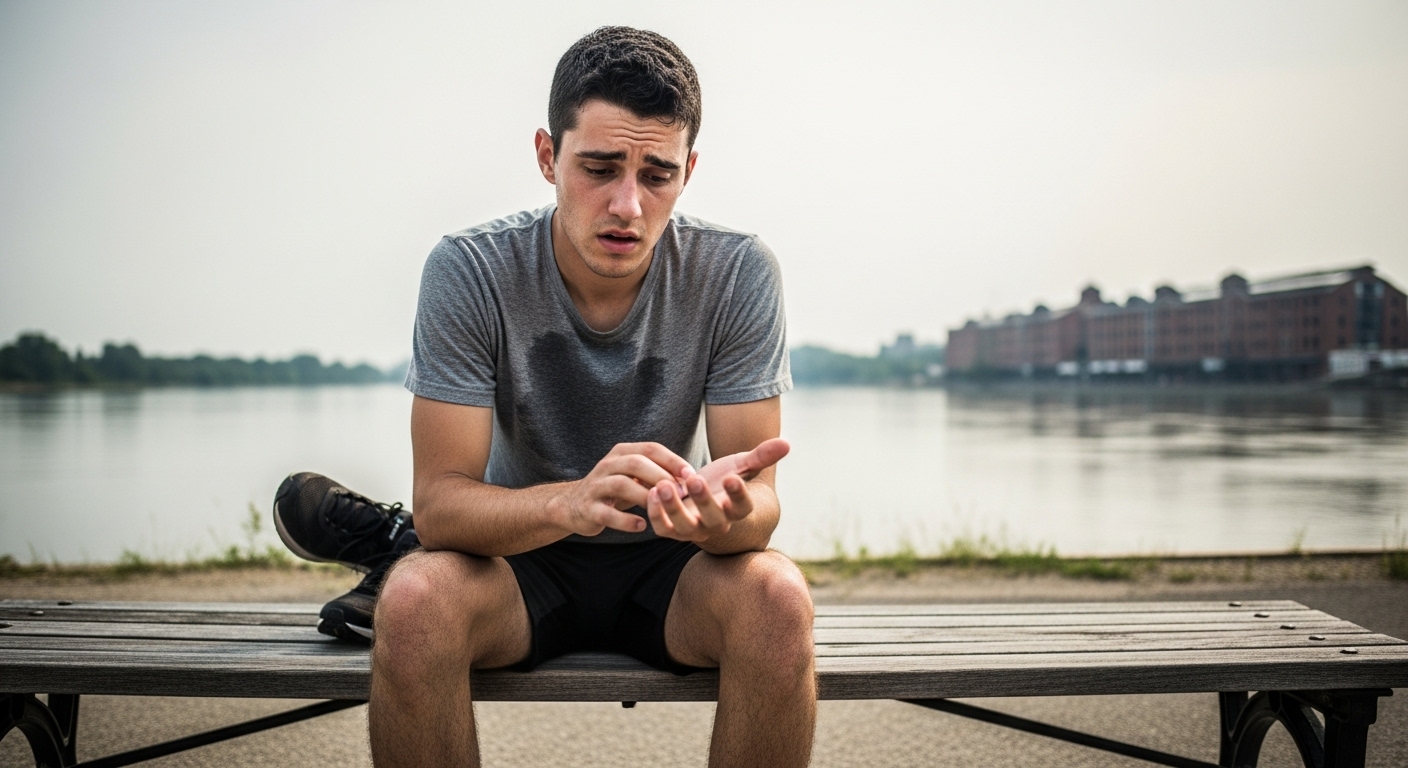
I slowly turned my hand over, then back again, watching, waiting for the flicker to return, a tiny, unsettling wave of distortion on my own skin, threatening to break the fragile illusion of my reality.
Share This Story


