Beneath the Frost-Bitten Spires
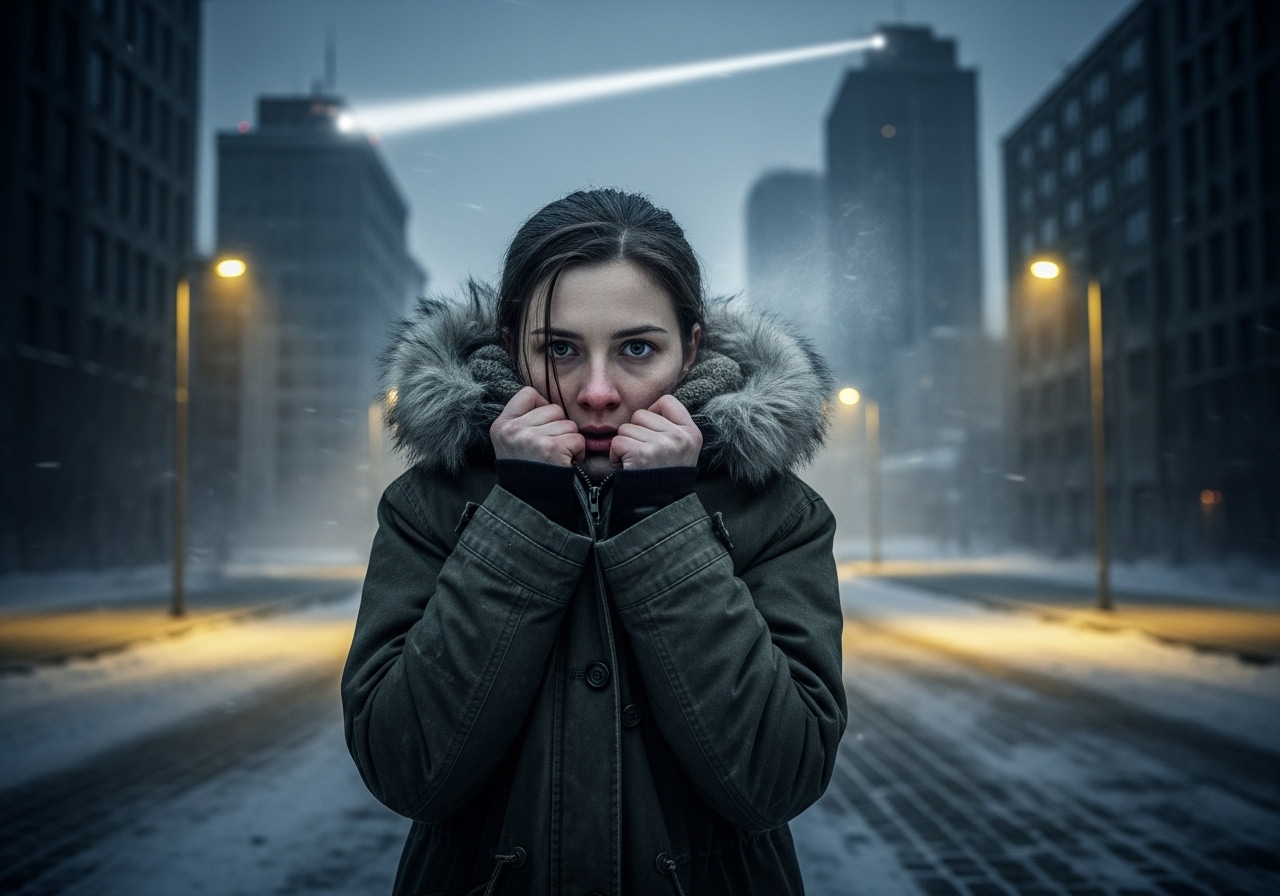
The wind, a razor-thin blade off Lake Huron, cut through Julie's scavenged parka. Each gust kicked up miniature blizzards from the packed snow, stinging her exposed cheeks until they felt like raw meat. The city's silhouette, usually a comforting cluster of lights even in its current state, was a suffocating mass tonight, punctuated only by the piercing white beams of the Sector Towers and the occasional sweep of a surveillance drone's searchlight. Streetlights, rationed and flickering, barely pushed back the encroaching indigo gloom that swallowed the cobbled lanes of what used to be the Distillery District. Now, it was just District Seven, a designated zone for 'permitted enterprise' – mostly government-sanctioned fabrication workshops and and a few heavily monitored communal kitchens. The air tasted of burnt oil and frozen exhaust, a constant reminder of the regime’s efficiency and the cold, unyielding grip it held on every breath.
Her breath plumed in front of her, a ghost of her own anxiety. The small data chip, no bigger than her thumbnail, felt like a lead weight in the hidden pocket stitched into her glove. Every scraping sound, every distant whir of machinery from the state-owned textile plants, ratcheted up the tension in her shoulders. She kept her gaze low, focused on the icy patches where the cobbles glittered treacherously, but her peripheral vision was a constant, frantic sweep. The CCOs – Civil Compliance Officers – were everywhere tonight. Like wolves, she thought, not even bothering to disguise the animosity in the comparison. They moved with a chilling efficiency, their thick, dark uniforms blending into the shadows, their eyes unseen behind the visors of their helmets.
A sudden, sharp beam of light sliced across the street ahead, momentarily blinding her. Julie flinched back, pressing herself against the frigid brick wall of a disused brewing facility, the rough texture of the mortar digging into her back through the thin fabric of her coat. Her heart hammered against her ribs, a frantic drum against the silence. She squeezed her eyes shut, then forced them open, adjusting to the sudden, stark darkness. The beam moved on, sweeping the snow-dusted archways. She counted the heavy, rhythmic thud of their boots: two pairs. A standard patrol. Her stomach clenched. Too close.
She waited, barely breathing, for what felt like an eternity. The scent of stale hops still clung to the old bricks, faint but distinct. She could hear them now, their low, guttural voices indistinct, then a crackle of static from a comms unit. One of them chuckled – a dry, unpleasant sound. They were getting closer to her hiding spot. Julie pressed herself tighter, trying to become part of the wall, an extension of the cold, unyielding stone. Her fingers, even within the thick glove, tingled with the cold, a sharp, insistent ache. She could almost feel the weight of the chip, a tiny, vital burden that might just get her killed.
Then, the sounds faded. The boots grew softer, the voices more distant. She risked a glance. The street was empty again, the pale glow of the rationed streetlights offering little comfort. They had passed. She let out a slow, shaky breath, her lungs burning with the cold. A stray dog, a skeletal shadow, darted out from an alley across the way, its ribs stark against its matted fur, before vanishing again into the labyrinth of shuttered storefronts. Even the animals here moved with a fearful caution. Julie pushed herself away from the wall, her muscles stiff, and continued her trek, faster now, trying to make up for lost time.
Echoes in the Stacks
The former public library was a grand, gothic structure, its limestone façade grimed with a century of city soot and the neglect of the past decade. It stood like a tombstone to forgotten knowledge, its massive oak doors sealed with heavy iron bars and a faded, official notice declaring it a ‘Restricted Archive. Entry Forbidden.’ Julie circled the perimeter, her boots crunching on the pristine, undisturbed snow. No fresh tracks. Good. The CCOs rarely bothered with places deemed ‘valueless’ by the Central Authority. The air here felt heavier, almost reverent, as if the ghosts of a million stories still lingered in the frigid air.
She found the entrance, not through the main doors, but a cleverly disguised service hatch tucked away behind a rusted utility shed. The mechanism was stiff, groaning in protest as she manipulated the hidden latches, her fingers numb. With a soft click, it opened, revealing a crawl space that smelled of damp concrete and ancient paper. She squeezed through, pulling the hatch shut behind her. The darkness inside was absolute, thick enough to taste. She fumbled for the tiny torch in her inner jacket pocket, its weak beam cutting a swathe through the gloom. Dust motes danced in the sparse light, endless and silent.
The crawl space led to a narrow, spiralling staircase, its metal treads cold and slick. She descended three flights, the echoes of her careful steps amplified in the oppressive quiet. Finally, she emerged into what must have been the old boiler room. It was small, cramped, but had a sense of purpose to it. A single, bare bulb hung from the ceiling, casting a sickly yellow glow on a workbench piled with salvaged electronics. Mario looked up from a tangle of wires, his spectacles perched on the end of his nose, his face smudged with grease. He offered a tight, almost imperceptible nod. No words were exchanged, not yet. Not when the very air might be listening.
Julie pulled off her glove, her hand stiff and blotchy with cold, and extracted the data chip. She placed it on the worn wooden surface of the bench. Mario picked it up with a pair of tweezers, his movements precise, almost surgical. He inserted it into a reader hooked up to a bulky, archaic computer monitor. The screen flickered to life, displaying lines of code that scrolled too fast for Julie to follow. Mario leaned closer, his brow furrowed in concentration. The silence stretched, punctuated only by the hum of the computer and the faint, rhythmic dripping of water somewhere in the distance.
"It’s worse," Mario finally mumbled, his voice a low, gravelly whisper, his gaze still fixed on the screen. "Much, much worse than we thought." He pushed his spectacles up his nose, running a hand through his thinning, greying hair. He looked tired, older than his forty-odd years. "Directive Seven. It’s not just about resource allocation or population dispersal anymore. They're… assigning fertility quotas. And re-education for anyone who deviates from the 'optimum family unit'. For everyone over thirty, too. Indoctrination camps, Julie. Full-blown." His voice cracked on the last words, a raw edge of disbelief and horror.
Julie felt a cold dread seep into her bones, colder than the winter air outside. Fertility quotas. Re-education. She pictured the sterile, emotionless faces of the CCOs, the endless forms, the mandatory ‘civic duty’ lectures. This wasn't just control; it was an attempt to rewrite the very essence of human connection. "What does it say? The chip, what does it have?" Her voice was barely audible, a hoarse whisper. Her fingers curled into fists, the nails digging into her palms. A sharp, almost painful clench in her gut.
"It's the implementation schedule," Mario explained, gesturing at the screen. "Detailed maps of the designated zones, the 'processing centres', transport routes. And a list. A preliminary list of… candidates. For 're-calibration'." He paused, taking a ragged breath. "It's a lot of people, Julie. Thousands in this city alone. And the names… they’re pulled from the old census data, pre-Authority. Anyone who ever showed an ounce of independent thought, anyone who didn’t immediately fall in line. Artists, teachers, community leaders. Even people who just signed a petition once, years ago. They’ve been building this database for decades."
He turned from the screen, his eyes wide and haunted. "We can't let this go through. This isn't just about survival anymore. This is… extinction of everything that makes us, well, us." He glanced around the cramped room, his gaze settling on a dusty, canvas-shrouded object in a far corner. "I found something else. Down here. This place… it was a proper bunker, before." He walked over, pulling away the canvas with a flourish. Beneath it was an antique shortwave radio, its brass knobs gleaming faintly, along with several heavy-duty batteries and a roll of thick antenna wire. "Old tech. Undetectable by their current sweeps. Might even reach outside the controlled zones."
Julie’s gaze was fixed on the radio. A lifeline. A fragile thread to a world she barely remembered, a world before the grey, suffocating blanket of the Authority. "Can it work? Really work?" she asked, her voice tinged with a desperate hope she hadn't realised she still possessed. The idea, the sheer audacity of it, sent a thrill through her. To speak freely, to reach out, to shatter the imposed silence. It felt revolutionary.
Mario nodded, a small, grim smile playing on his lips. "With some luck, and a good clear night… yes. But we need a power surge, something to mask the initial broadcast signal. A momentary distraction that their network analysts won't flag as an anomaly." He rubbed his chin thoughtfully, then looked back at the screen. "And we need to get this information out. The schedule. The names. People need to know what's coming. They need to know who is coming for them."
---
Suddenly, a piercing, discordant wail ripped through the silence of the library. Not a typical city alarm, but the distinctive, high-frequency shriek of a Sector Tower alert – the highest priority, indicating a breach. The bare bulb above them flickered erratically, then dimmed to a sickly orange. Dust shifted from the ceiling. Mario cursed under his breath, his previous weariness replaced by a frantic energy. "They know. Someone knows we're here. How?"
"Doesn't matter," Julie hissed, already moving, her hand instinctively going for the hidden chip, but it was still in the reader. "We split. You get the radio. Try to get it powered up. I'll… I'll try to draw them off. The chip… can you copy it?"
"Too late," Mario said, his fingers flying over the keyboard, trying to eject the tiny memory stick. "It's locked in. A fail-safe. If they capture the drive, they get everything. It needs to be wiped. Completely."
The wail intensified, accompanied now by the dull thud of heavy boots ascending the metal staircase. They were fast. Too fast. Julie heard the metallic scrape of the service hatch above them. They weren't coming from the main door. They'd found her entry point. Panic, cold and sharp, clawed at her throat.
"There's an old coal chute," Mario said, pointing to a dark recess in the wall. "Cramped. Leads to the sewers. Might give you a minute." He thrust a small, encrypted communicator into her hand. "Once you're clear, find a safe drop-point. I’ll make sure this data never sees the light of day. Or I die trying." His eyes, behind the smudged spectacles, held a grim resolve that sent a shiver down her spine.
Julie hesitated for a fraction of a second, just long enough to see the first CCO helmet appear at the top of the stairwell, its visor reflecting the orange emergency light. No time for goodbyes. No time for anything. She nodded sharply, a silent promise, then scrambled towards the dark maw of the coal chute. The opening was tighter than she'd anticipated, forcing her to contort her body, scraping her shoulders and knees on the rough, sooty metal. The stench of stagnant water and decay hit her with a physical force. She could hear Mario shouting something, then a crash, followed by the sharp crackle of a stun baton.
She didn't look back. She couldn’t. Just pushed, wriggled, her muscles screaming in protest, the weight of the communicator in her hand a terrifying beacon of what lay ahead and what she was leaving behind. The shouts of the CCOs grew louder, their voices echoing in the cramped boiler room. A beam of light, sudden and stark, pierced the darkness behind her, illuminating the dust and grime. She was in the chute now, fully committed, but the opening was still visible, a rapidly shrinking rectangle of pale orange light. She could hear them, right there, at the entrance to the chute, their heavy boots thudding on the metal, their harsh voices demanding she stop. Her heart threatened to burst from her chest as she heard the distinct, chilling click of a weapon being readied. The small space around her seemed to vibrate with their proximity, with the promise of capture. She could practically feel their cold, gloved hands reaching for her.
Then, a blinding flash from behind her, followed by the sharp, concussive crack of a stun round exploding inside the chute, ricocheting off the metal walls and sending a searing wave of pain through her entire body. Her vision exploded into white, and the smell of ozone filled the tight space. Her limbs went numb, her grip failing, and she felt herself tumbling forward, faster now, into the absolute, suffocating darkness below.
She hit the icy, filth-laden water of the sewer with a gasp, the cold shocking her back to a semblance of consciousness. The communicator, somehow, was still clutched in her hand, but a sharp pain lanced through her head, and the world began to spin. Above her, the sounds of the CCOs were fading, replaced by the rush of water and the metallic clang of a closing hatch. But the darkness was not empty. A new sound, a rustling in the murky depths ahead, stirred the black water, and Julie realised with a terrifying clarity that she was not alone down here.
A sharp pain lanced through her head, and the world began to spin. Above her, the sounds of the CCOs were fading, replaced by the rush of water and the metallic clang of a closing hatch. But the darkness was not empty. A new sound, a rustling in the murky depths ahead, stirred the black water, and Julie realised with a terrifying clarity that she was not alone down here.
Share This Story


