The Frozen Arteries of Britannia North
Winter clung to the city like a shroud woven from ice and despair, each gust of wind a mournful cry through the skeletal branches. The omnipresent hum of the surveillance drones, a low, metallic thrumming, vibrated in the bones, a constant reminder of eyes unseen, but always there. Grey skies pressed down, mirroring the spirits of those who shuffled along the gritted pathways, heads bowed against the biting cold and the unseen weight of the Directorate's gaze.
The snow crunched under Ethan's boots, a sound unnaturally loud in the hushed, early afternoon. Every crunch felt like a bell, marking his passage for unseen listeners. He kept his head down, breath pluming in front of him, trying to mimic the other husks shuffling along the ice-slicked pavement. An old man, bent almost double, wrestled a trolley full of scavenged cardboard. A woman in a too-thin coat pulled a child, no older than five, by the hand, the child's face streaked with snot and dried tears. No one looked up, not really. Not at each other. Not at the drones, dark specks against the low-hanging cloud, their low thrum a constant, physical pressure in the chest.
His right hand, gloved in worn wool, kept brushing against the inner pocket of his coat. The small, cold weight of the chip felt like a live thing against his ribs. Foolish, he knew. Carrying it this far, this close to the centre. But Trina had been insistent. This data couldn't be transmitted; too many layers of Directorate encryption, too many listening posts. They wanted it physical, undeniable.
A dull ache pulsed behind his eyes, a familiar companion these past few months. Sleepless nights spent tracing routes, memorising faces from grainy pictures, running scenarios in his head until the faces blurred, the routes tangled. He coughed, a dry, rasping sound that caught in the frigid air. The street was lined with identical, grey-washed buildings, their windows blank, reflecting nothing but the oppressive sky. A lone banner, faded and torn at the edges, hung from a lamppost, depicting a stern-faced Commandant Vlad, his eyes seeming to follow Ethan even as he passed. Vlad's omnipresent stare. It was everywhere.
The Crimson Check
Ahead, the bottleneck. Two Directorate Enforcement Officers, bundled in their heavy, charcoal-grey uniforms, stood beside a collapsible barrier, their rifles held casual, almost negligent, but the polished gleam of the barrels promised otherwise. A short queue of people formed, each presenting their Citizen ID and scanning their palm against a glowing blue pad. Ethan's stomach twisted into a knot. He’d rehearsed this. Every gesture. Every fabricated detail.
He joined the line, a ripple of cold dread washing over him. The wind picked up, whipping flakes of snow into stinging needles against his face. One of the officers, a burly man with a thick neck and a face scarred by what looked like an old burn, barked at a woman who was fumbling with her card. “Move it, citizen! You think we have all day to freeze our bollo—” The word caught, replaced by a grumble as the woman finally produced her ID. She scurried through, head bowed.
Ethan edged forward, trying to control the shallow, rapid rhythm of his breathing. His heart hammered against his ribs. Just a routine check. Nothing. His forged ID, a meticulous piece of artistry from the old network, would hold. It had to. He reached the barrier. The second officer, younger, with sharp, ferret-like eyes, took his card. The plastic felt cheap, thin, in Ethan's suddenly damp palm.
“Citizen ID: 74-Gamma-923,” the officer droned, scanning it. The blue light pulsed, then turned green. “Ethan Dubois. Resident of Sector 3. Employment: Sanitation Division.” He didn’t look up. “Destination?”
“Sector 7. Materials resupply at Depot 4-B, sir,” Ethan mumbled, forcing a weary, indifferent tone into his voice. The standard response for his assumed persona. He kept his gaze fixed on a dirty snowdrift by the officer's boot, resisting the urge to twitch, to look away, to betray the tremor in his hands. The officer’s fingers drummed on the scanner. Ethan watched them. Fat. Pink. Rough cuticles.
“Sector 7, eh?” The officer finally looked up, his eyes sharp, dissecting. Ethan met them, holding the gaze, a trick Trina had taught him: a blank stare, not defiant, not submissive, just empty. “Cold day for hauling refuse, Dubois.”
“Every day’s a cold day for it, sir,” Ethan said, a small, forced sigh. He shifted his weight, feigning impatience, a minor annoyance at the delay. The officer’s lips thinned. He pressed a button. The barrier swung open. “Move along.”
“Yes, sir.” Ethan nodded, forcing himself not to rush. Each step felt heavy, burdened. He didn't breathe easy until the checkpoint was a hundred metres behind him, the thrum of the drones covering the ragged gasp he couldn't help but let out.
---
The Moth-Eaten Refuge
Trina’s safe house was less 'safe house' and more 'condemned building on the verge of collapse'. A three-storey brick structure, its windows boarded up with mismatched planks, stood hunched between a disused textile factory and a skeletal remains of an old church spire. Rusting scaffolding clung to its front, more hazard than support. He’d been given the code, a complex sequence of taps on a loose brick, followed by a specific knock. He performed it, his fingers stiff with cold, the brick crumbling slightly under his touch.
The door groaned inward, revealing a sliver of darkness, smelling of damp earth and something acrid, like burnt sugar. He slipped inside, the heavy door thudding shut behind him, plunging him into near-total blackness. It took a moment for his eyes to adjust, the faint light filtering through gaps in the boarded windows revealing dust motes dancing in the frigid air. The air was colder inside, if that was even possible.
“Ethan? That you, lad?” Trina’s voice, raspy but unmistakable, came from deeper within. It echoed strangely in the empty space, a vast, open room stripped of anything valuable long ago. A single, battered lantern flickered on a crate in the centre, casting long, dancing shadows that made the derelict space feel even more cavernous and menacing.
“Yeah, it’s me,” he called back, his voice hoarse. He picked his way through the debris – broken plaster, shards of glass, what looked like half-eaten rats’ nests. He nearly tripped over a fallen beam, scraping his knee against the rough wood, a sharp sting. He cursed under his breath.
Trina sat on a low stool, hunched over the lantern, a thin, threadbare blanket draped over her shoulders. Her face, usually sharp and wary, seemed softened by the amber light, etched with a fatigue Ethan hadn't seen before. Dark smudges bruised the skin beneath her eyes. Her silver hair, usually pulled back in a tight bun, was loose, escaping in wisps around her face. “You’re late.”
“Checkpoint,” he said, pulling out the chip. He held it out. “They’re tightening up. Almost had me.”
Trina took the chip, her fingers bony, calloused. She didn’t speak, just examined the tiny rectangle of metal and plastic, her brow furrowed. The lantern light caught the faint tremor in her hands. She produced a small, ancient-looking device from a pocket inside her blanket, a relic from before the fall. She inserted the chip, her eyes fixed on the screen, a tiny flicker of green data scrolling across it. The hum of the drones outside seemed to intensify, a chilling symphony of oversight.
After a long moment, she sighed, a sound that seemed to carry the weight of years. “Good. This is… more than we hoped for. Directorate schematics for Sector 9’s new energy grid.” She looked up, her gaze piercing. “You did well, Ethan. Better than well.”
A faint warmth spread through him, a rare thing these days. He tried to ignore the discomfort in his scraped knee. “What now? Is it enough?”
She shook her head, a slow, weary movement. “Never enough. But it’s a start. Gives us a vulnerability.” She paused, her gaze dropping to the floor, then snapping back to his. “There’s something else. Something… urgent.”
He felt the familiar tightening in his chest. “I knew it.”
“The operatives in the West are… compromised,” Trina continued, her voice lower now, almost a whisper. “We lost contact with them two cycles ago. Vlad’s men are sweeping the entire Pacific coast. They found something. A manifest. A shipment of medical supplies, smuggled in under the nose of Sector Command. It was… meant for us.”
“And?” Ethan prompted, his stomach churning.
“The shipment was diverted. Taken to an interrogation facility on the outskirts of Fort Langley. They’re trying to trace its source. Our source.” She passed him a crudely drawn map, a few lines and circles on a piece of greasy paper. “The facility… we need to know what they’ve found. If anyone survived. Retrieve the supplies, if possible.”
He stared at the map, then at her. “Fort Langley? That’s… deep within Vlad’s personal zone. Heavily guarded. I’d be walking into a trap.”
“Maybe. Maybe not.” Her eyes were unflinching. “But this isn’t just about supplies, Ethan. It’s about a name. A new contact. She’s compromised if we don’t get to that facility. Before Vlad picks her apart.”
He rubbed his gloved hands together, the leather dry and cracked. The cold gnawed at his fingers. “Who?”
Trina hesitated, then uttered a name he didn't recognise. “Jian Li. She’s important. More important than the supplies.”
“And if I can’t get in?”
“Then you die trying,” she said, simply. No drama. Just a bleak, undeniable truth. “There’s no other option.” She pressed a small, thin datapad into his hand. “New comms. New instructions. A rendezvous point outside the Fort Langley perimeter. Three cycles from now.”
---
The Unseen Tracker
Ethan left the building, the dull light of the winter afternoon feeling strangely harsh after the gloom inside. He pulled his collar higher, shoving his hands deep into his pockets. The map and the datapad were tucked away, the chill of their presence sinking into his skin. He started back, retracing his steps, the drones still humming their monotonous song above.
He hadn’t gone more than a few blocks when he noticed it. A slight discolouration on the snowdrift by the deserted butcher’s shop he’d passed earlier. A fresh boot print, partially obscured, but distinct. Not his. Too large. And going in the opposite direction from the main flow of pedestrian traffic. His heart thumped a frantic rhythm against his ribs. A patrol? Just a random patrol? Or…
He quickened his pace, trying not to make it obvious. A small tremor ran through his legs. He glanced over his shoulder. Nothing. Just the grey buildings, the grey sky, the distant glint of a Directorate vehicle turning a corner far down the road. Too far to be a direct threat. He kept walking, trying to calm the frantic beat in his chest, convincing himself it was nothing. Paranoia. A natural side effect of the life he led.
But then, a prickle at the back of his neck. He reached his hand into his coat, not the inside pocket, but lower, near the hem. His fingers brushed against something small, metallic, and utterly foreign. Something hard-glued to the fabric of his coat lining, right at the small of his back, where it would be impossible for him to feel without reaching. A tiny, flat device, barely thicker than a coin. He froze, his breath catching in his throat.
They knew. Someone had been there, waiting. Someone had followed him, then planted this. And he had led them straight to Trina.
His vision blurred for a second, a dizzying rush of cold fear. He ripped the device free, the fabric tearing with a soft rip. He stared at it, a black disc, almost invisible against the dark wool of his glove. He had to assume it was live. Had to assume they were already tracking him, watching him, laughing at his foolish assumption of escape. They had let him go. They had let him go to lead them to the others. And he had. Every step a betrayal.
He crushed the device in his fist, the plastic casing cracking, and then hurled it into a snow-filled gutter. But the gesture felt futile, childish. He could feel their eyes now, more intensely than before. The cold seeped into his bones, a new, deeper chill that had nothing to do with the winter air. He had walked out of one trap, only to realise he was already in another, a much larger, more intricate one. And Trina, unknowingly, was caught in the same net.
The hum of the drones seemed louder now, a hungry, waiting sound.
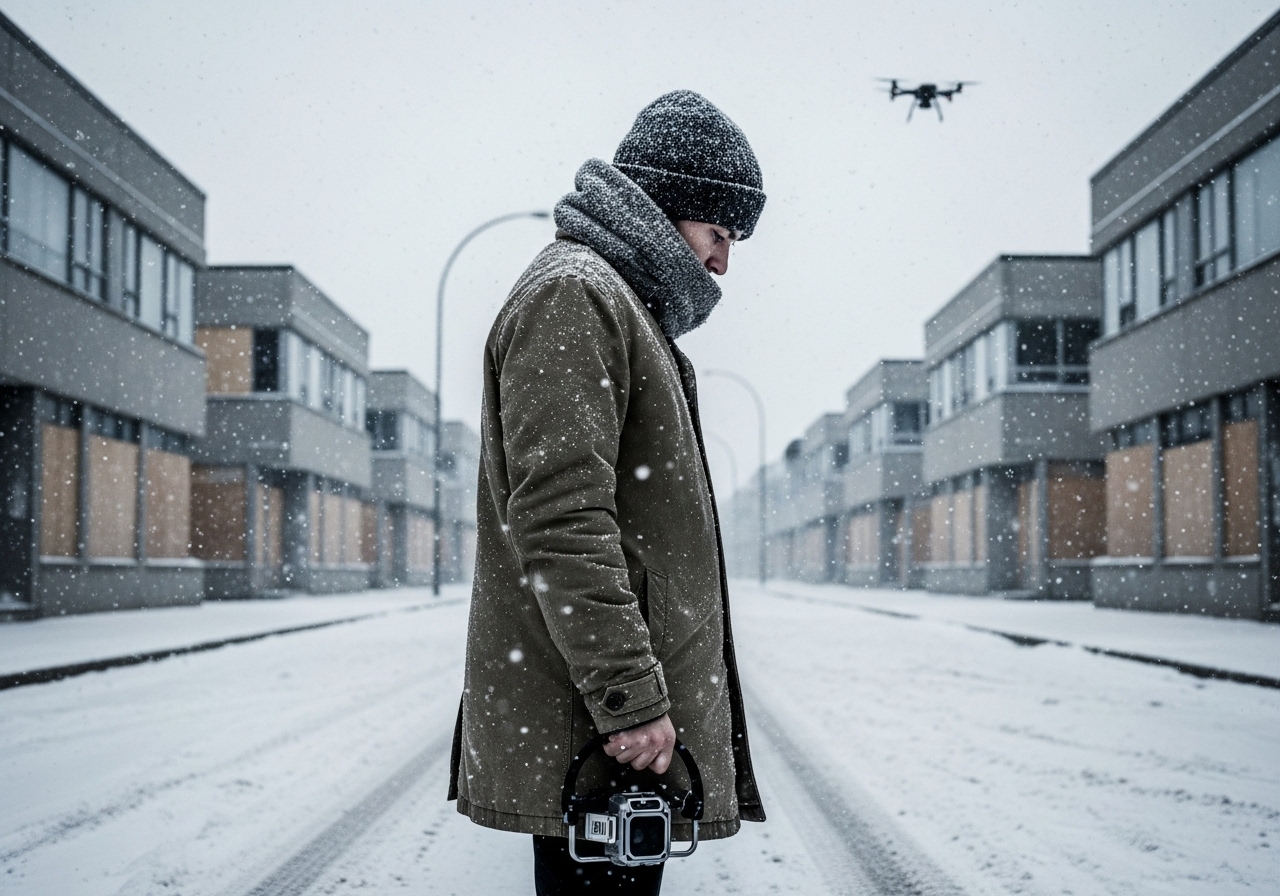
He knew they were watching, waiting. The trap wasn't for him alone; he had merely been the bait, and Trina, the only bridge to their resistance, was now irrevocably compromised, her fate sealed by his unsuspecting steps. The question wasn't if they would come for her, but when, and if he could get to her before the full weight of the Directorate descended.
Share This Story


