Across a Scarred Table
Arthur, a habitual observer, settles into his favourite café booth, allowing the muted chaos of The Cornerstone to wash over him as he watches a young couple grapple with unspoken tensions.
Arthur considered the coffee's acrid edge, a flavour as dependable as the winter chill that clawed at the café's frosted panes. Another Tuesday, another parade of unwritten lives. His own existed in these pockets, an observer, a collector of half-glimpses. He knew the precise squeak of the barista's shoes on the worn linoleum behind the counter, the faint, persistent thrum of the refrigerator, the way the light, weak even at midday, managed to catch the speckles of detritus, fragments of conversation, flakes of skin. Real things, not poetic fancies.
He watched the young man and woman by the window. Early twenties, perhaps. Both clad in practical, city-issue parkas, though hers was a brighter hue, a defiant splash against the muted Winnipeg greys. They sat with a space between them, a carefully cultivated chasm across the small, scarred table. He, with a jaw set like a frost-nipped landscape, stared out at the street, a permanent furrow etched between his brows. She, with eyes that occasionally darted towards him, then quickly away, fixed instead on the steam rising from her tea. A familiar tableau. Arthur had seen a hundred such hesitant beginnings, a thousand fractured middles.
---
A Silent Concordance
The young man cleared his throat, a dry rasp that barely cut through the café's general drone. "The matter concerning your proposal," he began, his voice a low timbre, "has been weighing heavily upon my thoughts."
The woman’s fingers tightened around her mug, a porcelain shield. "Indeed. One must, naturally, deliberate extensively upon such significant declarations." Her gaze remained fixed on the swirling tea leaves.
Arthur noted the deliberate formality, the almost theatrical politeness. It wasn't the language of lovers, not yet, perhaps never. It was the careful articulation of two individuals navigating a delicate fault line. He imagined the vast, unspoken chasms implied by each precisely chosen word. A city like Winnipeg, with its stark seasons, fostered such guardedness. People built walls, both of brick and of discourse, against the relentless cold, against the vast, empty spaces.
A tremor ran through the woman's hand as she lifted the mug. The man observed this, a flicker of something, perhaps concern or resignation, in his own stoic expression. He reached across the table, not for her hand, but for the forgotten sugar packet beside her mug, slowly tearing it open. The small rustle was disproportionately loud.
"My intentions," he continued, scattering sugar into his own forgotten coffee, "remain, as ever, unequivocally clear. It is the efficacy of their conveyance, I fear, which may be lacking."
She finally looked at him, her eyes, the colour of deep winter ice, meeting his. "Clarity, like warmth, is often a matter of perception, is it not?"
Arthur found himself leaning imperceptibly forward. This was the crux, the small, sharp point where their carefully constructed dialogue might either bend or shatter. He admired their commitment to this particular dance, this verbal ballet. It spoke of a deeper affection, perhaps, than any rash outpouring of sentiment could convey. A gritty sort of love, forged in the understated.
---
The Careful Assembly
A new arrival settled into the booth opposite Arthur, an elderly woman with hair the colour of unbleached linen and a coat that had seen many winters. She carried a large, canvas bag, which she placed carefully beside her. Her movements were slow, deliberate, each action imbued with the weight of years. Arthur had seen her before, a fixture. She ordered only black coffee, always.
She began her ritual. From the depths of her bag, she extracted a well-worn leather-bound journal, a small tin pencil case, and a pair of spectacles with frames as thin as wire. These were arranged on the table, not haphazardly, but with a precise geometric intent. The journal was positioned exactly at the edge of the placemat, the pencil case aligned with its spine, the spectacles resting neatly atop the case. It was an act of creation, a small, private world constructed amidst the café's din.
He remembered his grandmother, the way she used to arrange her sewing notions, each spool of thread, each needle, a soldier in a tiny, textile army. There was comfort in order, a small victory against the chaos that inevitably crept in at the edges of life.
The woman opened her journal. The pages within were thick, creamy, and covered in a fine, elegant script. She didn't write immediately. Instead, she sat, sipping her coffee, her gaze sweeping across the room, lingering on the young couple, on Arthur, on the harried barista, her expression unreadable, yet profoundly engaged. She was, he realised, another collector of glimpses, another weaver of narratives, perhaps more actively so than himself.
---
Unspoken Currents
The new barista, a gangly youth with an anxious sheen to his forehead, fumbled with an espresso machine, sending a spurt of scalding water onto the counter. He mumbled an apology to no one in particular, his face reddening. The elderly woman observed this with a faint, almost imperceptible smile. No judgment, merely observation.
Arthur thought about the invisible threads that connected them all. The young couple, navigating their unspoken anxieties. The elderly woman, building her small sanctuary of order. The barista, battling a machine that seemed to mock his inexperience. And himself, a silent, appreciative witness to these quiet dramas. There was a particular beauty in it, a resilient humanity that thrived even in the most ordinary of settings. A gritty optimism.
His thoughts drifted to his late wife, Eleanor. She would have loved this place. She had always said that the most profound stories weren't found in grand epics, but in the creases of a stranger's face, the hesitant pause before a spoken word, the way a hand reached for another, or didn't. She saw the extraordinary in the utterly mundane.
The young man across the room finally spoke again to his companion. "I possess a profound conviction," he stated, his voice now softer, more vulnerable, "that our shared trajectory, however arduous, is one worth traversing."
The woman, for the first time, smiled. A small, tentative blossoming, like the first crocuses pushing through the last vestiges of winter snow. "Such a sentiment," she replied, her voice equally gentle, "is not without its considerable merit."
Arthur watched as the chasm between them seemed to shrink, if only by an inch. A tiny, almost imperceptible shift, but significant nonetheless. The elderly woman across the room finally dipped her pen to her journal, her elegant script beginning to flow across the page. The café hummed on, a steady, unwavering pulse.
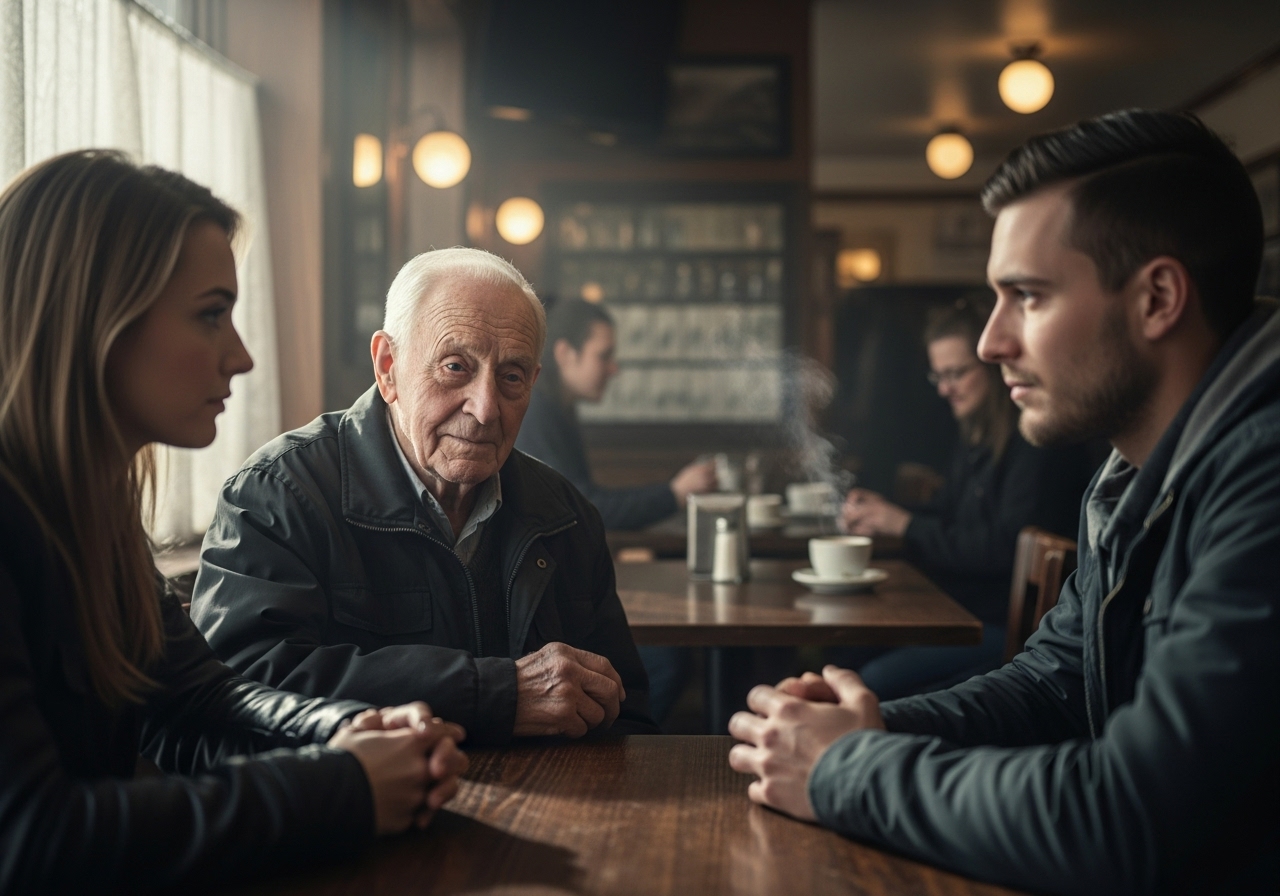
The world outside, grey and cold, might rage, but within these four walls, against the scent of roasting beans and the clatter of ceramic, life continued its intricate, resilient dance. The young couple would either bridge their chasm or widen it; the old woman would fill another page; the barista would eventually master the espresso machine. And Arthur would return, drawn by the quiet spectacle, the raw, beautiful unfolding of ordinary time.
Share This Story


