The Bite of the Northwind
The air itself felt like a physical blow, a raw, cutting thing that scraped against the exposed skin of Trevor's face. Snow, hard-packed and unforgiving, crunched under his boots with a sound that seemed too loud in the pre-dawn quiet, a quiet perpetually on edge. Above, the city's skeletal architecture, once symbols of commerce and aspiration, now stood as monuments to the regime, their sharp edges silhouetted against a bruised sky that promised no sun, only more grey. Every exhale was a cloud, a fleeting ghost of warmth immediately stolen by the relentless winter.
The alley reeked of stale refuse and the metallic tang of melting ice, a familiar perfume of urban decay. Trevor hunched deeper into his parka, the synthetic fabric doing little against the insidious chill that wormed its way into his bones. He checked his wrist-comm, a cheap, government-issue piece of plastic that only told the time and date – 04:37, 18th March. Another meaningless number in a long string of meaningless numbers. Marta was late. Or he was early. Time meant little beyond the shift rotations and the hour the floodlights flickered on above the district's outer perimeter.
His gaze flickered to the narrow gap between two derelict warehouses, a sliver of darkness where no light from the omnipresent street lamps dared to penetrate. It was a blind spot, one of the few left, a pocket of reprieve from the humming surveillance network that webbed the entire North American Sector 7. The concrete under his boots felt like granite, cold seeping through the worn soles. He shifted his weight, a quiet rustle of fabric. The silence, broken only by the distant, rhythmic hum of a ventilation shaft, stretched thin.
Then, a shadow detached itself from the deeper dark. Marta. Not late, just patient. Her silhouette was small, hunched, a familiar shape he’d seen a hundred times. She moved with a practiced economy, her steps barely disturbing the granular snow. Her face, when she finally turned it towards him, was a roadmap of worry lines etched by years of watching and waiting. Her breath plumed out in ragged bursts.
"You brought it?" Her voice was a low rasp, like dry leaves skittering across pavement. She didn’t look at him directly, her eyes darting between the alley mouth and the higher windows.
Trevor nodded, reaching into an inner pocket of his parka. His fingers, stiff with cold, fumbled for a moment before extracting a small, unmarked data chip. It was warm from his body heat, a small comfort. He passed it to her, their fingertips brushing for a fraction of a second. Her skin felt like old leather.
"Good. This one… it’s important. More important than the last." She tucked the chip into a hidden pouch on her belt, her movements swift and fluid. "They’re rerouting the Relief Shipments. South-eastern sub-sector is starving. Deliberate. They want to break them."
Trevor clenched his jaw, the muscle ticking. He knew about the Relief Shipments. Knew about the empty promises, the hollowed-out faces. He’d seen them himself, queuing for hours, only to be turned away. "What else?"
Marta’s eyes finally met his, a flicker of something desperate in their depths. "There’s a new centre. In the old ‘Toronto Hydro’ building, down near the lake. Active for a week now. They’ve got new dish arrays, big ones. The Auxiliary are swarming it. More than usual."
"Hydro building?" Trevor frowned. It was a relic, brick and rusted steel, mostly abandoned. Why now?
"Information," Marta whispered, leaning closer, the smell of something earthy, like old tea leaves, clinging to her. "Signal interception. Comms traffic. Everything. Word is, they’ve upped their capacity. Someone’s talking. Too much. Or too well. Your job, Trevor, is to find out who or what they’re listening for. And if they’re broadcasting anything… new."
Broadcasting. That sent a shiver down his spine that had nothing to do with the cold. The regime’s media channels were a controlled cascade of ‘unity’ messages and ‘re-education’ directives. Any unsanctioned broadcast was an act of suicidal defiance. "How do I get in close? That whole quadrant is locked down."
"You don’t. Not physically. Too hot. But the old ‘Harbourfront Centre’ building… it’s a good vantage point. Still structurally sound. There’s a high window on the fifth floor, facing east. You can see the new dishes from there. Take your gear. Just observe. Anything out of place. Any patterns. Any… anomalies."
Trevor swallowed, his throat suddenly dry. "Anomalies. Right. And if I’m spotted?"
Marta’s gaze hardened. "Then you’re a lost soul, Trevor. No one ever saw you. No one ever knew you. You understand?" Her tone was flat, devoid of emotion, a stark reminder of the stakes. He nodded, once. The cold suddenly felt sharper, less a natural phenomenon and more a deliberate torment.
---
He moved like a shadow himself, hugging the grimy brick walls, keeping to the deeper recesses of the street. Each breath sent a frosty plume into the air, visible evidence of his presence, a vulnerability he couldn't afford. The city was a maze of grey and white, the snow a fresh, unforgiving canvas that showed every misplaced footprint. He kept to the older service tunnels, the ones less frequently patrolled, the air within them thick with the metallic tang of damp earth and rust, the sound of his own breathing echoing unnaturally.
A screech of tyres from above, a piercing, almost animalistic cry of metal on ice, brought him up short. He froze, pressing himself against the rough concrete of the tunnel wall, his heart hammering against his ribs. Auxiliary patrol. He knew their vehicles, boxy, armoured transport units, their sirens a low, guttural growl that preceded their arrival. He waited, counted the seconds. The sound faded, a receding threat, leaving behind only the frantic thrum of his own pulse. He let out a long, silent breath he hadn't realised he was holding.
His route took him past what used to be a bustling market, now a skeletal shell of stalls, some still draped with tattered, frozen tarpaulins. The wind whistled through the gaps, carrying with it the faint, phantom scent of forgotten spices and fresh bread. He remembered his grandmother, the way she used to haggle, her laugh echoing in that very space. The memory was a dull ache, a ghost limb in the amputated body of his life. He pushed it down, focusing on the immediate, on the crunch of his boots, the grey light ahead.
The Harbourfront Centre building was a hulking brutalist structure, its concrete façade stained with years of neglect and grime. It was mostly empty now, deemed ‘structurally unsound’ by the regime, which meant ‘not worth maintaining for propaganda or security’. Perfect. Trevor scaled the outer fire escape, the iron rungs biting into his gloved hands, each squeak of metal a potential betrayal. His muscles ached, protesting the exertion, but he kept going, upwards, towards the window Marta had described.
The Unblinking Eye
He finally hauled himself over the sill, dropping silently onto the grimy floor of what looked like an abandoned office space. Dust motes danced in the sparse light filtering through the grimy panes. The air inside was still, cold, but sheltered. He pulled his small observation kit from his pack: a pair of battered image intensifier binoculars and a portable scanner. He set them up on a windowsill, carefully wiping a clear patch on the glass with his sleeve.
The view was stark. The lake, a vast expanse of frozen, grey-white, stretched out to the horizon. And there, against the flat backdrop of the distant city, stood the old Hydro building. It was bristling. New comms dishes, parabolic and angular, glinted dully in the pre-dawn gloom, stark against the dark brick. Auxiliary units were visible, small figures moving with precision, their movements like insects around a disturbed nest. Searchlights occasionally swept across the roof, cutting sharp, momentary paths through the lingering darkness.
Trevor brought the binoculars to his eyes, adjusting the focus. The dishes were massive, clearly designed for long-range, high-bandwidth reception. He scanned them, one by one. Nothing. Just the slow, deliberate rotation of the main array, tracking something unseen in the sky. He lowered the binoculars, picking up the scanner. He powered it on, the small screen flickering to life, a low hum emanating from its internal components. He swept the area, searching for anything beyond the standard regime frequencies, the encrypted Auxiliary channels, the white noise of static.
The scanner whined, a low, guttural sound, then settled into a rhythmic beep. Nothing unusual. He started to lower it, a leaden weariness settling into his shoulders. Another dead end. Another risky trip for nothing. He should have known. They wouldn't make it easy.
Then, a faint, almost imperceptible blip registered on the very edge of the scanner’s range. He froze, bringing the device back up, carefully angling it, trying to hone in. It was weak, almost buried under the surrounding electromagnetic pollution, but it was there. A signal. Not government, not Auxiliary. Something else. Something… distinct.
He adjusted the frequency, coaxing the scanner to focus its meagre power. The blip grew steadier, resolving into a faint, oscillating wave pattern. It was a broadcast. Low power, short bursts, highly directional. Someone was transmitting. From inside the Hydro building. Not just receiving, but sending. And the pattern… it wasn’t random. It was a sequence, a loop. Repeated. Like a beacon. Or a call.
His fingers fumbled with the zoom on his binoculars, bringing the main dish array into sharper focus. He scanned the auxiliary dishes, the smaller, more agile ones. One, positioned slightly lower than the rest, seemed to be vibrating with a barely perceptible hum. It was aimed not upwards, not generally, but directly west, towards the frozen lake. Towards the uninhabited stretches of the old industrial lands, beyond the city's effective perimeter.
Why would they be broadcasting? And why so subtly? It wasn't a public message. Not the usual propaganda. This was a whisper in the dark, a secret message sent by the oppressors themselves. He thought of Marta’s words: 'who or what they’re listening for.' But now, 'what they’re sending.' The implication settled on him like a block of ice. They were talking to someone. Or something. And it was happening right under the regime’s nose, from within their own command centre. A treacherous game played by shadowy figures at the top of the very system he sought to undermine. He didn't know if this was a crack in the regime's armour, or a new, more insidious trap.
He zoomed in on the specific dish, trying to discern any detail, anything that would give him a clue. The metal was cold, unyielding, reflecting the faint dawn light like a blind eye. A tiny, almost invisible flicker caught his attention on the dish's parabolic surface, a ripple of light that seemed too brief to be real. Not a reflection. Something emanating from it. A flash. Then gone. He wasn’t sure if he really saw it, or if the cold was finally getting to him. But the scanner still hummed with that faint, persistent signal, an impossible truth in the face of the regime's absolute control.
---
His fingers, numb despite his gloves, were already setting up the portable recorder, patching it into the scanner. He had to capture this. The evidence. But the question remained, nagging at him, a splinter under his fingernail: what was he really looking at? A counter-operation by a rogue faction within the regime? A hidden signal from the resistance, somehow infiltrated the heart of the enemy? Or something far more sinister, a deeper level of control and manipulation, a new weapon in the psychological war for their minds? The thought made his stomach clench. He didn’t know if this was hope or despair. He only knew he had to follow the signal, whatever it led him to.
The wind howled outside, a mournful, hungry sound, rattling the loose pane next to him. He shivered, pulling his parka tighter, his breath misting. The weight of the world, of this grim, frozen fragment of Canada, felt heavy on his shoulders. He was just one man, clinging to a thread, trying to unravel a darkness so vast it threatened to swallow everything. He could almost feel the eyes of the city on him, the unblinking, Cobalt Scars of a fallen nation.
He pressed the record button, the small light glowing red in the desolate quiet. He felt a tremor of fear, but beneath it, a strange, unwelcome surge of resolve. There was a signal. And now, he had to find its source.
---
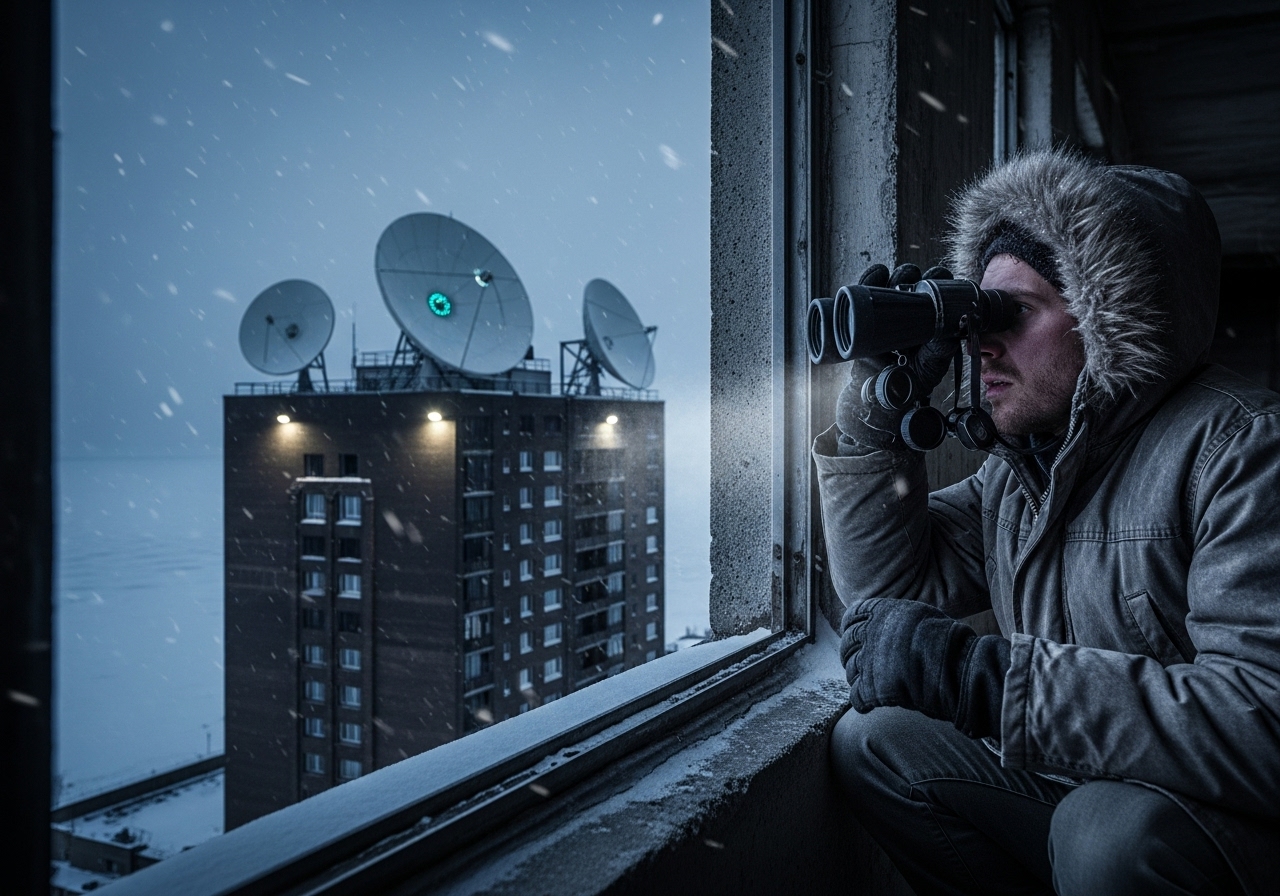
Trevor now possessed proof of a secret broadcast emanating from the heart of the regime's new surveillance hub, a signal that whispered towards the barren west. The knowledge was a leaden weight, a dangerous secret that promised either the fragile dawn of a new resistance or a deeper, more insidious layer of oppression he was only just beginning to uncover. His next move would be a gamble, one that could either shatter the control of the authoritarian state or ensure his own swift, silent disappearance into its unforgiving grip.
Share This Story


