HOSPITAL LOUNGE - NIGHT
Late at night, in a hospital residents' lounge in Northwestern Ontario, two medical residents, Lindsay and Sam, sift through black and white photographs meant for a local art exhibit, but their discussion quickly turns to a disturbing pattern of unexplained patient deaths and unsettling anomalies captured in their images from the hospital's old wing.
The glare from the fluorescent tubes in the residents’ lounge was already making my head throb, even before Sam started fanning out the latest batch of prints on the chipped Formica table. They were good, technically, sharper than mine, but they still felt… clean. Too clean for what we were trying to say. Or maybe, too clean for what I was starting to suspect.
“See? This one,” Sam pointed with a stubby finger, tapping a monochrome shot of the empty recovery bay in the old wing, the one with the cracked linoleum and the perpetually humming overhead light. “The light plays weird, yeah? But look at the depth. The contrast. It screams isolation. Perfect for ‘A Glimpse Beyond the Veil,’ right?” He said ‘veil’ like it was a joke, a self-aware nod to the pretentiousness of our little photography club, even though we were the only two active members, both utterly sleep-deprived.
I picked up the print, turning it in my hands. The paper felt slightly damp, which was odd. It probably just sat on the counter too long after developing. But the image… the recovery bay was always cold. Not just temperature-cold, but something else. A kind of emptiness that felt like it was absorbing all the light, all the sound. In Sam’s photo, the shadows under the gurney looked like they had weight, like they were pressed into the floorboards. But then, near the far wall, where the old oxygen tanks were strapped, there was that distortion again. A faint ripple, like heat haze off asphalt, but in black and white.
“What do you call this?” I asked, tracing the anomaly with my thumb. It wasn't quite a blur. More like the air itself had momentarily smeared, dragging the sterile white wall with it. We’d seen it before, in my own shots, in some of his. We’d always blamed the cheap film, the unsteady hands, the exhaustion that made our eyes play tricks.
Sam squinted. “Artifact. Lens flare, probably. Or maybe the digital grain. My phone’s pretty old, for a good camera.” He waved his hand dismissively, already reaching for another print. “No, no, forget that one. Too noisy. Look at this one, instead. The IV stand in Ward C, just before dawn. The way the light catches the drip, almost like a teardrop, but it’s hope, right? That’s what we want to convey. The fragile hope.”
He was always looking for hope. Me? I was mostly just looking for sleep, and maybe an answer to why Mrs. Carlisle, a woman who’d come in for a routine hernia repair, developed a rapidly progressing, untraceable infection that ate through her tissues faster than we could identify the pathogen, her labs screaming bacterial sepsis but every culture coming back clean. And she’d been in that same recovery bay for a few hours post-op before moving up to C-Wing. Just like Mr. Davison. And little Sarah.
My fingers tightened on Sam’s photo. “It’s not lens flare, Sam,” I said, my voice lower than I intended. The hospital hummed around us, a constant background drone of distant pagers, the clatter of carts, the muted announcements over the intercom. Northwestern Ontario winters were long and brutal, but inside the hospital, it was always this sterile, controlled environment, yet lately, it felt… porous.
“Then what, Lindsay? Ghost?” Sam snorted, leaning back in the uncomfortable plastic chair, which creaked in protest. He ran a hand through his perpetually messy brown hair. “Look, I know you’re still thinking about Mrs. Carlisle. It was rough. But sometimes, people just… go. Even with all our fancy machines and protocols. It happens. Especially in a place like this, out in the sticks, where half the equipment is from the seventies.”
“It wasn’t just Mrs. Carlisle, though, was it?” I pressed, ignoring his attempts at levity. “Remember Mr. Davison from three weeks ago? The fractured tibia? Developed that bizarre neurological tremor, then full-blown delirium within forty-eight hours. No signs of stroke, no encephalitis, CSF clear. And then Sarah, the kid with appendicitis? She had that sudden, inexplicable drop in core body temperature right after surgery, followed by a total system shutdown. All three of them spent time in that same bay. Bay three. And then moved to C-Wing.”
Sam stopped fanning the photos. His expression shifted, the easy humor fading, replaced by that familiar, weary doctor-look. He pinched the bridge of his nose. “Lindsay. We are talking about three isolated incidents over a month and a half. In a hospital with, what, fifty active beds? It’s not a pattern. It’s… noise. Background noise in a chaotic system. You’re overtired, and you’re finding connections where there aren’t any. Like in your photos.” He gestured to the print I still held.
“And what if the connections are actually there?” I retorted, my voice rising slightly. I lowered it again, remembering the thin walls of the lounge. “What if the noise is the signal? The distortion, Sam. It’s in every photo you’ve taken of Bay Three since the start of your rotation. And it’s in mine, too. Always subtly there. Like the air is vibrating differently there.”
He picked up another photo, this one a close-up of a patient’s hand, a nurse’s hand, reaching for a call button. It was a poignant image, full of implied stories. But then he laid it beside the one of Bay Three. “Okay, look. This… this thing you’re seeing…” He pointed at the faint smear in the corner of the Bay Three photo. “It’s not in this one. This was taken in Ward B. Totally clean.”
“Exactly!” I felt a rush of something, maybe vindication, maybe pure adrenaline from lack of sleep. “It’s localized. It’s only in the old wing. Or, more specifically, in certain rooms in the old wing. Bay Three, definitely. Room 104 in Ward C, where Mrs. Carlisle was, and where Mr. Davison was before they moved him. And Room 217 in Ward B, where Sarah was, which is also on the older side of the building.”
Sam stared at the photo, then at me. His skepticism was still etched on his face, but a flicker of something else, something I recognized from long nights studying microbiology, was there too: intellectual curiosity mixed with deep discomfort. “So, what, the ghost of Bay Three is causing flesh-eating bacteria and neurological disorders? Come on, Lindsay. We’re doctors. We deal in pathology, not poltergeists.”
“We deal in unexplained phenomena, Sam. We spend half our time trying to find a cause when the symptoms don’t fit. And these symptoms, in these specific cases, they don’t fit,” I argued, pushing the Bay Three photo closer to him. “What if it’s… something that interacts with the body? Something we can’t see, but a camera can pick up? Like an energy field? Or something that disrupts biological processes at a sub-cellular level? We’re in Northwestern Ontario. Half the old buildings around here have weird stories attached to them. This hospital was built on… well, nobody even knows what it was built on. Just, ‘old land.’ Locals talk about it sometimes, how it feels ‘thin’ in places.”
He picked up a coffee cup, cold and empty, and fiddled with the rim. His gaze drifted to the window, dark and reflecting the sickly green glow of the lounge. Outside, the frigid December air bit, snow already piled high on the forgotten cars in the parking lot. The town, such as it was, was asleep. “Thin,” he repeated, a little scoff in his voice, but it sounded forced. “You’re letting old wives’ tales get into your head. You’ve been working too many double shifts. You need a vacation. And a new camera that doesn’t pick up ‘energy fields’.”
“I don’t need a vacation, I need answers,” I countered. “And anyway, the photo exhibit. This is our chance. Instead of just ‘hope and despair in medicine,’ we make it… something else. We capture these distortions. We photograph the rooms where these things happen. We show the… the unseen patients.” I hated how it sounded, even as I said it. Like I was proposing a cheesy horror movie concept, not a serious art project by two stressed-out medical professionals.
Sam put the cold coffee cup down with a faint clink. “The unseen patients. Right. And what are we going to caption them with? ‘Bay Three: Where the Spirit of a Deceased Lumberjack Messes with Your Platelets’?” He cracked a thin smile, but his eyes were still wary. “Look, I’m not saying there isn’t something weird. I’m just saying it’s probably structural. Or an electrical issue. Bad wiring, causing some sort of interference that affects both the camera and, I don’t know, brain chemistry. Or bacterial growth, if it’s localized. Hospitals are petri dishes, Lindsay.”
“But the symptoms don’t always track. Mrs. Carlisle was a bacterial cascade, but Sarah was hypothermia and organ failure. Mr. Davison, neurological. It’s too disparate for one pathogen, and too specific for simple electrical interference. And the only constant is the location,” I insisted. “What if it’s something that predisposes people to different types of rapid deterioration, depending on their existing vulnerabilities? An amplifier, not a specific disease agent.”
He stood up and walked over to the small, grimy window, rubbing a spot of condensation with his sleeve. He was looking out at the darkened hospital grounds, the rows of pine trees heavy with snow. “An amplifier. A localized, non-physical amplifier of disease processes. So, a curse. You’re talking about a hospital curse.” His back was to me, his shoulders hunched. I could tell he hated the idea. We were supposed to fix things. Not attribute them to curses.
“I’m talking about something unknown,” I corrected, my voice firm. “Something beyond our current diagnostic capabilities, but that leaves a trace. A visual trace on film. And a physiological trace in our patients. If we can document it, photograph it, maybe we can start to understand it. What if our exhibit isn't just art, but evidence?”
Sam turned around, a slow, deliberate movement. His face, usually open and quick to smile, was drawn tight. “Evidence of what, Lindsay? That we’ve lost our minds from overwork? That we’re seeing patterns in the noise because we want to find meaning in every loss?” He picked up the Bay Three photo again, holding it up, this time closer to his face. He squinted at the faint smear, then at the bright artificial light of the lounge.
“Remember Dr. Albright?” I asked quietly, referencing the ER doc who transferred out last month, citing 'burnout,' though everyone knew she’d been jumpy, constantly talking about feeling 'watched' in the old psych ward. “She always said the walls here felt… alive. Like they were breathing. She didn’t mean literally, but in a way, she kind of did, didn’t she? This whole place, especially the older sections, it’s got a density to it, a heaviness. Like it’s holding its breath.”
Sam nodded slowly, his gaze still fixed on the photo. “Yeah, I remember. She was getting… odd. Said she heard whispers, too. Though I thought that was just the HVAC system. Or maybe the trauma.” He paused, then sighed, a long, tired sound that seemed to carry the weight of all the shifts, all the bad news. “Okay. Let’s say, for a second, I entertain this. This… theory. What do we do? Point our lenses at the walls and wait for a ghost to pop out for a selfie?”
“No. We’re systematic,” I said, feeling a surge of energy, the kind that comes from finally giving voice to a half-formed, terrifying idea. “We identify every area where these unexplained deteriorations have occurred. We cross-reference patient histories, times of exposure to those specific areas, and the nature of their symptoms. We’ve already got a rough list. Bay Three, Rooms 104, 217. Maybe a few others. Then we set up cameras. Discreetly. Not just our phones. My old SLR, for higher resolution. We take photos at regular intervals. Day, night, empty, occupied. We try to capture it. Whatever it is.”
He walked back to the table, rubbing his temples. “And the exhibit?”
“The exhibit becomes our cover. Our way to process the ‘stress of the job,’ the ‘unseen burdens’ of medical care. But we use it to present the evidence. We select the most compelling images, the ones that show the distortions most clearly. We title them evocatively, but without sounding like we’ve gone completely off the rails. We put them up in the community center, like we planned. And then we see who notices. Who else has felt something ‘thin’ or ‘heavy’ in these parts of the hospital. We open a conversation, without explicitly saying ‘ghost’ or ‘curse’.”
Sam picked up another photo, one of a doctor’s gloved hands meticulously suturing a wound. It was a beautiful shot, a testament to skill and focus. But then he looked back at the Bay Three photo. “You really think… you think there’s something here? Something physical, or… not physical, but detectable? And that it’s hurting people?” His voice was barely a whisper, a stark contrast to the usual boisterous energy he brought to the residents’ lounge.
“I don’t know what I think,” I admitted, my shoulders slumping a little. The rush of energy was already fading, replaced by a deep chill. “But I know what I’ve seen. In the charts. In my own gut feeling. And now, in these photographs. It’s a pattern, Sam. And ignoring it, blaming it on bad luck or overwork, feels… irresponsible. We are doctors. We’re supposed to find out what’s wrong, even when it’s beyond our current understanding. This is just… a different kind of diagnosis.”
He dropped the suturing photo, letting it flutter onto the pile. His fingers went to the Bay Three print, tracing the faint distortion again. “What if we’re wrong, Lindsay? What if we just end up looking like two crazy residents who cracked under the pressure?”
“What if we’re right, Sam?” I countered, the question hanging heavy in the air between us. The hum of the fluorescent lights seemed to intensify, a high-pitched whine that grated on my nerves. Outside, the wind picked up, rattling the old windowpane.
He looked at me, really looked at me, and I saw the fear in his eyes, but also a sliver of that scientific curiosity. The kind that makes you poke at something even when you know it might sting. “Okay,” he said, his voice quiet. “Okay, Lindsay. Let’s do it. We pick our shots. We get our gear. We try to catch this… thing. But if it gets too weird, if it starts feeling like more than just bad vibes and camera glitches… we pull the plug. Deal?”
“Deal,” I agreed, relief washing over me, despite the knot of dread forming in my stomach. At least I wasn’t alone in this anymore. We spent the next hour meticulously poring over every photo, flagging the ones that contained even the slightest hint of the distortion. Sam’s initial skepticism was still there, a thin layer of disbelief, but it was cracking. He kept muttering about static electricity, about light interference, but his eyes kept returning to the unsettling ripples in the images. We started pulling up floor plans on the lounge computer, marking out the rooms and bays. The old wing was a maze of extensions and renovations, but a core section, built in the early 1900s, seemed to be the epicenter.
The night wore on. The hospital quieted further, settling into its graveyard shift rhythm. My own body was screaming for sleep, my eyes gritty, my head a drum. But the intellectual puzzle, mixed with the chilling implications, kept me wired. We had a preliminary list of ten rooms now, all in the oldest parts of the building, all connected by a common thread of inexplicable patient deterioration.
“We need to be careful,” Sam said, pulling up another archived patient record on his tablet. “If anyone finds out we’re… investigating this… unofficially… it could mean our careers. They’ll send us to psych.”
“Then we make sure our photography exhibit looks like nothing more than a personal project,” I replied, staring at a floor plan. “A way for two young doctors to cope with the intensity of their work. Which, in a way, it still is. Just with a darker, stranger angle.”
As we talked, the screen on Sam’s tablet flickered. Just a momentary glitch, but it coincided with a faint, almost inaudible hum coming from somewhere deep within the hospital’s bowels. The hum wasn’t the usual HVAC drone. It was lower, more resonant, like a subterranean chord. It sent a shiver down my spine, making the hairs on my arms prickle. Sam didn’t seem to notice, his eyes glued to the screen, scrolling through patient notes from a case three months prior: another sudden, untraceable septic shock. Patient was in Room 217. The same room where little Sarah had been.
“This is it,” he said, his voice barely a whisper, pointing at a line in the electronic chart: Patient reported feeling an extreme, localized chill, despite normal room temperature. Stated: ‘It feels like the room is sucking the warmth right out of me.’ His finger trembled slightly.
My heart started to pound, a slow, heavy thud against my ribs. I grabbed my camera bag, pulling out my old Nikon D850, checking the battery. It was charged. The lenses were clean. My hands were steady, surprisingly. Whatever this was, whatever we were stumbling into, it was real enough to make my focus razor-sharp. The exhaustion, for a moment, vanished. It was replaced by a grim determination. And then, as if on cue, a muted, urgent page echoed through the quiet hospital halls. Dr. Singh, ER. Code Blue, Room 104. The same Room 104 that Mrs. Carlisle had been in. The one on our list. My breath caught in my throat. We exchanged a look, a shared, dawning horror. This wasn't just old photos and theories anymore. This was happening, right now. And we were still just two sleep-deprived residents with cameras, staring at a map, while something unseen continued its terrible work.
“Go,” I urged Sam, already slinging my camera bag over my shoulder. “Go to the ER. I’m going to Room 104. I need to see if… if it’s there. And I need to get a shot of it, if I can.” My voice sounded alien to my own ears, almost frantic. The adrenaline had returned, colder this time. This was no longer just an art project. It was an emergency, and we were the only ones who saw it coming, even if we couldn't explain it.
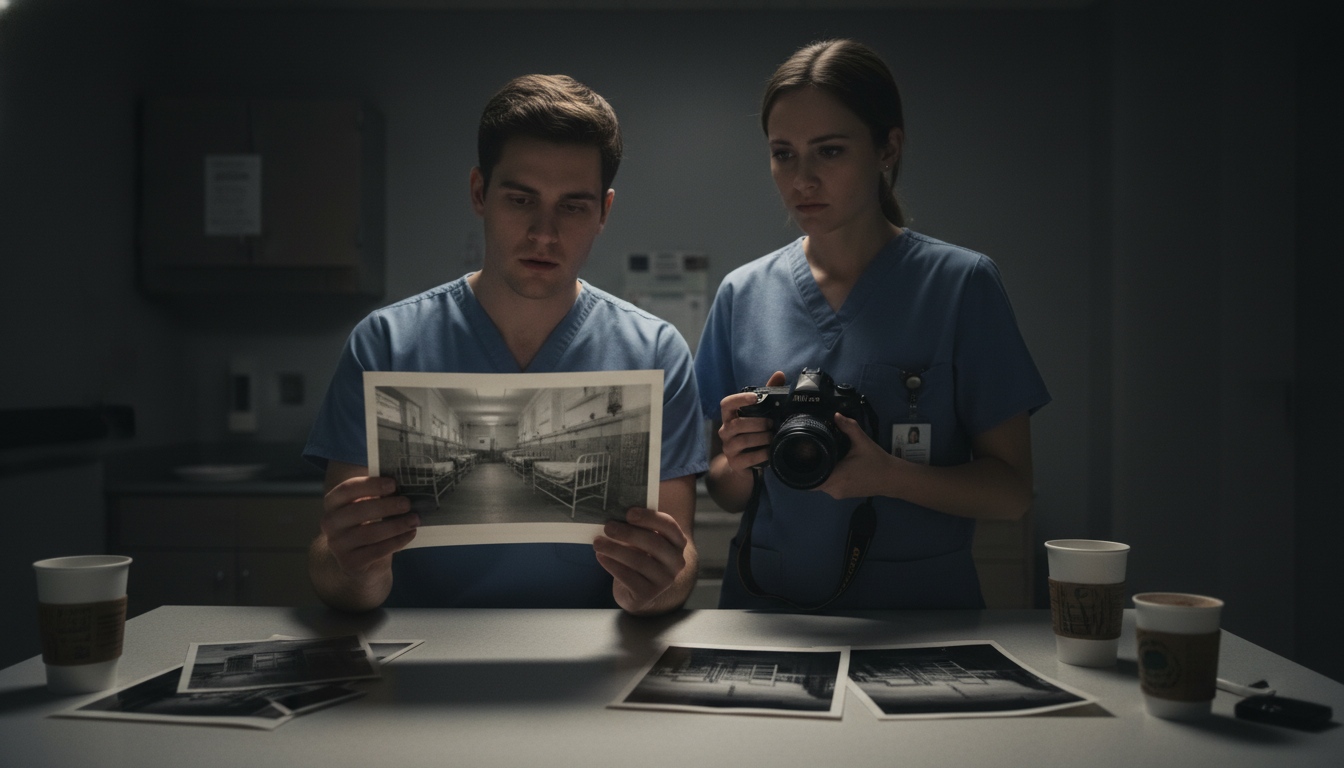
This wasn't just old photos and theories anymore. This was happening, right now. And we were still just two sleep-deprived residents with cameras, staring at a map, while something unseen continued its terrible work.
Share This Story


