The Gathering at the Iron Bridge
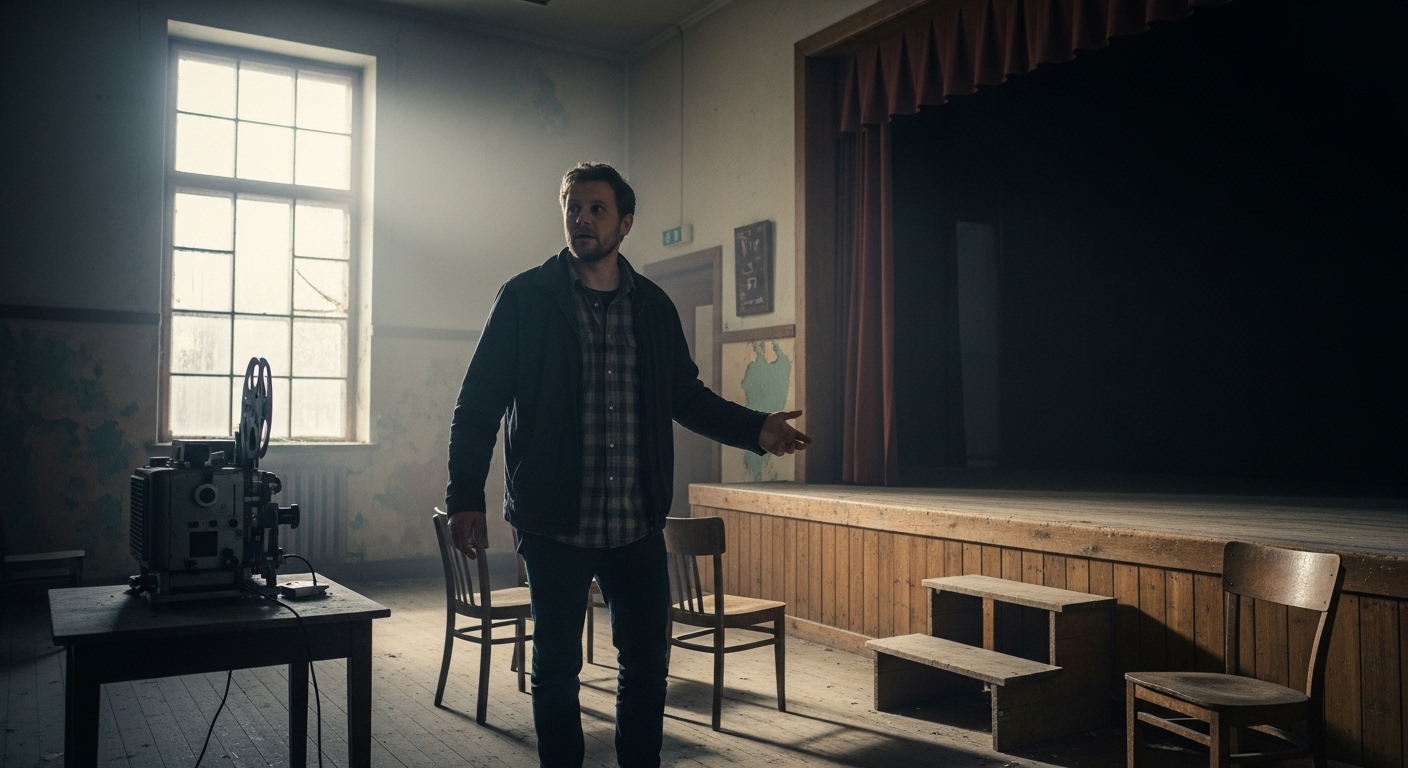
The wind, sharp with the scent of wet pine and distant woodsmoke, tore at the posters Evan had meticulously stapled to the community board. Red and gold maple leaves, brittle as old parchment, scuttled across the frosted ground. It was late October, and the grey light of afternoon had already begun its surrender to an early dusk, painting the sparse clapboard buildings of Oakhaven in shades of muted indigo. Inside the drafty, cavernous interior of the Oakhaven Community Hall, a handful of faces, etched with the seasons of the north, turned towards Evan, their expressions a blend of polite skepticism and weary resignation.
“...and so,” Evan articulated, his voice resonating hollowly in the cavernous hall, the acoustics doing little to flatter his earnest delivery, “this initiative, rooted deeply in the principles of Sustainable Development Goal eleven – specifically, ‘making cities and human settlements inclusive, safe, resilient, and sustainable’ – seeks to transform Oakhaven, not merely in infrastructure, but in spirit.” He paused, allowing the weight of his words to settle amongst the sparse gathering. The five faces before him remained largely unyielding, their gazes as fixed as the peeling wallpaper behind them.
Mika, her hands clasped tightly over a worn thermos of tea, shifted in her seat. The groan of the old wooden floorboards beneath her seemed to punctuate the silence. “Spirit, Evan, is a fine thing. But spirit does not heat this hall in January, nor does it mend a broken plough.” Her voice, though mild, carried the steady, unshakeable conviction of someone who had lived through many, many Oakhaven winters.
“Precisely, Mika!” Evan countered, his enthusiasm undimmed, though a familiar thread of frustration began to tighten in his chest. He took a few steps towards the small, rough-hewn stage at the far end of the hall, his boots echoing on the polished but scuffed floor. “The arts, the very act of creating and experiencing, are not frivolous expenditures. They are the mortar. They bind us. They build resilience. Imagine a photography workshop for the youth, documenting our unique landscape, our history. Imagine an elder’s storytelling circle, preserving our oral traditions, perhaps even translating them into performances, ensuring they endure, rather than fading like old photographs in a forgotten album.”
Tyler, whose lanky frame was draped over two chairs, snorted softly. A musician by disposition, though he currently worked at the general store, his eyes held a perpetual glint of skepticism. “Enduring stories don’t pay for new strings, Evan. Or keep the generator running when the hydro line freezes solid. We are barely keeping the lights on, let alone staging Shakespeare.”
Sienna, the local schoolteacher, a woman with kind, but intensely analytical eyes, intervened smoothly. “Tyler makes a valid point regarding practicality. Resources here are… finite. To divert them from essential services – road maintenance, medical supplies for the outpost – to artistic pursuits, however noble, feels a difficult proposition to justify to families struggling to make ends meet.” She adjusted her spectacles, the thin chain glinting in the faint light filtering through the high windows, which were obscured by years of grime and the skeletal branches of an oak, now completely denuded by the encroaching chill.
“But this is the point!” Evan urged, his voice rising, a small bead of sweat forming at his temple despite the cold. He knew this argument, had heard it in varying forms in every remote community he’d ever worked with. “This isn’t about diverting funds. It’s about attracting funds. Building capacity. A vibrant arts programme, even a small one, draws attention. It fosters local talent, creates a reason for our young people to stay, to return. It becomes an economic driver, a source of pride. It’s not either-or, it’s a symbiotic relationship. A community that values its culture, its collective expression, is a community that thrives. It’s sustainable.”
Mika finally unclasped her hands, setting the thermos down with a soft clink. Her gaze drifted upwards, towards the high rafters, where cobwebs hung like forgotten banners. “Culture, yes. Expression, yes. But some things are best left… undisturbed. This hall, it has seen many things. Good, and not so good.” Her voice dropped, a subtle shift in tone that Evan, despite himself, found unnerving. The air in the hall seemed to grow suddenly colder, a damp, heavy chill that seeped into his bones, distinct from the usual autumn bite.
“Mika, please,” Sienna said, a note of gentle admonishment in her voice. “We speak of future prospects, not ancient superstitions.”
Mika merely offered a small, knowing smile. “Superstition, perhaps. Or perhaps memory. This ground, where the hall now stands, was not always ground to be built upon. The old Iron Bridge, just down the road, it was moved, you know. Not built here. Moved from another site, after… certain events. This hall, constructed with its metal, shares a certain… resonance with its past.” She gestured vaguely towards the stage, then to the heavy iron support beams that crisscrossed the ceiling, dark and formidable against the whitewashed (though now greyed) planks. The beams, unpainted, showed patches of rust like old wounds.
Evan forced a polite, dismissive laugh, though it sounded thin even to his own ears. “Mika, with all due respect, we are discussing grant applications and community engagement, not local folklore. The hall is old, yes. It has character. That is precisely its appeal for an arts centre. The worn floorboards tell stories of dances and meetings, not… not spectres.” He tried to keep his voice steady, but the sudden, sharp drop in temperature was making his teeth ache.
“Spectres of a different kind, perhaps,” Mika murmured, almost to herself, her eyes still fixed on the rafters. “When they moved the Iron Bridge, they didn't just move the iron. They brought the ground it stood on. The foundations. And what lay beneath.” Her words hung in the air, heavy and unspoken, like the thick, grey clouds gathering outside the tall windows. A gust of wind rattled the glass, a mournful sound.
---
The meeting eventually wound down, the arguments unresolved, but a tentative agreement reached for Evan to draft a preliminary proposal. As the others bundled into their heavy coats, their breath pluming white in the chill air, Evan found himself lingering. Mika’s words had burrowed under his skin, a tiny, uncomfortable sliver. He walked towards the stage, running a hand over the rough-sawn wood. The scent of aged timber, dust, and something metallic, like stale pennies, clung to the air. He tried to rationalise it: old buildings, fluctuating temperatures, the power of suggestion. But the chill persisted, a deep, pervasive cold that seemed to emanate from the very fabric of the building.
He noticed Tyler, still hovering near one of the enormous iron beams supporting the roof. Tyler, usually so quick to depart any formal gathering, was staring intently at a section of the beam, his brow furrowed. “Found something, Tyler?” Evan asked, his voice still carrying a faint echo of his earlier, more assertive tone.
Tyler didn’t look up. He slowly extended a finger, tracing a faint, almost imperceptible discoloration on the grimy surface of the iron. “Not… not rust. Not entirely.” He tapped it gently. The sound was flat, dead. “It’s like… blood. Dried. But too dark. Too… old. And it’s not just on the surface. It looks like it’s in the metal.” He pulled his hand back quickly, almost instinctively wiping his fingers on his worn denim trousers. The movement was jerky, uncharacteristic of his usual languid grace.
Evan leaned closer, squinting. The mark was indeed peculiar. A sprawling, irregular pattern, like a burst of crimson ink that had bled deeply into the greyish-black iron. It wasn't uniform, fading in some places, stark in others. It reminded him, unsettlingly, of an old, faded bruise. He touched it, tentatively. The surface was cold, but not as cold as the general air. There was no texture to the stain, it was simply part of the iron itself. A dull, coppery tang, faint but unmistakable, reached his nostrils. It wasn’t the familiar smell of rust. It was something deeper, more visceral.
“It’s probably some kind of mineral deposit,” Evan declared, more to convince himself than Tyler. “Old buildings, old materials. You find all sorts of anomalies.”
Tyler finally met his gaze, his eyes wide. “Mineral deposit that looks like… a handprint? See here.” He pointed to a slightly denser concentration of the stain, where five distinct, if elongated, smudges radiated outwards, almost like an impression left by a gloved hand pressing into cooling metal. “And look, it’s not alone. There are others. Faint. But they’re there, further along.” He moved slowly, his head tilted, his eyes scanning the vast expanse of the beam, then upwards, towards the intersecting supports.
Evan followed his gaze, a prickle of unease beginning to crawl up his spine. Indeed, when he looked with greater intent, the odd, dark crimson stains were not isolated. They stretched along the main beam, then seemed to follow the angles of smaller crossbeams, like a macabre, abstract calligraphy. The hall, which moments ago had felt merely cold and aged, now seemed imbued with a silent, watchful presence. The shadows cast by the setting sun through the grimy windows deepened, making the details of the room recede, leaving only the oppressive weight of the iron and the strange marks upon it.
“The Iron Bridge,” Mika’s words echoed in his mind. “They didn't just move the iron. They brought the ground it stood on. The foundations. And what lay beneath.” He found himself shivering, not from the cold, but from something else entirely. The coppery scent seemed to grow stronger, or perhaps his imagination was simply supplying it now, painting the air with the metallic tang of old blood.
“I should… I should check the hall’s records,” Evan mumbled, the sudden urgency surprising even himself. He needed to understand the building's history, its true origins beyond the simple anecdotes he’d been told. He needed an explanation, a rational one, for the chilling observations. Tyler nodded slowly, his face grim, his gaze still fixed on the stained iron. He didn't offer to help, nor did he dismiss Evan's sudden preoccupation. He merely seemed to understand, with a quiet, artistic intuition, that there was something profoundly wrong here.
---
Later that evening, the old library, little more than a single room attached to the municipal office, was hushed and cold, illuminated by the single, buzzing fluorescent light above Evan’s head. The scent of decaying paper and dry dust was heavy. He meticulously sifted through archived ledgers, local newspaper clippings yellowed with age, and official documents detailing the hall’s construction. Most were mundane: expenditures for lumber, lists of volunteers, dates of various community dances.
He found the original blueprints. Dated 1968. They indicated the use of reclaimed iron from the old railway bridge – indeed, the Iron Bridge. A small, handwritten notation on the corner of one blueprint, almost an afterthought, stated: ‘Site remediation required prior to foundation work. Unstable sub-grade.’ Nothing more. No details about why the sub-grade was unstable, or what ‘remediation’ entailed. The language was sterile, bureaucratic, designed to obscure as much as reveal.
Digging deeper, he uncovered a box marked ‘Miscellaneous: Hall Project.’ Inside, amongst forgotten photographs of the groundbreaking ceremony and faded letters from suppliers, was a slim, leather-bound journal. It wasn't an official document, more a personal diary, its cover cracked and peeling. The first few pages detailed typical construction woes: delayed shipments, uncooperative weather, budget overruns. Evan recognised the handwriting: Archibald Finch, the foreman of the original construction crew, long deceased.
He flipped through the journal, his breath misting in the cold air of the library. Finch’s entries became increasingly disjointed towards the middle of the book. References to “troubles with the earth,” “strange shifting,” and an odd preoccupation with the “foundations from the old bridge.” One entry, dated mid-October 1968, stood out, underlined twice in a frantic hand: ‘The ground here… it does not wish to be built upon. The old tales… perhaps there is truth to them after all. The chill… it emanates from below. We have covered it. We have built over it. But I do not believe it sleeps.’
Evan frowned, running a finger over the words. What tales? What chill? Finch had been a pragmatic, no-nonsense sort, by all accounts. Not given to flights of fancy. Yet his words pulsed with a raw, undeniable fear. Just as Evan was about to close the journal, a loose, brittle piece of paper fluttered from between the pages. It was folded multiple times, and when he carefully unfolded it, he found a crude charcoal drawing. It depicted the Oakhaven Community Hall, but not as it stood now. It showed the hall with strange, dark tendrils seemingly coiling from its foundation, reaching up, almost embracing the iron beams of the roof. The tendrils were the same dark, bruised crimson colour he’d seen on the actual beams. And at the centre, almost like a pulsating heart, was a distorted, almost skeletal human figure, its arms outstretched, merging with the dark earth below and the iron above, its mouth agape in a silent scream. A cold, palpable dread began to coil in Evan’s stomach, a far deeper chill than any Oakhaven autumn could deliver.
He traced the rough charcoal lines again, the cold seeping from the paper into his fingertips, a chilling premonition that the darkness Mika spoke of was not merely the cold of an Oakhaven winter, but something ancient, restless, and far more sinister than he could have ever imagined.
Share This Story


