A Silence of Chlorophyll
The plant was Linda’s greatest failure. For fifty years as a botanist, she had coaxed life from the most stubborn seeds and resurrected flora on the brink of extinction. But this thing… this thing was a silent, emerald insult. It had been a gift from a former colleague, discovered in a geological sample from a deep-ice core. It had leaves like polished jade and a stem like coiled wire, but in the five years she’d owned it, it had not grown, not wilted, not changed in any discernible way. It just sat in its pot in the corner of her coffee shop, radiating a profound and ancient indifference.
She watered it out of habit, not hope. It didn't seem to need it. The soil was always vaguely damp, the leaves perpetually dewy. It was less a plant and more a sculpture of a plant, perfect and unchanging. Her customers liked it. They called it the ‘Zen plant’. Linda knew better. It wasn't calm; it was waiting. The thought was absurd, unscientific, but she couldn’t shake it. The plant was waiting for something, and the air of a Bristol coffee shop clearly wasn't it.
“Any movement from your roommate?”
Terry slid into his usual booth, placing a small black case on the table. He was a retired audio engineer, a man who heard the world in frequencies and waveforms. He was tall and thin, with a shock of white hair that suggested a life of minor electrocutions. He was the only person who shared her fascination with the plant's inertia.
“It glared at me this morning when I dusted its leaves,” Linda said, bringing him his tea. “Or maybe I imagined it. It’s hard to tell.”
“It’s not glaring. It’s listening,” Terry said with certainty. He opened his case, revealing not a musical instrument, but a complex-looking oscillator and a small, high-frequency speaker. “I’ve been analysing the recordings from last week. There’s a resonance. A very faint harmonic vibration coming from the stem when the espresso machine hits a certain pitch. I think I’ve isolated it.”
“Terry, we’ve been through this. It’s a plant, not a radio receiver. You’re going to give it tinnitus.”
“Humour me,” he pleaded, his eyes alight with the thrill of the chase. “I’ve synthesized the waveform. Amplified it. Just for a minute. Let’s see what happens.”
Linda sighed, but she couldn’t deny her own curiosity. “Fine. But if it sheds all its leaves in protest, you’re sweeping them up.”
Terry grinned and flicked a switch. There was no sound, not to human ears. But the air in the cafe seemed to thicken, to vibrate at a fundamental level. Linda felt it in her teeth. She looked at the plant. And her breath caught in her throat.
The Crystalline Pollen
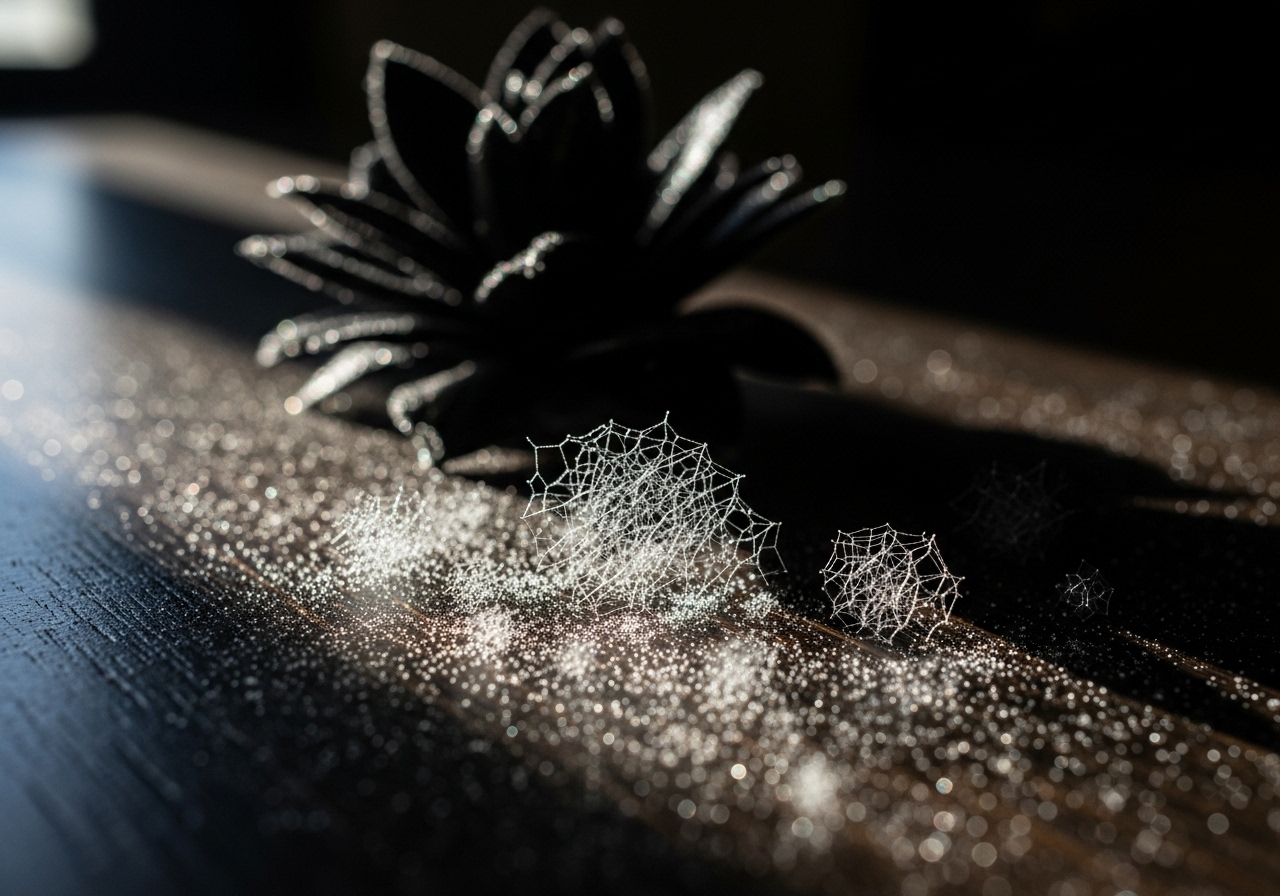
At the apex of the central stem, a tightly-closed bud she had long dismissed as a permanent feature began to tremble. Slowly, petal by petal, it began to unfurl. The petals were not green, but a deep, impossible black, a shade so dark it seemed to drink the light around it. They were like shards of obsidian, yet they moved with the fluid grace of living tissue.
“Terry,” she breathed. “Turn it off.”
“No, look!”
As the flower opened, it released a cloud of shimmering dust. It wasn't yellow pollen, but a fine, silvery powder that caught the light like crushed diamonds. It drifted through the air, ignoring the gentle currents from the heating vent, and began to settle in a fine layer on the dark surfaces of the nearby tables.
The bell on the door chimed, and John came in, grumbling about the price of parking. He was a geologist, a man who thought in epochs and measured the world in strata. “What’s that smell?” he asked, sniffing the air. “Smells like ozone. And… hot metal.”
His eyes fell on the blooming flower. “My word, Linda. What is that?”
“I have absolutely no idea,” she admitted, unable to tear her gaze away.
John, ever the scientist, was not looking at the flower. His attention had been captured by the dust settling on the tables. He walked over to one, leaned down, and peered at the shimmering layer. He gently scraped a small amount onto his fingertip and rubbed it between his thumb and forefinger.
“Extraordinary,” he murmured. He pulled a small jeweller's loupe from his coat pocket and examined his fingertip. His expression shifted from curiosity to utter bafflement.
“The crystalline structure is perfect. Isotropic. I’ve never seen anything like it. It’s not quartz, not mica… it’s not in any mineral classification I know.” He looked up at them, his eyes wide. “Linda, where did you say this plant came from?”
“An Antarctic ice core sample,” she replied, her voice faint.
“Of course,” John breathed. “It’s not terrestrial.”
---
As he spoke, the fine layer of dust on the table began to move. Much like John's sugar cubes weeks before, but with a different purpose. The tiny crystals weren't forming equations. They were organizing themselves, flowing like liquid metal, coalescing into geometric patterns. Hexagons, spirals, and complex lattices spread across the surface of the wood.
Terry finally switched off the oscillator. The high-frequency hum in the air vanished. But the dust kept moving.
“It’s reacting to something,” Terry whispered. “But my machine is off.”
“It’s not reacting,” John said, his voice filled with a terrible, exhilarating awe. “It’s building.”
He was right. The dust was rising from the tables, lifting into the air in shimmering veils. It flowed towards the centre of the room, a silent, glittering vortex. The three of them stood frozen, watching as the crystalline cloud began to resolve, to take on a new form in the air above the central table.
It was a perfect, silent, shimmering replica of the coffee shop itself. A doll's house made of alien dust, floating in the air, complete with a tiny, perfect model of the plant in the corner, and three minuscule, glittering figures staring up in wonder.
The tiny, crystalline figure representing Linda inside the miniature coffee shop lifted its arm and pointed directly at the real Linda. At the same moment, the full-sized, alien plant in the corner began to pulse with a soft, internal light, and every other plant in the shop—the ferns, the ficus, the cheap plastic ivy—began to wither and turn to grey ash.
Share This Story


