The Atlantic's Grey Indifference
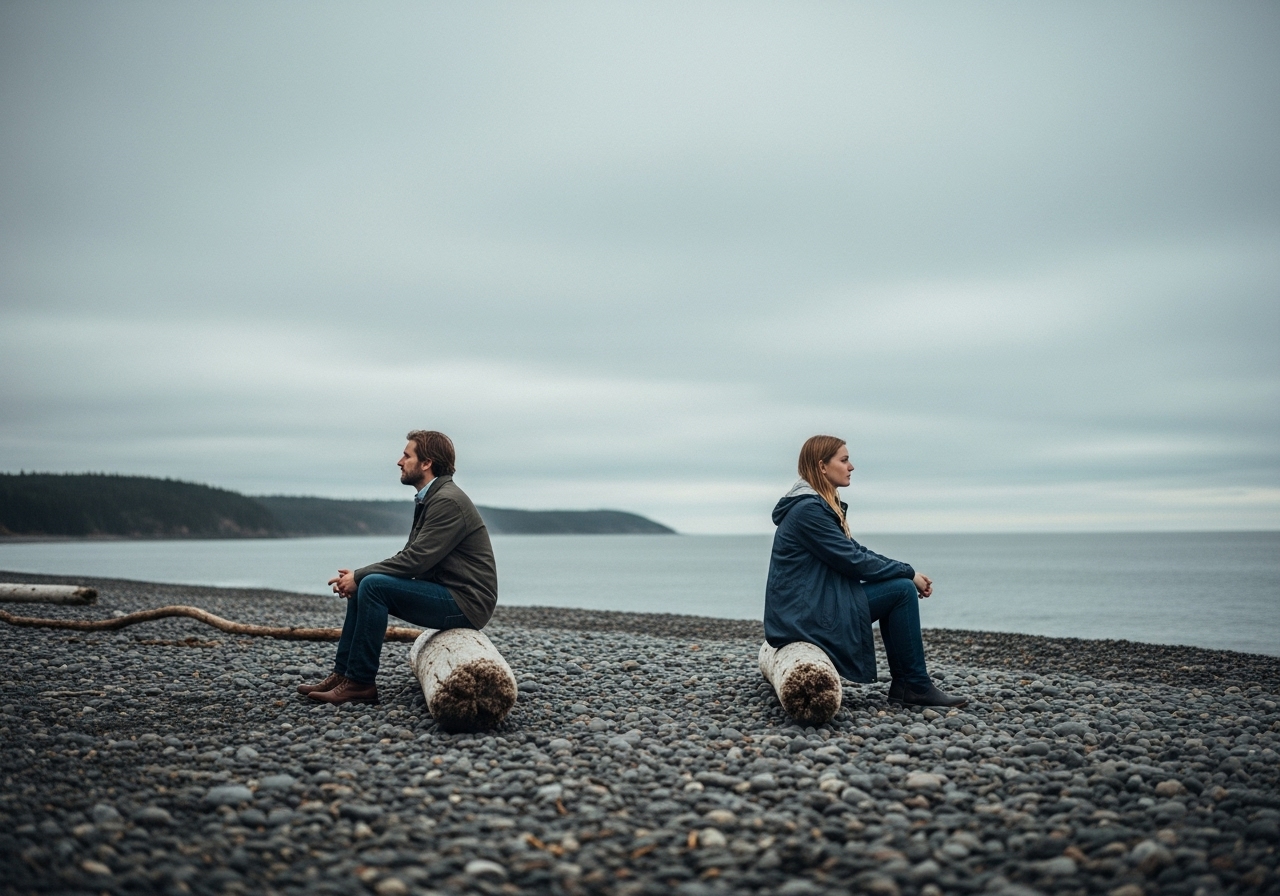
The car was parked where the gravel road dissolved into coarse sand and smooth, grey stones. The air was thick with the smell of low tide: salt, brine, and the faint, organic scent of decaying seaweed. The sky was a uniform, heavy grey, indistinguishable from the surface of the Atlantic, which rolled in with a slow, percussive rhythm, each wave collapsing on the shore with a heavy sigh.
They sat on a large piece of driftwood, its surface bleached pale and smooth by years of sun and salt. It was the first time they had stopped moving in six thousand kilometres. From the Pacific to the Atlantic, they had crossed a continent, and all they had done was put more distance between themselves.
Terrence picked up a flat, grey stone and, with a flick of his wrist, sent it skipping across the water’s surface. One, two, three, four skips before it sank. He used to be able to get seven.
“So,” Blair said, her voice almost lost in the sound of the surf. “This is it. The end of the line.”
“Looks like it,” Terrence said, searching for another good skipping stone. His refusal to engage, to look at the gravity of the moment, was a familiar defence mechanism. Blair found she wasn't even annoyed by it anymore. She was just… tired.
The whole trip had been his idea. A grand, romantic gesture after the disaster with the counterfeit bags. ‘Let’s just drive,’ he’d said. ‘We’ll find ourselves. We’ll figure it out.’ But you couldn’t figure things out when you were constantly in motion. All they had done was pack up their problems and take them on tour.
“I got an email this morning,” Blair said. She pulled her knees up to her chest, wrapping her arms around them for warmth. “From that tech firm in Gastown. The one I interviewed with before we left.”
Terrence stopped searching for stones. He didn't look at her, but she knew he was listening. “Yeah?”
“They offered me the project manager position. It’s a good offer. Really good. Benefits, pension plan, corner office.” She recited the details like a mantra, a prayer to the god of stability. “They need an answer by Friday.”
He was quiet for a long time, watching the waves. “A corner office,” he said finally, the words sounding foreign and slightly ridiculous in this wild, empty place. “That’s what you always wanted.”
“It’s a secure future,” she said, defending a choice she hadn’t made yet. “It’s a plan.”
“Right. A plan.” Terrence found a stone and turned it over and over in his palm. It was perfectly smooth. He didn't throw it. “And what’s my role in this plan? Do I get a visitor’s pass? Maybe water your plants on the weekend?”
The bitterness in his voice was sharp, but it was edged with a genuine pain that cut through her. “That’s not fair, Terry.”
“Isn’t it?” He finally turned to face her, and his eyes were raw with a hopeless, desperate energy. “Come on, Blair. Let’s be honest, for once. We’re standing at the edge of the whole damn country because we can’t stand still. We drove all this way and nothing’s changed. You still want a mortgage and a five-year plan. I still want… I don’t know what I want. But it isn’t that. It isn't a corner office in a city that’s choking me.”
---
He stood up and walked to the water’s edge, the waves washing over the toes of his worn-out boots. He didn't seem to notice the cold.
“I like it here,” he said, his back to her. “It’s quiet. The people are… real. I talked to a fisherman in Lunenburg yesterday. He gets up, he goes out on the water, he comes back. He knows what his day is going to be. There’s something honest about it.”
“You want to be a fisherman?” Blair asked, the question laced with a gentle incredulity.
“No,” he said, shaking his head. “I just want to feel like I’m doing something real. Not just chasing money or status. Not just trying to live up to your parents’ idea of success.”
The mention of her parents hung in the air. The unpaid loan was the great, unspoken third passenger on their trip. They hadn't mentioned it since they’d left BC, but it was always there, in the careful way they split petrol costs, in the cheap motels they stayed in.
“This has nothing to do with my parents,” she said, though they both knew it was a lie. “This is about what we want. And for the first time, I think we have to admit they’re not the same thing.”
It was out. The truth they had driven six thousand kilometres to avoid. They had been friends since university, their lives intertwined for a decade. They had propped each other up, held each other back, loved each other and resented each other in equal measure. They had built their whole identities around being ‘Blair and Terrence.’
What were they, separately?
He walked back from the water and stood in front of her. “So you’re going back,” he said. It wasn’t a question.
“My flight would be from Halifax. On Thursday,” she said, her voice quiet. “I’d take the bus from here.”
The practicalities were suddenly very clear. The logistics of their separation. He would keep the car. She would take her two suitcases. It was all so simple, so mundane, for something that felt like an amputation.
“Okay,” he said, and he nodded slowly. A single, final acknowledgement. “Okay, Blair.”
He didn't try to change her mind. He didn't offer a counter-proposal, a new grand scheme. He just accepted it. And in its own way, that was the most heartbreaking part of all. It meant he had known it was coming, too. This wasn't a fork in the road. It was just the place where their two separate paths, which had run parallel for so long, finally, inevitably, diverged.
Terrence reached into his pocket and pulled out the smooth, grey stone he'd been holding. He pressed it into her hand. "For the corner office," he said, his voice devoid of sarcasm, full of a quiet, devastating sincerity. "So you don't forget what the edge of the world feels like."
Share This Story


