The Unmarked Doorway
It was autumn outside, a crisp, gold-leafed picture, but down here, under the small northern community recreation hall, it was a timeless, subterranean grey. The single bare bulb Bonnie had strung up cast long, dancing shadows that made the stacks of broken furniture and dusty boxes look like silent, hunched sentinels. A shiver, not entirely from the chill, traced my spine.
The screwdriver, a stubby, battered thing Bonnie had found in a biscuit tin, slipped again. It scraped a fresh line across the already scored head of the ancient screw, a tiny, grating sound that vibrated up my arm. "Right," I mumbled, mostly to myself, "that’s definitely stripped now. Proper job."
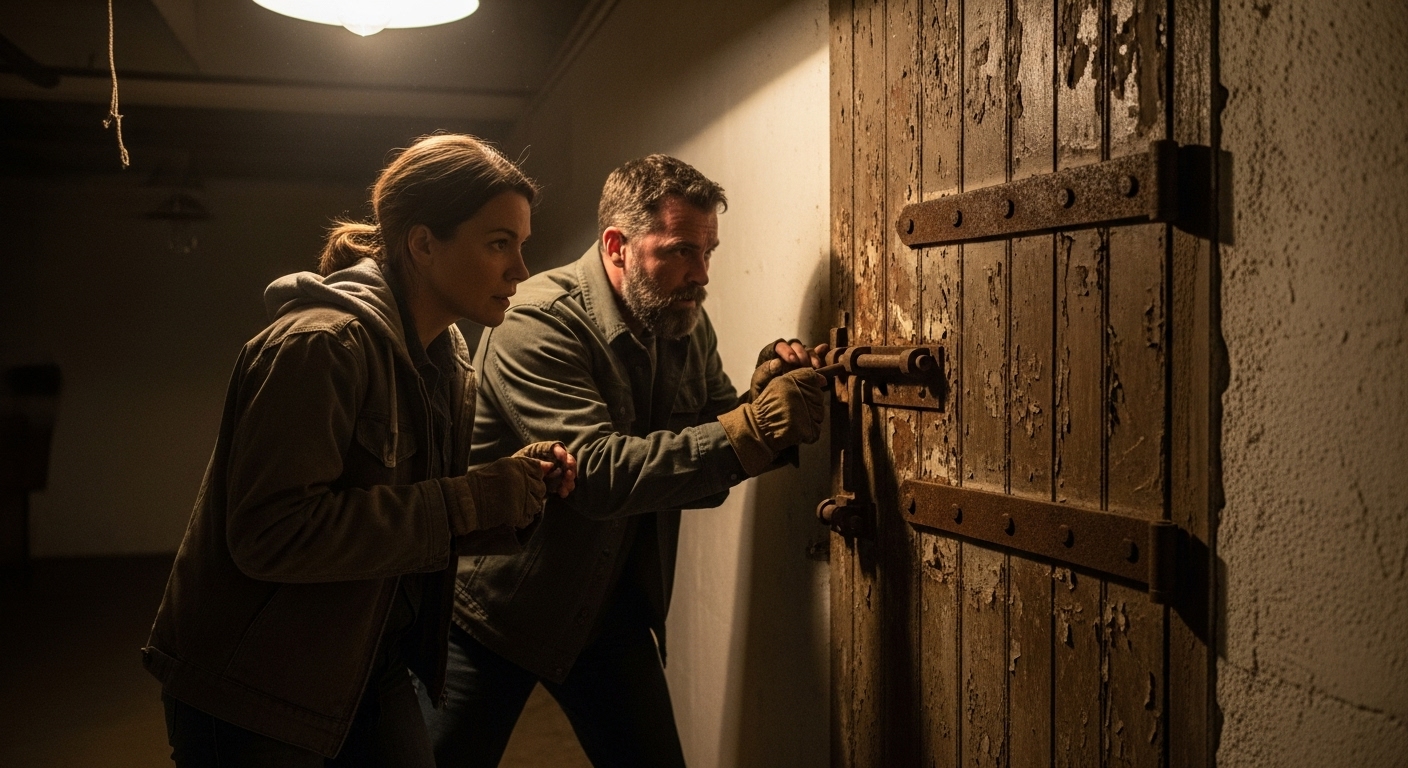
Bonnie sighed, pushing a stray strand of hair from her forehead with a gloved hand. She had a streak of grey paint—or what might have been paint, given the state of this basement—smudged across her cheekbone, making her look like a particularly exasperated badger. "Honestly, who bolts a door this many times?" she asked, her voice tight with effort. She was wrestling with a crowbar, trying to wedge it under the lower hinge. "It’s a community hall basement, not Fort Knox."
Dmitri, perched precariously on a stack of encyclopaedias that threatened to give way at any moment, grunted. He was applying a generous amount of some industrial-strength rust solvent to the top hinge, the fumes already making my eyes water. "Security theatre, Bonnie. Or someone had a very bad experience with pigeons. Or bad art. Maybe it was a very bad art room." He nudged a heavy, corroded hinge with the brush, and a shower of orange flakes rained down. He looked pleased with himself.
My mind drifted, the smell of rust and dust a familiar, unsettling perfume. It reminded me, vaguely, of the old bunkers we'd cleared out near Kandahar, though those had smelled more of desiccated fear and something faintly acrid. Not just damp earth and forgotten ambition. Here, it was a fight against entropy, a battle where the enemy was merely neglect, not something with an AK-47. A blessing, really. But the instincts... the way I instinctively scanned the ceiling for unstable points, the way my ears were tuned to the groan of the old building, the way my shoulders still pulled tight at sudden, unexpected sounds – those were harder to shed than the uniform.
"This is not just some storage closet," I declared, more to shake myself out of the memory haze than to inform them. "Look at the quality of these bolts. Not standard issue for a rec hall. And it's sealed. Not locked, sealed. With lead paint over the cracks, by the looks of it." I tapped a knuckle against the door's rough, unvarnished surface. It felt solid, dense, like something built to withstand more than just curious teenagers.
"So, what, we're expecting a forgotten stash of Prohibition-era hooch?" Bonnie grunted, her crowbar finally finding purchase, causing a dull thud. "Or Mrs. Higginbottom's prize-winning zucchini recipes from 1957? Because frankly, after moving half a ton of broken ice skates, I'd take either."
Dmitri hummed, wiping his brow with the back of his hand, leaving a clean patch in the grime. "Or, my personal favourite, a time capsule filled with the collective angst of a thousand northern adolescents." He grinned, a flash of white in his dust-streaked face. "Imagine the poetry."
We fell into a rhythm then, the metallic rasp of tools against stubborn wood and metal, punctuated by the occasional cough or muttered curse. The hall above us was quiet, the usual autumn chatter of children's after-school programmes yet to begin. It was late September, the air outside already carrying that sharp, clean scent of approaching winter, a reminder that we were racing the clock. The town wanted their "Northern Arts & Heritage Centre" open by Remembrance Day, a slightly morbid but community-approved deadline. Our "mission," as Dmitri had dubbed it, was to reclaim this forgotten corner, turning its dusty expanse into a vibrant space for local artists and a small historical display. A peculiar kind of deployment, this. Less about extraction, more about exhumation.
The Grinding Resistance
The door itself was a mystery. There was no knob, no keyhole, just a series of heavy, corroded bolts sunk deep into the frame. We’d spent the better part of two hours just exposing them, chipping away at layers of old paint and plaster. My back ached, a familiar dull throb that had been my constant companion since a rather unfortunate incident with a Humvee and a ditch. "Feels like we're disarming a bomb," I muttered, trying a different angle with a pry bar.
"Low-yield, I hope," Bonnie said, leaning her weight into the crowbar, her muscles straining. "I'm not looking for another explosive decompression, thank you very much." Her voice held a note of dry humour, but I caught the slight tremor beneath it. She never talked about her last tour. None of us really did, not in detail. Just fragments, sometimes, carried on the back of a joke or a shared grunt of exertion. A way of letting the steam out without opening the whole pressure cooker.
"Just structural integrity, Bonnie," Dmitri said, ever the pragmatic one. "Likely just a lot of structural integrity built by someone who really, really didn't want whatever's in there to get out. Or in. Probably out, actually. Humans are bad at keeping things out. Very good at keeping things in."
My thoughts snagged on that. Keeping things in. There were plenty of things I kept in. Bits of memory, scraps of conversations, the smell of burning diesel, the ringing in my ears that sometimes flared up when it was too quiet. Or when I was working with tools that made metallic screeches. Like now. This was good work though. Honest, tangible. Turning a forgotten, rubbish-strewn void into something useful. Something beautiful, hopefully. It beat the alternative. It beat… a lot of alternatives.
"Right," I said, focusing on the task. "Bonnie, try the top bolt again. Dmitri, use that solvent, then give it a sharp tap with the hammer. I'll take the bottom. On three. One... two... three!"
---
The cacophony was immediate: the screech of protesting metal, the hollow thud of Dmitri’s hammer, Bonnie’s breathless grunt. The smell of rust solvent intensified, mixing with the damp earth of the basement. A chunk of plaster broke free from the wall, bouncing off my shoulder with a soft puff of dust. And then, with a groan that seemed to echo from the very foundations of the old building, the door shifted. Just a fraction of an inch, but enough. A sliver of darkness, deeper and colder than the room we were in, appeared at the edge.
Into the Unseen
A gust of chilled air, smelling faintly of old paper and something else, something metallic and sharp, wafted out. Dmitri coughed, waving a hand in front of his face. "Definitely not pigeons," he wheezed. "Smells like a library died in here. Or a very old toolbox."
Bonnie peered into the gap, her brow furrowed. "It's… dark. Like, really dark. Did someone brick up the windows?"
We worked the door open slowly, inch by painful inch. The hinges shrieked like banshees, protesting their liberation. Finally, with a collective heave, it swung inward with a final, groaning sigh, revealing a small, perfectly square room beyond. No windows, just a single, dusty chamber. It wasn't filled with dusty furniture or broken sports equipment like the rest of the basement. Instead, a neat stack of crates sat in the middle, draped with a heavy, canvas sheet. On a small, makeshift shelf against the far wall were a few metal boxes and a rolled-up poster, faded and brittle. The air felt heavy, charged with a strange stillness. This wasn't just storage. This was a deliberate concealment. My heart gave an odd thrum. This wasn't a time capsule for zucchini recipes. This felt… different. More significant. A knot of anticipation, cold and sharp, tightened in my gut. Dmitri was already carefully pulling back the canvas sheet, revealing neatly stencilled markings on the wooden crates. Letters and numbers I couldn't immediately decipher, but they looked official. Bonnie, meanwhile, had reached for the rolled-up poster, her fingers gingerly unrolling a corner. "What is all this?" Bonnie murmured, her voice hushed, the humour gone from her tone. The poster unfurled enough to show a stark, black-and-white image. A stylized fighter jet, angular and menacing, diving through a stormy sky. Beneath it, bold, block letters, obscured by age, seemed to hint at something about 'defence' and 'northern skies.'
Dmitri had managed to pry open the top crate. Inside, carefully wrapped in what looked like oilcloth, were objects that made my blood run a little colder. A faded army tunic, complete with patches I recognized, though from an earlier era. A rusty bayonet, its blade dull with age but still menacing. And beneath that, a small, leather-bound journal. It wasn't the kind of journal someone kept for recipes. It was the kind you filled when you had things to remember, things that couldn't be spoken.
I pulled the thin, leather-bound volume closer, the cover smooth beneath my thumb, and felt a profound, chilling sense that some things, once buried, were meant to stay that way. The date etched into the spine, 1943, seemed to hum with a forgotten static, and then I saw the name, barely legible, beneath a smudged insignia. It was a name I knew, a name that shouldn't be here, not like this.
I pulled the thin, leather-bound volume closer, the cover smooth beneath my thumb, and felt a profound, chilling sense that some things, once buried, were meant to stay that way. The date etched into the spine, 1943, seemed to hum with a forgotten static, and then I saw the name, barely legible, beneath a smudged insignia. It was a name I knew, a name that shouldn't be here, not like this.
Share This Story


