Beneath the Frost-Rimmed Gears
The wind, a raw, indifferent blade, scoured the expanse of The Forks. Bev’s gloved fingers, thick with the cold, fumbled with the lens cap, her breath pluming white and immediate. The air smelled of damp wool and exhaust fumes, a sharp tang beneath the perpetual frost. She hunched against the biting prairie wind, her gaze fixed on the ornate, antiquated clock tower that presided over the confluence of the rivers, a strange, anachronistic sentinel in the urban sprawl. Her camera, a heavy, familiar weight, felt alien in hands that trembled, not just from the cold, but from something far colder within.
The 50mm lens misted with each exhale, a fleeting shroud over her true objective. Bev wiped it with a corner of her scarf, the rough wool scratching her cheek. Her fingers were stiff, clumsy, and the tiny brass toggle on the camera body refused to click into place. It wasn’t the cold alone; a tremor started deep in her chest, a nervous flutter that spread to her fingertips, making the simple act of photography a monumental effort.
She needed the shot. Not for art, not for memory, but for proof. A quiet, undeniable truth that Art had painstakingly buried beneath layers of congenial smiles and vague explanations. The clock tower, a sturdy sentinel of brick and aged copper, seemed to mock her with its stoic presence. Its face, a mosaic of Roman numerals, was flanked by intricate, filigreed brass panels that hummed faintly in the wind, like dormant machinery.
For weeks, the hum had been an unwelcome soundtrack to her nights. A low, throbbing thrum from the basement, where Art’s ‘hobby room’ had become a fortress. He’d spend hours down there, the smell of coal smoke and heated oil occasionally wafting up, mingling with the scent of their Sunday roast. Bev had pretended not to notice, had nodded and smiled when he spoke of ‘refining his gears,’ of ‘calibrating the pressure valves.’ It sounded like a theatrical prop department, not the pastime of a retired civil engineer. But the sounds… the metallic clinks, the sudden bursts of steam that vibrated through the floorboards, they were too real, too insistent.
A shiver, deeper than the winter chill, ran through her. She focused the lens again, her eye stinging from the cold. The particular detail she sought was on the lower right flank of the clock’s base, almost obscured by a patina of verdigris and frost: a small, circular vent, unlike any she’d ever seen on a public edifice. It was too precise, too functional, edged with tiny, almost imperceptible rivets that gleamed dully under the weak winter sun. A single wisp of vapour, like a held breath, escaped from it every few seconds, dissolving instantly into the crisp air.
Art, always so particular about details, had mentioned a similar vent once, in passing, when describing some 'restoration work' on an antique barometer. But this was no barometer. This was part of a public monument, and that wispy exhalation of steam spoke of a hidden, working mechanism, far more complex than historical clockwork. It spoke of pressure, of power, of a system actively engaged beneath the frozen earth.
She finally managed to steady her hands, taking three quick photos, each click of the shutter a small, desperate act. Her vision blurred for a moment, the cold wind whipping stray grey hairs across her face. The image on the small screen of her camera was grainy, but the vent was clear enough. The brass of its edging seemed to glow, almost to pulsate.
The Weight of Unseen Springs
She stuffed the camera back into her coat pocket, pulling her scarf tighter around her chin. The Forks was alive, despite the cold. Skaters glided across the frozen river trails, their laughter brittle and bright. Families bundled in layers shuffled towards the market, hot chocolates steaming. It was a tableau of winter cheer, and Bev felt like an unwelcome smudge on its pristine surface. Her own cheer had curdled long ago, replaced by a constant, low-level anxiety that hummed beneath her skin like Art’s basement contraptions.
She started walking, her boots crunching on the packed snow of the river path. The Red River, frozen solid, lay beneath a thick blanket of white. Art used to love these walks. They’d hold hands, his grip firm, her fingers numb inside his. Now, their hands rarely met, and when they did, it felt like two strangers touching, a courtesy, not a connection. The warmth had slowly, imperceptibly, drained out of their marriage, replaced by a polite, cavernous silence.
She thought of last Tuesday, the night Art hadn’t come to bed until after three. He’d smelled faintly of ozone and something metallic, like burnt sugar. When she’d asked, he’d simply grunted, ‘Another late night. Calibrations.’ His eyes, usually a calm, steady grey, had been darting, almost furtive. He’d avoided her gaze, focusing instead on aligning the cuff of his pyjamas, a small, irrelevant detail that now felt loaded with meaning.
The path curved, offering a view of the city skyline, a scattering of modern glass towers interspersed with older, more solid brick structures. One of them, a squat, windowless building near the river’s edge, caught her eye. She’d always assumed it was a forgotten pump house, part of the old rail yards. But today, she noticed a faint, rhythmic pulse emanating from its direction, a deep, almost subterranean throb that resonated in her teeth. It wasn't the distant city rumble. This was different, more organic, more… mechanical.
She veered off the main path, picking her way through knee-deep snow towards the old building. A sign, half-obscured by frozen ivy, declared it the ‘Red River Pumping Station – est. 1886.’ But the door was new, heavy gauge steel, painted a dark, industrial green, secured with a pad-lock that looked less like something from the late 19th century and more like a modern vault. No windows. Just that thrum.
A particular memory flashed: Art, bent over a workbench in his workshop, his brow furrowed in concentration. He was assembling a small, impossibly intricate brass globe, no larger than a child’s fist. Tiny gears spun within its transparent casing, and a faint vapour curled from a miniature vent on its side. He’d been murmuring to himself, '…pressure regulator… needs precise atmospheric feedback… the river’s currents…' She’d dismissed it as another one of his eccentricities, his fascination with intricate clockwork. Now, the words snagged in her mind like burs, pulling at a deeper, darker fabric.
The globe. The vent. The hum. Everything started to connect, a terrifying, intricate web that Art had been weaving around them for years. Their life, their quiet home, her belief in his predictable, gentle nature – it was all a façade, a beautifully constructed shell. He wasn't just a tinkerer. He was building something. Something powerful. Something secret. And for what purpose?
She reached the pumping station door, placing her palm against the cold metal. The thrum vibrated through her hand, a deep, almost living pulse. A gust of wind howled, rattling the ivy. Her heart hammered against her ribs. She was standing on the precipice of a revelation, a vast, complex mechanism of deception. And the cold, the awful, pervasive cold, was no longer just the winter. It was the chill of her own fear, a fear that Art, the man she had loved for over thirty years, was a stranger. A dangerous one.
---
The Cold Mechanism of Truth
She turned back towards the river, towards the distant, comforting glow of the city, but the comfort was gone. Replaced by a gnawing emptiness. The skaters looked like automatons, moving in perfect, programmed circles. The laughter from the market seemed tinny, artificial. She pulled her phone out of her pocket, her fingers still numb, and opened the browser. Her search history was a litany of obscure terms: 'anachronistic engineering societies,' 'Winnipeg steam infrastructure,' 'victorian automated systems.' She was desperate for an explanation, for a benign interpretation of the intricate gears and steam vents that were slowly encroaching on her reality.
No answers. Only more questions, coiling tighter, suffocating her. She thought of their home, the house she had always considered her sanctuary, now a possible repository for clandestine machinery, for secrets that could unravel everything. Art was not just keeping a hobby; he was keeping a world, a hidden, complex world built on brass and steam and lies. And she was a living, breathing part of that deception, unaware, until now, of the springs and levers turning just beneath her feet.
A figure emerged from the shadows of the old rail bridge, silhouetted against the pale winter sky. Tall, heavily built, moving with a deliberate, almost mechanical gait. It was too far to make out details, but the coat, a heavy, dark wool, and the way the person held their head, a stiff, almost rigid posture… it was too familiar. Not Art. But someone connected to Art, she was certain of it. Someone involved in whatever subterranean machinations he was part of.
She shrank back behind a cluster of leafless Manitoba maples, her breath catching in her throat. The figure paused at the edge of the pumping station, glanced at the door, then slowly, deliberately, pulled out a small, metallic object. It glinted briefly in the weak sun, a flash of polished brass. Then, the figure produced a key, not a conventional one, but something longer, thinner, with an intricate, almost decorative head. It was inserted into a hidden lock, a tiny, almost invisible slot next to the massive padlock. A soft click, barely audible over the wind, reached Bev. The figure pushed the heavy steel door open and slipped inside, leaving the door ajar by only a sliver, the deep thrumming intensifying for a moment before the door swung shut again with a soft, final thud.
Bev stayed hidden, frozen by a terror she hadn't known she was capable of. The cold had ceased to matter. All that mattered was the realization blooming in her chest: her life was no longer her own. It was a cog in Art’s hidden machine, a carefully wound spring, about to snap. The brass object, the intricate key, the secretive access to a ‘pumping station’ that clearly housed something far more anachronistic than water pumps. Art wasn't just working on a hobby; he was a custodian of secrets, a mechanic of deception, and she was trapped in his elaborate, steam-powered cage.
The world had shifted. The Forks, once a place of serene winter beauty, now felt like a stage for a quiet, unfolding conspiracy. Her gaze drifted back to the clock tower, its brass panels almost seeming to breathe, to pulse with the unseen mechanisms within. She thought of the little brass globe Art had been working on, the pressure regulator. He hadn't just been tinkering. He had been designing. And now, out here, in the biting winter, she finally understood what the regulator was for: not for a barometer, but for a system. A system that could easily unravel, and take her with it.
She didn't know who the figure was, or what they were doing inside the pumping station. But she knew, with an absolute, terrifying certainty, that Art was at the heart of it. And her quiet life, her safe, predictable world, had been merely a carefully maintained illusion, waiting for one faulty gear to bring it all crashing down.
Her chest felt tight, a band of cold steel compressing her lungs. What now? The questions beat against her mind, relentless and sharp as the winter wind. What had Art truly built? What had he become? And what part, unknowingly, had she played in its construction? She stood there, watching the door, a sudden, horrifying clarity descending upon her. She was not just a wife; she was a witness. And witnesses, in stories like these, rarely remained unharmed.
The bitter air tasted of iron. She glanced at the faint vapour still rising from the clock tower vent, a whisper of hidden power in the frozen landscape. The springs of her old life had unwound, leaving her adrift in the cold, intricate machinery of Art's true existence. She had to decide: remain a passive component, or risk everything to dismantle the dangerous world he had built.
What had seemed like a simple, domestic unease, a quiet resentment, had morphed into something far more intricate, something with brass and gears and the potential to explode. The winter sun dipped lower, casting long, stark shadows across the snow. The thrum from the pumping station continued, a steady, ominous heartbeat in the fading light. And Bev, shivering but resolute, knew her world had irrevocably, chillingly, changed.
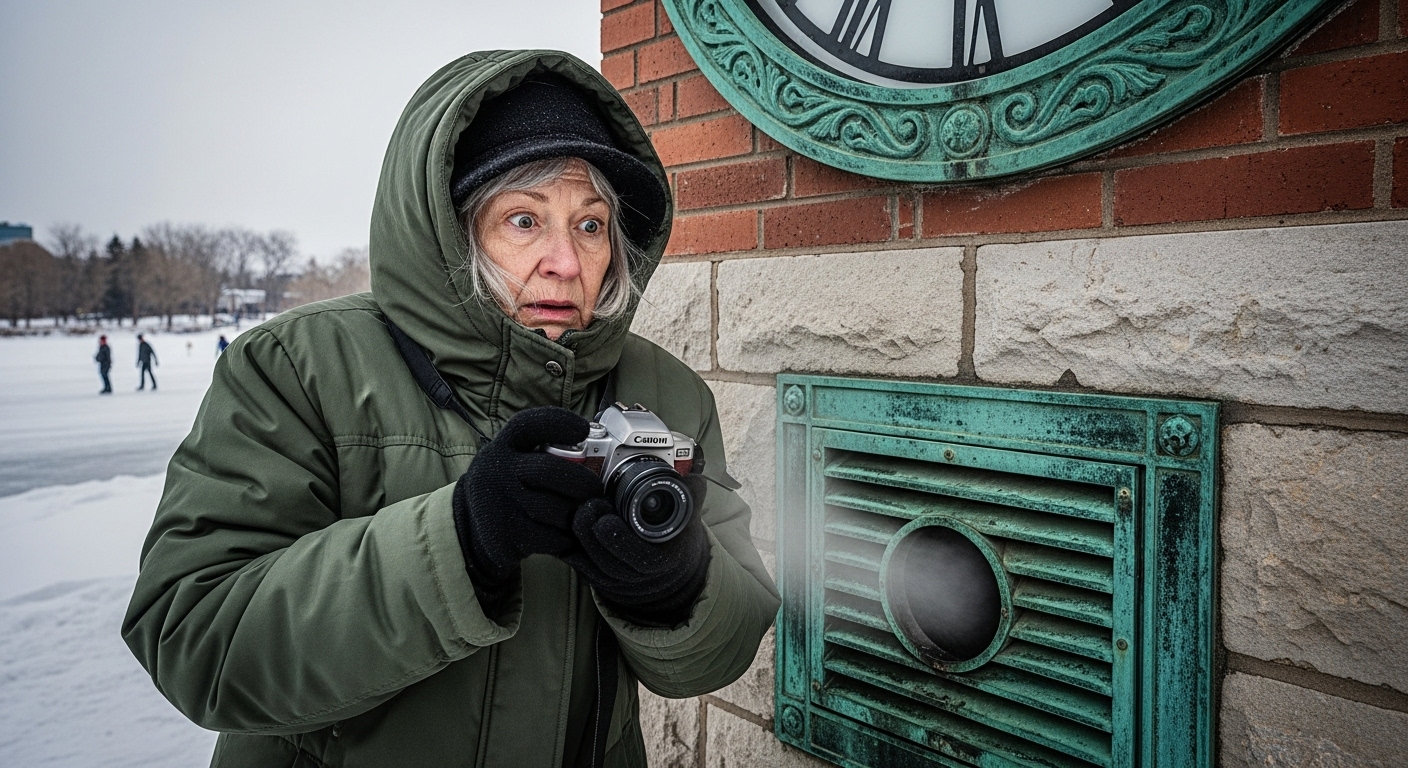
Bev knew her world had irrevocably, chillingly, changed. The question was, what was Art truly building, and what part, unknowingly, had she played in its construction? The thrum from the pumping station pulsed like an ominous heartbeat, demanding an answer.
Share This Story


