An Ache in the Pharmacy Aisles
The fluorescent lights hummed a low, unsettling drone over the sterile white aisles of the pharmacy. Maria clutched her worn fabric purse, the synthetic smell of sanitiser and stale paper clinging to the air, making her stomach clench. A dull ache throbbed in her right knee, a constant companion these days, mirroring the mounting tension in her chest.
The pharmacist, a young man with a neatly trimmed beard and a nametag that read 'Daniel', looked up from his screen with a weary sigh. 'I'm sorry, Ms. Rodriguez,' he said, his voice flat, 'but the system shows no active profile for you. We can’t dispense without a verified ID.'
Maria felt her grip tighten on the worn strap of her purse. 'But I've been coming here for thirty years. My prescription for the arthritis medication – Dr. Alcott sent it last week. It’s the blue pill, you know, for the swelling.' She gestured vaguely towards the shelves of brightly packaged boxes.
Daniel gave a polite, almost practised, shrug. His eyes flickered to the queue forming behind Maria. 'Paper prescriptions aren’t linked to the current health registry, not anymore. Not without a digital identity account. It’s been… mandatory for a while now.' He tapped a finger against the glowing screen, as if appealing to a higher, unseen authority.
A flush crept up Maria’s neck. 'Mandatory? I live in my own home, Daniel. I pay my taxes. I just… I don’t use those things. The cards. The apps.' Her voice, despite her best efforts, wavered. She hadn't wanted the digital card, the 'ConnectID' as they called it, a sleek strip of plastic and code that promised to simplify everything. It had felt like an invasion, a tiny wire snaking into the quiet corners of her life. She'd managed for years, relying on old habits, on the faded memory of a world that once was. Now, that world was actively forgetting her.
Daniel looked at her, his expression a mixture of pity and exasperation. 'Without it, you’re… well, you’re not in the system, Ms. Rodriguez. We can’t process transactions. Can’t even confirm your existence, officially.' He winced, as if the words themselves tasted bad. 'Perhaps if you spoke to your next of kin? Someone who could vouch for you, maybe help you activate an account?'
Vouch for her existence. The phrase hung in the air, heavy and absurd. She existed. She was right here, her knees aching, her breath short. 'My niece, Jennie,' Maria said, the name a lifeline. 'She has the card. She can… what do I do?'
---
Outside, the autumn wind whipped past, carrying the damp scent of fallen leaves and the distant, metallic tang of exhaust fumes. Maria pulled her cardigan tighter, the wool scratchy against her skin. Her phone, an ancient model with a cracked screen, felt cold in her hand. Jennie usually answered on the first ring. Not today.
She tried again, the automated voice on the other end chirping, 'Insufficient account balance. Please top up your ConnectID wallet to proceed.' Maria squeezed her eyes shut. She'd always used cash for small things, for the bus, for the market. Her pension, paid directly to her bank, was still there, untouched, but how to access it without the digital gateway?
A young woman brushed past her, tapping a holographic display on her wrist, seamlessly ordering a ride-share. Maria felt a pang, not of envy, but of profound disconnect. She was a ghost in the machine, and the machine was everyone else’s reality.
She thought about walking to Jennie’s flat. It wasn't far, maybe three kilometres, but her arthritis… and carrying the shopping she hadn’t managed to buy. It felt like scaling a mountain. Still, what choice did she have? The bus stop was just around the corner, a beacon of a simpler time.
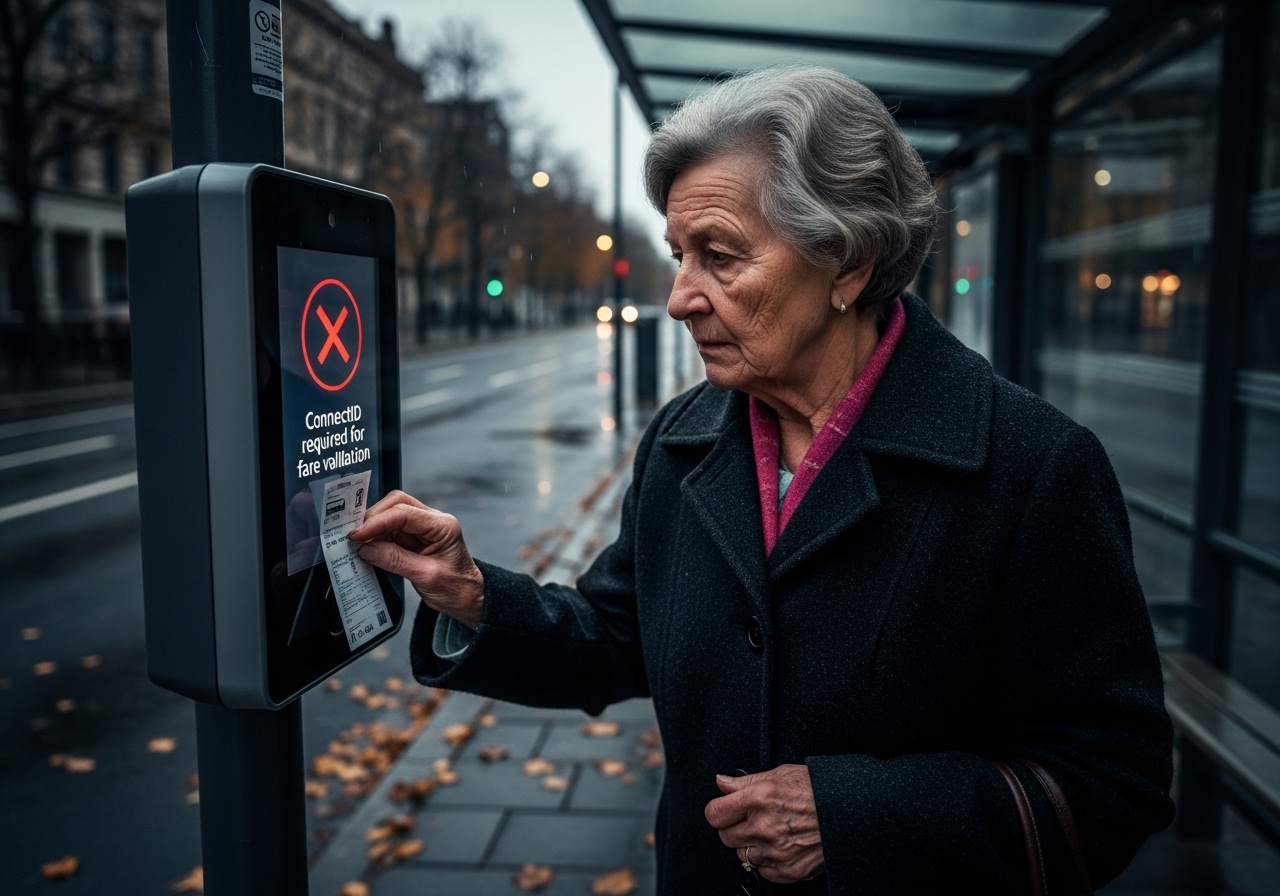
At the stop, the digital display glowed, showing arrival times for three routes. Maria stepped forward, reaching into her purse for the crumpled bus pass she'd used for years. She held it out to the scanner on the post. Nothing. A red ‘X’ appeared on the small screen above the sensor. 'ConnectID required for fare validation,' a synthesised voice announced, flat and unyielding.
A tremor ran through her. 'No, this is my pass,' she murmured, tapping it against the unresponsive pad again. The red 'X' remained, mocking. People walking by glanced, then quickly looked away, their faces impassive, absorbed in their own screens and seamless transactions. It was the same look Daniel had given her, a polite dismissal of an inconvenient anomaly.
She tried a third time, a desperate, childish gesture. The voice repeated, 'ConnectID required for fare validation.' Her hands started to shake. The wind picked up, swirling a handful of grimy leaves around her ankles. The bus arrived then, a sleek, electric vehicle gliding silently to a halt. The doors hissed open. A woman with a pram scanned her wrist and walked straight on. Maria hesitated, her eyes meeting the driver's in the rearview mirror. The driver, a woman with tired eyes, merely shook her head, a silent apology or perhaps just a weary acknowledgement of the rules.
The doors began to close, a slow, deliberate movement. Maria didn't move. She couldn’t. The bus pulled away, a blur of clean lines disappearing down the street, taking with it her last, best hope of reaching Jennie. The street felt colder, suddenly, emptier.
Her phone vibrated in her hand. Jennie. Finally. Maria fumbled, almost dropping it. 'Jennie? Oh, thank goodness. I… I can’t get my medication. And the bus…' Her voice cracked, the words tumbling out in a rush.
'Maria? What’s going on? I’ve been trying to call you,' Jennie’s voice was tinny, strained. 'They deactivated your Community Access Account. Not just the health registry. Everything. They say you haven't logged in, haven't verified your biometric data in… years. Maria, they’ve flagged you as 'dormant' in the system. I’m trying to access your bank, but it’s all locked down. I can’t even see your pension deposits.'
The words hit Maria like a physical blow. Dormant. Like an old appliance, powered down, forgotten. The street lights flickered on, casting long, distorted shadows. A drop of rain, cold and sharp, landed on her cheek. It wasn't just the medication, or the bus. It was everything. She was dissolving, piece by painful piece.
The Fading Imprint
She leaned against the cold metal of the bus shelter, the ache in her knee radiating up her thigh. The conversation with Jennie had been a blur of increasingly panicked questions and increasingly grim answers. It wasn’t just access; it was recognition itself. Her address, her utilities, even her old library card – all linked, all now severed. Jennie, bless her, was doing her best, but even her digital fluency was proving useless against a system designed to simply excise the non-compliant. 'I’ll come to you,' Jennie had said, her voice tight with frustration. 'I just need to finish this work thing, then I’ll head over.'
But Maria had the distinct, chilling feeling that ‘over’ was getting further and further away. She looked at her phone again, the battery icon showing a single, precarious bar. How long until it, too, became a useless brick? How long until the very air she breathed felt like it required a validated account?
She imagined walking into her small terraced house, turning on the lights, expecting the familiar hum of the refrigerator. Would the power grid, too, demand a digital handshake she couldn't provide? The thought sent a fresh wave of nausea through her. She felt like a character in a bad dream, trying to explain her existence to a wall.
A small, worn advertisement for 'ConnectID: Your Life, Simplified' glowed from a nearby pillar. A smiling family, all perfectly coiffed, their faces radiating effortless ease. Maria scoffed. Simplified. It had simplified her right out of the picture.
She started walking, slowly, towards home. Each step was a small victory against a world determined to erase her. The thought of her few remaining paper banknotes, secreted away in a tin box under her bed, offered a sliver of comfort. But comfort for what? A meal? A bus ticket she couldn't use? The irony tasted bitter. She was a ghost, walking among the living, her very shadow fading with each digitised transaction she couldn't complete.
The wind picked up again, rustling the skeletal branches of the maples lining the street. Leaves skittered across the pavement like lost souls. Maria shivered, pulling her cardigan even tighter. Her breath plumed in the cold air, a tangible sign of her presence, even if the digital world refused to acknowledge it.
What would happen when her pension stopped coming? What about food? What about the simple act of existing without an approved serial number? The questions buzzed around her head like angry wasps, each sting a fresh dose of panic. She was Maria Rodriguez, a retired nurse, a woman who had delivered countless babies, soothed countless fears, held countless hands. And now she was nobody. Less than nobody. An error message.
She felt a sudden, inexplicable urge to shout, to scream her name into the darkening street, just to prove to herself that she still had a voice, that she wasn't just a flicker on a forgotten screen. But the sound caught in her throat, a dry, dusty whisper. She was alone, utterly and terrifyingly alone, and the chill of the autumn evening was nothing compared to the cold dread settling deep in her bones.
The faint glow of her phone screen died completely, leaving Maria in utter darkness as she realised, with a sickening lurch, that if Jennie couldn't find her, no one would. The night, and the system, had truly swallowed her whole.
Share This Story


