Route 17 North
The interior of a cramped team van smelling of damp gear and stale snacks, moving through a rainy landscape.
“Pass the chips?”
“They’re stale.”
“I don’t care. Pass ‘em.”
“Seriously, Jonas. They taste like cardboard that sat in a sauna. Just wait until we stop.”
Jonas didn’t wait. He reached over the seat back, his fingers grazing the rough fabric of Miko’s hoodie, and blindly snatched the crinkling silver bag. Miko didn’t fight him. He just sighed, a long exhale that seemed to merge with the constant, droning hum of the van’s heater. The air in the vehicle was thick, a humid soup of wet wool, drying spandex, and the sharp, metallic tang of energy drinks. It was the smell of a season ending. Or maybe just the smell of twelve guys crammed into a Ford Transit for six hours.
Outside, the world was a blur of grey and green. The spring rain had been relentless since they left the boathouse in St. Catharines, turning the highway into a slick, black ribbon that reflected the headlights of oncoming trucks. Every time a semi roared past, the whole van shuddered, a gust of wind buffering the side panels like a phantom wave hitting the hull.
Jonas crunched a chip. Miko was right. Stale. He chewed it anyway, staring out at the passing treeline. The branches were bare, mostly, but there was that fuzz of green at the tips, that suggestion of waking up. April in Ontario was always an argument between winter and summer, and today, winter was losing, but it was going down fighting with this cold, miserable rain.
“You think Andrews’s gonna make us unload the trailer tonight?” vaguely came a voice from the back—maybe Sam.
“Andrews’s asleep,” Miko said, keeping his voice low. He nodded toward the front passenger seat where Coach Andrews’s head was lolling against the window, mouth slightly open, vibrating with the suspension.
“Ben’s driving, though. Ben’s a hardass.”
“Ben just wants to go home and sleep. We’ll dump the boats in the yard and rig them tomorrow.”
Jonas stopped listening. The conversation drifted over him, overlapping fragments of complaints and laughter that didn’t quite land. He felt… hollow. It wasn’t the race. They’d done okay. Silver in the heavyweight four. Not gold, not the banner they wanted, but respectably fast. They had moved the boat well. That feeling of the hull lifting out of the water, the run, the synchronicity of four spines compressing and extending at the exact same millisecond—it had been there.
But now it was gone. The medals were stuffed in duffel bags, probably scratching against water bottles and keys. The uni-suits were peeling off skin in damp rolls. And Miko… Miko was looking at his phone, scrolling through something, the blue light illuminating the sharp angle of his jaw and the dark circles under his eyes.
This was it. The last bus ride. Senior year. Miko was going to McGill for engineering. Jonas was staying local, taking a gap year to work construction with his uncle, maybe train for the provincial team if his back held up. The boat was breaking up.
Jonas shifted, his knees knocking against the seat in front. His quads still burned, a dull, throbbing reminder of the final 500 metres. He pressed his forehead against the cold glass. Condensation bloomed around his skin, a halo of fog obscuring the dreary landscape.
“Hey,” Miko said, nudging Jonas’s shoulder with his elbow. “Stop brooding. You look like a tragic poet.”
“I’m not brooding. I’m cramping.”
“Eat a banana. Potassium.”
“I ate the banana. Hours ago. It’s gone.”
“Then suffer in silence, bow-boy.”
Jonas smiled, but it felt tight. “You’re gonna miss this.”
“The cramping? The smell of Sam’s feet? No. No, I will not.”
“The rhythm,” Jonas said. He hadn’t meant to say it. It sounded pretentious, the kind of thing you write in a journal, not say out loud to a guy who just called you a tragic poet. “You know. The swing.”
Miko paused. He stopped scrolling. He looked at the screen for a second longer, then clicked it off, plunging his face into shadow. He turned to look at Jonas. The sarcasm was gone, replaced by something tired and genuine.
“Yeah,” Miko said softly. “Yeah, I’ll miss the swing.”
Wet Tarmac
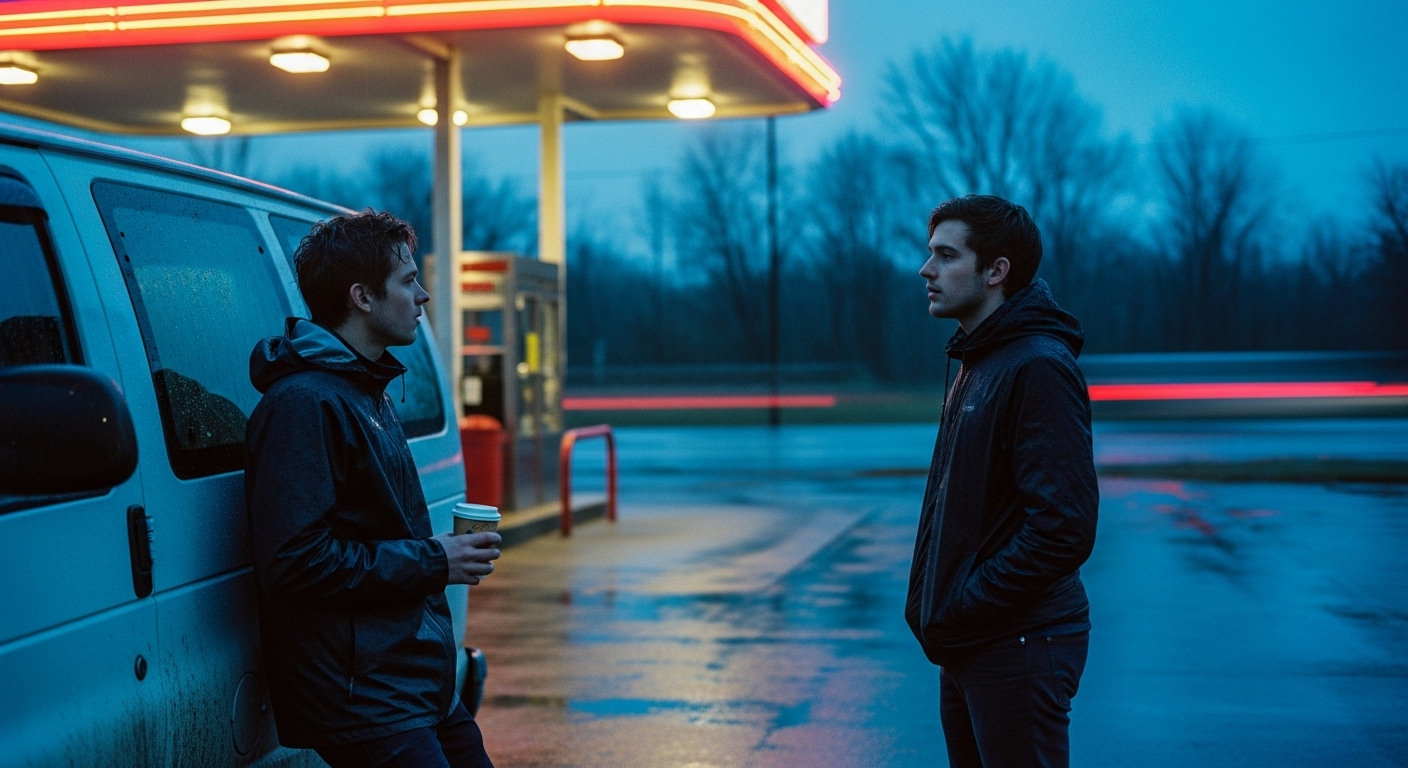
The van lurched, slowing down. The indicator clicked—tick-tock, tick-tock—a metronome that felt too slow compared to the race pace beating in Jonas’s head. They pulled off the highway into one of those generic service stations that punctuate the 401 like rest notes in a long, boring score.
“Pit stop!” Ben yelled from the driver’s seat. “Fifteen minutes. If you’re not back, you’re walking.”
The sliding door groaned open, and the sound of rain became immediate and loud, a hiss of water on pavement. Cold air rushed in, smelling of wet asphalt, petrol, and damp earth. It was shocking after the incubator warmth of the van.
Jonas stumbled out, his legs stiff. He landed on the wet pavement, his sneakers soaking through almost instantly. He stretched, hearing his spine crack. Around him, the other guys were groaning, stretching, zipping up windbreakers. They looked like a motley crew of giants, all tall and broad-shouldered, looking out of place among the regular sedans and tired families shuffling toward the Tim Hortons.
He didn’t want coffee. He just wanted… space. He walked away from the building, toward the edge of the parking lot where the light from the tall arc-sodium lamps faded into the darkness of the woods.
The rain was lighter now, more of a mist. It clung to his eyelashes. He zipped his team jacket up to his chin. The nylon swished—a familiar sound.
Footsteps crunched on the gravel behind him. He didn’t turn. He knew the cadence.
“You’re gonna get soaked,” Miko said, stepping up beside him.
“I’m already wet. Boat spray. Sweat. Rain. What’s the difference?”
Miko huffed, a cloud of white vapour escaping his lips. He shoved his hands deep into the pockets of his track pants. “We did good today, J. That second 500? Where we walked through Western? That was… that was solid.”
“We lost the sprint,” Jonas said. He looked at the wire fence separating the lot from a dark, muddy field. A plastic bag was caught in the chain-link, flapping frantically in the wind.
“We ran out of water. Another ten strokes, we would have had them.”
“But we didn’t.”
“Doesn’t matter.” Miko kicked a loose stone. It skittered across the wet blacktop and vanished into a puddle with a plip sound. “It’s done. Stats are in the book.”
Jonas looked at him. Miko was shivering slightly. He wasn’t wearing a jacket, just his hoodie. He looked younger like this, away from the boat, away from the aggression of the race. Just a kid shivering in a parking lot.
“I don’t know what I’m gonna do,” Jonas admitted. The words fell out like stones, heavy and unpolished. “Without the training schedule. Without… you know, the guys. You.”
There. He said it.
Miko didn’t look away. He didn’t make a joke. He watched a transport truck rumble past on the highway, its trailer lights a long streak of red. “You’ll work. You’ll train. You’ll find a single scull and you’ll get fast. Scary fast. You always row better when you don’t have to worry about matching someone else’s rhythm.”
“That’s not true.”
“It is. You’re a control freak, Jonas. In a single, you’re the master and commander. You’ll love it.”
“I hate sculling. It’s lonely.”
“It’s peaceful,” Miko corrected. He turned, his shoulder brushing Jonas’s arm. “And hey. Montreal isn’t the moon. There’s trains. There’s… phones.”
“You’re terrible at texting.”
“I’m excellent at texting. I just choose to be mysterious.”
Jonas laughed. It was a short, sharp sound, but it broke the tension in his chest. “Mysterious. Right. Like when you didn’t tell us you lost your skeg until we were at the start line?”
“That was a tactical omission! Panic is bad for performance.”
They stood there for a moment longer, the rain misting over them. The orange light from the parking lot reflected in the puddles, making the oil slicks look like rainbows. It wasn’t a beautiful place—it was gritty, industrial, smelling of exhaust and frying grease—but it felt real. Grounded.
Jonas looked at the field beyond the fence. The darkness wasn’t empty. He could hear peepers—those tiny frogs—singing in the ditch. Thousands of them. A wall of sound rising up from the mud. Life, waking up.
“Spring,” Jonas muttered.
“What?”
“ The frogs. Listen.”
Miko tilted his head. “Loud little buggers.”
“Yeah.” Jonas took a breath. The air was cold, sharp, and clean behind the diesel fumes. It tasted like thaw. Like mud turning into soil. “I guess it’s starting.”
“What is?”
“Everything else.”
---
“Let’s go! Move it, ladies!” Ben’s voice cracked across the parking lot.
Miko slapped Jonas on the back. “Time to go. I’m buying you a donut. A stale one, to match the chips.”
“I hate you,” Jonas said, pushing off the fence.
“Liar.”
They walked back toward the van. The white Ford sat there, mud-spattered, idling, a beast of burden waiting to carry them the last hundred kilometres. The windows were steamed up again. Inside, the guys were probably arguing about music or asleep.
Jonas climbed in. The warmth hit him instantly, oppressive and comforting at the same time. He slid into his seat. The damp spot on the upholstery was still there. He buckled his belt. The click was final.
Miko dropped into the seat next to him and tossed a wax paper bag into his lap. “Honey cruller. Don’t say I never did nothing for you.”
“Anything. You never did anything for me. Grammar, engineer.”
“Eat your donut.”
The van groaned into gear. They rolled out of the lot, merging back onto the highway. The wiper blades slapped back and forth, thwack-hiss, thwack-hiss. Jonas took a bite of the donut. It was sweet, sugary, and soft. He watched the lights of the service station fade behind them, swallowed by the rain and the night.
He looked at his hands. Calloused, blistered, shaking slightly from the caffeine or the fatigue. They were strong hands. They had pulled thousands of strokes. They would pull thousands more.
The sadness was still there, a low ache in his chest like a bruised rib, but it felt different now. Less like a wall, and more like… ballast. Something to keep him steady in whatever chop came next.
He leaned his head back and closed his eyes, listening to the rhythm of the road.
He didn't know if they would ever row in the same boat again, but as the engine turned over, the road ahead looked less like an ending and more like open water.
Share This Story


