The Weight of Controlled Harmony
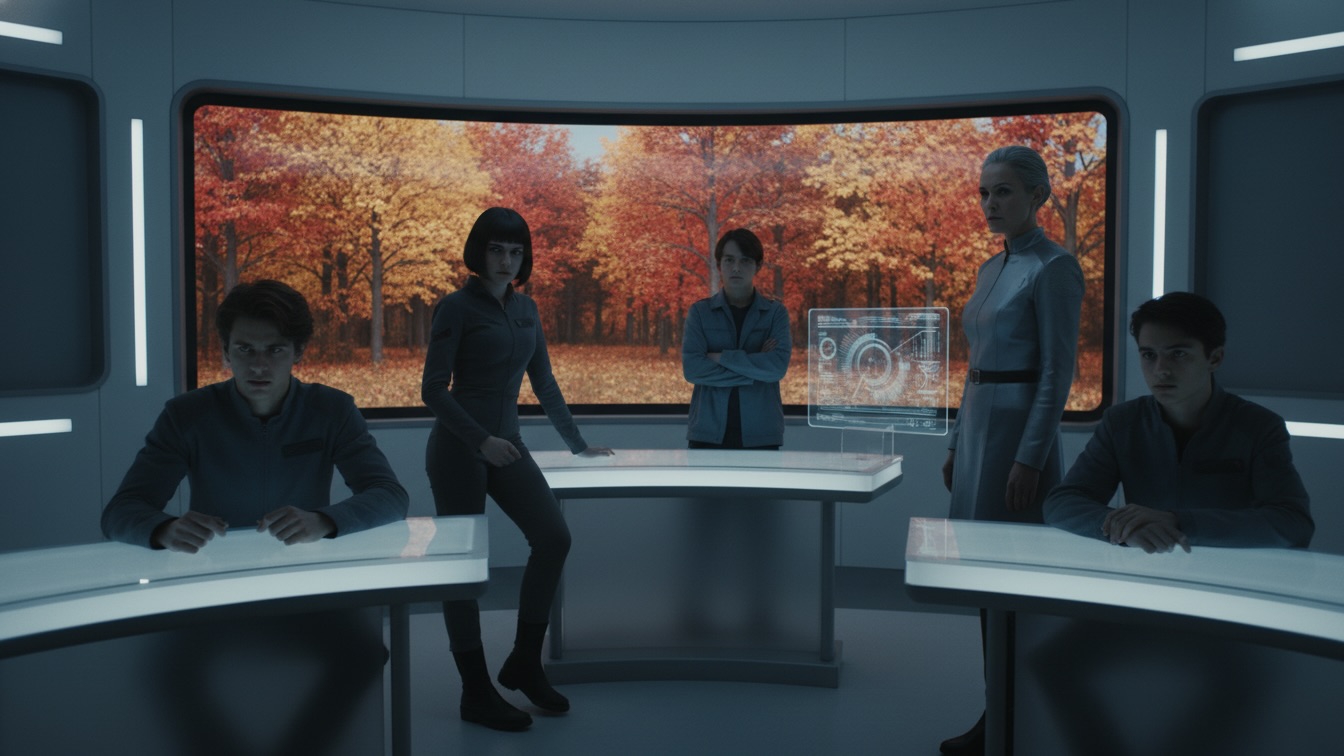
A sterile, futuristic classroom within a space station, where the outside world is an artificial autumn landscape. Teenagers are seated in a semicircle, facing a strict professor. The atmosphere is tense, as a discussion about 'the arts' becomes a veiled interrogation of individual thought and loyalty to the Authority.
The hum, a low, persistent thrum beneath the recycled plas-decking, always started in his molars, then vibrated through the bones of his skull. It was the ship’s song, the constant reminder of the void pressing in, of the thin shell between breath and vacuum. Across the classroom’s filtered viewport, the synthetic autumn glow bled through the polarized glass, a simulation of ochre and rust-red leaves clinging to impossible branches. They swayed in an artificial breeze that never quite felt cold enough, never carried the scent of wet earth or decay. Just a sterile, recycled breath. He hated the autumn simulation, the way it tried to trick the eyes into believing in something natural, something wild, when everything was so meticulously controlled.
Jett’s knuckles, white where they gripped the edge of his data-slate, were a mirror of the tension knotting his gut. Professor Ansten was at the front, silhouetted against the ersatz arboretum, her posture as unyielding as the alloy walls. Her voice, usually a calm, resonant frequency that could cut through the hum, was currently muted, a distant drone as she scrolled through the day’s 'engagement parameters.' Engagement parameters. That’s what they called discussions now. Not conversations. Not debates. Engagements. As if every word had to be a strategic maneuver, every thought a calculated deployment. And today’s engagement? The 'Societal Merits of Approved Creative Expression.' Jett felt a familiar tremor. This was always a trap. Always.
He glanced around the semicircular arrangement of desks. Other faces, most of them familiar, a few new ones from Sector Gamma. Linda, with her hair braided tightly, lips pressed into a thin line, tracing patterns on her own slate. Kaito, leaning back, feigning disinterest, but his eyes darted from the professor to the viewport, searching for something, anything, beyond the programmed horizon. They were all teenagers, caught in the same slow-motion fall, trying to appear normal, compliant, while their minds chafed against the invisible collars. The recycled air tasted faintly metallic, the way it always did just before a major review, like a charged atmosphere, waiting for a spark.
Professor Ansten finally turned, her gaze sweeping over them, lingering just a fraction too long on Kaito’s feigned indifference, then on Jett’s tightly wound stillness. “As you know,” she began, her voice gaining its usual clarity, a careful cadence, “the Authority places a high value on… collective emotional regulation. It is paramount for systemic stability. Today, we delve into how designated artistic practices contribute to this equilibrium. Jett, perhaps you could begin. Your recent submission, 'Synapse Echoes,' demonstrated an… interesting perspective.”
Jett’s breath hitched. Synapse Echoes. He’d poured every fragment of his frustration, every flicker of hope, into that piece. A digital soundscape, raw and discordant, layered with the faintest, almost subliminal, human cries, then resolving into a jarring, clinical harmony. He’d thought it was clever, subversive enough to pass for 'experimental,' but too ambiguous to be flagged. Now, her mentioning it… it felt like a spotlight, not a compliment. His throat felt dry, a patch of sandpaper. He wished for the real autumn rain, a chill that would force him to shiver, to feel something uncomplicated.
“Professor,” Jett managed, his voice cracking slightly, “I… I believe art, even… approved art, provides an outlet. For… for the individual. It allows us to process… stimuli, without disrupting… collective function.” He chose his words carefully, like stepping stones across a river, each one measured, safe. It was the official line, polished and sterile, but he tried to infuse it with just enough genuine conviction to sound plausible. The truth was, his piece was about the suffocation, the way individual thought was crushed under the weight of 'collective function.'
Ansten gave a slow, deliberate nod, her gaze unreadable. “An outlet. Yes. The Authority recognizes the necessity of channeled expression. Kaito? What is your assessment of Jett’s contribution to this discussion?”
Kaito sat up, a subtle shift, like a predator suddenly alerted. He ran a hand through his perpetually messy dark hair. “Synapse Echoes… it was efficient. The way the… initial dissonance… it resolved. Quickly. It showed… the importance of resolution. Of finding… balance. Even in… difficult data.” He stumbled over the words, his usual quick wit replaced by a carefully constructed façade of academic jargon. Jett knew Kaito got it, truly. They’d spent hours in the hidden comms channels, dissecting the true meaning of 'resolution' in their world. But here, Kaito was playing the game, bending the meaning to fit the Authority’s narrative.
Linda, usually quiet, suddenly spoke up, her voice a little too sharp, a little too loud in the measured quiet of the room. “But… what about empathy, Professor? Doesn’t art, real art, help us understand each other? Feel… what others feel?” Her eyes, wide and earnest, swept across the room, challenging. She wore a worn, faded sweater, a rare touch of personal choice in a world of uniforms, its threads unraveling slightly at the cuff. Jett admired her, but a cold dread snaked through him. Empathy was a dangerous word. Feelings, especially unquantified ones, were a liability.
A ripple of unease passed through the classroom. A few students shifted, uncomfortable. Ansten’s gaze, which had softened almost imperceptibly at Linda’s words, hardened, just a fraction. “Empathy, Linda,” she said, her voice dropping a notch, “is a complex construct. In excess, it can lead to… factionalism. To unproductive deviation. The Authority promotes understanding based on shared directives, not on… individual emotional resonance. Art, in our society, guides emotion towards collective purpose. It is a tool for cohesion, for reinforcing the common good.”
She paused, letting the weight of her words settle. Jett felt the hum in his molars intensify. This was it. The subtle realignment. The re-education. It always felt like this, the slow, grinding away of individual thought, replaced by the smooth, polished surface of what was acceptable. He looked at Linda, saw the quick flicker of disappointment in her eyes, the way her shoulders slumped. He wanted to say something, anything, to challenge Ansten, to affirm Linda’s yearning for genuine connection, but the words felt trapped behind a wall of caution and fear. The air suddenly felt heavier, thick with unspoken truths.
“Consider,” Ansten continued, her tone regaining its academic neutrality, “the monumental holographs displayed across Sector Prime’s public plazas. The 'Ascension of the Collective.' The 'Architects of Unity.' These are works of immense scale and technical artistry. Do they not inspire awe? A shared sense of purpose? Linda, do you not feel a surge of pride when witnessing the seamless integration of our multi-system efforts, depicted in such vivid detail?”
Linda hesitated, her gaze dropping to her slate. “I… I understand their purpose, Professor. They are… impressive. But they don’t make me… feel like the old Earth music, you know? The stuff from the archives, before the Great Burn. When people sang about… losing things. Or about wanting things. That felt… different.” Her voice trailed off, barely a whisper.
“Archival media is precisely that, Linda,” Ansten countered, her voice firm, “historical data. Untethered emotional expression often leads to instability. We have learned from history. The purpose of art, now, is to fortify, not to question. To harmonize, not to disrupt. Our current creative directives are designed to channel these powerful human impulses into productive, stabilizing pathways.” She looked at Jett again, a silent invitation, or perhaps a challenge, for him to elaborate on his 'outlet' theory.
Jett cleared his throat, pushing down the rebellious thought that 'harmonize' often meant 'silence.' “The… the visual arts, too,” he offered, pulling himself back into the acceptable narrative. “The symmetry of the city-spires, the perfectly synchronized light displays in the residential blocks. They bring a sense of order. Of… predictability. In a complex existence. Like a visual anchor.” He knew he was parroting the official line, but what else could he do? His own 'Synapse Echoes' was currently twisting in his mind, its dissonance louder than its forced resolution.
“Precisely, Jett,” Ansten affirmed, a faint smile playing on her lips, a disconcerting thing, like light on polished chrome. “Order. Predictability. These are the cornerstones of societal well-being. Art, in its highest form, becomes an architectural element of peace. It guides the eye, the ear, the mind, towards the ideal. It is the invisible scaffolding of our harmonious existence. And it is crucial that young minds, such as yours, comprehend its true utility.”
Kaito shifted again, a restless energy about him. “But if it’s all… guided, Professor. If it’s all for… utility. Does it still count as… art? Or is it just… propaganda? An algorithm designed to keep everyone… quiet?” The words tumbled out, faster than he intended, raw and edged with something close to defiance. Jett felt a jolt of alarm. Kaito had gone too far, strayed too close to the forbidden zone.
A heavy silence descended, broken only by the ship’s ubiquitous hum. Ansten’s faint smile vanished, replaced by an expression of cold, measured assessment. She took a slow step from behind her console, moving towards Kaito, her presence filling the already confined space. The air thickened, charged with a subtle, electric tension. Jett’s gaze flickered to the viewport, where the artificial autumn leaves seemed to shimmer with an unnatural intensity, almost mocking their precarious discussion.
“Kaito,” Ansten said, her voice dangerously soft, each syllable a precise strike. “That is an… unapproved interpretation. The Authority provides opportunity for self-expression within parameters designed for optimal collective benefit. To suggest otherwise is to imply a malicious intent where only beneficent guidance exists. Do you understand the implication of your statement?”
Kaito visibly recoiled, the color draining from his face. “No, Professor! I… I just meant… if it’s not from the… inside, you know? The real inside. Does it… resonate the same way?” He fumbled, trying to backtrack, to soften the blow. His hands twitched at his sides, as if fighting an invisible restraint.
“The 'real inside,' Kaito, is precisely what the Authority cultivates,” Ansten stated, her voice hardening further. “A healthy, balanced internal landscape, free from the chaotic impulses of an unregulated past. Your 'Synapse Echoes,' Jett, demonstrated a commendable understanding of how to take… disparate impulses, and bring them into a desirable, functional whole. It mirrored the very process of our society’s evolution.”
Jett swallowed hard. Her words were a chilling reinterpretation of his work, turning his quiet rebellion into an endorsement of the very system he resented. His soundscape, meant to express the struggle against enforced harmony, was now being held up as an example of successful indoctrination. It felt like a violation, a surgical procedure on his own creative output, stripping it of its true meaning and repurposing it for the Authority’s agenda. The hum vibrated louder, a dull ache behind his eyes.
“Perhaps, Kaito,” Ansten continued, her focus still on the now pale and silent student, “you would benefit from reviewing some of the older, unapproved art forms. A deeper understanding of their destructive potential might clarify the wisdom of our current methodologies. I can assign you some supplementary materials. And Linda, your interest in 'empathy' is noted. Perhaps a study of the neuro-chemical basis of collective emotional response would prove illuminating.”
Linda nodded, her gaze fixed on the desktop, her previous fire extinguished. The implications were clear. Extra 're-education,' targeted for their particular 'deviations.' Jett felt a cold anger coalesce in his chest. They weren’t allowed to feel empathy, only to study its neuro-chemical basis. They weren't allowed to create from a raw, unfiltered 'inside,' only to produce 'functional wholes.' The 'positive impacts of art,' in this chilling interpretation, were merely the positive impacts for the system, for the Authority, not for the messy, vibrant, contradictory human soul.
The artificial autumn outside seemed to darken slightly, the simulated shadows lengthening, as if even the light was under the Authority’s thumb. Jett wondered what true autumn light looked like, unfiltered, unprogrammed. He’d only ever seen it through these polarized windows, or in archived data that quickly became pixelated and unstable. He imagined a real wind, carrying the scent of something real, something dying, but not dead, not yet. The thought was a dangerous one, a seed of dissent planted deep within his mind.
Ansten finally returned to her console, her face placid once more. “Excellent engagement today, class. Remember, understanding the function of art within our societal structure is not merely an academic exercise. It is a fundamental component of your civic duty. Your contributions to cultural stability are anticipated and appreciated.” Her voice, once again, took on its calm, resonant quality, but to Jett, it now sounded like a siren’s song, lulling them into a false sense of security before the final, unavoidable embrace of the crushing deep.
He watched the other students gather their slates, their movements subdued, avoiding eye contact. Linda brushed past him, her hand briefly, almost imperceptibly, touching his arm, a silent plea, a shared understanding of the invisible shackles. Kaito, still pale, avoided everyone’s gaze, already lost in the prospect of his 'supplementary materials.' The hum in Jett’s molars was no longer just the ship’s thrum; it was a deeper resonance, a drumbeat of approaching revelation. He knew, with a certainty that chilled him to the core, that his 'Synapse Echoes' was far from resolved. In fact, it had just begun to truly echo.
He knew, with a certainty that chilled him to the core, that his 'Synapse Echoes' was far from resolved. In fact, it had just begun to truly echo.
Share This Story


