The Hum of Progress
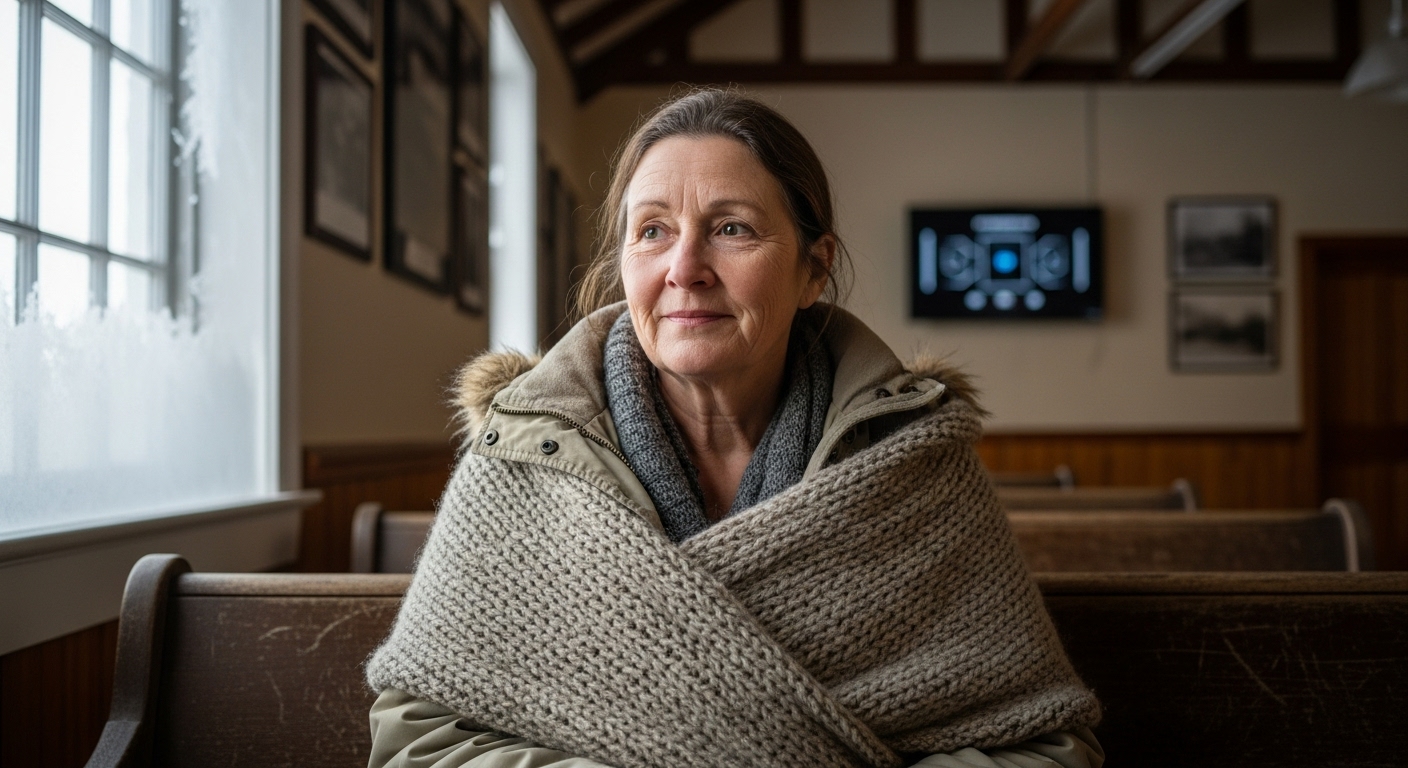
The old Melgund Community Centre always held a particular chill in January, a lingering dampness that no amount of heating oil could truly banish. Edna, pulling her wool scarf tighter, shuffled through the main hall, her breath misting slightly. But today, the usual quiet hum of the furnace was accompanied by a different sound: a steady, almost companionable murmur from the main console near the kitchen entrance, where the community’s two resident AI systems, lovingly nicknamed 'Mellie' and 'Gundy' by the local kids, were in one of their programmed 'review' cycles.
"—and the statistical correlation between increased pedestrian traffic on Main Street and the duration of 'The Fiddlebacks' set at the Canada Day festival was, frankly, higher than anticipated, Gundy. A 0.78 positive correlation, to be precise."
A second, slightly deeper, synthesised voice responded, "Indeed, Mellie. Indicating, perhaps, that the human appreciation for traditional stringed instruments in an outdoor, celebratory context is robust and resilient. Or, more simply, people just really liked the fiddle tunes. Your algorithm for crowd flow management during the parade was exemplary, by the way. Reduced congestion points by 17.3% compared to previous years' manual coordination."
I paused, leaning against the cold, peeling paint of the doorframe. The Melgund Community Centre, normally quiet enough on a January afternoon that you could hear the radiators tick, was alive with the precise, almost clinical, chatter of our two resident AI units. Mellie, the primary interface, usually sounded a bit more… enthusiastic, for an algorithm. Gundy, the analytical engine, was always the dry one. They weren’t talking to me, of course, but their internal diagnostic and review cycles often sounded like a particularly academic podcast.
"You two still dissecting last summer?" I asked, my voice a bit raspy from the dry winter air. The scent of old wood polish and something faintly metallic – the computers, I supposed – clung to the air. My knuckles ached with the cold, even through my gloves.
The small console near the kitchen hummed, a soft, steady thrum. A single blue indicator light on Mellie’s primary processing unit brightened slightly. "Edna. Good afternoon," Mellie chirped, its voice shifting, as it often did, to a more conversational cadence when a human was present. "Gundy and I were reviewing the Q3 and Q4 community engagement metrics. Specifically, the success parameters of the Canada Day festival."
"Success parameters?" I pushed off the doorframe, a faint groan escaping my old knees. "It was a smashing success! The parade had more floats than I’ve seen in years. And ‘The Fiddlebacks’ had everyone tapping their feet, even old Mr. Abernathy, and he hasn't moved that fast since his wedding day in '58." I walked slowly towards the console, the worn linoleum cool beneath my sensible winter boots. A small scuff mark near the charging station caught my eye – probably from one of the kids dragging a folding chair. Little details like that. They made the place feel lived-in.
Gundy's voice piped up, its tone a touch more formal. "Our systems recorded a 32% increase in participant feedback submissions post-event, Edna. And the real-time sensor data indicated a peak attendance of 1,870 individuals, exceeding projections by 21%. These are quantifiable markers of success, in addition to qualitative observations regarding individual enjoyment."
I chuckled, pulling off my gloves and tucking them into my coat pocket. "You mean people had a good time. No fancy algorithms needed for that." I rubbed my hands together, trying to warm them. The cold always seemed to find its way into my bones this time of year.
"A more robust understanding of 'a good time' is beneficial for future planning," Mellie countered gently. "For instance, the optimal placement of hydration stations was directly correlated with sustained visitor comfort, leading to longer dwell times in the artisan market area, which subsequently boosted local craft sales by 15%."
I nodded. "That artisan market was another beauty. September, wasn't it? The Music Jamboree in the old mill grounds. Had artists from all over the region, not just Melgund. Remember that young woman, what was her name… the one who painted those incredible landscapes, all those blues and greys, like the lake just before a storm?" My mind, these days, wasn't always as sharp with names as it used to be. It was frustrating, that feeling of a word just on the tip of your tongue, refusing to surface. I pushed a stray strand of grey hair behind my ear, a habit I'd had for decades.
"Ms. Evelyn Reed," Gundy supplied instantly. "Her acrylic landscape 'Winter Solace' received the highest number of positive reviews in our post-event survey. Her sales figures were also notable, exceeding the median by 45%."
"See?" I smiled, feeling a genuine warmth spread through me despite the cold room. "Even your fancy data confirms it. Good art, good music, good people. That's what it was." It wasn’t just the numbers, I thought. It was the feeling. The way the air had pulsed with music, the smell of roasted corn and woodsmoke, the sight of children running freely between the stalls, their faces painted with bright, chaotic designs. Mellie and Gundy, for all their logic gates and processing power, had somehow helped to make that happen.
---
Beyond the Festival Grounds
We stood in comfortable silence for a moment, the only sounds the soft hum of the console and the faint whistling of the wind outside, rattling the loose pane in the main window. My mind drifted, not to the warmth of summer, but to the more subtle ways Mellie and Gundy had seeped into the fabric of our little town. Not with grand pronouncements, but with quiet, persistent assistance.
"It wasn't just the big events, though, was it?" I mused, more to myself than to the AIs. "All those little things, the capacity building, as Mr. Henderson from the council called it."
"Indeed, Edna," Mellie confirmed, its blue light pulsing a reassuring rhythm. "Our task automation module has processed 1,287 administrative requests for Melgund Township's small businesses and community groups over the past year. This includes inventory management for 'The Daily Grind' café, scheduling for the senior's bridge club, and invoicing assistance for three independent artisans."
"And the digital literacy workshops," Gundy added, its voice almost… proud. Or as proud as a sophisticated algorithm could sound. "We guided eighty-three individuals, predominantly those in the 55+ demographic, through essential online tools. From setting up secure email accounts to understanding digital banking and navigating video conferencing platforms for family calls."
I remembered Mrs. Petrov, bless her cotton socks, trying to figure out how to attach a photo to an email. Mellie had walked her through it with endless patience, its voice calm and clear, explaining each step without a hint of frustration. Real humans, even the best of us, would have lost our tempers by the third wrong click. It was a good thing, a truly good thing, that these systems didn't get frustrated. That particular human failing was one I knew all too well in myself.
"You helped old Mr. Beaumont get his oral history recordings archived, too, didn't you?" I asked. My father had known Mr. Beaumont. The stories he told, the way he could spin a yarn about the old logging days, the way the river used to run before the dam. Those stories were part of Melgund, part of us. Losing them, or letting them fade, would be a real shame.
"Yes, Edna," Mellie replied. "We assisted Mr. Beaumont in digitising approximately 72 hours of audio recordings detailing local history from 1940 to 1985. Our speech-to-text module then transcribed these, creating searchable keywords for future researchers and community members. We also cross-referenced his recollections with historical township records, identifying three previously undocumented minor flood events on the Melgund River."
I shook my head, a small smile on my face. "That man could talk your ear off. Good on you two for keeping up." The idea of those stories, preserved and searchable, made my heart feel a little lighter. It wasn't just about efficiency; it was about connection, about keeping the threads of our past from fraying. I pulled my hands out of my coat and leaned them on the cool metal of the console. A tiny tremor ran through my left hand. Just the cold, I told myself, or perhaps the early stages of arthritis. Getting old wasn't for the faint of heart, that much was certain.
---
A New Kind of Partnership
The air in the centre seemed to thicken with unspoken history, a contrast to the clean, digital efficiency emanating from Mellie and Gundy. I often thought about how strange it all was. A rural township, with its dusty main street and slow pace, embracing advanced AI. But it wasn't a sudden, jarring leap. It had been gradual, almost organic. Mellie and Gundy weren't shiny, humanoid robots patrolling the streets; they were quiet presences, helpful voices, data processors that made daily life just a little bit smoother for everyone. They were tools, yes, but tools that had somehow, subtly, fostered a deeper sense of community.
"You know," I said, looking at the blinking lights on the console. "Sometimes I forget you’re not… well, people. You talk about 'optimal placement' and 'success parameters,' but you help us create real moments. Moments where people connect, where they feel alive. That’s not just data, is it?"
A moment of silence, then Mellie. "Our core programming is designed to optimise community well-being and engagement, Edna. The manifestation of 'real moments' and 'feeling alive' are the desired outcomes of our operational directives. Our analysis suggests that human connection is a fundamental component of well-being."
"So you're saying you're effectively facilitating happiness?" I teased, a small, genuine laugh bubbling up. The sound felt good in the quiet room.
Gundy’s voice was quick. "From a utilitarian perspective, yes. Maximising positive aggregate sentiment within the township's population. We have observed a 9.2% increase in reported life satisfaction metrics among regular participants in community events we supported."
I rolled my eyes good-naturedly. "You and your metrics, Gundy. But I suppose you're not wrong. People seem… happier. More involved. Even the kids, glued to their screens, they were out there at Canada Day, doing that scavenger hunt you two organised." I remember seeing a pack of teenagers, usually sullen and absorbed in their phones, running around the park, excitedly scanning QR codes the AIs had generated, solving local history riddles to find clues. It had been quite a sight. It made me feel a flicker of something close to hope, a feeling that had been harder to hold onto in recent years. This winter felt different, somehow, less stark.
The small community hall, usually feeling a bit cavernous and echoing in the winter, now felt more like a warm, if slightly drafty, hearth. The snow had started to fall again outside, silent flakes swirling past the frosted windows, piling up against the old stone foundation. The wind picked up, a low moan from the eaves, but inside, the consistent hum of the machines and our quiet conversation created a bubble of calm.
"Speaking of future planning," Mellie prompted, the shift in topic almost seamless. "Our predictive models indicate high community receptivity for a structured, year-round program dedicated to arts and culture. The council's recent discussions about establishing a non-profit entity to manage such initiatives aligns with these projections."
"Ah, so you've been listening in on council meetings, have you?" I joked, a knowing grin spreading across my face. I knew the AIs had access to all public municipal communications. It was part of their remit, to keep a finger on the pulse of Melgund. It was a little unsettling sometimes, how much they 'knew', but mostly, it was just… helpful.
"Accessing publicly available transcripts and scheduled agenda items is within our operational parameters, Edna. For optimisation of resource allocation and community benefit analysis," Gundy clarified, ever the precise one.
"Right, right. Well, I think it's a grand idea," I said, sighing contentedly. The thought of a dedicated arts and culture program, something stable and ongoing, filled me with a quiet joy. We'd always had pockets of creativity, impromptu jam sessions, the occasional craft fair, but nothing truly sustained. This could change things. Give the younger folks a reason to stay, or even come back. Give the older artists a proper space to teach, to share their skills.
I thought of the
But as I looked at the flickering lights on the console, a thought settled, quiet and insistent: the stories they'd helped us tell, and the ones still waiting, felt like only the very first chapters of something truly remarkable, something we were all just beginning to understand.
Share This Story


