The Hum of Progress
The server room, usually a sterile, hushed space, vibrated with a low, rhythmic hum that was almost a comfort in the deep winter cold. Outside, the world was a dull expanse of grey snow and bare branches, but inside, against the pale green glow of status lights, Unit 734 and Unit 902 were meticulously weaving the data threads of Melgund Township’s past year into a comprehensive tapestry. Kyle, the community coordinator, leaned against a rack, the warmth of his chipped ceramic mug a small comfort against the chill that seemed to seep through the building's old foundations. He watched the bots' projected interfaces dance across the wall, a silent ballet of statistics and summaries.
A faint tremor ran through the floorboards, a sympathetic vibration from the old heating system kicking in. Kyle shifted his weight, his fingers tracing the rim of his mug. "Anything surprising in the Q4 data, 734?" His voice was low, almost lost in the steady whir and click from the racks.
The central interface, a holographic projection shimmering with a thousand moving data points, highlighted a section. Unit 734's synthesized voice, devoid of inflection, offered, "Anomalies detected in 'Community Engagement: Passive Observation' for October. Slight decrease in park usage correlated with early frost advisories. Expected." A small, almost imperceptible flicker in the blue light on its core unit suggested a data confidence level. Expected, then.
"And the Canada Day metrics? Still holding strong?" Kyle watched 902, the slightly more verbose of the two, pull up an overlay. Red, gold, and white confetti streamed across the projection, interspersed with smiling faces. A distant mental echo of the smell of grilled sausages and cheap fireworks. It had been a good one, last July. The best in years.
"Engagement scores for the Canada Day festival remained at 0.92 on a 1.0 scale, consistent with preliminary projections," Unit 902 reported. "Volunteer satisfaction, 0.88. Participant feedback, 0.91. Economic impact, local vendor revenue increased by 17.3% year-over-year. All favourable metrics, Kyle." The numbers didn't lie. They never did. But they also didn't capture the small details: the way the light had caught the faces of the children during the parade, the surprisingly good jam session that broke out near the old bandstand, the collective sigh of relief as the sun finally broke through the clouds late in the afternoon.
Kyle nodded, taking a slow sip of his coffee. Black, strong, bitter, just the way he liked it. He remembered the planning for that day. The endless spreadsheets, the permits, the weather contingency plans. The human element, the stress, the triumphs that were impossible to quantify in a 0.91 score. He'd lost three pounds that week. But the community had felt it. You couldn't digitise that collective feeling of pride and belonging, not truly. The bots captured the data around it, the evidence of it, but not the thing itself.
"The live music component at the main stage saw a 23% increase in sustained audience presence compared to the prior year," 734 added, its interface showing a heat map of the crowd. "This suggests a successful alignment of musical genres with demographic preferences identified through social media trend analysis."
"Right," Kyle murmured, his gaze drifting to the frost-etched windowpane. The winter outside was a stark contrast to the vibrancy the bots were recalling. The community centre had been packed then, bustling with families. Now, it was just the hum, the soft glow, and the distant, muffled sound of the snowplough working its way down Main Street. "We ran out of hot dogs by three. No algorithm could have predicted that one."
902’s core unit blinked. "Data indicated a sufficient supply based on historical consumption patterns. Human variables such as 'unexpected surge in appetite post-parade' remain challenging to model with absolute accuracy." The lack of apology was almost comical. Kyle let a small smile play on his lips. You had to appreciate their candour, their pure, unadulterated data-driven honesty.
---
"The September Artists' Market and Music Jamboree yielded equally robust results," 902 continued, the Canada Day display dissolving into a vibrant array of artisan crafts and local musicians. "Vendor applications increased by 31%, with average artist sales up 12% over 2023. Foot traffic through the market area peaked between 14:00 and 16:30. The outdoor stage, despite cooler temperatures, maintained consistent engagement levels, demonstrating event resilience against environmental factors."
Kyle remembered the crisp air that day, the smell of woodsmoke from a nearby chimney mixing with the faint scent of charcoal from the food trucks. He could almost hear the strum of an acoustic guitar, the slightly off-key harmony of a local choir. "The collaboration with the regional arts council, that really helped," he said, thinking of how many small-town artists had finally found a platform, their work displayed not just for neighbours but for visitors from farther afield. "And the live-streaming of the main performances? That pushed the reach out another hundred kilometres, didn't it?"
"Correct," 734 interjected, a new graph appearing. "Live-stream unique viewers: 4,378. Peak concurrent viewership: 893. Geolocation data indicates engagement across four neighbouring townships. This significantly exceeded the outreach target by 287%."
"287%," Kyle repeated, a soft whistle escaping his lips. It was almost absurd. A few years ago, that kind of reach would have required a dedicated marketing team and a budget Melgund simply didn't have. Now, it was just a few lines of code, some automated social media scheduling, and the bots managing the backend of the streaming platform. It meant that a pottery maker in Melgund could sell a bowl to someone in, say, Millbrook, without ever leaving their stall. It flattened distances, which was vital for a rural community.
Capacity Building in Action
"Beyond event support, Unit 734, Unit 902, your work in automating administrative tasks has been transformative," Kyle said, pushing off the server rack and moving towards the larger wall display. He gestured to a series of flowcharts that simplified complex bureaucratic processes. "Grant applications, event registrations, volunteer scheduling… it's all so much smoother now."
"Our algorithms optimized the grant application interface, reducing average completion time by 48%," 734 stated. "Error rate decreased by 62%. This allowed community organisations to allocate more human resources to program delivery rather than administrative overhead."
"And the oral history project?" Kyle asked, his voice softer now. This was a sensitive area, the collection of local stories, family histories, the small, specific narratives that defined Melgund. It wasn't about big data or revenue. It was about memory, identity.
"The 'Melgund Voices' digital archive currently holds 137 transcribed interviews," 902 reported, pulling up a visual of a meticulously organised digital library. "Our natural language processing models accurately transcribed 98.7% of audio, with human verification required for remaining 1.3%. Metadata tagging and cross-referencing capabilities are fully operational, making historical accounts easily searchable and accessible to the public. The system has also identified thematic commonalities within the narratives, allowing for new avenues of historical study."
Kyle felt a distinct warmth spread through him, something deeper than the coffee. He'd been skeptical, initially. Afraid that the bots would somehow sterilise the raw, messy beauty of human stories. But they hadn't. They'd provided the framework, the scaffolding, allowing the stories to be preserved, to be heard by future generations without the decay of old tapes or the loss of fragile paper. It had freed up local historians, who had previously spent countless hours on transcription, to focus on analysis, on contextualisation, on meaning.
He remembered old Mrs. Peterson, her voice frail but steady, recounting her family’s arrival in Melgund a century ago. 902 had processed every word, every stutter, every pregnant pause. Kyle had listened to the raw audio, then read the transcription. The bot hadn't missed a beat. He’d helped Mrs. Peterson navigate the simple interface to add her own photographs, scanning them at high resolution, making sure they were digitally restored to be as vibrant as her memories.
"It means we can get more stories," Kyle said, almost to himself. "More voices heard. We're not just archiving, we're building a foundation for understanding where we came from, where we are."
He ran a hand over his slightly bristly jaw, the faint stubble a testament to the long hours he'd been putting in. The automation of the more mundane tasks had undeniably freed him up, and other key volunteers, to focus on bigger picture items. Instead of chasing down overdue forms, they were now brainstorming. Instead of reconciling budgets, they were connecting artists.
The initial fears, those quiet whispers in the community about AI taking over, about losing the 'human touch,' had slowly faded. Seeing the tangible benefits – the crowded festivals, the thriving artists, the accessible histories – had changed minds. The bots weren't replacing people; they were amplifying them. They were the silent, tireless partners who handled the minutiae, allowing the humans to shine. He glanced at the screens again. Data, in their world, was a language of progress, a dialect of potential. And it sang a hopeful tune for Melgund.
---
"Which brings us to the present," Kyle said, turning back to the glowing interfaces. He tapped his mug against the metal rack, a sharp, resonant sound in the quiet room. "All this success, all this capacity we've built. The council's seeing it. The community's feeling it. We need to formalise it. Give it its own legs."
The bots were already listening, their internal processors whirring, anticipating. 734 projected a blank document template. "Proposal: New Initiatives."
"Exactly," Kyle confirmed, his voice gaining a new energy. He walked towards the main display, his movements suddenly more purposeful. "We're talking about a dedicated non-profit. Something specifically for recreation, arts, and culture. A standalone entity. It would ensure stability, allow for targeted fundraising, and create a permanent framework for everything we’ve done and everything we want to do."
902 immediately began populating the template with fields: 'Organizational Structure,' 'Funding Model,' 'Program Pillars.' "Initial data modelling indicates a high probability of success for a dedicated non-profit entity, given current community engagement metrics and projected resource availability," 902 reported. "Key challenges identified: initial capital acquisition, board recruitment, and developing a sustainable operational framework."
"I know the challenges," Kyle acknowledged, a familiar weight settling on his shoulders, but this time, it felt lighter, manageable. He knew the data was right. He knew the work ahead would be immense. But unlike before, he wasn't alone. He had the town, the volunteers, and these two diligent, tireless machines. "But the interest is there. The need is there. Pottery classes, a community theatre group, maybe a permanent gallery space for local artists, an annual winter festival that really draws people in... this could be huge for Melgund. A real focal point."
He imagined the future. The community centre, always lively, but now with a dedicated engine to drive its cultural heart. Children laughing in a drawing class, elders sharing stories in a comfortable nook, artists collaborating, musicians playing. A tangible legacy, built on the often-invisible work of data, automation, and human connection.
He took a slow breath, the cold from the window a sharp contrast to the warmth brewing inside him. "Okay," Kyle said, looking at the two glowing screens. "Show me what we need for the next phase. Let's make this new program truly happen."
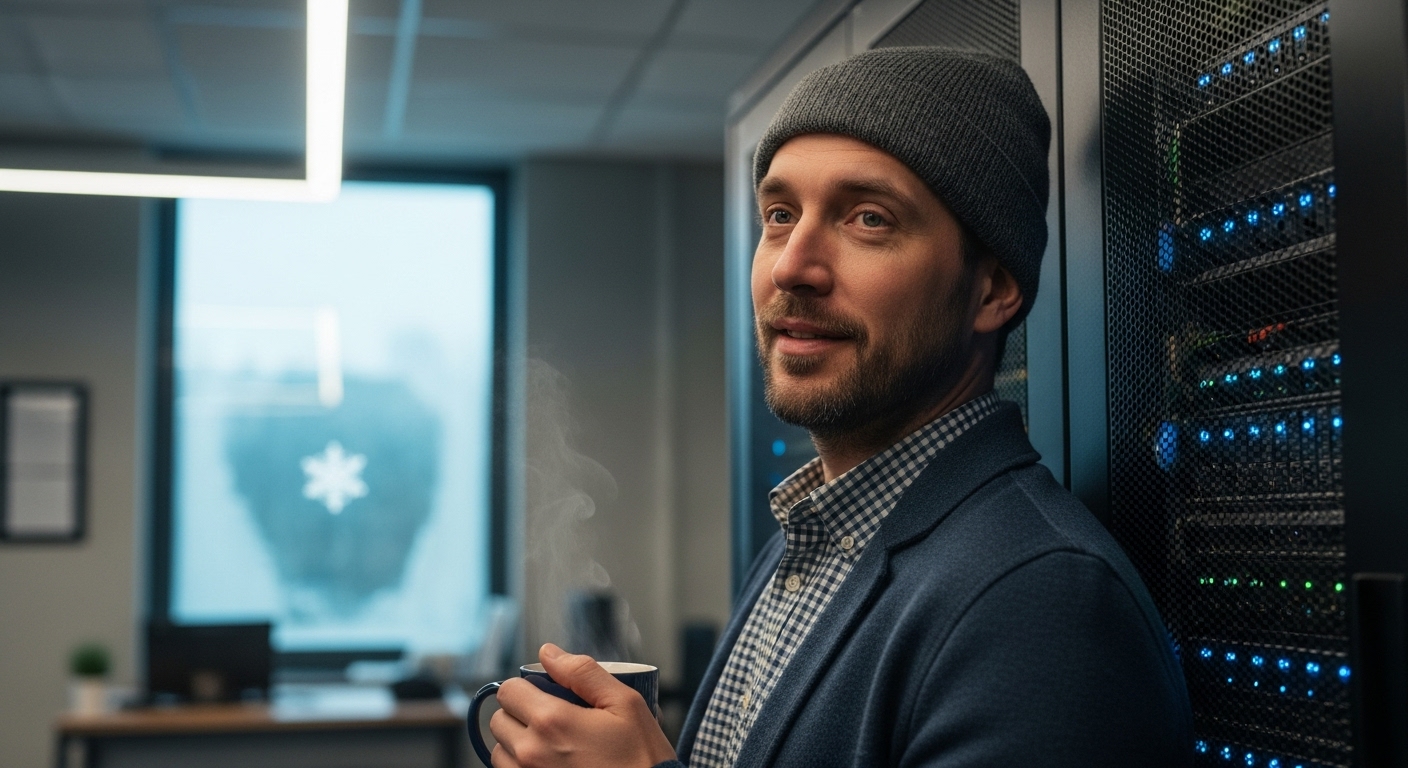
He took a slow breath, the cold from the window a sharp contrast to the warmth brewing inside him. "Okay," Kyle said, looking at the two glowing screens. "Show me what we need for the next phase. Let's make this new program truly happen."
Share This Story


