The Hum Beneath the Linoleum
The cafeteria was, as always, a symphony of adolescent chaos: the clatter of trays, the shrill laughter of newly-formed cliques, the low thrum of a thousand whispered secrets. Sunlight, thick and golden from the late autumn afternoon, spilled across the linoleum floor, catching dust motes in its wide, indifferent gaze. A familiar smell of burnt cheese and industrial cleaner hung heavy, a comforting, if unappetising, blanket. Yet, for Frank, the ordinary theatre of lunchtime felt strangely… perforated, as if the reality around them was a film projector skipping frames.
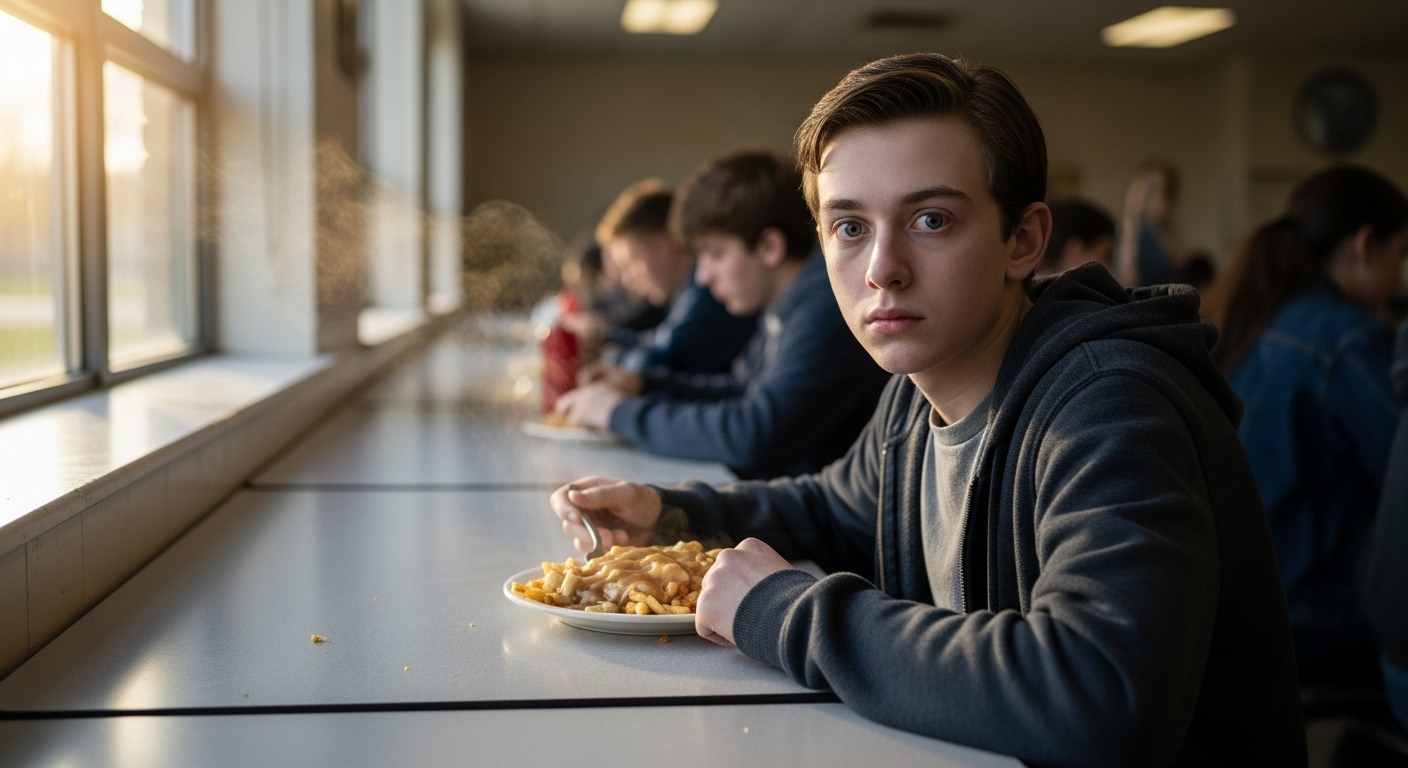
The gravy, Frank decided, was the worst culprit. Not because of its consistency, which was typically Canadian school-cafeteria-issue — thick, gluey, with an unnatural sheen — but because of its sheer, unwavering perfection. It clung to every fry, every cheese curd, on every single plate of poutine across the entire cavernous room, with an unsettling, almost deliberate uniformity. It seemed to defy the very laws of entropy, a perfectly even, caramel-brown shroud.
“You’re doing it again,” Casey stated, her voice a low, theatrical murmur across the table, pulling Frank from his profound contemplation of the gravy’s gravitational pull. She tapped a fingernail, painted a defiant cobalt blue, against the Formica. “The intense scrutiny. You’ll bore a hole through that poor, innocent poutine.”
Frank blinked, his gaze finally detaching from his meal to meet her. “Innocent? This poutine harbours secrets, Casey. Deep, unsettling secrets. Look at it. Really look.” He gestured with his fork, a fry impaled, dripping with the suspect liquid. “Does it not strike you as… unnaturally consistent? The way the light just… absorbs into it, rather than reflecting?”
Casey sighed, a performance of long-suffering adolescence. She picked up her own fork, gave her poutine a cursory poke. “It strikes me as institutional. And, frankly, rather tempting. I mean, it’s poutine, Frank. It’s supposed to be a comfort, not a cosmic enigma.” She took a bite, chewed thoughtfully. “Cheesy. Salty. Delightfully unhealthy. What more could one ask for from a mid-afternoon arterial obstruction?”
He watched her, a knot tightening in his chest. How could she not perceive it? It was like trying to explain the colour purple to someone who only saw in shades of grey. The entire cafeteria, a familiar autumn hum of bodies and voices, felt off. The bright, almost aggressive fluorescent lights above flickered, not with a mechanical stutter, but with a barely perceptible pulse, like an immense, silent heart beating just out of rhythm with the world.
“The lights,” Frank persisted, lowering his voice conspiratorially, as if the surrounding chatter might somehow listen. “Do you not feel it? That… almost imperceptible thrum? It’s not the old ballast failing, Casey. It’s… something else. It feels as if the air itself is vibrating, a high, thin note just beyond the reach of human hearing, yet it chafes at my molars.” He rubbed his jaw, a small, involuntary gesture.
Casey, however, merely raised a perfectly sculpted eyebrow. “Frank, my dear, you have always possessed a peculiar sensitivity to the mundane. Perhaps you’re just experiencing the joys of a sub-par electrical grid. Or, dare I suggest, an impending headache?” She offered a placid, sympathetic smile that did nothing to quell his unease. Her dismissal, though gentle, was absolute, and it only served to isolate him further in his unsettling observations.
He looked around, feeling suddenly vulnerable. The other students were absorbed in their own small dramas: a clandestine hand-holding under the table, a furious whisper about a pop quiz, the boisterous laughter of the hockey team. All so normal, so perfectly oblivious. Yet, to Frank, their movements seemed a fraction too smooth, their smiles a fraction too wide, their very existence a touch too… rehearsed. The thought, cold and unwelcome, skittered across his mind: were they even real, or merely highly convincing automatons in this surreal, gravy-soaked tableau?
A shiver traced a cold path down his spine, despite the warmth of the crowded room. He gripped his fork tighter, the cheap plastic bending slightly under the pressure. It wasn't merely the gravy, or the pulsing lights. It was the staff. Mrs. Hawkins, the perpetually stern cafeteria supervisor, usually barked orders with a kind of weary, militant efficiency. Today, she moved with an eerie grace, her steps silent on the linoleum, her stern gaze sweeping the room with an unnatural regularity, like a lighthouse beam programmed to a perfect, unwavering cycle. And the cook, the new fellow who had started just a week ago – a man whose name Frank couldn’t recall, nor could anyone else, it seemed – he was the most disturbing element.
The cook, a portly man with impossibly white chef whites and an equally impossibly clean, neatly trimmed beard, was at the serving line, ladling out more of the infamous poutine. His movements were fluid, almost liquid, his arm extending and retracting with the same mechanical precision, each scoop identical to the last. He hummed a tuneless, repetitive melody under his breath, a low drone that seemed to vibrate in Frank’s very bones. Frank watched as the cook, without glancing up, reached for a dropped ladle, his hand moving with an unnatural speed, retracting it before it even seemed to hit the floor. It was too fast. Too seamless.
“The cook,” Frank murmured, nudging Casey with his elbow. “He moves like… a machine that’s pretending to be human. Look at the way he refills the gravy vat. It’s like a pre-programmed sequence. No hesitation. No wasted motion. Not even a flick of the wrist. Just… perfect efficiency.”
Casey followed his gaze, chewing slowly. “He seems perfectly adequate at his job, Frank. Perhaps a little… earnest. Unlike some people, he appreciates the sanctity of a well-poured gravy. There’s a dramatic gravitas to it, don’t you think? Like a culinary ballet, if you will.” She smirked, clearly enjoying her own theatrical turn of phrase. “Perhaps he simply enjoys his work. A rare and beautiful thing.”
Frank shook his head, a faint, metallic tang on his tongue that wasn’t from the salt of the poutine. “No, it’s beyond mere enthusiasm. It's… unnatural. His eyes, Casey. Have you truly observed his eyes? They’re… too still. Like polished stones. And that hum. It’s from him, I think. That low, insistent thrumming.”
Casey’s expression softened slightly, her theatricality dimming into something genuinely concerned. “Frank, you have been rather… preoccupied lately. Are you sleeping properly? You seem rather… unstrung. Perhaps a visit to the school counsellor’s office would be in order, just to discuss these peculiar observations of yours.” She reached across the table, her hand resting briefly, warmly, on his forearm. Her touch felt real, solid, a comforting anchor in the increasingly fluid reality he was perceiving. For a moment, he almost believed her, almost dismissed it all as the product of an overactive imagination, fuelled by too many late-night documentaries on conspiracy theories.
But then, he saw it. Reflected in the stainless steel surface of the sugar dispenser, an impossible shimmer. Not his own reflection, but a fleeting, distorted image of the cook behind him, his impossibly white uniform rippling, as if made of water, and just beneath the surface, a hint of something dark and undulating. A brief, almost imperceptible warp in the fabric of the room, like heat rising off asphalt, but cold. His breath hitched, a small, involuntary sound. He squeezed his eyes shut, then opened them again. The reflection was normal. Just the cook, dutifully ladling.
“I… I need to use the washroom,” Frank mumbled, pushing his half-eaten poutine away, the thought of the gravy now utterly nauseating. He needed to get away, just for a moment, to clear his head, to reassure himself that the world was still sane. He felt a sudden, inexplicable urge to be alone, away from Casey’s well-meaning but ultimately unhelpful rationality, away from the disconcerting hum and the unnervingly perfect gravy.
---
He navigated the crowded tables, the sounds of laughter and chatter washing over him, a disorienting tide. Each step felt heavy, as if the floor itself was resisting his passage. The metallic tang in his mouth grew stronger, accompanied by a faint scent of… copper, almost like freshly minted coins, or a wire overheating. He tried to tell himself it was just the school’s plumbing, or perhaps a leaky battery somewhere, but the smell seemed to cling to him, growing more intense as he neared the far wall, where the kitchen’s swinging doors separated the chaos of the dining hall from the supposed order of food preparation.
The washrooms were beyond the kitchen entrance, down a short, dimly lit corridor. As he approached the kitchen doors, a low, rhythmic thump-thump sound, like something heavy being dropped and retracted, pulsed from within. It was subtle, almost lost beneath the general cafeteria din, but it resonated with that same unnerving frequency as the lights, as the cook’s hum. It was the source of the vibration, he realised, the vibration he’d felt in his molars.
He paused, his hand hovering over the push-bar of the washroom door, his heart thudding a frantic rhythm against his ribs. Curiosity, or perhaps a morbid fascination, pulled him towards the kitchen. He glanced back at Casey, who was now engaged in an animated discussion with a girl from their history class, completely oblivious. Good. He didn’t want her to see him do this. He had to know. He had to prove he wasn't imagining it.
Pushing one of the heavy kitchen doors open just a crack, he peered into the brightly lit, steamy expanse. The thump-thump was clearer here, originating from the far corner, obscured by a towering stack of metal trays. The cook was nowhere in sight, but Mrs. Hawkins was there, her back to him, meticulously scrubbing a stainless steel counter, her movements similarly fluid, unnervingly precise. She paused, then resumed, her reflection in the polished steel a perfect, unblemished mimicry of her actions. There was no flicker, no distortion, no hint of anything amiss.
Frank felt a wave of self-doubt. Perhaps Casey was right. Perhaps he was simply overtired, his imagination conjuring phantoms from the mundane. The silence of the kitchen, save for the rhythmic scrubbing and that distant thump-thump, was almost oppressive. He was about to retreat, to dismiss his anxieties as adolescent melodrama, when he caught sight of something else. On a wheeled trolley, laden with stacks of clean, gleaming plates, a single ladle lay, forgotten. It was the same ladle the cook had dropped and retrieved with impossible speed earlier, the one that had glinted ominously in Frank’s peripheral vision.
He stepped fully into the kitchen, the door swinging silently shut behind him. The air was thick with the scent of hot grease and chlorine cleaner, a harsh, almost sterile smell that felt wrong, somehow, in a place meant to prepare food. Mrs. Hawkins continued her scrubbing, her back still turned. The thump-thump grew louder as Frank crept towards the trolley, drawn by an irresistible urge to examine the ladle. He picked it up. It was cold to the touch, almost unnaturally so, despite the heat of the kitchen. And then he saw it.
Reflected in the ladle’s perfectly polished bowl, a convex, fish-eye distortion of the kitchen behind him. Not Mrs. Hawkins, not the stacks of trays. But something else. A vast, dark form, filling the entire kitchen, writhing with an impossible, silent motion, like a thousand tangled limbs. It was indistinct, terrifyingly so, a churning void of impossible angles and textures that made his stomach clench. And within that form, just for a millisecond, he saw what looked like… countless, unblinking eyes, reflecting the fluorescent lights in a horrifying, mirrored mosaic. A silent, internal scream tore through him.
He spun around, the ladle clattering to the floor, his heart a frantic drum solo against his ribs. The kitchen was empty. Just Mrs. Hawkins, still scrubbing the counter, her back still to him. But now, the rhythmic thump-thump had stopped. The silence was absolute, save for the faint, distant hum of the cafeteria beyond the doors. He tried to breathe, but his lungs refused to obey, as if the air had suddenly become too heavy, too thick to draw in. He felt a profound, primal terror blossom in his chest, a cold, blossoming flower of dread. He had seen it. He hadn’t imagined it.
And then, from behind the stack of metal trays, the cook emerged. Slowly. Deliberately. His movements no longer fluid or precise, but something entirely different. Each footfall was heavy, dragging, as if his shoes were weighted with lead. His head, which had been perfectly still before, now tilted at an unnatural angle, like a broken doll’s. His eyes, the polished stones Frank had observed, were now fixed directly upon him, but they seemed… deeper, somehow. Infinitely old. And as he began to walk towards Frank, a slow, predatory amble, the unnerving hum, that low, unsettling drone, began again, originating from the cook’s throat, a guttural vibration that filled the now-silent kitchen, drowning out everything else.
The cook’s smile, then, widened, impossibly, splitting the skin at the corners of his mouth, and the hand he raised, not to wave, but to beckon, seemed to stretch, fingers elongating, before Frank, paralysed and certain of a profound, horrifying miscalculation, felt an insistent, cold pressure on his shoulder, a presence he knew could not possibly be Casey.
The cook’s smile, then, widened, impossibly, splitting the skin at the corners of his mouth, and the hand he raised, not to wave, but to beckon, seemed to stretch, fingers elongating, before Frank, paralysed and certain of a profound, horrifying miscalculation, felt an insistent, cold pressure on his shoulder, a presence he knew could not possibly be Casey.
Share This Story


