Dust and Dreams
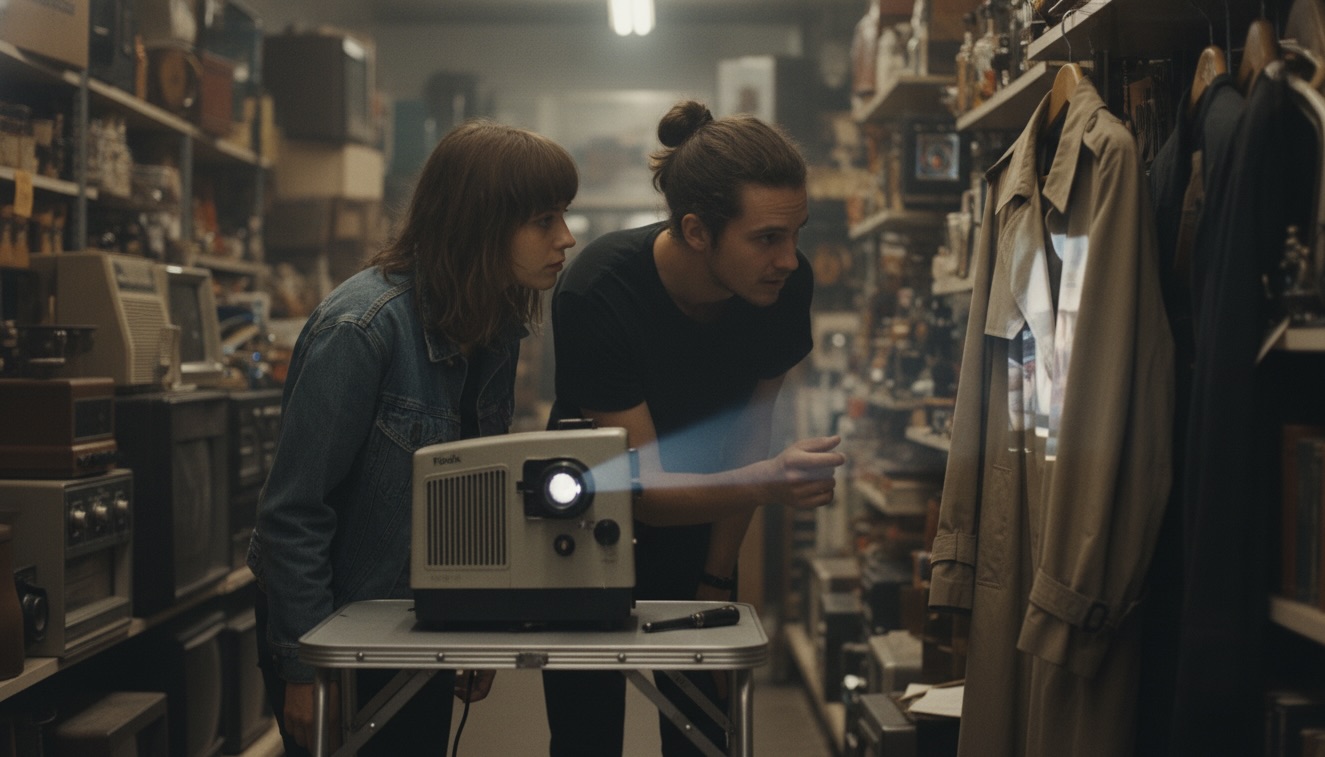
A dusty, cluttered antique shop in Winnipeg on a hot summer afternoon, where two strangers bond over a vintage slide projector.
The heat in Winnipeg during July didn’t just sit on you; it aggressively occupied your personal space. It was a wet, heavy blanket of humidity rising off the Red River, mixing with the exhaust of Portage Avenue buses and the smell of frying asphalt. Casey felt it pasting her bangs to her forehead, a sensation she hated but tolerated because the alternative was staying inside her apartment, staring at a half-packed suitcase and a degree she hadn’t figured out how to use yet. She needed air conditioning, or at least the illusion of it, so she ducked into 'Second Time Around,' a thrift shop that smelled predominantly of cedar chips and other people’s laundry.
Inside, the air was still and cool, trapped in a perpetual twilight by shelves stacked so high they blocked the front windows. It was a maze of discarded histories. Casey navigated a narrow aisle flanked by precarious towers of VHS tapes and ceramic mugs with sayings like 'World's Okayest Golfer.' She wasn't looking for anything. That was the point. Looking for something implied intent, and intent required energy she didn't have. She just wanted to be somewhere that wasn't her living room.
Her internal monologue was a loop of low-grade anxiety. Did I email the registrar? Is the lease up on the 31st or the 1st? Why do my knees hurt? Is twenty-two too young for knee pain? Probably the humidity. She picked up a heavy glass ashtray, the amber kind that weighed three pounds, and turned it over. Two dollars. Someone had smoked a thousand cigarettes over this thing, arguing about politics or money or love, and now it was two dollars. She put it back. The clink of glass on metal shelving sounded too loud in the quiet shop.
From the corner of the room, near the back where the wiring of questionable safety lived, a fan oscillated with a rhythmic thwack-hiss, thwack-hiss. It pushed the dust motes around rather than cooling anything. Casey wandered toward the electronics section. This was usually a graveyard of printer cables and alarm clocks, but today, something bulky sat on a folding table, half-obscured by a tangle of extension cords.
It was a Kodak Carousel slide projector. The kind from the sixties or seventies, built like a tank, dark gray metal and black plastic. Beside it sat a round tray, the carousel itself, still loaded with slides. It looked like a flying saucer that had crash-landed on a formica table.
Casey paused. She liked old machines. They were honest in a way modern tech wasn't. You could see the screws. You could hear the gears. She reached out and touched the lens housing. It was cool to the touch. Does it work? She looked around for an outlet. There was a power strip on the floor, blinking with an angry orange light. She crouched down, her knees popping audibly—definitely the humidity—and plugged the thick, three-pronged cord in.
Nothing happened.
She frowned, jiggling the switch. "Come on," she whispered. "Don't be dead."
"You have to hold the fan button down while you hit the lamp switch," a voice said from above her. "It's a safety thing. Keeps the bulb from blowing."
Casey looked up, squinting against the fluorescent overheads. A guy was standing at the end of the aisle, holding a terrifyingly ugly lamp shaped like a fish. He looked about her age, maybe a year older, wearing a faded black t-shirt for a band she didn't recognize and jeans that were arguably too thick for the weather. He had dark hair pulled back in a messy bun and glasses that slid slightly down his nose.
"A safety feature?" Casey asked, skeptical. "From the era of lawn darts and lead paint?"
The guy smiled, a quick, crooked expression that vanished as he looked back at the machine. He set the fish lamp down on a nearby chair with a surprising amount of care. "Yeah, well. Bulbs were expensive. I'm Geoff, by the way."
"Casey." She turned back to the machine, pressing the buttons as he directed. The fan whirred to life first—a deep, mechanical roar that sounded like a plane taking off. Then, she hit the lamp switch. A beam of intense, yellow-white light shot out of the lens, cutting through the dust in the air. It hit the back of a beige trench coat hanging on a rack three feet away.
"Focus is on the side," Geoff said, stepping closer. He didn't invade her space, just hovered near the table, hands in his pockets. He smelled like coffee and that specific, clean scent of rain on concrete.
Casey found the wheel and twisted it. The square of light on the trench coat sharpened. "Okay. Moment of truth." She hit the 'Forward' button on the side of the machine.
The carousel clunked. A mechanical arm shoved a slide down into the gate. The light shifted.
Projected onto the back of the trench coat was a slightly warped image of a backyard barbecue. It was washed out, the colors shifted toward magenta with age. People in high-waisted shorts and horn-rimmed glasses held red plastic cups. A toddler was crying in the background near a sprinkler.
"Whoa," Geoff breathed. "Instant ghosts."
Casey adjusted the trench coat to flatten the image. "It’s weird, right? Buying someone else's memories. Like, who were these people? Why did this end up here?"
"Maybe they died," Geoff said, then winced. "That was dark. Sorry. I work in IT, I deal with dead hard drives all day. I default to 'catastrophic failure' as an explanation for everything."
Casey laughed, a short, sharp sound. "No, it's a valid theory. Estate sale leftovers. The things the grandkids didn't want."
She clicked to the next slide. Clunk-whir.
A landscape. A lake, maybe Lake Winnipeg or somewhere in the Whiteshell. The water was a flat, calm blue. A canoe sat on the shore, upside down. No people.
"That looks peaceful," Casey said. She leaned against the table, crossing her arms. "I could use some of that. My brain feels like the intersection of Portage and Main right now."
Geoff picked up a stray slide mount from the table and turned it over in his fingers. "Yeah? What's the traffic jam? School?"
"Graduation. The 'what comes next' void," Casey admitted. She surprised herself; she didn't usually unload on strangers in thrift stores. Maybe it was the noise of the projector fan; it created a cone of privacy. "I have an Art History degree and a lease that's ending. I’m vibrating with uselessness."
Geoff nodded slowly. "I get that. I studied structural engineering for three years before I dropped out to fix laptops. My parents were… thrilled. But I like fixing small things. Bridges are too much pressure. If a laptop breaks, someone loses a spreadsheet. If a bridge breaks… yeah."
"So you chose low stakes," Casey said, clicking the button again.
"I chose manageable chaos," he corrected.
The next slide was a close-up of a dog. A golden retriever with a party hat on. It was out of focus, the nose taking up half the frame.
"Manageable chaos," Casey repeated, looking at the blurry dog. "I like that. Right now, I feel like I'm supposed to be building a bridge, but I don't even have a hammer. I'm just… looking at the river."
Geoff moved a stack of National Geographic magazines to sit on the edge of a low dresser. "The river's not so bad. You can swim. Or just float."
"I'm not a strong swimmer," Casey muttered. She watched the dust dance in the projector beam. "I feel like I'm waiting for permission to do something. Like an adult is supposed to come in and say, 'Okay, Casey, here is your assigned plot line. Go be a protagonist.' But nobody comes."
"Nobody comes," Geoff agreed. "You just kind of… start walking. And hope you don't fall in a manhole." He gestured at the screen. "Next slide. Let's see where they went."
Casey clicked. Clunk-whir.
The image changed. This one was different. It wasn't a casual snapshot. It was a woman, young, sitting on the hood of a powder-blue car. She wasn't smiling. She was looking off to the side, away from the camera, holding a map. The wind was blowing her hair across her face. The lighting was dramatic, long shadows stretching out behind her.
"She looks lost," Casey said softly.
"Or determined," Geoff countered. He leaned forward, squinting. "Look at the map. That’s not a road map. It’s too big. Topographic maybe?"
Casey moved closer to the trench coat screen. The texture of the fabric gave the woman’s face a ghostly, woven quality. "You think she’s looking for something?"
"Treasure," Geoff said, deadpan. Then he grinned. "Or a campsite. But treasure is a better story. Maybe she stole the car."
"Definitely stole the car," Casey decided. "She’s running away from a boring job at a... button factory."
"Button factory? Specific."
"My aunt worked at a button factory. Apparently, it’s soul-crushing. You dream in circles." Casey traced the outline of the car in the air. "So she stole the car, grabbed the map, and drove north. To the lake."
"And the guy taking the picture?" Geoff asked. "Accomplice or hostage?"
"Accomplice. But a reluctant one. He’s the one who worries about the gas mileage." Casey looked at Geoff. "Like you."
Geoff laughed, and this time it was a real, full sound that made his eyes crinkle. "Hey, I’d be a great getaway driver. I’d just make sure we had snacks and a tire iron first. Practicality isn't the enemy of adventure, it’s the fuel."
"That sounds like something a guidance counselor would say." Casey clicked the button.
The next slide was a total blur. Just streaks of light. Someone had bumped the camera or taken a picture of fireworks while sneezing.
"Art," Geoff declared. "Abstract expressionism."
"Failure," Casey countered, but she was smiling. "A mistake they kept anyway."
"That’s the thing about these old carousel trays," Geoff said, his voice dropping a bit, becoming more contemplative. "You couldn't delete them. You took the picture, you paid to develop it, and then you had it. Even the bad ones. You had to physically throw it away if you didn't want it. Now, we just swipe and delete. We curate everything. We only keep the perfect 1% of our lives. These people… they kept the blurry dog and the accidental floor shot."
Casey looked at the streak of light. He was right. There was something forgiving about it. The permanence of the mistake. "I delete like five photos for every one I keep," she admitted. "I filter everything. My life looks great on Instagram. In reality, I’m eating cereal for dinner and avoiding my landlord."
"Cereal is a solid dinner choice," Geoff said. "But I get it. The curation is exhausting. It’s a performance. This..." He gestured to the projector. "This is just... happening. It’s raw."
"Raw and dusty," Casey said, wiping her hand on her jeans. She felt a sudden, sharp pang of loneliness, but it wasn't the bad kind. It was the kind that recognized it was being shared. "Do you think they found it? The campsite? Or the treasure?"
"I think they found something," Geoff said. "They kept the slides, didn't they? If it was a disaster, the carousel would be in a landfill, not a thrift store."
"Unless they died immediately after," Casey pointed out.
"You really are morbid, aren't you?"
"I’m a realist with gothic tendencies."
Geoff pushed off the dresser and walked over to the table. He stood next to her, looking down at the machine. He was close enough that she could see a small scar on his chin, a thin white line interrupting the stubble. "I think," he said slowly, "that we assume other people’s lives were simpler because we only see the highlights. But that woman on the car? She probably had knee pain too. And worried about her lease. And then she went and sat on a hood and looked cool for 1/60th of a second."
Casey stared at him. "Are you trying to be profound in front of a fish lamp?"
"Is it working?"
"A little bit."
The shop owner, a man who looked like he had evolved directly from a pile of tweed jackets, walked by the end of the aisle. He glanced at the light beam, then at them. "If you burn out that bulb, you're buying it," he grunted, not stopping.
"We should probably turn it off," Casey whispered. "Before we owe him twenty bucks for a lightbulb from 1974."
"Wait, one more," Geoff said. "Let's see the end of the trip."
Casey pressed the button one last time.
The mechanism cycled. The final slide dropped.
It wasn't a landscape or a person. It was a sign. A wooden sign, hand-painted, nailed to a tree. It was crooked. The paint was peeling. It said: B-Side Diner. 5km.
"B-Side Diner," Geoff read. "Never heard of it."
"Me neither. And I know every diner in a fifty-kilometer radius. I run on coffee and grease."
Geoff pulled his phone out of his pocket. "Google time. Let's see if the practical approach yields results."
Casey watched him tap the screen. His thumbs moved fast. He wasn't just checking a map; he was hunting. She liked that focus. It made her feel like they were on a team, however briefly.
"Okay," Geoff muttered. "Nothing on Maps. Nothing on Yelp... obviously. Wait. Here’s a blog post from 2008. Some guy documenting abandoned roadside attractions in the Interlake."
He turned the phone toward her. It was a grainy photo of a collapsed building, but the sign was there, leaning against a pile of rubble. B-Side Diner.
"It’s gone," Casey said, feeling a weirdly sharp disappointment. "Of course it is."
"Wait, look at the location tag," Geoff said, zooming in. "Highway 6, past Grosse Isle. That’s not far. Like, forty minutes."
"To see a pile of rubble?"
"To see the place where the woman on the hood was going," Geoff corrected. He looked at her, his expression shifting from casual to something more intent. "You said you were waiting for a plot line. A quest."
Casey looked from the phone to the projector, then to Geoff. The humidity outside was still waiting for them. The apartment with the boxes was still waiting. But here was a guy with a messy bun and a theory about manageable chaos, offering her a forty-minute drive to nowhere.
"It’s going to be hot," she said.
"My car has AC. And I have a cooler in the trunk. It might contain grape soda."
"Grape soda? Are you twelve?"
"I have sophisticated tastes," Geoff said, grinning. "So? Are we buying the slides?"
Casey looked at the carousel. Eighty slides of strangers. A woman on a car. A blurry dog. A sign for a diner that didn't exist anymore. It was clutter. It was junk. It was exactly the kind of thing she shouldn't be spending money on.
"We have to," she said. "We can't leave her here."
"Good," Geoff said. He reached over and hit the fan switch. The machine wound down with a dying groan, the light fading to orange, then black. The silence that rushed back into the aisle was heavy, but less oppressive than before.
They carried the machine to the front counter together. It was awkward, heavy, and smelled like burning dust. The owner rang it up without looking at them.
"Fifteen dollars," he grumbled. "No returns."
Geoff paid. Casey carried the carousel tray like a pizza box.
They stepped out of the shop and the heat hit them like a physical blow. The sun was blinding, reflecting off the chrome of parked cars. The noise of the city—sirens, shouting, the rumble of a bus—washed over them.
Casey squinted, adjusting her grip on the tray. "So. Highway 6?"
Geoff unlocked a silver Honda Civic parked at the curb. It was dented on the passenger door and covered in a fine layer of prairie dust. "Highway 6. If we leave now, we can get there before the light gets bad. We can take a photo. Make it slide number eighty-one."
"I don't have a film camera," Casey said, walking toward the car.
"I do," Geoff said, popping the trunk. Inside, nestled among computer cables and a gym bag, was an old Canon. "Always prepared."
Casey smiled, and for the first time in weeks, the knot in her chest loosened. She wasn't building a bridge today. She wasn't solving her life. She was just going to look at some rubble with a stranger who liked grape soda.
"Shotgun," she said, and threw her bag in the back.
As the car pulled away from the curb, merging into the afternoon traffic, Casey watched the thrift store disappear in the side mirror. The heat didn't feel so heavy anymore, or maybe she just didn't mind the weight.
As the car pulled away from the curb, merging into the afternoon traffic, Casey watched the thrift store disappear in the side mirror, knowing the heat didn't feel so heavy anymore.
Share This Story


