The West Yard
Three teenagers trespass in an industrial railyard in Northwestern Ontario, 1996, discovering a piece of guerilla art that shouldn't exist.
The chain-link fence rattled, a harsh, metallic complaint against the wind coming off the lake. Lenny froze, one boot wedged into the diamond mesh, his breath clouding the air in short, panicked bursts. He waited for the sweep of a flashlight, the crunch of security tires on gravel, or the bark of a guard dog. Nothing happened. Just the low, steady hum of the transformer station a block away and the distant, rhythmic thumping of a loose sheet of corrugated metal on the abandoned grain elevator.
"Move your ass, Da Vinci," Sam hissed from below. She was already crouching in the tall, dead grass on the other side, her flannel jacket pulled tight around her throat. "My knees are soaking up this slush."
Lenny vaulted the top, catching the hem of his jeans on a twisted wire before dropping down. The landing wasn't graceful. He hit a patch of half-frozen mud and slid, windmilling his arms to stay upright. His sneakers, canvas high-tops that offered zero protection against the Northwestern Ontario spring, were instantly soaked. He swore, low and vicious.
"Graceful," Julian muttered, landing softly beside him. Julian was the only one of them who dressed for the weather—heavy work boots, a thick parka that smelled like diesel and woodsmoke. He adjusted his glasses, squinting into the gloom of the West Yard. "You okay?"
"Wet socks," Lenny grumbled, kicking a chunk of ice. "Instant regret. Why are we here again?"
"Because you need inspiration," Sam said, standing up and brushing burrs off her jeans. She pointed a gloved finger toward the looming silhouette of the grain silo that dominated the skyline. It was a concrete monolith, stained with fifty years of rust and industrial neglect, rising two hundred feet into the ink-black sky. "And because Julian heard a rumor."
They started walking, navigating the maze of rusted rail tracks and rotting railway ties. The ground was treacherous—a mix of dirty snow, known locally as 'snirt,' and mud that sucked at their feet. The air smelled of wet asphalt, sulfur from the paper mill down the highway, and the sharp, clean scent of thawing pine.
"It wasn't a rumor," Julian corrected, stepping over a puddle that reflected the orange glow of the town's distant streetlights. "My dad was complaining about it. Said the yard foreman was losing his mind this morning. Said someone defaced the north face. High up."
"Defaced?" Lenny asked. "Like, a tag? Some kid with a spray can?"
"That's the thing," Julian said, stopping near the base of a rusted hopper car. He looked up at the silo, his breath hitching slightly. "Dad said it wasn't just a tag. He said it was impossible."
They rounded the curve of the track, the massive concrete cylinder blocking out the stars. The wind picked up, cutting through Lenny's denim jacket like a knife. He shoved his hands into his pockets, his fingers finding the familiar, comforting edges of a lighter and a crushed pack of gum. He didn't smoke, but he liked the click of the flint.
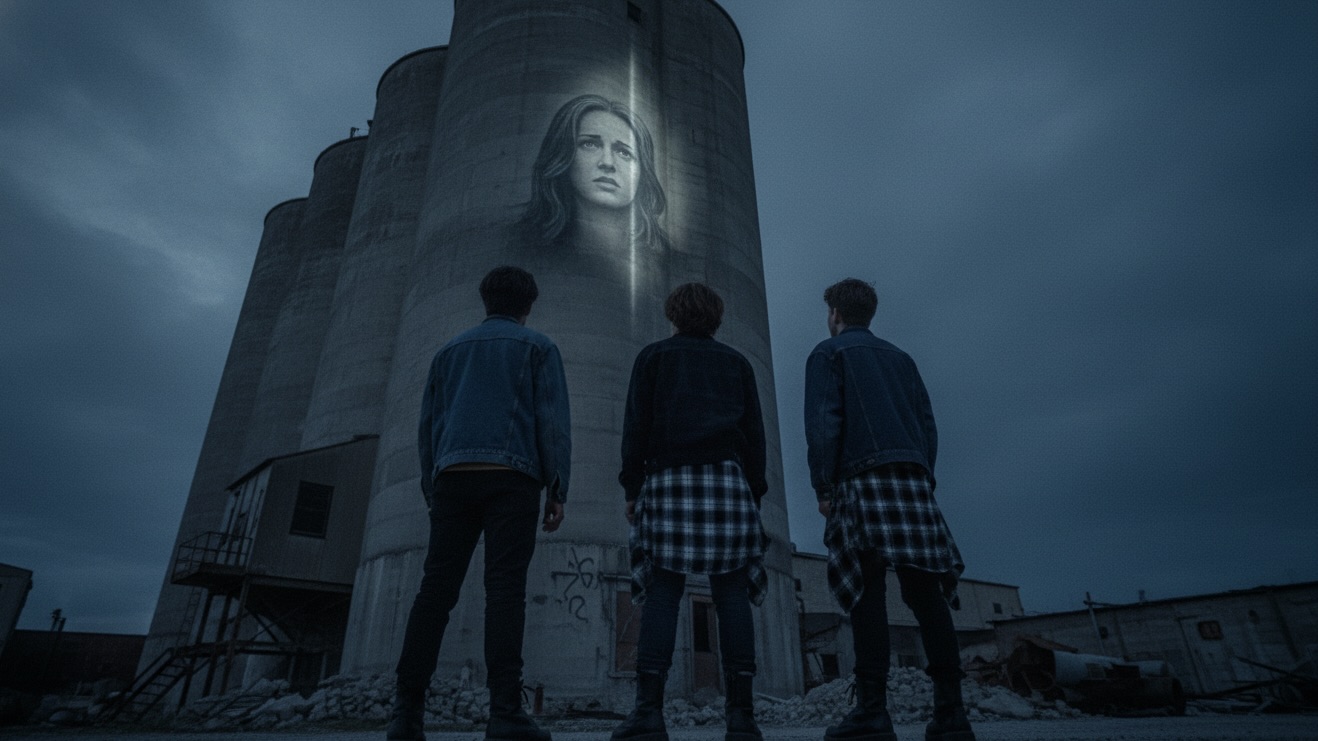
"Okay," Sam said, stopping dead. She tilted her head back, her mouth falling open slightly. "Holy..."
Lenny followed her gaze. He had to crane his neck, squinting against the gloom. Then, the clouds shifted, allowing a wash of weak moonlight to hit the concrete. He felt a jolt go through his chest, sharp and electric.
Seventy feet up, where the concrete was smooth and unbroken by ladders or catwalks, was a painting. It wasn't a sloppy signature or a crude symbol. It was a face. Massive, maybe twenty feet high, rendered in stark blacks and greys. It was a woman’s face, eyes closed, screaming silently, her hair dissolving into birds that seemed to fly upward into the darkness. The perspective was perfect. The shading was professional.
"How?" Lenny whispered. The question felt heavy in his mouth. "There's no ledge. No scaffolding."
"Ropes?" Sam suggested, though she sounded doubtful. She stepped closer, her boots crunching on broken glass. "You'd need a rig. You'd need a team. Someone would have seen them. This is right next to the highway."
"It happened last night," Julian said. "Between the shift change and sunrise. Four hours."
Lenny stared at the face. The expression captured a terrifying mix of agony and liberation. It looked the way he felt most days—trapped in a town where the biggest ambition was getting a job at the mill before it closed, or getting a job at the crushing plant before it closed. The sheer scale of it made him feel small. And useless. He spent hours in his bedroom sketching on printer paper, terrified to show anyone, and someone had just turned the ugliest building in town into a masterpiece in the middle of the night.
"It's beautiful," Sam said, her voice unusually soft. She wasn't the type for softness; she played bass in a grunge band called 'Road Salt' and had a reputation for throwing drumsticks at hecklers. But she stood there, mesmerized.
"It's haunting," Julian added, pulling a small point-and-shoot camera from his pocket. The mechanical whir of the lens extending sounded loud in the quiet yard. He snapped a photo, the flash illuminating the grim industrial debris around them for a split second—rusted metal shards, old tires, the skeletal remains of a machinery shed.
"Don't," Lenny said, shielding his eyes. "Someone sees that flash, we're dead."
"Nobody's watching," Julian said, winding the film. "The mill laid off the night security for this sector three months ago. Budget cuts. We're ghosts here."
They stood in silence for a long time, three small figures dwarfed by the industrial decay and the inexplicable art above them. The cold seeped into Lenny's bones, but he didn't want to leave. Looking at the paint, he felt a strange kinship with whoever did this. It was an act of defiance. A scream into the void.
"Let's get out of here," Sam said finally, shivering. "My toes are numb and I need coffee. The bad kind."
The retreat was faster. They scrambled back over the fence, adrenaline replaced by a buzzing, frantic energy. They piled into Julian's car, a rusted-out 1988 sedan that smelled permanently of wet dog and stale french fries. The heater rattled violently as Julian turned the key, blasting lukewarm air that smelled like burning dust.
"Donut Diner?" Julian asked, wrestling the gear stick into reverse.
"Donut Diner," Lenny and Sam said in unison.
The drive into town was short. The roads were heaved from the frost, creating a rhythm of bumps that shook the car's suspension. Main Street was deserted, the traffic lights blinking amber for no one. The town of Blackwood Crossing was asleep, huddled against the cold like a stray animal. Storefronts were dark, some boarded up, others displaying faded posters for community events that had passed weeks ago.
They slid into a booth at the diner, the vinyl cracked and taped over with silver duct tape. The waitress, a woman named Barb who had been working there since the seventies and had seen generations of bored teenagers come and go, dropped three mugs on the table without asking.
"Pot's fresh-ish," she said, her voice like gravel. "Don't make a mess."
"Thanks, Barb," Lenny said, wrapping his frozen hands around the mug. The ceramic was hot, burning his fingertips in a good way. He stared into the black liquid.
"So," Sam said, ripping open three sugar packets at once and dumping them in. "Who is it?"
"Banksy?" Julian joked, cleaning his glasses with a napkin.
"In Northwestern Ontario?" Sam snorted. "Yeah, right. He took a wrong turn at London and ended up in the bush. No. It's someone local. Has to be."
"Who has that kind of talent here?" Lenny asked, feeling that familiar prickle of jealousy. "Mr. Henderson? He paints landscapes of moose. That wasn't a moose."
"Maybe it's a drifter," Julian suggested. "Someone passing through on the trans-Canada."
"With fifty gallons of paint and climbing gear?" Sam shook her head. She took a sip of her coffee and grimaced. "Tastes like battery acid. Perfect. Look, the point isn't who did it. The point is why."
Lenny looked out the window. The reflection of the diner's neon sign flickered on the wet pavement outside. "To prove they exist," he said quietly.
Sam and Julian looked at him. Lenny shrugged, feeling self-conscious. "I mean, think about it. You live here. You go to school here. You graduate. You get a job. You die. And nothing changes. The rocks don't care. The lake doesn't care. That silo... it's been there since the forties. It's just a tombstone for the grain industry. Putting that face on it... it changes the story."
"That's deep, man," Sam said, but she wasn't mocking him. She was tapping her spoon against the table, a nervous habit. "It's true, though. It's why I play. Even if it's just in my garage and the only audience is the neighbor's cat. You have to make something noise. Visual noise. Audio noise. Whatever."
"But does it matter?" Lenny asked, the frustration bubbling up. "If nobody sees it? I mean, Julian's dad said they're going to blast it off. Probably tomorrow. It'll be gone. All that work. For what?"
"We saw it," Julian said. He was holding his camera, running his thumb over the rewind crank. "I got it on film. Provided I didn't mess up the exposure. It lasts."
"It's just hard," Lenny said, leaning back. The vinyl squaked. "Being... trying to be an artist here. In Toronto, or Vancouver, people get it. Here? If you're not building a deck or fixing a transmission, you're wasting time. My dad saw my sketchbook last week and asked if I was going to 'grow out of it' before college applications are due."
Sam nodded, her expression darkening. "My aunt keeps asking when I'm going to sell my bass and buy a 'reliable car.' Like a car is going to save my soul. People here... they're practical. They have to be. The winters try to kill you. The economy tries to starve you. Art feels like a luxury we can't afford."
"But that's why we need it more," Julian argued. He was the quiet one usually, the observer, but his eyes were intense behind his smudge-proof lenses. "Because it's practical to survive, but it's miserable if that's all you do. That face on the silo? That wasn't a luxury. That was a necessity. Whoever painted that... they had to. You could see it in the eyes. It was an exorcism."
Lenny thought about his own room. The stack of drawings under his bed. The half-finished canvas in his closet that he covered with a sheet whenever his mom came in to vacuum. He painted landscapes, mostly. The way the light hit the granite cuts on the highway. The way the birch trees looked like skeletons in November. He loved this place, and he hated it. He hated the isolation, but he loved the savage, raw beauty of it. The conflict paralyzed him.
"I want to go back," Lenny said suddenly.
Sam blinked. "We just left. We're warm. I have coffee."
"Not now," Lenny said. "Tomorrow. Tonight. Later. I want to see if they left anything. Paint cans. Brushes. A rope. Anything to show how they did it."
"CSI: Kenora," Sam smirked. "Fine. But if I get arrested, I'm telling the cops you kidnapped me."
"Deal," Lenny said.
The door of the diner opened with a jingle of bells, letting in a gust of cold air. A heavy-set man in a reflective vest walked in, stomping snow off his boots. He looked tired, his face gray with stubble. He went to the counter, nodding at Barb.
"Night shift over?" Barb asked.
"Early dismissal," the man grunted. "Something going on at the yard. Police are all over the north sector. Say there's a structural issue with the old silo."
Lenny kicked Julian under the table. Julian didn't flinch, but his grip on the camera tightened.
"Structural issue?" Barb asked, pouring the man a coffee.
"Some vandalism," the man said, rubbing his eyes. "But the foreman's acting weird. Says the concrete is compromising. They're bringing in the sandblasters at dawn. Maybe a demo crew."
"Demo?" Lenny whispered. "They can't demo the silo. It's a landmark."
"It's a liability," Julian whispered back. "And now it's drawing attention."
They finished their coffees in silence, the mood shifted. The exhilaration of the discovery was replaced by a gnawing anxiety. The town didn't just ignore art; it actively erased it if it didn't fit the lines. The practical world was coming for the screaming woman.
They paid—splitting the bill with crumpled fives and quarters—and went back to the car. The sky was beginning to lighten in the east, a bruise of purple and grey against the black.
"Drop me at the bridge," Sam said. "I need to walk. clear my head."
"It's freezing," Julian said.
"I'm Canadian. I'll live." She looked at Lenny. "Don't stop drawing, okay? Even if it's just for you. Even if they sandblast it off."
Lenny nodded. "Yeah. You too. keep playing."
He watched her walk away down the empty sidewalk, her breath trailing behind her like steam. Julian drove Lenny home, the car silent except for the hum of the tires.
When Lenny got to his house, he didn't go to sleep. He went to his window. He could just see the tip of the silo over the tree line, miles away. He pulled out his sketchbook. He didn't draw the trees or the rocks this time. He drew the face. He drew it from memory, trying to capture that desperate, flying hair.
The next day was a blur of school. Lenny sat through Math and History, tapping his pencil, waiting for the bell. The rumor mill was churning. Everyone was talking about the 'ghost graffiti.' Some kids said it was a gang sign. Others said it was Satanic. No one seemed to get it.
At lunch, he found Julian in the darkroom. The red safety light made the small space feel like a submarine.
"Did you develop it?" Lenny asked.
Julian was using tongs to agitate a print in the developer tray. "Watch."
Lenny leaned over the tray. slowly, the image ghosted into existence. The stark contrast of the black paint against the grey concrete. The crumbling texture of the silo. And the face. It was even more intense in black and white.
"Look closer," Julian said, pointing to the bottom corner of the print, near the neck of the figure.
Lenny squinted. There, almost invisible against the rust stains, was a symbol. A small, stylized bird. A raven.
"I've seen that before," Lenny said, his blood running cold. "In the old shed behind the quarry. Where the older kids used to party in the eighties."
"My brother's old hangout," Julian said. "He disappeared in ninety-two. Everyone said he went to Winnipeg. Just took off."
Lenny looked at Julian. "You think your brother came back?"
"I don't know," Julian said, his voice trembling slightly. "But look at the date."
Lenny looked. Scratched into the paint, tiny but legible in the high-resolution grain of the film, were numbers. 1992.
"It wasn't painted last night," Lenny whispered. "It's four years old."
"But the rust..." Julian said. "The rust was over the paint in some spots. It's been there. Under the grime. Someone cleaned it. They didn't paint it last night. They revealed it."
The realization hit Lenny like a physical blow. The art had been there the whole time, screaming silently under layers of industrial soot and neglect. Someone had just washed the windows.
"We have to go back," Lenny said. "Now."
They skipped afternoon classes. They picked up Sam, who was waiting by the gas station where she worked part-time. When they told her, she turned pale.
"The quarry shed?" she asked. "I haven't been there in years. It's unsafe."
"We have to check," Lenny said.
They drove to the quarry, parked the car, and hiked through the slush. The woods were silent, the birds not yet back from the south. The shed was a collapsing wooden structure, leaning precariously against a granite outcrop.
Inside, it smelled of rot and old beer. The walls were covered in decades of graffiti. Names, dates, crude drawings. Lenny scanned the walls with a flashlight.
"There," Sam pointed.
In the corner, faded and peeling, was the raven. And next to it, a sketch. A rough draft of the silo face.
"It's him," Julian said. "It's my brother's work."
"But why reveal it now?" Sam asked. "If he's... gone?"
Lenny looked at the floor. In the dust, untouched by the years of debris, were fresh footprints. Boot prints. The same tread as the security guards at the mill.
"Guys," Lenny said, his voice tight. "These footprints. They aren't ours."
"Maybe kids?" Sam suggested.
"No," Lenny said. "Look at the stride. Heavy. purposeful. And look at this."
He pointed to a spot near the wall. A cigarette butt. Fresh. Not flattened. And next to it, a small, crushed can of paint thinner.
"They knew," Julian realized. "The mill. They knew it was there. They covered it up years ago. Maybe... maybe that's why he left. Or why he didn't."
A twig snapped outside. Loud. Close.
The three of them froze. The silence of the northern woods, usually so vast and comforting, suddenly felt suffocating. It wasn't empty. It was watching.
"We need to go," Sam whispered. "Right now."
They backed out of the shed, moving slowly. The sun was setting, casting long, distorted shadows through the trees. As they reached the car, Lenny looked back toward the quarry edge. For a second, he thought he saw a figure standing on the ridge, silhouetted against the dying light. A man in a reflective vest. motionless.
They drove back to town in silence, speeding slightly on the icy roads. When they reached the highway, they looked toward the silo. Scaffolding was already going up. Tarps were being draped over the face. The scream was being muffled.
Lenny felt a heavy weight settle in his stomach. The introspection of the morning—the artistic angst, the desire to leave—felt childish now. This wasn't just about art vs. trade. This was about memory vs. erasure. In a small town, everyone knows everyone, which means everyone knows the secrets. And some secrets were kept with paint, and some were kept with concrete.
He looked at his hands. They were shaking. He gripped his sketchbook tighter.
"They're going to destroy it," Julian said, staring straight ahead.
"They can try," Lenny said, though he didn't believe it. "We saw it."
"Yeah," Sam said, watching the rearview mirror. "But who saw us?"
As they crossed the bridge into town, the streetlights flickered on, one by one, creating a path of artificial light that revealed nothing of what lay in the dark water below.
As they crossed the bridge into town, the streetlights flickered on, one by one, creating a path of artificial light that revealed nothing of what lay in the dark water below.
Share This Story


