Wiring the Bedrock
A cluttered, repurposed room in a community centre near Borups Corners, filled with the hum of computer fans and the smell of stale coffee and fall dampness.
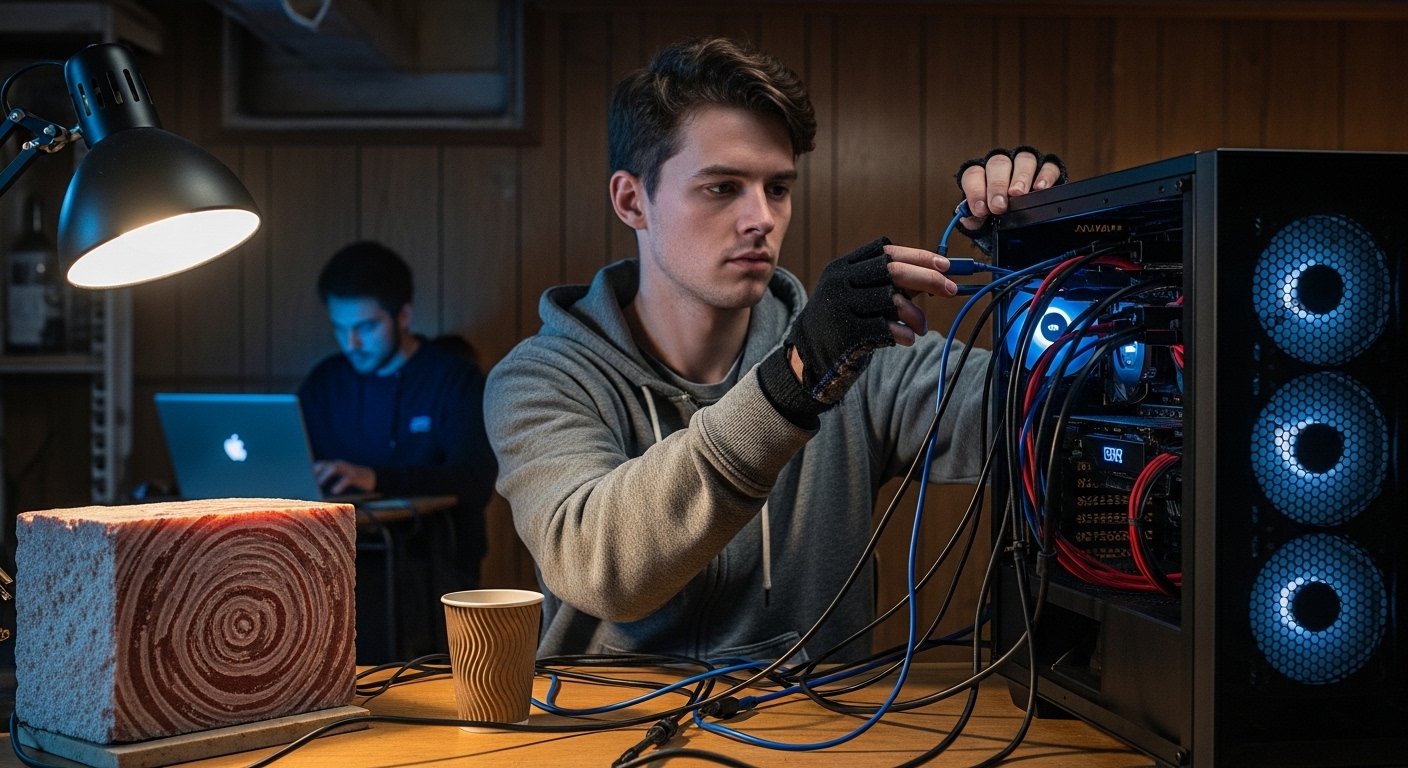
Sam jammed the USB-C connector into the port with a little more force than was probably recommended, swearing under his breath when the monitor flickered and went black again. The basement of the community centre always smelled like this—wet wool, floor wax, and the distinct, dusty scent of electronics running too hot. It was late October in Northwestern Ontario, and the heating system in the building hadn't quite decided to kick in for the season yet.
"It’s the frame rate," Li said without looking up from his laptop. He was sitting cross-legged on a folding chair that looked like it might collapse under him at any moment, surrounded by a fortress of empty Tim Hortons cups. "The texture mapping on the crystalline bedrock is too dense. The GPU is choking on the granite."
Sam wiped his hands on his jeans. "It’s not the granite. It’s the cable. This thing has been taped together since, like, 2019. If we want this showcase to work for the town council next week, we need a feed that doesn't look like a strobe light."
He jiggled the wire. The screen flared to life, showing a wireframe rendering of a tunnel. It was a digital ghost of the Revell site, the proposed location for the deep geological repository. Sam had spent the last three weeks staring at these grey polygons, trying to make them feel like safety, like permanence.
Bea walked in, kicking the door shut behind her with a thud that shook the flimsy card table holding their main rig. She was carrying a tray of donuts and looked like she’d just walked through a wind tunnel. Her toque was pulled down low over her ears.
"It is freezing out there," she said, dumping the tray next to Li’s elbow. "Wind's coming off the lake. I think I saw snow mixed in with the rain. How’s the hole in the ground coming along?"
"The hole is fine," Sam said, grabbing a honey dip. "The technology required to visualize the hole is currently rebelling against us."
Li finally looked up, adjusting his glasses. "I was just telling Sam. We are trying to render the multi-barrier system with too much fidelity. In the Lanzhou labs, when we simulate the Beishan site, we use LOD—Level of Detail—scaling. We don't need to render every grain of bentonite clay when the user is standing ten metres away."
"But that's the point, isn't it?" Sam argued, mouth half-full. "Participatory research. We want the locals to see it. To really see it. If it looks like a cartoon, they won't trust the science. They need to see the copper coating on the canisters. They need to see the rock stability."
He sat back in the creaky office chair, staring at the monitor. The wireframe rotated slowly. This project—a fusion of art, science, and community engagement—was their baby. They were trying to take the incredibly complex hydrogeological data from the Nuclear Waste Management project and turn it into something a high school student or a grandmother could experience in VR. It was about showing, not just telling, how the rock would hold the fuel for a thousand years.
Deep Time and Cold Coffee
Li stretched, his back popping audibly. "The rock at Revell is good. Stable. Similar to what we study in Gansu. High structural integrity. But Sam, if the computer crashes, they see nothing. Better to have a slightly lower resolution canister than a Blue Screen of Death."
"He's right," Bea said, unspooling a coil of XLR cable. She was working on the soundscape. "Besides, the immersion isn't just visuals. I’ve been recording out at the site. The wind through the jack pines, the crunch of lichen. If I layer that over the transition from surface to underground, people will feel it. Audio does half the work. You don't need a million polygons if the sound puts them there."
Sam sighed, rubbing his eyes. The fluorescent lights overhead buzzed with a low, headache-inducing hum. "Okay. Fine. We drop the texture resolution on the tunnel walls. But the canister stays 4K. That's the star of the show."
Li tapped a few keys. "Compromise accepted. Re-baking the lighting now. It will take..." he squinted at a progress bar, "...forty minutes."
"Coffee break," Bea declared.
They huddled around a small space heater Sam had dragged out of the storage closet. The orange glow was the only warm thing in the room. Outside, the wind rattled the single-pane windows.
"It’s wild to think about," Sam said, staring at the heater coils. "We're sitting here freezing, worrying about a render crash, and we're talking about building something that has to last millennia. The time scale... it messes with my head."
Li nodded slowly. "That is the challenge of the field. At Lanzhou University, the School of Nuclear Science focuses heavily on this—environmental safety over centuries. We look at how radionuclides migrate through soil and water. It is not just engineering; it is predicting the future. The Beishan site... it is very remote. Revell is... well, it is also remote, but people live here. People hunt here. That is why your arts-based approach is interesting to me. In the lab, we focus on vitrification, on materials science. But here, you are focusing on the story."
"The story matters," Bea said, tapping her boot against the heater leg. "My uncle works in forestry. He knows the land better than any satellite. If we can't explain to him how the water flows underground, how the engineered barriers work with the natural rock, he’s never going to buy in. It’s not about dumbing it down; it’s about speaking the same language."
Sam looked at the chaotic mess of wires. "Speaking the language... which brings us to the script. Did you run the AI pass on the narration?"
Li winced slightly. "I did. The system at the university is designed to assist scriptwriting by analyzing audience preferences and technical data. I fed it the safety reports and the emotional tone we wanted—'reassuring but scientific'."
"And?" Sam asked.
"And... well, see for yourself." Li opened a text file on his laptop and turned the screen around.
Sam squinted at the text. "'The rock is a blanket. A very hard, granite blanket that sleeps for a long time. Do not worry about the atoms; they are safe in the copper house.'"
Bea snorted, nearly choking on her coffee. "'The copper house'? seriously?"
"It is... poetic?" Li offered weakly. "The AI is trying to bridge the gap between technical jargon and accessible language. Sometimes it over-corrects."
"It sounds like a bedtime story for a geophysicist's toddler," Sam said, laughing. It felt good to laugh. The tension in his shoulders loosened a bit. "Okay, so the AI gives us a structure. It gave us the pacing—intro at the surface, descent, explanation of the barrier, return to surface. That works. But we need to rewrite the dialogue. No 'copper houses'."
---
The Uncanny Valley of Text
They spent the next hour rewriting. It was a messy, collaborative process. Sam typed, while Bea paced the small room, acting out the lines to test the rhythm. Li fact-checked everything against the technical schematics he had stored on his drive.
"Instead of 'copper house'," Bea suggested, stopping in front of the map of the Revell area pinned to the wall, "how about we focus on the layers? Like wearing a coat in winter. You have the shirt, the sweater, the parka. The fuel pellet, the cladding, the container, the bentonite clay, the rock. Five layers."
"That works," Li said, nodding. "It is accurate. The multi-barrier system is exactly that. Redundancy. If one fails, the others hold. The university’s research into corrosion resistance confirms the copper is the primary shell, but the clay... the clay swells when wet. It seals everything. It is a self-healing wound."
"'Self-healing'," Sam typed. "I like that. It sounds organic. People understand healing. They don't understand 'swelling pressure of megapascals'."
They worked through the script, stripping away the robotic cadence of the AI generation and replacing it with the way people actually talked in the north. They cut the flowery metaphors and replaced them with concrete, tactile descriptions. The smell of wet stone. The weight of the earth. The silence of deep time.
"We are using the AI as a skeleton," Li observed, watching Sam delete a paragraph about 'ethereal safety energies'. "But we are putting the meat on the bones ourselves."
"Gross metaphor, but accurate," Bea said. "Okay, render should be done. Let's see if we broke the computer."
Sam spun his chair back to the main rig. The progress bar was gone. The desktop was showing the file icon. "Moment of truth."
He picked up the headset. It was a bulky thing, heavy and scuffed from too many uses. He wiped the lenses with the edge of his hoodie. "I'm going in. Watch the frame rate counter."
He pulled the strap over his head. The damp basement, the smell of coffee, and the grey light of the rainy afternoon vanished.
500 Metres Down
Darkness. Then, a soft blue loading circle. Then, light.
Sam was standing in a boreal forest. It was summer in the simulation—bright, green, high contrast. He looked down at his hands; they were gloved virtual hands. He turned his head. The trees swayed slightly. Bea’s audio work kicked in—the buzz of a deer fly, the distant call of a raven.
"Audio check," Sam said. His voice sounded different in his own ears with the headphones on.
"Loud and clear," Bea's voice came through the comms. "How's the latency?"
"Smooth so far. Walking to the shaft entrance."
He pushed the joystick forward. The virtual camera glided over the mossy ground. He approached the repository entrance—a clean, industrial structure that looked small against the backdrop of the trees. He stepped onto the elevator platform.
The descent began. This was the part that usually stuttered. The engine had to unload the forest assets and stream in the geological data seamlessly.
The walls of the shaft blurred upwards. The light from the surface faded, replaced by the artificial strip lighting of the lift. Down. Down. The depth counter on his wrist display clicked past 100 metres, 200, 300.
"Transitioning to repository level," Li said. "Watch the texture pop-in."
The elevator slowed. The doors slid open. Sam stepped out into the gallery.
It was breathtaking. Not in a scenic way, but in a heavy, industrial way. The tunnel was carved directly into the grey-pink granite. The texture work—even downgraded—held up. He could see the grain of the rock, the shimmer of mica. It felt solid. It didn't look like a video game level; it looked like a photograph of a place that didn't exist yet.
He walked down the corridor. To his right, the placement rooms. He triggered the interaction. The floor became transparent, revealing the cross-section they had worked so hard on.
There it was. The canister. The buffer. The rock. A Russian nesting doll of safety measures.
"I'm seeing the clay buffer," Sam reported. "The swelling animation... it's working. It looks like... like wet pottery. Dense."
"Good," Li said. "That is the simulation data from the material science lab imported directly into the mesh. It behaves physically correct."
Sam knelt in the virtual tunnel. He reached out and touched the wall. Obviously, he felt nothing but air, but his brain was tricked for a second. He expected the cold, damp grit of deep earth.
"It feels quiet," Sam said. "Really quiet."
"That's the noise floor," Bea whispered. "I dropped the ambient sound to near zero. Just the sound of your own virtual breathing and the hum of the ventilation. It’s supposed to feel isolated."
It worked. The fear that usually accompanied the idea of nuclear waste—the glowing green goo of cartoons—was absent. Instead, there was just engineering. Massive, boring, reliable engineering. It felt like standing inside a pyramid. A tomb for something dangerous, sealed away by math and stone.
"It’s not glitching," Sam said, standing up. "I'm looking at the copper canister detail. The light reflects off it correctly. It doesn't look like plastic. It looks like metal."
"We did it," Li said, his voice sounding relieved. "The optimization held."
Sam pulled the headset off. The real world rushed back in—the cold draft, the buzzing lights. He blinked, adjusting to the dimness. Li was grinning. Bea was giving a thumbs up.
"It works," Sam said, putting the headset on the table. "It actually feels real. When you're down there... you get it. You understand why the rock matters."
Surface Tension
They spent the next hour taking turns. Li went in to check the geological accuracy. Bea went in to tweak the audio mix. When they were finally done, the sun had set, and the basement was pitch black except for the monitors.
Sam leaned back, stretching his arms over his head. "We have a show. The council is going to freak out. In a good way."
"It is a good start," Li said, packing up his laptop. "The fusion of the Lanzhou technical data and the local context... it makes the science accessible. It is what we call 'knowledge translation'."
"It’s just storytelling," Bea said, putting on her coat. "Just with better props."
Sam looked at the map on the wall again. The Revell site was a small dot in a sea of green and blue. The simulation was great for the underground, for the engineering. But something was missing. The transition from the forest to the shaft had been... okay. But it was generic assets. It was 'TreeModel04'. It wasn't their forest.
"You know," Sam said, staring at the map. "The underground part is perfect. But the surface... it felt fake. Compared to the rock, the trees looked like cardboard."
"We used the standard asset library," Li said, shrugging. "We do not have the budget for custom photogrammetry of the whole forest."
"Not the whole forest," Sam said, a new energy buzzing in his chest. He stood up and walked over to the metal shelving unit in the corner. On the top shelf, gathering dust, was a quadcopter drone case.
"What are you thinking?" Bea asked, pausing with her hand on the doorknob.
Sam pulled the case down. It was heavy. "We map the surface. The actual site. We go out there tomorrow. We fly the drone, capture the actual topography, the actual trees. We overlay the real world on top of the simulation. So when they start the experience, they're standing in the exact spot where the repository will be."
Li looked concerned. "That is a lot of data. And the weather..."
"We can crunch the data," Sam said. "And the weather just makes it look better. More real."
Bea smiled. "I can record the actual wind at the site while you fly. No more stock sound effects."
Sam looked at the drone sitting on the shelf, then back at the map. They weren't just digging down anymore; they were going to have to fly.
Sam looked at the drone sitting on the shelf, then back at the map. They weren't just digging down anymore; they were going to have to fly.
Share This Story


