Citrus Cartography
My mind, an overeager detective, always searched for patterns where none existed. Today, the puzzle presented itself in the form of an orange peel. Not just any orange peel, but one peeled with a meticulous, almost surgical precision, forming a perfect spiral on the gritty concrete beside the bench. It was out of place amidst the usual detritus of bus stops – stray tickets, damp flyers, discarded coffee cups. This was the city’s central interchange, a churning vortex of human motion and diesel fumes. The air hung heavy with the smell of exhaust, mingled with the faint, sweet ghost of frying onions from the nearby kebab van. Sunlight, a thin, watery presence, struggled to penetrate the glass canopy overhead, casting weak, elongated shadows that danced with every passing bus. A constant, low thrum of engines vibrated through the pavement, a persistent reminder of the city's pulse.
The digital display for the Number Sixteen bus was having a seizure. It flickered between ‘Due’ and ‘5 Min’ with the frantic, indecisive energy of a trapped moth.
I’d worked in this part of the city long enough to know the board was a liar. Its promises were written in faulty wiring and wishful thinking. A better predictor was the tremor in the pavement, the subtle shift in air pressure that announced a double-decker was bullying its way through traffic a block away. For now, the street was still.
My own internal clock, usually a reliable second opinion, was preoccupied. It had been snagged by the orange peel. The thing was an artifact, a piece of found sculpture left on the grimy concrete of the bus shelter. It wasn’t a random tearing, a hasty shredding left by a commuter grabbing a quick dose of vitamin C. This was a single, unbroken spiral, a perfect corkscrew of zest laid out with geometric precision. The pith was clean, with no ragged edges.
It was a tribute to a level of patience I couldn’t fathom, especially not here, in the exhaust-choked hurry of a Tuesday afternoon.
Who does that? I leaned against the graffiti-scratched plexiglass of the shelter, my briefcase resting against my leg, and constructed a profile. The peeler was meticulous, probably a little obsessive. They didn’t use their thumbs; this was the work of a small, sharp knife. A pocketknife, maybe. Swiss Army, classic red. They had time to kill, but not in a bored, restless way. This was focused time. A ritual. Maybe they did it every day. Maybe this wasn’t the first spiral left at a bus stop.
The thought sent a faint, familiar fizz of curiosity through my veins. It was the feeling that always got me into trouble, the low hum that said there’s a story here.
That's when I felt a shift in the space beside me. A presence, not just another body joining the queue. I smelled cloves and something faintly like old paper before I saw her. She was young, maybe twenty-two, with a cloud of electric-blue hair that defied the dreary grey of the cityscape. She wore a patched-up denim jacket over a faded black t-shirt, the sleeves pushed up to reveal arms covered in a dense tapestry of tattoos. I could make out a raven in mid-flight on one forearm, its feathers rendered in excruciating detail, and a complex astrolabe on the other, its brass rings and pointers looking like they could actually turn. Huge, retro-style headphones covered her ears, but she wasn't lost in the music.
Her eyes, the color of moss after a rainstorm, were fixed on the ground, methodically scanning the pavement.
Her gaze swept over discarded tickets, dark gum-blotches, and a crushed paper cup before landing, with an almost audible click of focus, on the orange peel. Her lips, pierced with a small silver ring, twitched. It wasn't quite a smile; it was more like a flicker of recognition, a private acknowledgment. Then, as if feeling my stare, she lifted her head and her eyes met mine. There was no surprise in them, just a direct, challenging glint that made me feel like I’d been the one under observation all along.
She pulled the headphones down, letting them rest around her neck. A tinny beat leaked out, fast and complicated. "Some people just know how to leave their mark, eh?" Her voice was quieter than I expected, a low alto that seemed at odds with her vibrant appearance. "Not with a spray can, mind you. With citrus."
The question of the peeler suddenly felt less academic. "It's certainly… distinctive," I said, my voice sounding unnaturally formal to my own ears. I shifted my weight, feeling like a student being quizzed. "A commentary on urban decay, perhaps? Or a snack break?"
A short, sharp laugh escaped her. It wasn’t a giggle; it was a percussive snort of genuine amusement. "Oh, it's more than that," she said, leaning back against the glass, mirroring my posture. "Everything's more than that. You just have to stop looking at the surface. That’s the trick they play. Make the interesting thing so obvious you never think to look for the real thing."
Before I could ask what ‘the real thing’ was, a new sound intruded. It was the rhythmic, aggravated thumping of a cane on concrete, accompanied by a stream of loud grumbling. "…outrageous, is what it is! A pound-fifty for a cup of hot water and a bag of dust! Daylight robbery! In my day, you could get a proper brew for thruppence…"
Old Man Henderson, a permanent feature of the 5:15 PM commuter stratum, shuffled past us. He wore the same tweed overcoat he wore in all seasons, and his face was always pinched in a state of deep dissatisfaction with the modern world. He was so engrossed in his monologue about the declining quality and escalating price of tea that he didn't even register our presence, let alone the cryptic object of our attention at his feet. He was a perfect demonstration of her point: living in the same square footage of reality, but tuned to a completely different frequency.
He settled onto the far end of the bench with a final, gusty sigh, pulling a crumpled newspaper from his coat. The moment passed. The bubble of our strange conversation re-formed.
"So," I pressed, lowering my voice slightly, feeling the thrill of conspiracy. "What's the 'more than that' here? What's the real thing?"
She didn't answer right away. Her eyes drifted from the orange peel towards the curb, her expression becoming distant, analytical. The playful glint was gone, replaced by a focused intensity. "Well, you see the spiral, right? Perfect, unbroken. The colour, the shape. It’s loud. It’s designed to catch the eye of someone like you. Someone who notices things. That's the easy bit." She paused, and her eyes flicked back to mine. "The hard bit is what it’s pointing to. Or where it came from. Or who it’s for."
Her gaze dropped again, this time with intention. She shifted her left foot, a battered-looking combat boot with mismatched laces, just a few inches. The movement was so small, so casual, I almost dismissed it. But it was deliberate. It drew my eye to a spot on the concrete just beyond the tail end of the orange spiral. At first, I saw nothing but the usual urban grime. But as I stared, resolving the visual noise, I saw it. A scuff mark.
It wasn’t just a random abrasion from a dragged suitcase. This was a specific shape, a small, gouged-out crescent moon, no bigger than my thumbnail. It was subtle, almost invisible unless you were crouched down or knew exactly where to look. The concrete inside the crescent was a slightly lighter shade of grey, the fresh damage standing out from the weathered surface around it. It felt like the world had tilted slightly. The orange peel wasn't the message. The orange peel was a brightly coloured, fragrant exclamation point drawing attention to the real message, hidden in plain sight.
"Are you suggesting it's… a signal?" I whispered, the question feeling both ridiculous and profoundly serious. My heart was thumping a little faster now.
She offered a one-shouldered shrug, an elegant gesture of non-committal confirmation. "Could be. Or it could be a really good peeler had a clumsy moment. But who peels with that kind of focus, then just leaves it? At the busiest bus stop in the city? In the middle of the afternoon? Nah." She pushed a strand of blue hair from her face. "There's intent there. There's always intent. You just have to learn the language."
I crouched down, pretending to tie my shoelace, getting a closer look. The crescent was undeniably deliberate. It was pointed away from the street, down a narrow alleyway that squeezed between a closed-down newsagent and a laundromat. The alley was a throat of shadows, choked with overflowing bins and discarded pallets. It was not an inviting path.
The deep groan of hydraulics and the squeal of air brakes cut through the air. The Number Sixteen, a hulking beast of faded green and grimy grey, was pulling up to the curb, its diesel engine rumbling low and powerful. Its destination board, now functioning, read 'HIGH STREET WEST'.
I stood up, brushing dust from my trousers. "Well," I said, turning back to her, a sense of anticlimax settling in. The real world, in the form of public transportation, had arrived. "If it is a signal, I hope someone gets the message."
She was already moving towards the bus, pulling her headphones back over her ears. She turned and gave me a smile, and this time it was different. It was wide and genuine, lighting up her face and crinkling the corners of her sharp green eyes. "Oh, someone always does," she said, her voice warm. "Just not always the one who's looking for it."
With a casual wave, she stepped onto the bus. I watched the splash of her blue hair move down the aisle against the muted tones of the other passengers. She found a window seat, sank into it, and just as the pneumatic doors began to hiss shut, she looked back at me. Her expression was unreadable, but she gave a tiny, almost imperceptible nod. Not at me. At the orange peel on the ground between us.
The bus pulled away with a sigh of exhaust, leaving me on the pavement. Old Man Henderson was still wrestling with his paper, oblivious. I was alone with the coiled peel, the crescent scuff mark, and a head full of questions.
My own bus, the Number Nine, wasn't due for another five minutes. An eternity. My gaze went from the elegant spiral to the gouged mark, and then to the dark mouth of the alley. It smelled of damp brick and rotting food. It was a place you actively avoided, a piece of urban geography designed to be ignored.
Was this a game? An elaborate piece of street art, a breadcrumb trail for the curious? Or was I just a bored office drone with an overactive imagination, desperate to find meaning in a discarded piece of fruit? I thought of my apartment, of the microwave meal waiting for me, of the reports I had to finish before morning. It was a safe, predictable loop.
The alley was not. It was an unknown variable. A departure from the script. The girl with the blue hair—Cora, I decided to call her, for the raven on her arm—she wasn't just observing the game; she was a part of it. A player, or maybe even a referee. And she had, with a few quiet words and a nod, invited me to play.
I took a step towards the curb, then stopped. This was absurd. I was a man who filed invoices and worried about quarterly earnings. I didn’t follow cryptic clues into dark alleys. But the fizz of curiosity was back, stronger this time, a heady mix of fear and excitement. The orange peel, drying now in the city air, seemed to pulse with a faint energy. It was a choice, laid bare on the concrete. The Number Nine, with its promise of routine and safety, or the crescent moon, with its silent, mysterious pull.
I looked at my watch. Four minutes. Plenty of time to walk away. Plenty of time to forget the whole thing. But I knew I wouldn't. The story had its hooks in me now. With a deep breath that tasted of diesel and dust, I turned away from the bus stop and took a tentative step toward the alley.
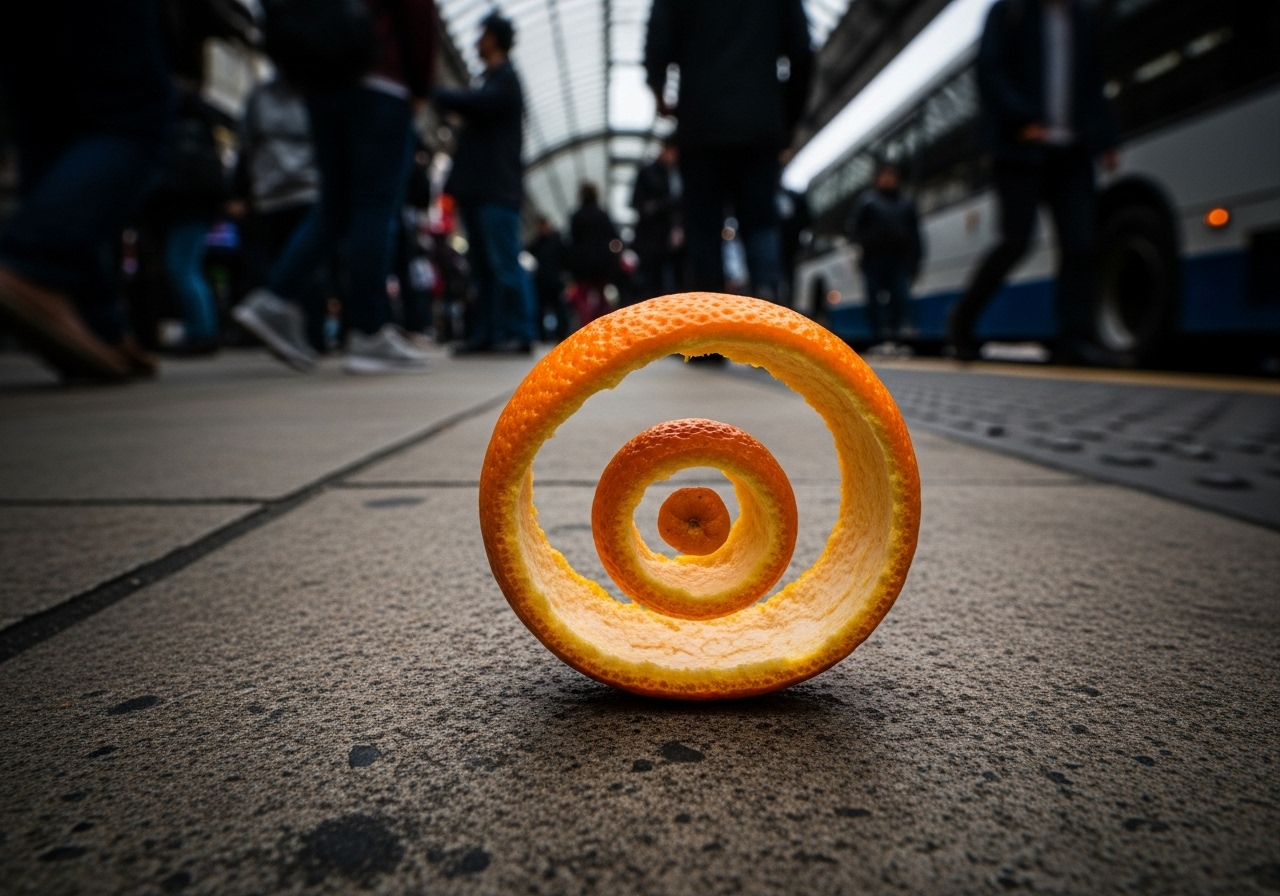
The bus pulled away, leaving me with the perfectly spiralled orange peel and the subtle scuff mark, a cryptic message left behind by a girl with blue hair, still wondering if I was meant to decipher it or merely observe its silent presence.
Share This Story


