The Box Under the Stairs
Andrew discovers a disturbance in his quiet home—a misplaced Christmas ornament that triggers a surreal deviation from the season.
It began with a sound that had no business existing in April. It was the distinct, hollow scritch-roll of thin glass on hardwood, a sound belonging to deep winter, to the aftermath of cats and clumsy children. Andrew sat up in his bed. The morning light was watery and pale, filtering through the blinds in horizontal slashes that illuminated the dust suspended in the air. The air smelled of damp earth and tulips, the cloying scent of the garden waking up after the long freeze. Spring. Indisputably Spring.
But the sound persisted. Scritch-roll. Tap.
Andrew lowered his feet to the floor. His knees popped, a dry, cracking report that seemed louder than the mystery noise. He was seventy-four, and his body was a catalogue of minor structural failures. He reached for his dressing gown, the wool heavy and scratchy against his thinning skin, and tied the cord with trembling fingers. He did not call out. Who would he call to? The house had been silent for three years, save for the refrigerator’s hum and the settling of the foundation.
He shuffled into the hallway. The runner rug was worn threadbare down the centre, a path eroded by decades of footsteps—his, Martha’s, the dog’s. All gone now, leaving only the path. And there, resting against the skirting board near the top of the stairs, was the source of the noise.
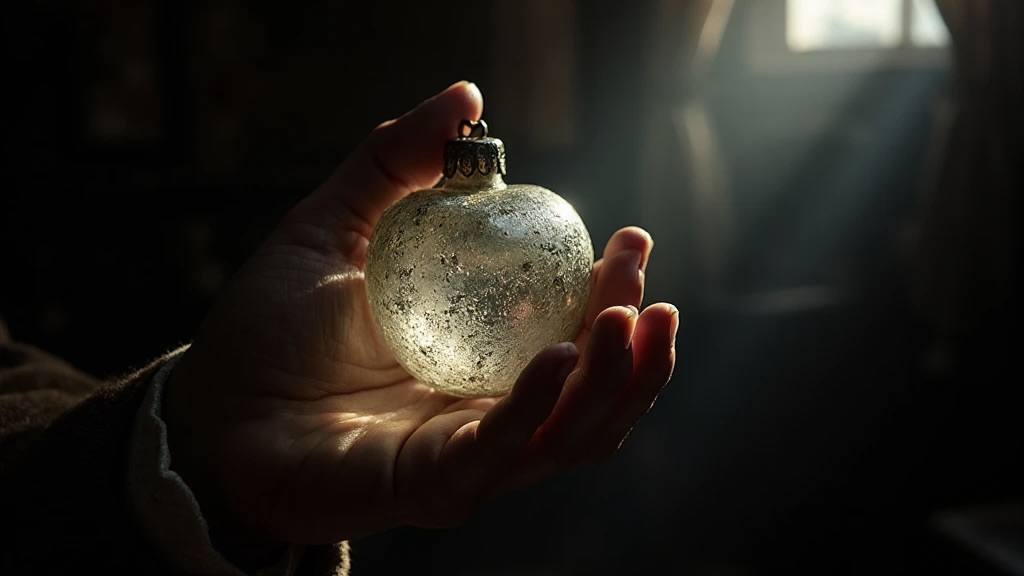
A silver bauble. A vintage mercury glass apple, tarnished with age, its metal cap askew.
Andrew stared at it. He had packed the Christmas decorations away in January. He remembered the satisfying snap of the plastic tote lids. He remembered hauling them up the attic ladder, his breath wheezing in the cold attic air. There was no logical reason for this ornament to be here, sitting in the hallway like a dropped conversation.
He bent down, the blood rushing to his head in a dizzying wave, and picked it up. It was freezing. Not just cool to the touch, but ice-cold, as if it had been sitting in a snowbank. He held it to his eye. The silvered surface distorted his reflection, stretching his face into a grotesque, weeping moon.
"Curious," he whispered. His voice sounded rusty, unused.
The air in the hallway shifted. The smell of tulips vanished, replaced instantly by the sharp, resinous tang of pine and woodsmoke. A shiver walked down Andrew’s spine. The hallway stretched, or perhaps his vision tunnelled, making the door at the far end seem miles away. He felt a sudden, crushing weight of melancholy, a physical pressure on his chest that was both terrible and strangely comforting. It was the feeling of 4:00 PM in December, when the light fails and the world feels small.
He knew what he had to do. The logic of it was slippery, dream-logic, but it was undeniable. The house was confused. The house needed to be reminded of the time, or perhaps, the time needed to be corrected.
---
The attic hatch groaned as he pushed it open. Dust drifted down, not like dirt, but like grey snow. It tasted of old paper and dried lavender. Andrew climbed the ladder, the glass apple tucked safely in his pocket. The attic was usually a place of dry storage, oppressive in its stillness, but today it felt like a waiting room. The shadows in the corners seemed to breathe, expanding and contracting with a slow, rhythmic pulse.
He found the tree box. It was a cardboard coffin, taped shut with yellowing packing tape. He dragged it toward the hatch. It felt lighter than he remembered, or perhaps he was stronger. Adrenaline, or something like it, hummed in his veins.
Downstairs, in the living room, he cleared the space in front of the bay window. Outside, a robin hopped across the greening lawn, pulling at a worm. The contrast was violent—the vibrant, aggressive life outside against the preserved, artificial winter he was about to construct inside. He felt like a curator of a museum that was closing down.
There was a knock at the door. Three sharp raps. Precision.
Andrew froze. He wasn't expecting anyone. He smoothed his hair, tightened his dressing gown, and went to the door. Standing on the porch was Jared, his neighbour from two doors down. Jared was a tall, skeletal man who always wore a three-piece tweed suit, regardless of the weather. He held a cane topped with a silver skull.
"Good morrow, Andrew," Jared said. His voice was deep, theatrical, projecting as if to the back row of an auditorium. "The air carries a peculiar charge today, does it not?"
Andrew blinked. "Jared. It is... unexpected to see you."
"The wind whispered of needles and tinsel," Jared said, stepping inside without being invited. He bypassed Andrew and walked straight to the living room, his cane tapping a staccato rhythm on the hardwood. He stopped before the cardboard box. "Ah. The great resurrection. I thought as much."
"I found an ornament," Andrew said, closing the door. The sunlight from the window seemed to bend around Jared, avoiding him. "In the hallway. It was cold."
"A harbinger," Jared declared, turning to face him. His eyes were milky blue, unblinking. "The calendar is a tyrant, Andrew. We are often slaves to its linear march. But occasionally... occasionally, we are granted a reprieve. A loop. Shall we proceed?"
"It seems necessary," Andrew replied, falling into the cadence of the conversation. It felt like a script he had memorized long ago but forgotten until this moment. "Though I fear I am unprepared. The sherry is not decanted."
"We shall survive on atmosphere alone," Jared said, waving a hand. "Open the sarcophagus."
Andrew cut the tape. The flaps parted with a sigh. inside, the artificial boughs lay compressed, their green plastic needles flattened by months of darkness. He began to pull them out. As he touched them, the room temperature dropped. Frost began to fern across the inside of the bay window, obscuring the view of the blooming cherry tree outside.
"Section A," Andrew announced, holding up the base.
"The foundation of the world," Jared intoned. He took the metal stand and set it on the floor. "Plant it deep, Andrew. The soil here is thin."
They worked in silence for a time, stacking the sections of the tree. It was a meditative act. Snap, fluff, arrange. Snap, fluff, arrange. With each branch Andrew spread, a memory unlocked in his mind, vivid and hallucinatory. He saw Martha laughing in 1982, wearing a red sweater that smelled of cinnamon. He saw his daughter, small and sticky-fingered, crying over a broken candy cane in 1994. The memories didn't play out in his head; they projected onto the walls, flickering like silent films.
"The ghosts are lively," Jared observed, adjusting a branch. "They approve of the disruption."
"It is not disruption," Andrew corrected, his hands deep in the plastic foliage. "It is alignment. I feel... I feel that I have been waiting for this since January."
The tree stood complete. It was a dark, jagged silhouette against the frosted window. It looked wrong, undeniably. A Christmas tree in daylight, in spring, is a melancholy object. It looks naked, exposed. But as the frost thickened on the glass, blocking out the sun, the room dimmed into a twilight gloom.
"The adornments," Jared said softly.
Andrew brought out the second tote. This one held the true treasures. The lights, the baubles, the wooden soldiers. He plugged in the string of lights. Half of them were dead, leaving dark gaps in the strand.
"Imperfection is the hallmark of humanity," Jared noted. "String them. Let the darkness breathe."
Andrew wound the lights around the tree. The working bulbs cast a warm, amber glow that didn't reach the corners of the room. The shadows in the corners were growing taller, stretching toward the ceiling like smoke.
He picked up the glass apple he had found in the hallway. He hung it on a prominent branch. It spun slowly, catching the amber light.
"Do you remember the year of the great snow?" Andrew asked, picking up a wooden bird ornament. "Ninety-six?"
"I remember the silence," Jared replied. "The way the world stopped. We are approaching that silence again, Andrew. Can you feel it?"
"I can," Andrew said. He felt lightheaded. His arthritis, usually a constant grinding companion, had faded. He felt untethered, as if gravity were losing its hold on him. "Is this... is this senility, Jared? Am I losing my mind?"
Jared laughed, a dry, rattling sound. "Senility is a medical term for when the veil gets thin. You are not losing anything. You are finding. Look at the tree."
Andrew looked. The tree was changing. The plastic needles were darkening, becoming organic. He could smell the sap, sharp and sticky. The trunk was rough bark. The ornaments weren't just hanging; they were growing from the branches like strange, glittering fruit.
"It is becoming," Andrew whispered.
"It is remembering," Jared corrected.
They continued to decorate. Andrew hung a ceramic star that his mother had made. He hung a string of popcorn that should have rotted years ago but looked fresh and white. With every object placed, the room stretched further. The ceiling seemed to recede into darkness. The walls moved back. The furniture—the armchair, the television, the bookshelf—looked tiny and far away, like dollhouse furniture.
Andrew reached into the box and his hand brushed against something soft. A velvet pouch. He pulled it out. It was heavy.
"The heart," Jared said, leaning on his cane. "Open it."
Andrew undid the drawstring. inside was a heavy, lead crystal teardrop. He held it up. It was flawed, full of bubbles and inclusions, but it caught the light and shattered it into a thousand rainbows. He moved to hang it, but his hand stopped.
"It doesn't belong here," Andrew said. The thought wasn't his, but it was true.
"No," Jared agreed. "The tree is hungry, but it is picky. That one is too heavy for these branches. It belongs... elsewhere."
Andrew looked at the tree. It was full, bowing under the weight of a lifetime of collected trinkets. But the top... the top was bare. The spike of the tree pointed accusingly at the darkness above.
"The topper," Andrew said. "I don't have the angel. The angel broke. Last year. Or ten years ago. I swept the porcelain dust into the bin."
"A tree without a crown is a sentence without a period," Jared said. "It is unfinished. The ritual cannot close."
Andrew felt a panic rise in his throat. If he didn't finish the tree, the room would stay like this—stretched, cold, full of ghosts. He would be trapped in this amber twilight forever. "I have nothing else. The box is empty."
Jared tapped his cane on the floor. The sound echoed as if they were in a cathedral. "Think, Andrew. The season is Spring. What rules the Spring?"
"Growth," Andrew said. "Life."
"And where is the life?" Jared pointed with a bony finger towards the front door. The frost on the bay window had not touched the front door. Through the small window in the door, Andrew could see the green, vibrant light of the afternoon sun.
"Outside," Andrew said.
"The tree is indoor winter," Jared said. "But to finish it, to seal the loop and close the door on the ghosts, you must crown it with Spring. You must bring the outside in."
Andrew looked at the glass apple on the branch. It reflected the room—the vast, cavernous dark, the glowing tree, and the two small, old men standing before it. It looked like a world trapped in a bubble.
"I have to go out," Andrew said. The thought terrified him. He hadn't left the house in weeks. The world outside was fast, loud, and full of people who looked through him. But the tree demanded it.
"A quest," Jared said, bowing low. "How chivalric. I shall guard the fortress."
Andrew walked to the hallway. The runner rug seemed to stretch for miles. He put on his coat, an old tweed thing that smelled of mothballs. He put on his flat cap. He felt like an explorer donning his gear for an expedition to the pole.
He opened the front door. The air hit him like a physical blow—warm, humid, smelling of wet asphalt and blooming lilac. The contrast with the frozen living room made his eyes water. The street was quiet, but the trees lining the sidewalk were exploding with green leaves.
He turned back to look at Jared. The neighbour was standing by the tree, his silhouette stark against the glowing lights. He looked less like a man and more like a scarecrow made of shadows.
"What am I looking for?" Andrew asked.
"You will know it when it bleeds," Jared said enigmatically.
Andrew stepped onto the porch. He looked at the garden. The daffodils were nodding their yellow heads. Too common. The tulips were too gaudy. He needed something ancient. Something that held the weight of the transition.
He walked down the path. His shoes crunched on the gravel. He realized he was still holding the lead crystal teardrop in his hand. He shoved it into his pocket.
The neighbourhood was changing as he walked. The houses on either side seemed to be leaning away from him. The fences were taller. The silence was absolute; no cars, no distant sirens, just the sound of his own breath and the wind in the leaves.
He turned the corner towards the small wooded park at the end of the street. He used to walk the dog there. It was a scrubby little patch of woods, mostly second-growth maple and unruly blackberry bushes. But today, the trees looked immense. Their trunks were thick pillars of grey and black, their canopy a solid roof of green.
He stepped off the pavement and onto the dirt path. The city noise vanished completely. He was in a deep, primeval forest. The light here was green and filtered, swimming with pollen.
He needed a star. Or something like it.
He walked for what felt like hours, though his watch had stopped at 4:00. His legs didn't hurt. He felt lighter with every step, shedding the weight of his age like an old snake shedding its skin. He saw a flash of white in the undergrowth.
He pushed through the ferns. They were wet and brushed against his trousers like cold fingers.
There, in a clearing, was a bush he didn't recognize. It was thorny, its branches twisted like barbed wire. And in the centre, growing from the highest thorn, was a single, white blossom. It was shaped like a star, five-pointed and perfect. It glowed with its own inner light.
Andrew reached out. The thorns looked sharp enough to pierce bone.
He hesitated. To take the star was to damage the living thing. But the tree in the parlour was waiting. The ghosts were waiting. He had to finish the ritual.
He gripped the stem. The thorns bit into his thumb. A drop of blood welled up, bright red against the white flower. "You will know it when it bleeds," Jared had said.
He snapped the stem. The sound was like a gunshot.
The forest went silent. The wind stopped. Andrew held the flower. It was warm, pulsing against his palm. He turned back towards the way he had come, but the path was gone. The ferns had closed ranks. The trees had shifted.
He wasn't in the park anymore. He was somewhere else entirely.
He clutched the crystal teardrop in one pocket and the bleeding star in his hand. He knew then that the star was not in the house at all; it was waiting for him out in the thrumming, green violence of the spring woods.
He knew then that the star was not in the house at all; it was waiting for him out in the thrumming, green violence of the spring woods.
Share This Story


