The Long Walk Home
Leon and Sam fight against a severe drop in temperature while walking home from school, discussing the futility of creative effort in a town focused on survival.
The wind didn't howl. That was a lie people told in books. The wind here just pushed. It was a heavy, invisible hand shoving Leon backward, trying to knock him into the hard-packed snowbank. He leaned into it, chin tucked inside the scratchy wool of his scarf. His eyelashes were already sticking together. Every time he blinked, he had to force them apart. It felt like glue.
"Hurry up," Sam said. Sam was five steps ahead, a black shape in a puffy jacket that was too big for him. He walked with his head down, shoulders hunched up to his ears. He looked like a beetle fighting a current.
"I'm coming," Leon said. The words got swallowed by the wool. He adjusted the blue plastic bag in his left hand. His mitten was thick, but the plastic was slippery. He had to squeeze hard to keep it from flying away. Inside the bag was the sketchbook. It was the coil-bound kind, ninety-nine cents from the pharmacy. The cover was cardboard, but the paper was okay. If you didn't press too hard. If you pressed too hard, the pencil went right through.
They turned the corner onto Pine Street. The streetlights were already on, buzzing with that sick orange light. It was only four in the afternoon, but the sky was the color of a bruised knee. Purple and grey and fading fast. The town felt closed. Shut down. The houses were dark boxes with snow piled up to the windowsills. Smoke went straight up from the chimneys, thin white lines that vanished.
Leon’s boots made a dry squeak on the road. It was too cold for the snow to be wet. It was like walking on Styrofoam.
"My dad says it’s gonna hit minus forty tonight," Sam shouted back. He didn't turn around. "With the windchill."
"It feels like it," Leon mumbled. The cold was stinging the strip of skin between his toque and his scarf. It felt like a burn. He switched the bag to his other hand. His fingers were starting to ache, a deep throb in the knuckles.
They passed the old hardware store. The windows were boarded up with plywood that had turned grey from the weather. Someone had spray-painted a smiley face on it years ago, but now the paint was peeling, so it looked like a skull. Leon looked at it. He always looked at it. He liked the way the black paint cracked, showing the wood underneath.
"Don't look at that," Sam said, slowing down enough to walk beside Leon. "It's ugly."
"I know," Leon said. "That's why I'm looking."
Sam snorted. A puff of white steam came out of his nose. "You're weird. It's just junk. This whole place is junk."
"It's texture," Leon said. He used the word carefully. He’d read it on the back of a paint tube at school. Texture. It sounded professional.
"It's trash," Sam corrected. He kicked a chunk of ice. It skittered across the asphalt and hit a buried fire hydrant with a hollow clack. "My uncle says they're gonna tear it down in the spring. Build a parking lot for the rink."
"They should leave it," Leon said. He gripped the bag tighter. "Or paint it. Like a mural."
Sam stopped. He turned his whole body because his coat was too stiff to just turn his neck. He looked at Leon like Leon had just said he could fly. "A mural? In this town? Who's gonna paint it? You?"
"Maybe," Leon said. He looked at his boots. The toe of the right one was scuffed, showing the white lining. "I could."
"With what?" Sam asked. He wasn't being mean. He was just being Sam. Practical. Brutal. "Paint freezes. You can't paint outside. And if you paint inside, nobody sees it. And if you paint it in the summer, the bugs stick to it. And then the winter comes and peels it off anyway."
Leon didn't answer. He knew Sam was right. The winter ate everything here. It ate the roads, cracking the pavement until it looked like a puzzle. It ate the cars, rusting out the wheel wells until they crumbled. It ate the paint off the houses.
"I drew something today," Leon said. He didn't know why he said it. The wind gusted, harder this time, slapping the back of his jacket.
Sam started walking again. "Yeah? What? Another robot?"
"No. A wolf. But... not a regular wolf. It's got... geometry. Like, lines and triangles."
"Geometry?" Sam laughed. It was a sharp, barking sound. "Like math homework?"
"No. Like... shapes. It looks cool. Mr. Henderson said it was good."
"Henderson is leaving," Sam said. He said it casually, like he was talking about the weather.
Leon stopped. The cold wrapped around his legs instantly, creeping up his jeans. "What?"
"My mom heard it at the store. He's moving back to Toronto. Says he can't take the dark. Says it messes with his head."
Leon felt a hollow spot open up in his stomach. Mr. Henderson was the only one who let Leon use the good markers. The ones that smelled like alcohol and made thick, permanent lines. "He didn't say anything."
"Why would he?" Sam shrugged. "Adults don't tell us stuff. They just pack up and go. My cousin did that. Just left his truck in the driveway and took the bus. Gone."
They kept walking. The silence between them was heavy now, filled only by the scritch-scritch of their nylon pants rubbing together. Leon looked at the blue bag. He thought about Mr. Henderson leaving. He thought about the art room, with its smell of dried tempera paint and dusty paper. It was the only room in the school that felt warm, even when the heating was busted.
If Mr. Henderson left, who would teach art? Probably Mrs. Gable. She taught math. She made them draw straight lines with rulers. She hated mess.
"Maybe he won't go," Leon said softly.
"He's gonna go," Sam said. "Everyone goes if they can. Or they stay and get weird. Like Old Man Miller. You want to end up like Miller? Collecting pop cans and yelling at the snowplow?"
"He carves birds," Leon said defensively. "I saw them. On his porch. Little wooden birds."
"They're ugly birds," Sam said. "And he smells like wet dog. That's what happens. You try to be... whatever... artistic here, and you just go crazy. The cold freezes your brain."
Leon felt a surge of anger. It was hot and sudden, burning in his chest. "It's not about the cold. It's about... seeing things."
"Seeing what?" Sam waved a mittened hand at the street. "Snow? Ice? Dead trucks? There's nothing to see, Leon. It's just white and grey. That's it."
"There's blue," Leon said. He pointed at a shadow stretching out from a telephone pole. "Look. The shadow isn't black. It's blue. Dark blue. And the sky is pink right at the bottom. And the snow on that roof is... it's almost yellow because of the streetlight."
Sam stopped again. He squinted at the shadow. He stood there for a long time, the wind whipping the fur on his hood. Then he shook his head. "It's a shadow, Leon. It's just dark. You're making stuff up."
"I'm not!" Leon shouted. The wind tore the sound from his mouth. "I'm drawing it! That's what the book is for!"
"Drawing shadows," Sam muttered. He turned and started walking faster. "That's useful. That'll get you a job at the mill. 'Hey boss, I can draw a blue shadow.'"
Leon ran to catch up. He wanted to push Sam. He wanted to shove him into the snowbank. But he couldn't risk dropping the bag. "You don't get it."
"I get it fine," Sam said. "You want to be special. But nobody is special here. We're just cold."
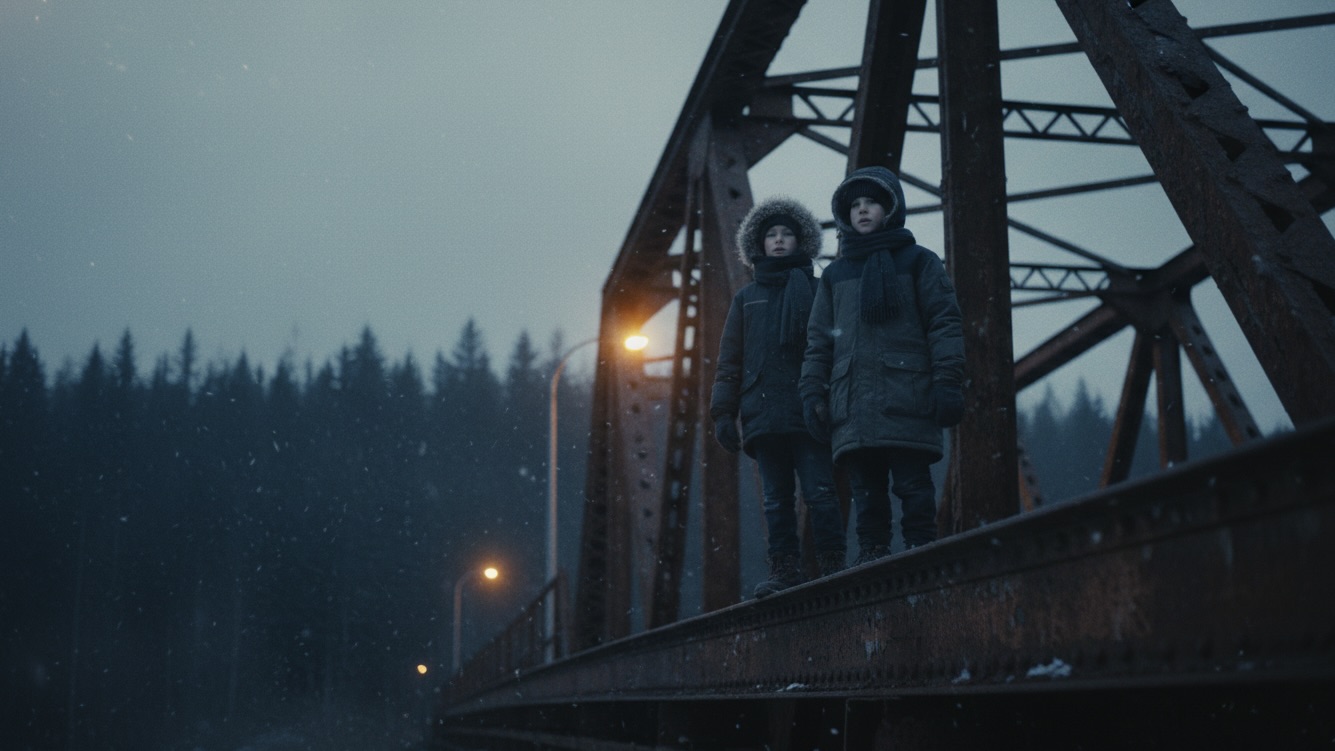
They reached the edge of the ravine. A metal bridge crossed over the creek. The creek was frozen solid, a jagged scar of ice winding through the trees. The metal railings of the bridge were coated in hoarfrost, thick and fuzzy like white mold. When they stepped onto the metal grate of the bridge, their footsteps rang out. Clang. Clang.
The wind was worse on the bridge. It came rushing down the creek bed, unimpeded. It hit them sideways. Leon staggered. His boot slipped on the metal grate.
He threw his arms out for balance. The blue plastic bag slipped from his mitten.
"No!" Leon screamed.
The bag didn't fall down. The wind caught it. It inflated like a balloon, a sudden blue sphere, and shot sideways. It skid across the metal grating, heading for the railing.
Leon lunged. He didn't think about the ice. He didn't think about his knees. He threw himself forward, sliding on his stomach.
His mitten brushed the plastic. He felt the slick surface.
But the wind was faster. It punted the bag through the gap in the railing.
Leon scrambled to his knees and looked over. The bag was dancing. It swirled down into the ravine, a bright blue spot against the endless white. It caught on a branch, flapped wildly, then tore loose and tumbled down onto the frozen creek bed.
"It's gone," Sam said. He was standing by the railing, holding on with both hands. "Leave it, Leon. It's too deep down there."
"I can't," Leon gasped. He was already climbing over the railing. The metal burned his legs through his snow pants.
"Leon, don't be stupid!" Sam yelled. There was real fear in his voice now. "The snow is deep! You don't know if the ice is thick!"
"It's minus thirty!" Leon shouted back. "The ice is thick!"
He dropped. It wasn't a far drop, maybe four feet to the slope of the bank. He landed in snow that came up to his waist. It was soft and powdery. He sank right in. The cold rushed into his boots instantly.
He started to wade. It was like moving through water. He had to lift his legs high, fighting the weight of the snow. He kept his eyes on the blue bag. It was stuck against a dead log down on the ice.
"Leon!" Sam was shouting from the bridge. "My dad is gonna kill you! He's gonna kill me for letting you!"
Leon ignored him. He was sweating inside his jacket, a cold, clammy sweat. His breath was coming in short, jagged gasps. The air tasted like metal.
He reached the bottom of the slope. The creek ice was swept clean by the wind. It was black and polished. He stepped onto it carefully. It held. It felt solid as rock.
He ran—a sliding, shuffling run—toward the log. The blue bag was fluttering, trapped by a broken branch.
He grabbed it. The plastic was torn. A long rip down the side.
He looked inside. The sketchbook was there. He pulled it out. The cover was wet with snow. He wiped it frantically with his mitten. The cardboard was dark where the snow had melted against it. He opened it.
The pages were cold. Stiff. He turned to the wolf.
It was okay. The marker hadn't bled yet. The geometric wolf stared back at him, sharp black lines against the white paper. It looked fierce. It looked like it didn't care about the cold.
Leon closed the book and shoved it under his jacket, right against his sweater. He wanted his body heat to dry it.
He looked up at the bridge. Sam was a small dark shape against the grey sky, looking down.
"You got it?" Sam yelled.
"Yeah!" Leon yelled back. His voice cracked.
"You're an idiot!" Sam shouted. "Now you gotta climb back up!"
Leon looked at the slope. It was steep. The snow was churned up where he had come down. It was going to be hard.
He stood there for a second on the ice. Down here, out of the wind, it was strangely quiet. The trees blocked the gusts. It felt like a church. Tall black spruce trees leaning in. The silence was heavy. It pressed against his ears.
He looked at the wolf in his mind. The sharp angles. The logic of it. He thought about Mr. Henderson packing boxes. He thought about the peeling smiley face.
Why did he do it? Sam was right. It was just paper. It was just lines.
But holding the cold book against his chest, feeling the sharp corner of the binding dig into his ribs, he felt something else. A kind of hardness. Not the hardness of the ice, or the hardness of the men who worked at the mill. A different kind. A secret hardness.
He started to climb. He had to use his hands to claw into the snow. His gloves were soaked. His fingers started to burn, then go numb. He kicked his toes into the bank, making steps.
It took him ten minutes to get to the top. Sam grabbed his hood and hauled him over the railing.
Leon collapsed on the metal grate, panting. White spots danced in his vision.
"You are so stupid," Sam said, panting too. "You're actually broken in the head."
"I got it," Leon wheezed.
"Let me see," Sam demanded.
Leon sat up. He unzipped his jacket a few inches and pulled out the book. He held it up. The cover was warped and bent. It looked pathetic.
Sam looked at it. He looked at Leon's red face, splotched with white frostbite marks on his cheeks.
"It's bent," Sam said.
"It's fine," Leon said. He stroked the cover. "It dries flat."
Sam shook his head. He looked angry, but he also looked... sad. He looked like an old man. "You went down there for that. For a bent book."
"It's my work," Leon said. He realized as he said it that it was true. It wasn't play. It was work. It was the hardest work he did.
"Your work," Sam repeated. He spat on the ground. The spit froze before it hit the metal. "Come on. If we stop moving, we freeze. My toes are gone."
They started walking again. The adrenaline was fading, leaving Leon shaking. His legs felt like jelly. The wet snow in his boots was melting, soaking his socks. His feet were blocks of ice.
They crossed the bridge and entered the subdivision. The houses here were smaller. Vinyl siding that cracked in the cold. Chain link fences.
"You going to tell your mom?" Sam asked.
"No," Leon said. "She'll say I'm careless."
"You are careless," Sam said. "You care about the wrong stuff."
"Maybe," Leon said.
"Not maybe. For sure. You care about drawings and shadows. You need to care about... I don't know. Real stuff. Batteries. Wood. Tires."
"Those are boring," Leon said.
"They keep you alive," Sam snapped. "Drawings don't keep you alive."
Leon thought about the wolf. He thought about the lines. He thought about how, when he was drawing it, he didn't feel the cold. He didn't feel the town closing in. He felt big. "They keep me alive," he whispered.
Sam didn't hear him. Or he pretended not to.
They reached Sam's driveway first. Sam's dad's truck was there, plugged in with an orange extension cord. The engine block heater hummed. A low, electric vibration.
"See you tomorrow," Sam said. He didn't wave. He just walked up the driveway, kicking at the snowdrifts.
"Yeah," Leon said. "See you."
Leon walked the last two blocks alone. The wind was picking up again. It rattled the stop signs. It whistled through the hydro wires. The sun was completely gone now. The sky was a flat, dead black. No stars. Just heavy clouds full of more snow.
He reached his house. The front light was out. It had been out for a month. His dad kept forgetting to buy a bulb.
Leon stood on the porch. He didn't go in right away. He could hear the TV inside. The muffled sound of the news.
He pulled the sketchbook out again. In the darkness, he couldn't see the wolf. He could only feel the warped cardboard. The cold had already set into the paper. It felt like a slab of ice.
He looked at the street. The wind blew a fine spray of snow across the asphalt. It looked like smoke. It looked like ghosts.
Sam was right. The town didn't want this. The town wanted plywood and steel and ice. It wanted things that didn't break.
Leon put the book back inside his jacket. He zipped it all the way up to his chin. He felt the cold paper pressing against his heart, chilling the blood before it could pump through him.
He put his hand on the doorknob. The metal bit into his palm.
He turned the knob, knowing that inside the warmth, the paper would thaw, warp, and perhaps never look the same again.
Share This Story


