Heat and Hardware
A sweltering afternoon in a converted garage in Northwestern Ontario, where the hum of computer fans competes with the buzzing of cicadas outside.
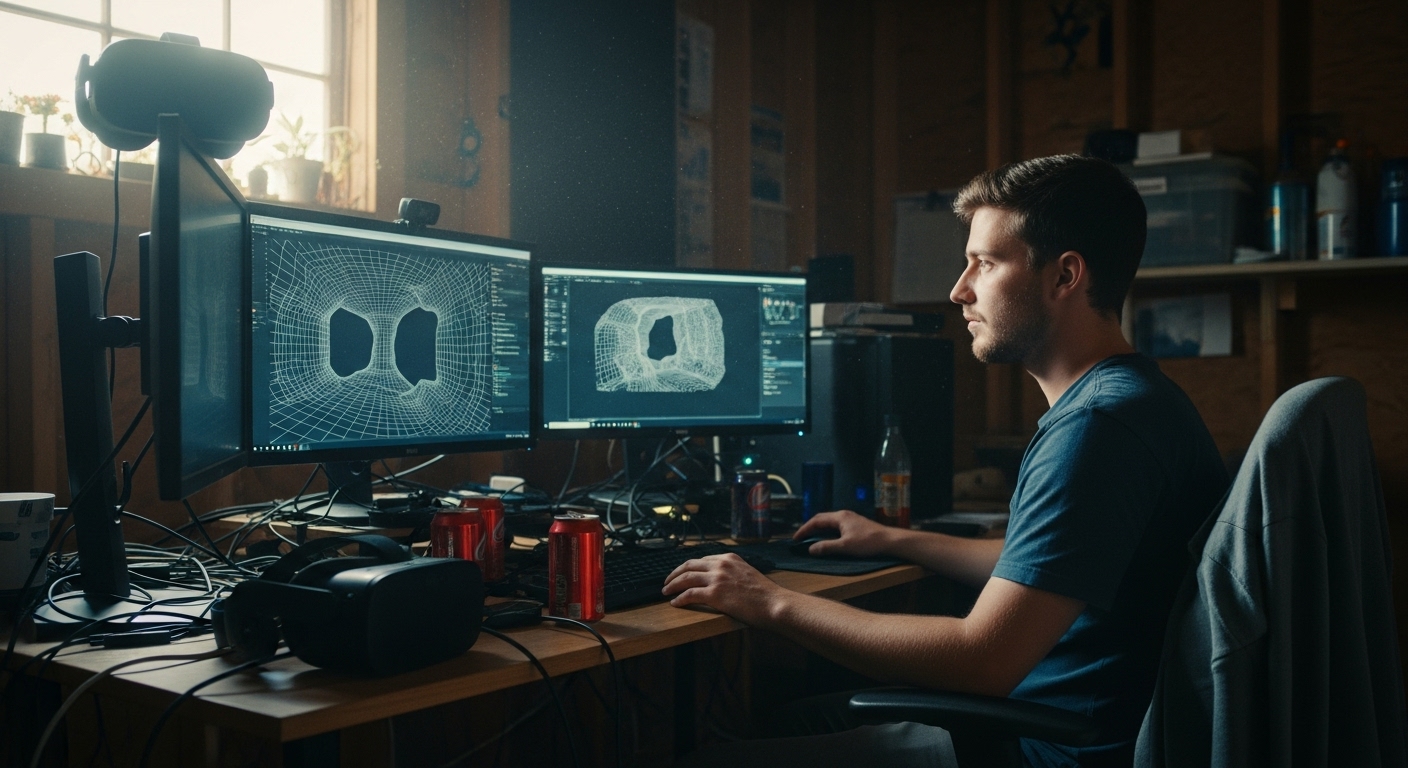
The progress bar had been stuck at ninety-eight percent for ten minutes. Sam stared at it, willing the blue pixels to inch forward, but the computer was taking its time, groaning under the strain of the render. The heat in the garage didn’t help. It was a thick, physical weight, pressing down on the roof and seeping through the insulation. July in Northwestern Ontario wasn't just warm; it was an invasion. The air smelled of hot pine needles, dust, and the faint, acrid scent of overheating plastic.
He wiped sweat from his forehead with the back of his hand, noting the grit that came away with it. They really needed to invest in an air conditioner if they were going to keep running three high-end GPUs simultaneously. But the grant money only stretched so far, and right now, it was stretched tight over licences for the new XR software and the server rack humming angrily in the corner.
Sam leaned back in the mesh chair, which squeaked in protest. Why did they decide to map the texture of granite in 8K resolution? It seemed necessary at the time. Essential, even. If you’re going to build a virtual experience about deep geological repositories, the rock has to look like rock. It has to feel heavy, even if you can't touch it. It needs to convey that sense of permanence, of something that has sat undisturbed for a billion years and will sit for a billion more.
"Is it done yet?" Mina didn’t look up from her tablet. She was sitting cross-legged on the concrete floor, surrounded by storyboards drawn on index cards.
"It's thinking about it," Sam said. "Deeply. Philosophically."
"Well, tell it to think faster. We lose the light in two hours, and I want to test the AR overlay against the actual sunset."
"You can't rush art," Ben chimed in from the audio station—a card table draped in a heavy moving blanket to dampen the echo. He adjusted his headphones, one cup off his ear. "And you certainly can't rush a graphics card that’s currently hot enough to fry an egg on. I checked. I have an egg ready."
"Don't put food on the rig, Ben," Sam said, though he didn't turn around. The fan noise was a constant drone, a white noise machine that barely masked the buzzing of horseflies battering against the window screen. "We talked about this. No biologicals near the silicon."
"It’s a metaphor," Ben said. "For the intensity of our creative process."
"It's a fire hazard," Sam corrected.
The screen flickered, blacked out for a heart-stopping second, and then refreshed. The image resolved: a hyper-realistic cross-section of the Canadian Shield, crystalline bedrock rendered with painstaking accuracy. The fissures, the quartz veins, the sheer density of it. It looked good. It looked real.
"We're up," Sam said.
Mina was at his shoulder in a second, smelling of bug spray and peppermint tea. She squinted at the monitor. "Okay. That’s... actually decent. The lighting on the feldspar? Nice touch."
"It's ray-traced," Sam said, feeling a small surge of pride. "Simulated photon pathing. It behaves exactly like light would underground, if there was light underground."
"Which there isn't," Tyler said, walking in from the side door. He carried a tray of iced coffees, the condensation dripping onto his knuckles. "That's kind of the point of a deep geological repository. Dark. Stable. Boring. Thanks for the render, though. I need it for the pitch deck."
Tyler was the one who kept them grounded in the science. While Mina wanted narrative arcs and Sam wanted polygon counts, Tyler read the hydrogeological reports from the Nuclear Waste Management Organization for fun. He was the one who reminded them that they weren't just making a sci-fi movie; they were engaging with a reality that was unfolding right under their feet.
"Grab a headset," Sam said, taking a coffee. The ice rattled against the plastic. "Let's do a walkthrough before the system melts."
---
The Beishan Connection
Twenty minutes later, they were back in reality, pulling the heavy headsets off their faces. The transition was always jarring—going from the cool, silent, echoing caverns of the virtual repository back to the humid, cluttered garage.
"The acoustics are wrong in the main tunnel," Ben said immediately, grabbing a notebook. "Too much reverb. Granite absorbs more than that, especially if we're simulating the bentonite clay buffer. It should sound... dead. heavy."
"Noted," Sam said. "I can tweak the audio occlusion."
Tyler was tapping away at his laptop, ignoring the critique. "Hey, remember how we were talking about looking for international comparisons? For the participatory research angle?"
"Yeah," Mina said, fanning herself with a storyboard. "Finland, right? Onkalo?"
"Finland is the obvious one," Tyler said. "Everyone talks about Onkalo. But look at this." He spun his laptop around. "China. The Beishan site."
Sam leaned in. On the screen was a map of Gansu province, desolate and rugged. It looked strikingly familiar. Not in the vegetation, maybe, but in the bones of the land. The rock.
"It's a dedicated deep geological repository for high-level waste," Tyler explained, his voice taking on that rapid-fire cadence he got when he found a new obsession. "Just like the Revell site here. Stable crystalline bedrock. That's the key. They aren't using salt domes or clay layers; they're betting on the granite, just like us."
"Granite is granite," Ben said. "Whether it's in Revell Township or the Gobi Desert."
"Exactly," Tyler said. "But listen to the methodology. They’re doing the exact same site characterization we see here. Hydrogeological tests, rock stability assessments, in-situ simulations. They need to know how water moves—or doesn't move—over thousands of years. It’s the same science."
Mina picked up the mouse and scrolled down the article. "Locations like these are rare," she read aloud. "'Very few places combine the right geology, depth, isolation, and accessibility.' It’s like we’re twins. Fraternal twins separated at birth by an ocean."
"And politics," Sam added. "And language."
"But the rock speaks the same language," Mina said, her eyes widening. She was doing that thing where she started directing a scene in her head. "Think about it. We’re here, obsessing over how to visualize this stuff for the community, how to make people understand the timescale of nuclear safety. There’s a group of people over there, probably our age, worrying about the exact same things."
"Lanzhou University," Tyler pointed to a header on the page. "That’s the hub. Their School of Nuclear Science and Technology. They investigate migration of radioactive materials, environmental impact, vitrification..."
"Vitrification," Ben said, testing the word. "Glass making. Turning waste into glass. That sounds cool. Sounds like something we could visualize."
"It is," Tyler said. "But look at this. They aren't just doing the hard science. They have a whole arm dedicated to training and knowledge development. They’re building infrastructure in Gansu because that’s where the industry is. Just like how the colleges around here are gearing up for the repository jobs."
Sam looked at the map again. The vastness of the region struck him. It was remote. It was serious. "So, what? We send them a postcard? 'Greetings from the other big rock'?"
"No," Mina said, dropping the mouse. "We find the artists."
---
Digital Mirrors
The search query changed. Instead of 'Beishan geology', they started typing 'Lanzhou University film media arts'.
The results populated, and the room went quiet for a moment, save for the hum of the server.
"No way," Sam said quietly.
"What?" Ben asked, leaning over the back of Sam's chair.
"Look at their research areas," Sam pointed. "'AI-Assisted Scriptwriting.' 'Virtual Production for Scene Simulation.' 'AI in Post-Production.'"
"Get out," Mina whispered. She pushed Sam aside gently to get a better look. "They're researching how VR and AR can simulate film sets and lighting conditions. That’s literally what we just did. We just built a virtual set to test the lighting for the documentary scenes."
"They're doing it to reduce costs and logistical challenges," Sam read. "And to facilitate remote collaboration."
"Remote collaboration," Tyler repeated. He looked at the group. "Do you think they mean... really remote? Like, trans-Pacific remote?"
"They're using AI for script generation too," Ben laughed. "Analyzing audience preferences. Maybe they can help us figure out why nobody liked our last short film."
"Because it was six minutes of a tree growing, Ben," Mina said absently. She was scrolling through a paper on ethical considerations in AI authorship published by scholars at Lanzhou. "This is incredible. They’re asking the same questions we are. 'How should AI authorship be credited?' 'What are the cultural impacts?' We had that argument last night over the generated dialogue for the NPC guide."
"We didn't have an argument," Sam said. "I just said that if the computer writes the line, the computer gets the credit. You're the one who got existential about the soul of the machine."
"It matters!" Mina insisted. "But look, they’re integrating radiochemistry and environmental science with this high-tech media production. Or at least, they’re in the same ecosystem. The School of Nuclear Science is right there. The media researchers are right there."
She stood up and started pacing, her hands moving as she framed shots in the air. "Okay, picture this. A participatory project. We connect with students at Lanzhou. We share our assets. We give them our scan of the Shield rock. They give us... whatever the equivalent is from Beishan. A scan of their granite."
"We build a hybrid space," Sam said, catching the thread. "A VR environment where you walk through a tunnel in Ontario and come out in a cavern in Gansu. Seamless transition. The textures blend."
"And we talk about the waste," Tyler added. "We talk about the responsibility. We interview youth here about what it means to host this facility, and they interview youth there. We use the AI translation tools to bridge the dialogue."
"Real-time translation in the headset," Sam said. "I can do that. There are APIs for that."
Ben was nodding, tapping a rhythm on the table. "The soundscape... shifting from the boreal forest—wind in the spruce, ravens—to the Gobi wind. That high, whistling sound. I can mix that. It would be... disorienting. In a good way."
"It fits the mandate," Tyler said, practically vibrating. "Arts-based research. Youth engagement. New technologies. It’s perfect. We aren't just making a movie about nuclear waste; we're using the technology of the future to talk about the waste of the future with the only other people on the planet who get it."
Sam looked at the screen, at the list of faculty and student projects at Lanzhou. It felt strange, this sudden intimacy with a place he had never visited. He imagined a guy like him, sitting in a lab in Gansu, maybe sweating through a hot summer day, staring at a render bar, worrying about polygon counts and radiation shielding materials.
"How do we reach them?" Sam asked. "Cold email?"
"Too formal," Mina said. "We’re filmmakers. We send a video."
---
The Pitch
Setup took an hour. They cleared the pizza boxes and the loose cables. They set up the 360-degree camera in the centre of the garage. They opened the big bay door to let the evening light flood in—the golden hour that every photographer chased, though they called it 'the magic window' to avoid clichés.
The light hit the dust motes dancing in the air, turning the messy workshop into something almost cathedral-like. The server rack blinked its blue LEDs in the background, a reminder of the processing power lurking behind the rustic setting.
"Okay," Mina said, standing behind the tripod. "We keep it simple. We introduce ourselves. We show the rig. We show the rock. We tell them we know about Beishan. We tell them we know about their AI research."
"Should we speak slowly?" Ben asked.
"Speak normally," Sam said. "We'll subtitle it. And we'll use that AI dubbing tool we've been testing to generate a Mandarin track. It won't be perfect, but it’ll show we did our homework."
"Ready?" Mina asked.
Sam stood next to Tyler. He felt ridiculous and important all at once. They were four kids in a garage in the middle of the Canadian bush, about to hail a frequency across the world.
"Rolling," Mina said.
"Hi," Sam started, looking into the fisheye lens. "We're... well, we're a media collective from Northwestern Ontario. We're standing on the Canadian Shield."
Tyler held up a chunk of core sample, a cylinder of grey and pink granite heavy in his hand. "This is two and a half billion years old," Tyler said. "It's stable. It's solid. And we know you have rock just like this."
"We're building a virtual repository," Sam continued. "Using Unreal Engine, photogrammetry, and LIDAR scans. We read about your work at Lanzhou University. The virtual production stuff? The AI scriptwriting? We're doing that too."
"We want to collaborate," Mina said, stepping into the frame. "We want to build a bridge between Revell and Beishan. A digital bridge. We want to know what the future looks like from where you're standing."
They rambled a bit. Ben made a joke about the heat which probably wouldn't translate. But the energy was there. It was raw and honest. They finished by panning the camera around the workshop, showing the monitors, the VR headsets, the mess, the life.
"Cut," Mina said.
"Do you think they'll reply?" Ben asked, starting to coil a cable.
"They're researchers," Tyler said. "They're curious by definition. And we just proposed the coolest cross-cultural study they've probably ever seen. If they don't reply, I'll fly there myself and knock on the door."
Sam sat back down at his desk. The render was finally done. He clicked 'Save'. The file was massive. A gigabyte of data representing a hole in the ground that didn't exist yet, but would outlast civilization.
He opened the video editor and imported the footage they had just shot. "I'll have a rough cut by midnight," he said. "Mina, you draft the email text. Tyler, find the specific contact for the School of Nuclear Science and the media department. We copy everyone."
"Shotgun approach," Tyler nodded. "I like it."
---
Cooling Down
By 10:00 PM, the air had finally started to cool. The cicadas had quieted down, replaced by the rhythmic chirping of crickets. The garage door was still open, letting in the smell of damp grass and the cooling asphalt of the driveway.
They sat on the concrete lip of the garage, passing around a bag of chips. The computers inside were finally sleeping, the fans silent.
Sam looked out at the tree line. It was just shadows now, jagged shapes against a sky that was holding onto the last bruised purple of twilight. Beneath those trees, beneath the soil, was the rock. The Shield. It went down for kilometres. Solid. Unmoving.
He thought about the Beishan site. He imagined the Gobi. Dry, wind-scoured, vast. But underneath, the same stability. The same silence.
It was strange to think that the most advanced technology they possessed—neural networks, real-time rendering, immersive XR—was being used to understand something as primal as stone. They were using light to study darkness. They were using the ephemeral—code that could be deleted in a keystroke—to plan for the eternal.
"You know," Mina said softly, breaking the silence. "If this works... if we actually build this thing with them... it’s going to be huge."
"It's going to be a nightmare to render," Sam said, cracking a smile. "Two distinct geological biomes in one scene? My GPU is going to file a union grievance."
"Worth it," Ben said. He tossed a pebble into the darkness. It skittered across the driveway.
"Yeah," Sam agreed. "Worth it."
He pulled his phone out and checked the time. It was morning in Lanzhou. The students there would be waking up, grabbing coffee or tea, walking to the lab. Maybe one of them was sitting down at a computer right now, checking their inbox.
Sam felt a sudden, sharp connection to that unknown counterpart. A shared anxiety about the future, a shared excitement about the tools they had to shape it. They were the stewards of the new fire, trying to figure out how to bury the ashes of the old one.
He stood up and brushed the crumbs from his jeans.
"Let's send it," Sam said.
The cursor blinked in the text field, a tiny, rhythmic pulse waiting for the first word that would bridge seven thousand miles of rock and wire.
Share This Story


