The Garage
Jimmy visits Simon in his converted garage studio during a harsh Northwestern Ontario deep freeze to confront him about a stalled portfolio and their stalled relationship.
It wasn't just cold; it was the kind of temperature that felt personal, like the atmosphere had a specific grudge against exposed skin. Jimmy sat in his Honda Civic, the engine idling with a rough, uneven shudder that vibrated up through the seat and into his spine. The heat was on full blast but only managed to push lukewarm air around his knees. He stared at the garage door in front of him. Peeling white paint, a rusted handle, a sticker that said ‘SUPPORT LOCAL LOGGERS’ half-scraped off near the bottom.
He shouldn't be here. He should be at home, formatting the PDF for the Toronto grant application. The deadline was forty-eight hours away, and his artist statement still read like a suicide note written by a pretentious teenager. “Exploring the liminal spaces of rural decay.” Garbage. Absolute garbage. He knew it, the jury would know it, and the trees outside, standing like frozen sentinels of indifference, definitely knew it.
But the silence in his apartment had gotten too loud. That specific, ringing silence you only get in the north when the snow absorbs every sound from the highway and leaves you with nothing but the hum of the refrigerator and your own spiraling thoughts. So, he drove here. To Simon. Because Simon was the only other person in a fifty-kilometer radius who understood that trying to make art in this town was like trying to grow orchids in a meat locker.
Jimmy killed the engine. The silence rushed in immediately, heavy and suffocating. He grabbed his toque, jammed it over his ears, and stepped out. The air hit him like a physical slap, smelling of woodsmoke and exhaust. He crunched through the hard-packed snow to the side door of the garage and didn't bother knocking. You didn't knock for Simon. It implied a formality that had dissolved between them somewhere around the tenth grade.
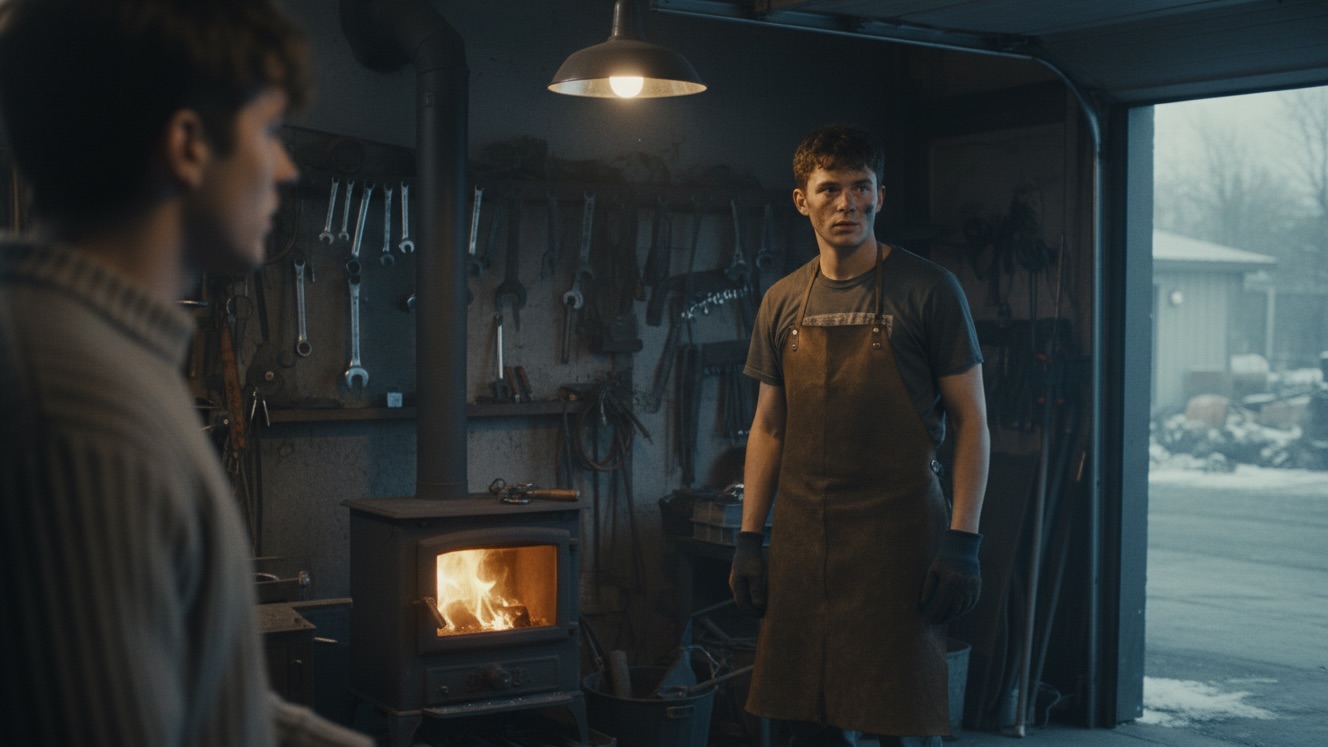
The inside of the garage was a violent assault on the senses compared to the gray stillness outside. It was hot, aggressively so, fed by a cast-iron wood stove in the corner that was glowing a dull, menacing red. The air tasted metallic—burning copper, flux, and the oily scent of old chainsaws. And music. Loud, thrashing punk rock vibrating off the corrugated metal walls.
Simon was hunched over a workbench, back to the door, welding mask flipped down. Sparks showered around him in a chaotic fountain, bouncing off his leather apron. He looked like a demon tending a very specific, mechanical hellfire.
Jimmy kicked the door shut, the latch rattling. He stood there for a second, letting the heat thaw the numbness in his cheeks. He watched Simon work. There was an annoying competence to the way Simon moved. Efficient. The guy could weld a delicate seam on a scrap metal sculpture with the same hands that fixed logging skidders during the day. It was unfair. It was attractive. Jimmy hated it.
He walked over and killed the boombox. The silence that followed was ringing, punctuated only by the hiss of the acetylene torch as Simon released the trigger.
Simon didn’t jump. He just turned off the gas, flipped the mask up, and turned around. His face was streaked with soot, sweat matting his dark hair to his forehead. He looked tired. He always looked tired lately.
“You killed the vibe, Jules,” Simon said. His voice was rough, scraping the bottom of his register. He grabbed a rag from the bench and wiped his neck, leaving a streak of grease.
“The vibe was hearing loss,” Jimmy said, leaning against a stack of winter tires. He crossed his arms, tucking his hands into his armpits to warm them. “How can you think in here?”
“I don't. That’s the point.” Simon tossed the rag down and picked up a water bottle, draining half of it in one go. He eyed Jimmy over the plastic rim. “You look manic. The grant?”
“The grant,” Jimmy confirmed. “It’s a disaster. I have twelve photos of snowbanks that look like… well, snowbanks. And an essay that uses the word ‘juxtaposition’ three times in the first paragraph.”
Simon snorted. “Only three? You’re losing your touch. Throw in ‘ephemeral’ and you’ve got a bingo.”
“I’m serious, Si. It’s bad. I’m going to send it in, they’re going to laugh at it, and I’m going to be working at the Esso station until I die of lung cancer or boredom.”
Simon leaned back against the workbench, crossing his ankles. He was wearing those heavy work pants that were stiff with grease and stiff with cold, heavy boots that clunked when he shifted. “The Esso isn't that bad. Dave lets you eat the expired hot dogs.”
“I hate you.”
“You love me. I have heat.” Simon gestured vaguely around the clutter of the shop. It was a graveyard of metal. Old transmission gears, rebar, twisted sheets of tin roofing. Simon took the junk the town threw away—the literal refuse of industry—and twisted it into these jagged, haunting shapes. Birds made of saw blades. Wolves made of wire. It was brilliant. It was gritty. It was everything Jimmy’s soft, over-thought photography wasn't.
“Move,” Jimmy said, walking past him to the wood stove. He held his hands out to the radiating warmth. “My landlord keeps the thermostat at sixty-two. I think he’s cryogenically freezing me to save on rent control issues later.”
“Put on a sweater.”
“I am wearing a sweater. I’m wearing two.” Jimmy turned to face him. The heat was searing his backside now, a welcome pain. “Why aren’t you panicked? You have the sculpture submission for the Thunder Bay gallery due on Friday.”
Simon shrugged, picking up a wrench and turning it over in his hands. “It gets done or it doesn’t. Panicking doesn’t weld faster.”
“That’s a lie. You panic. You just do it internally where it gives you ulcers.”
Simon smirked, a quick, crooked expression that cracked the grime on his face. “You know me so well. It’s gross.”
“Someone has to.” Jimmy watched him. The garage felt smaller suddenly. The air between them was always thick, charged with something Jimmy refused to name because naming it would make it real, and if it was real, he’d have to deal with it. “Show me what you’re working on.”
Simon hesitated. He looked at the twisted mass of metal on the bench, then back at Jimmy. “It’s not finished.”
“Since when do you care? Show me.”
Simon stepped aside. Jimmy moved closer, squinting against the harsh overhead shop light. It was… a hand. Or, the suggestion of a hand. Made of heavy chain links welded rigid, reaching up, fingers grasping at nothing. But the wrist was shackled to a heavy, rusted brake drum. It looked painful. It looked desperate.
“Subtle,” Jimmy deadpanned, though his chest tightened looking at it. It was exactly how he felt. Stuck. Heavy.
“I’m calling it ‘The Rent is Due’,” Simon said dryly.
Jimmy laughed, a sharp sound that bounced off the metal walls. “God. We’re such clichés. Tortured artists in the frozen north.”
“speak for yourself. I’m just a guy with a welding torch and too much scrap metal.” Simon moved closer, reaching past Jimmy to grab a file from the bench. His arm brushed Jimmy’s shoulder. The contact was brief, accidental, but it sent a jolt through Jimmy that had nothing to do with static electricity.
Jimmy didn't move away. “You’re good, Simon. You know that, right? This is… it’s good.”
Simon paused, the file in his hand. He looked at the sculpture, his expression unreadable. “Does it matter? It’s going to sit in a gallery in Thunder Bay for three weeks, maybe some tourist buys it for their cottage in Muskoka to look ‘rustic’, and then I’m back here fixing skidders.”
“It matters,” Jimmy said, fiercely. “It has to matter. Otherwise, what are we doing?”
Simon turned to him then, fully. His eyes were dark, rimmed with fatigue. “We’re living, Jules. We’re paying bills. We’re freezing our asses off. Not everything has to be a grand statement.”
“Easy for you to say. You have a trade. You can fix things. I just… observe things. And lately, all I’m observing is that I’m twenty-three and I’ve never lived anywhere that doesn’t have winter for six months of the year.”
“Toronto has winter.”
“It’s slush. It’s not this.” Jimmy gestured at the walls, at the implied world outside. “This is… hostile. It eats people, Simon. It eats ambition.”
Simon stepped into his space. He smelled of sweat and iron. “Is that what you think? That I’ve been eaten?”
Jimmy looked up at him. Simon was taller, broader. He took up space in a way Jimmy never could. “I think you’re comfortable being unhappy here. And that scares me.”
Simon went still. The playful glint in his eyes vanished. “Comfortable? You think I like waking up at 5 AM to thaw pipes? You think I like smelling like diesel every day?”
“Then leave! Come with me. If I get this grant—”
“If,” Simon cut in sharply. “And if you don’t?”
“Then I’ll go anyway. I’ll figure it out. Wait tables. Whatever.”
“And leave me here.” It wasn’t a question. It was a statement, flat and heavy.
Jimmy swallowed. The heat from the stove was making him sweat under his layers now. “You could come.”
“I can’t weld in a condo, Jimmy. I can’t afford a studio in the city. My life is here. My dad’s shop is here.”
“Your dad’s shop is failing.”
“Yeah, well, it’s still mine to fail.” Simon turned away, picking up the file and aggressively rasping it against a rough weld. Scritch. Scritch. Scritch. The sound was grating.
Jimmy watched his back. The tension in his shoulders. The way the muscles in his forearm flexed with every stroke of the file. He wanted to reach out and stop him. He wanted to shake him. He wanted to kiss him. The confusion of impulses made him dizzy.
“You’re terrified,” Jimmy said quietly. “You’re scared that if you leave, you’ll realize you’re not the big fish anymore. You’re just another guy with a torch.”
Simon spun around, slamming the file down. “Shut up.”
“Make me.”
It was a stupid thing to say. childish. provocative. The air in the garage snapped tight. Simon glared at him, his chest heaving slightly. For a second, Jimmy thought Simon might actually hit him. Or throw him out.
Instead, Simon laughed. It was a harsh, humorless sound. “You’re such a brat. You come in here, insult my life, insult my work ethic, just because you’re blocked on some essay?”
“I’m not blocked. I’m having an existential crisis. There’s a difference.”
“The difference is about forty dollars an hour in therapy fees.” Simon shook his head, the anger draining out of him as quickly as it had come, replaced by that weary resignation. “Grab a beer. Fridge under the bench.”
Jimmy hesitated, then sighed. He walked over to the mini-fridge covered in stickers, crouched down, and pulled out two cans of cheap lager. He cracked one and handed it to Simon, then opened his own. The aluminum was painfully cold against his fingers.
“Thanks,” Simon muttered, taking a long pull. He wiped his mouth with the back of his hand. “Look. Your photos aren't garbage. You have a good eye. That shot of the abandoned motel? The one with the broken neon sign? It’s great.”
“It’s depressing,” Jimmy corrected, leaning back against the bench next to him. Their shoulders were touching now. Neither moved. “It’s poverty porn.”
“It’s honest,” Simon said. “That’s what makes it good. You’re not trying to make it look pretty. You’re showing what it is. That’s why you should send the application. Even if the essay is bullshit.”
Jimmy stared at his boots. “I don’t know if I can take the rejection. Not right now. It feels like… if they say no, then this is it. This is the rest of my life.”
“It’s not,” Simon said softly. “You’re twenty-three, you idiot. Nothing is the rest of your life yet.”
“Feels like it.”
Simon turned his head, looking down at Jimmy. The shop light cast deep shadows under his eyes, making his cheekbones look sharper. “You’re too dramatic. It’s the isolation. It makes everything feel like a Greek tragedy.”
“Maybe I like tragedy.”
“You like attention,” Simon corrected, nudging him with his shoulder. “And you like complaining.”
Jimmy smiled, reluctantly. “I’m good at it.”
“World class.” Simon took another sip of beer. “Read me the statement.”
“No.”
“Read it. I’ll tell you if it’s actually garbage or if you’re just in a spiral.”
Jimmy groaned, tilting his head back to look at the rafters. Dust motes danced in the light—no, not dust motes. Sawdust. Gritty, throat-scratching sawdust. “I don’t have it with me.”
“Liar. It’s on your phone. You have it open right now, don’t you?”
Jimmy fished his phone out of his pocket. The screen was cracked in the corner. He unlocked it, the blue light harsh in the dim garage. “Fine. But if you laugh, I’m pouring this beer into your welder.”
“I’d kill you. Go ahead.”
Jimmy cleared his throat. He felt exposed, stripped raw. Reading his writing to Simon was more intimate than being naked. “Okay. ‘In the vast, silence of the boreal shield, identity becomes fragmented. My work seeks to document the erosion of the self against the permanence of the landscape…’”
He stopped. He looked at Simon. Simon was staring at him, intense and unblinking.
“Well?” Jimmy asked, defensive. “It’s bad, right?”
“It’s… a little intense,” Simon admitted. “But it sounds like you. It sounds like how you talk when you’ve had three whiskeys and start ranting about the government.”
“Is that a compliment?”
“It means it’s authentic. Erosion of the self. That’s good. That’s what it feels like here sometimes. Like the wind is slowly sanding you down until there’s nothing left but bone.”
Jimmy looked at him, surprised. “Exactly. That’s exactly it.”
“See? You know what you’re doing.” Simon bumped his shoulder again. “You just need to stop overthinking the words and let the pictures do the work.”
“I hate that you’re right.”
“I’m always right. It’s my burden.” Simon finished his beer and crushed the can in one hand. The sound was loud, final. He tossed it into a recycling bin that was overflowing with metal scraps. “Stay for dinner? I have leftover chili. It’s spicy enough to kill the bacteria from the spoon.”
Jimmy checked the time. He should go home. He should finish the application. But the thought of his empty apartment, the silence, the cold… it was unbearable. “Yeah. Okay. But I’m not eating with a dirty spoon.”
“Suit yourself. I think I have a plastic fork somewhere.”
Simon moved away to stoke the fire, opening the stove door. The orange glow illuminated his face, softening the harsh angles. Jimmy watched him, feeling that familiar ache in his chest. The longing to be closer, to be part of that warmth. He wondered if Simon knew. He wondered if Simon felt it too, in the spaces between their arguments, in the static on the line between them.
Jimmy took a sip of his beer. It tasted like metal and hops. He looked at the sculpture again—the hand, chained and reaching. He understood it now. It wasn't just about rent. It was about reaching for something you couldn't quite touch, held back by the weight of where you were.
“Hey, Si?”
“Yeah?” Simon poked at the logs with a blackened iron rod.
“If I go… if I leave… you know I’ll come back, right? I wouldn't just vanish.”
Simon didn’t look up. The fire popped, a sharp crack. “People always say that, Jules. They say they’ll come back for Christmas. Then it’s just for funerals. Then… they just stop coming.”
“I’m not people.”
Simon closed the stove door. The room plunged back into semi-darkness, lit only by the overhead bulb. He stood up, wiping his hands on his pants. He looked at Jimmy, and for a moment, the mask was gone. He looked young. Scared.
“I know,” Simon said quietly. “That’s what I’m afraid of.”
He turned and walked toward the small door at the back of the garage that led to the kitchenette. “Come on. Chili’s getting cold. Or… staying cold. Whatever.”
Jimmy stayed by the bench for a second longer. He looked at his phone, the cursor blinking at the end of his sentence. Erosion of the self. He thumbed the screen off, sliding it into his pocket. He looked at the empty space where Simon had been standing. The heat from the stove was still radiating, reaching him across the room.
He followed Simon into the dark, leaving the welding torch cold on the bench, wondering if he was walking towards a future or just another warm place to hide.
Share This Story


