Dust and Lantern-Glow
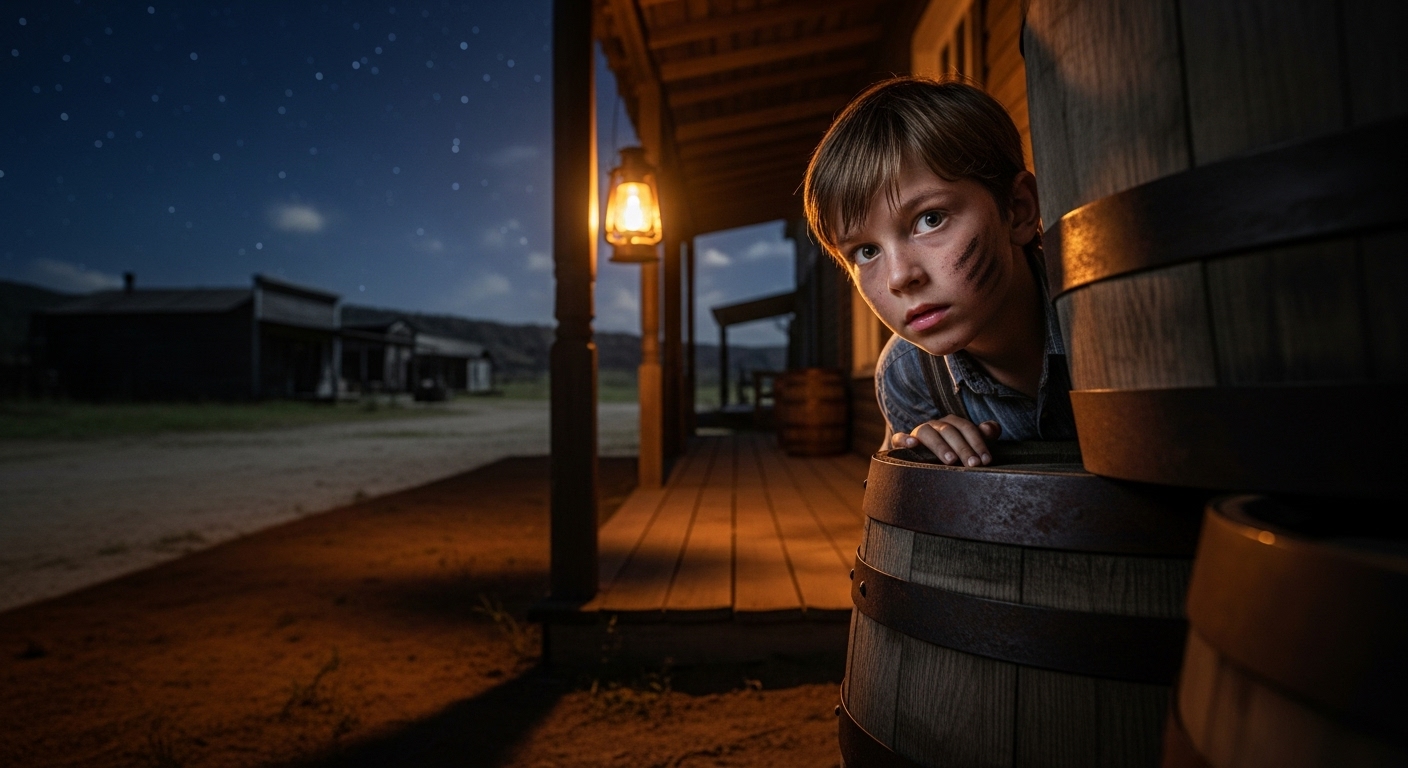
The oppressive heat of a late summer day lingered, trapping itself within the wooden walls of the small cabin. Outside, the dust held the last faint warmth, and the air hung heavy and still, smelling faintly of dry earth and distant sagebrush. A single, battered lantern threw a weak, flickering circle of light across the porch of the general store, outlining the worn planks and the heavy silence of the frontier night.
Isaiah couldn’t sleep. The air felt thick, pressed against his skin like a damp cloth. He kicked a leg out from under the thin blanket, found no relief. His arm, flung across his forehead, stuck slightly. Sleep. People talked about it like it was a gift, a soft river. For him, tonight, it was a bolted door. He heard his mother’s low, rumbling snores from the other side of the thin wall, then his father’s heavier, irregular breathing. A scratchy sound, like a mouse under the floorboards. Or maybe just the house settling. It always did that at night, as if the wood itself had secrets it was trying to work out.
He imagined the sun, already a hot blister on the horizon, just waiting to climb, to bake everything dry again. He hated summer nights sometimes. They felt… too long. Too much space for thoughts that weren’t useful, like the way the lantern light always seemed to flicker just when he wanted to read the small print on the almanac. Or the way the dust danced in the one beam of sunlight that ever made it through the crack in the window in the mornings. No, not motes. Just… dust. Floating.
His gut gave a little flutter. Outside. He could go outside. Just for a bit. Dad would whip him good if he found out. Mom would get that quiet, disappointed look that was worse than any whipping. But the cabin felt like a box, sealed tight, the air used up. The thought pressed in. Just a breath of cool air. Even if it wasn’t really cool. It would be different. That was enough.
He eased himself off the cot, the straw mattress rustling like a hundred tiny whispers. Bare feet on the rough-hewn floorboards. A splinter waiting, always. He moved like a ghost, past the rough-hewn table, past the shelf with the few books and the half-eaten loaf of day-old bread. The door creaked. He froze, one hand on the cold iron latch. Nothing. Only the familiar night sounds: a distant coyote, the faint creak of the windmill, a single cricket chirping with relentless optimism.
He slipped out, pulling the door shut with a soft click that still seemed too loud. The air outside was heavy, yes, but it wasn’t used. It carried the scent of dry grass, a faint whiff of horse, and something else, something metallic and sharp, like the distant memory of a lightning storm. His eyes adjusted, seeing the world in shades of grey and deep blue. The moon, a half-eaten biscuit in the sky, cast long, distorted shadows of the stable, the general store, the empty street.
His breath hitched, a small, involuntary thing. He was out. Really out. A strange, prickly feeling of both fear and a wild kind of freedom washed over him. He started walking, not sure where he was going. The dust felt soft under his bare feet, cool at first, then quickly warming from the residual heat. He scuffed his toes, sending up little clouds that dissolved into the still air.
He passed the saloon, its windows dark and silent, smelling faintly of stale beer and something sweet, like old wood and spilled sugar. He knew better than to linger there. His father's warnings, barked out with a stern face, were etched into his memory. But tonight, it was just a building, a silent, slumped beast in the moonlight.
He ambled towards the general store, a place usually bustling with chatter and the clatter of goods. Now, it stood quiet, a solid block against the muted skyline. He felt a pull, a curiosity that tugged him forward. He could see a faint, yellow light spilling from the small, uncurtained window at the back. Martha, the owner, sometimes worked late, counting coin or mending things.
Isaiah approached cautiously, his footsteps almost silent in the deep dust. He edged around a stack of empty crates, smelling old apples and mildewed canvas. Peeking around the corner, he saw them. Not Martha inside, but Martha and Jedediah outside, sitting on the edge of the store's porch, where a single, battered oil lantern hung from a hook, swaying just slightly in a breeze that only seemed to touch the flame.
Jedediah, the rancher from the north road, looked smaller than he did during the day, slumped forward, his wide-brimmed hat resting on his knees. Martha, usually so straight-backed and brisk, had her shoulders slightly rounded, her hands clasped.
"It’s the heat, Jedediah," Martha said, her voice low, almost a murmur. "Dries everything out."
Jedediah grunted. He picked up a loose piece of wood from the porch floor, ran his thumb over its rough grain. "Ain’t just the heat. It’s… the way things are."
Isaiah didn't understand "the way things are." Things just were. The sun rose, the sun set, the dust got everywhere.
"You got more time than you think," Martha offered, a small crack in her voice. "The creek bed ain’t fully dry yet. There’s still a trickle."
Jedediah shook his head, a slow, heavy motion. "A trickle for the next man, maybe. Not for forty head." He tossed the wood piece aside, and it landed with a soft thump in the dust. "Prices ain’t holding. Not with what’s coming in from up north."
Isaiah watched, feeling like a shadow that didn’t belong. He understood "prices" – his mother always talked about them, usually with a sigh. But "forty head"? He imagined forty angry heads of cattle, bellowing, demanding water. He giggled, a tiny, soundless puff of air, then clamped a hand over his mouth.
Martha sighed. It was a long, tired sound. "What about the well? That old one near the cottonwoods?"
"Dry as a preacher's sermon in August," Jedediah muttered. He rubbed his temples with a calloused hand. "Could try and dig it deeper, but… that takes coin. And muscle. And I ain't got either to spare."
A moment of silence stretched between them, thick and heavy like the night air. Isaiah felt it, a pressure, even if he didn't grasp its full meaning. He could feel the weight of Jedediah's tiredness, Martha's quiet worry. It seeped into the ground, into the very air.
"I could… extend it," Martha said, her gaze fixed on something in the distant darkness, perhaps the rising hills. "A few more weeks on the feed. Just till the rains, if they come."
Jedediah looked up, his eyes catching the lantern light. They looked red-rimmed, weary. "Martha, you already…" He trailed off, shaking his head again. "I can’t. It wouldn't be right."
"Right and wrong," Martha said softly, "sometimes they ain't the same as just trying to make it through another month. What's right is keeping your stock alive. Keeping you going." Her voice was still quiet, but it had an edge, a firmness Isaiah hadn't heard before. It wasn't angry, not exactly, but it was strong, like the roots of the old cottonwood tree by the creek.
Jedediah looked down at his hat again, turning it slowly in his hands. "I'll pay you, Martha. Every last cent."
"I know you will," she said. She reached out, just for a second, and touched his forearm. A quick, light touch, then her hand retracted. "Just… try for that well. See what comes up."
Isaiah blinked. He understood "pay" and "cent," but the way they said it, the way Martha touched Jedediah's arm, it wasn't about money. Not really. It was something else, something that hummed beneath their words like a low, quiet drone. It was about… giving, even when you didn’t have much to give. And taking, even when you knew it was a heavy thing to take.
---
A twig snapped nearby. Isaiah froze, his heart leaping into his throat. He pressed himself against the rough wood of the crates, trying to become one with the shadows. Had he been seen? Was it a stray dog? A bat? His eyes darted, searching the darkness beyond the lantern's reach. He held his breath, tasting the dust on his tongue, the metallic tang of fear.
Jedediah and Martha didn't seem to notice. They were still sitting there, silent now, just two figures in the pale moonlight, weighted by the unspoken things between them. The lantern continued its slow, hypnotic swing.
After what felt like an eternity, but was probably only a minute or two, Isaiah risked a glance back. Nothing. The twig must have been just a twig. A branch falling, maybe. The night was full of such small, sudden noises. He realised his legs ached from crouching, his cheek was pressed uncomfortably against a rough plank.
He looked at Jedediah and Martha again. They weren't talking. Just sitting. Waiting. For what, he didn't know. For the sun? For a sign? He felt a strange sort of fullness in his chest, a mix of relief and something else, something he couldn't name. The kind of feeling when you saw something you shouldn’t, something private, but it wasn't bad. Just… real.
He slowly, carefully, began to back away, keeping low, moving with the quiet precision he had learned from countless games of hide-and-seek. The cool dust puffed around his feet with each step. He didn’t look back again, didn’t want to disturb the quiet scene he’d stumbled upon. It felt important, fragile.
The walk back felt different. The town wasn't just buildings and empty spaces now. It was a place where people sat in the dark, talking about things that weren't simple, things that were hard. Where quiet promises were made, and heavy burdens were shared. The smell of the horse stable, usually just a smell, now carried a hint of Jedediah's worry. The cricket's chirp seemed less optimistic, more like a lone voice in a vast silence.
He reached his cabin, the door looking just as it had when he left it. He turned the latch, slipping inside. The familiar smells of dried sage and old cooking grease met him. He eased the door shut. His parents were still breathing their heavy, rhythmic sleep. He made his way back to his cot, pulling the thin blanket over him.
The straw mattress rustled again, but this time, he didn't mind. The heat was still there, but it didn't feel as oppressive. His mind raced, replaying Martha’s quiet voice, Jedediah’s slumped shoulders, the quick touch of her hand. He didn’t have all the pieces. Not nearly. But he had enough to know that the world outside the cabin, even at night, held more than just darkness and rules. It held… a kind of complicated kindness. And that was a bigger, stranger thing than any story his dad told about desperadoes or gold strikes. He closed his eyes, but sleep didn't come, not yet. He was too busy piecing together the scuff marks on the evening.
The knowledge he’d gathered, thin as a spider’s silk, was now a knot in his belly, something heavy and real that the morning sun wouldn't burn away, leaving him to wonder what else the quiet, dusty world held just beyond his sight.
Share This Story


