The Scrapyard
A sweltering afternoon in a cluttered industrial lot where a collaborative art piece has been destroyed.
The heat didn't just sit on the town; it pressed down with a thumb, pinning everything to the cracked asphalt. It was ninety degrees in the shade, if you could find any, and the air smelled of hot pine needles and burning transmission fluid. Cole wiped the back of his neck with a rag that was already greased black. He stood in front of the chain-link fence, staring at the gap where the padlock used to be.
The chain lay in the dirt, cut clean. Not a bolt cutter job. An angle grinder. Someone had taken their time. The sparks would have been visible from the road, a shower of orange against the blue-black dark of 2 AM, but nobody stopped in this town for sparks. They stopped for deer, or cops, or the occasional hitchhiker if they looked desperate enough, but sparks in an industrial park were just part of the scenery.
Cole pushed the gate. It screamed on dry hinges. He walked into the yard, his boots crunching on gravel and bits of twisted metal. The humidity made his t-shirt stick to his spine. He didn't want to look, but he had to. He had to know how bad it was.
The Shed—a corrugated tin shack they rented for two hundred bucks a month—was open. inside, the heat was a physical wall. And there it was. The sculpture. Three months of welding, scavenging, and arguing.
They had called it 'The Shield'. A stupid name. Lynne had hated it. She wanted to call it 'Scrap 44' or something utilitarian, but Cole had insisted on something that sounded like it meant something. Now, it didn't matter.
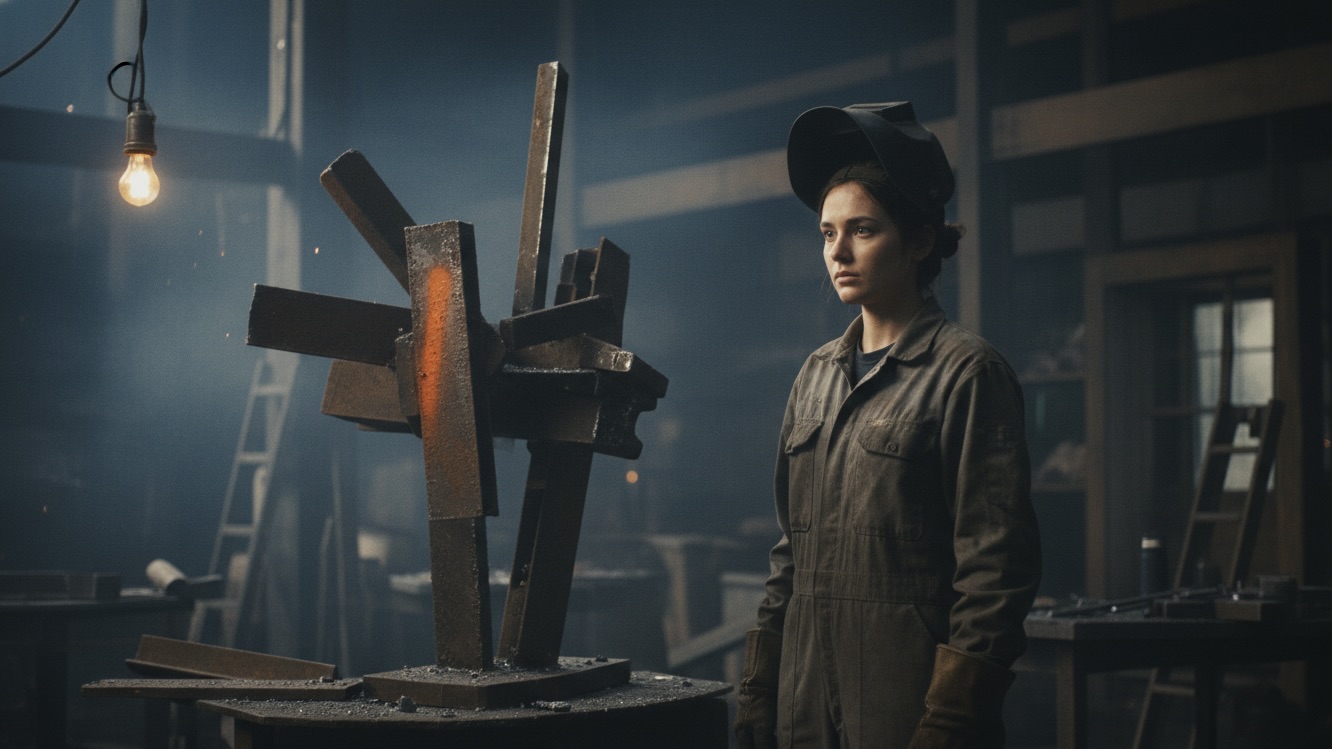
The vertical beams, sourced from the wreckage of the old pulp mill, were bent. Someone had taken a sledgehammer to the delicate latticework in the center. The copper wiring they’d spent weeks stripping from abandoned houses was gone, ripped out, leaving jagged scars in the steel. But the worst part wasn't the theft. It was the paint.
Bright, neon orange spray paint. A crude, jagged line drawn across the center, and a single word scrawled on the concrete floor beneath it: JUNK.
Cole felt a hollow thud in his chest. Not surprise. Just a dull, confirming ache. He reached for his phone, his thumb hovering over Lynne’s contact. She was going to kill someone. Not literally, probably, but the energy she carried was kinetic, dangerous. She worked at the auto body shop down on Oliver Road, fixing dents in F-150s for guys who didn't think she could hold a wrench.
He dialed. It rang four times before she picked up.
"Yeah?" Her voice was flat. Shop noise in the background. An impact gun whirring.
"You need to come to the shed," Cole said.
"I'm on shift, Cole. I got a bumper to sand."
"Lynne. The gate was cut."
The line went silent. The impact gun stopped. "I'm leaving now."
Cole hung up. He sat on an overturned bucket, staring at the orange paint. A fly, fat and iridescent, buzzed around his head, landing on his sweat-slicked forearm. He swatted it away. The silence of the yard was heavy, broken only by the distant hum of the trans-Canada highway, the lifeline that bypassed the town's rot but fed its gas stations.
He remembered the argument they’d had last week. Lynne standing right there, sparks flying from her MIG welder, mask flipped up, sweat dripping off her chin.
'Why are we doing this, Cole?' she’d asked, wiping soot from her forehead. 'Who’s gonna look at this? The squirrels? Old man Miller when he comes to dump his trash?'
'It’s for the portfolio,' he’d said, the lie tasting like copper in his mouth. 'For the grant.'
'There is no grant,' she’d snapped, flipping the mask back down. 'There’s just us, playing pretend in a junkyard.'
Maybe she was right. Maybe the vandal had just done some editing.
Twenty minutes later, a rusted Silverado pulled up. The muffler was held on by coat hangers and hope. Lynne got out. She didn't slam the door; she just let it swing shut. She was wearing her coveralls, tied at the waist, a grey tank top stained with grease underneath. Her hair, dark and heavy, was pulled back in a messy knot.
She walked past him without a word, stepping into the shed. She stood there for a long time. Her boots were steel-toed, heavy, caked in Bondo dust. She looked at the bent beams. She looked at the missing copper. She looked at the orange paint.
Cole watched her shoulders. He expected them to tense, expected her to kick the wall. Instead, she just slumped. A fraction of an inch. The air went out of her.
"Copper heads," she said quietly.
"Yeah. Probably."
"They didn't have to bend the frame, though. That was just... for fun."
"Or spite," Cole offered.
Lynne turned. Her face was hard, angles sharp in the harsh light coming through the door. Her eyes were dark, tired. She didn't look mystical or tragic. She looked like someone who had just finished a ten-hour shift sanding rust and didn't have the energy to scream.
"Spite implies they know who we are," she said. "They don't. We're just the weirdos storing trash in the shed."
She walked over to the sculpture and ran a gloved hand over the spray paint. It was still tacky. "Done last night. Or this morning."
"I was gonna call the cops," Cole said, though he knew he wouldn't.
Lynne laughed. It was a dry, barking sound. "For what? Vandalism of refuse? They'd fine us for operating an illegal studio in a commercial zone. You know that."
She kicked a loose bolt across the floor. It skittered and hit the far wall with a clink.
"So what do we do?" Cole asked. "Fix it?"
"Fix it?" Lynne looked at him like he was insane. "It's structural, Cole. The heat warp on those beams... we'd have to cut it apart and start over. I don't have the gas for that. I stole the last tank of argon from the shop and boss is already asking questions."
She sat down on the concrete floor, ignoring the dirt. She pulled a pack of cigarettes from her pocket, lit one, and blew the smoke toward the roof. The blue haze mingled with the dust motes dancing in the sunbeams.
"I hate this town," she said. It wasn't a scream. It was a fact. Like stating the sky was blue or the lake was cold.
Cole sat opposite her, leaning against the workbench. "You always say that."
"Because it's always true. It eats people, Cole. It chews them up and spits them out grey. Look at my dad. Thirty years at the mill, and now he just sits on the porch watching cars go by. He used to carve wood. Did you know that? Made these intricate little bears. Now he can't hold a knife because his hands shake too much from the vibration of the saw."
Cole picked at a splinter in the wood of the bench. "We're not your dad."
"Aren't we?" Lynne gestured around the shed. "We're hiding in a shack making things nobody wants, hoping a gallery in Toronto discovers us by telepathy. It's delusional."
"It's practice."
"It's masturbation," she countered, ash falling on her jeans. "It's just something to do so we don't have to admit we're stuck."
The heat seemed to rise. The smell of the spray paint was giving Cole a headache. It smelled like acetone and artificial fruit. He looked at the word JUNK again.
"I think I know who did it," Cole lied. He didn't know. He just wanted to shift the conversation away from the truth she was spilling.
Lynne looked at him, one eyebrow raised. "Yeah? Who?"
"Those kids from the high school. The ones who hang out at the quarry. I saw them buying orange paint at Canadian Tire yesterday."
"You saw kids buying paint. In a hardware store. That's your lead?" Her sarcasm was corrosive.
"It's something."
"It's nothing. And even if it was them, what are you gonna do? Go beat up a bunch of sixteen-year-olds?" She took a long drag. "Let 'em have it. Maybe they enjoyed breaking it more than we enjoyed making it. At least someone got some emotion out of the damn thing."
Cole stood up, agitated. He paced the small space. "So that's it? We just leave it?"
"I didn't say that."
"Then what?"
Lynne stood up slowly. She walked over to the corner where the tools were scattered. She picked up the angle grinder. She checked the cord. It was cut, too. Of course.
"We need a generator," she said. "And a new grinder."
"I have a grinder at home," Cole said. "But no power here now. They must have tripped the breaker or cut the line outside."
"Check the box."
Cole went outside, squinting against the glare. The electrical box on the side of the shed was pried open. The fuses were gone. Stolen. Copper again.
"Gone," he called out.
Lynne emerged from the shed, blinking. "Figures."
She walked over to her truck and dropped the tailgate. She sat on it, legs dangling. "You got any beer?"
"In the cooler. Probably warm."
Cole retrieved two cans of generic lager from the Styrofoam cooler in the corner. They were lukewarm, sweating condensation. He handed one to Lynne. She cracked it open, the foam spilling over her knuckles. She didn't wipe it off.
They sat in silence for a while, drinking the bad beer, watching the heat waves shimmer off the gravel.
"My cousin is moving to Winnipeg," Lynne said suddenly. "Says there's work framing houses."
"Winnipeg's cold," Cole said.
"It's a city. Cities have galleries. Real ones. Not coffee shops that hang paintings next to the bathroom."
"You gonna go?"
She shrugged. "I don't know. I got the truck payments. And Dad... he's not good, Cole. He forgets to eat if I don't put the plate in front of him."
Cole nodded. That was the trap. It wasn't just the money; it was the guilt. The tangled roots that went down into the Canadian Shield granite and held you fast. Leaving felt like amputation.
"I tried to paint the Sleeping Giant yesterday," Cole admitted. The Sleeping Giant was the massive rock formation in the bay, the icon of the region. Every artist painted it. It was a rite of passage and a cliché all at once.
"And?"
"It looked like a bruise. Just a big, purple bruise on the water. I couldn't get the light right. It always looks too romantic in pictures. But when you look at it, really look at it, it's just... hard. Indifferent stone."
"That's the Noir talking," Lynne smirked. "You read too many depressing books."
"Maybe. Or maybe the landscape is just hostile."
"The landscape doesn't care, Cole. That's the point. It was here a billion years before us and it'll be here a billion years after. We're just moss. Temporary."
She crushed her can. "Let's go to the quarry."
"Why?"
"If it was those kids, maybe they're there. And if not... I need to swim. I have grit in my teeth."
They took her truck. The air conditioning was broken, so they drove with the windows down, the wind whipping Lynne's hair around her face. They drove past the strip malls, theTim Hortons, the abandoned paper mill that looked like a skeletal cathedral of rust. The town thinned out into spruce forest, the trees pressing in close to the road.
The quarry was an old excavation site filled with rainwater and groundwater. It was deep, cold, and technically trespassing, which meant half the town swam there. When they pulled up, there were three other cars. A rusted Civic, a new F-150, and a van with a mattress in the back.
They got out. The noise hit them—music, shouting, the splash of bodies hitting water. It was a visceral, chaotic scene. Teenagers sunning themselves on the flat rocks like lizards. A few guys drinking beer on the tailgate of the Ford.
Cole scanned the crowd. He didn't recognize anyone specific, just the types. The hockey players, the burnouts, the girls trying to look older than they were.
"See any orange paint?" Lynne asked, her voice low.
Cole looked. He looked at hands. Fingernails. Shoes.
"There," he whispered.
A kid, maybe seventeen, skinny, wearing oversized swim trunks. He was sitting on a rock near the water's edge. There were faint orange smudges on his ankles, like he'd sprayed his shoes and missed.
Lynne narrowed her eyes. She started walking down the slope. Cole grabbed her arm.
"Lynne, wait."
"Get off me."
"What are you gonna do? Scream at him? Look at his friends." He nodded toward the group of guys by the truck. They were bigger than the kid. Bigger than Cole.
Lynne shook him off but didn't keep walking. She stood there, vibrating with tension. "He wrecked our work, Cole. He thinks it's funny."
"It is funny to him. That's the problem. We can't make him care."
She stared at the kid. The kid laughed at something his friend said, throwing his head back. He looked completely unburdened. He didn't have a mortgage, or a sick dad, or a portfolio that was going nowhere. He just had a summer afternoon and a can of stolen paint.
"I hate him," Lynne whispered. "I hate him because he's happy."
"He's not happy," Cole said. "He's bored. There's a difference."
Lynne turned away, walking back toward the truck. "I'm not swimming with them."
"Where then?"
"The Point. The rocky side. Nobody goes there because of the leeches."
"Great. Leeches."
They drove another ten minutes down a logging road that threatened to tear the suspension out of the Silverado. The Point was a jagged finger of rock jutting into the big lake. The water here was colder, darker. The waves slapped against the granite with a rhythmic, wet violence.
They sat on the rocks. Lynne took off her boots and dipped her feet in. The water was clear, terrifyingly so. You could see the drop-off, the shelf where the light just stopped.
"My grandmother used to say the water takes what it wants," Lynne said, staring down. "She wouldn't let us swim past the drop-off."
"Smart woman."
"She wasn't mystical about it. She was practical. Cold water cramps your muscles. You sink. You die. Physics."
Cole watched a water strider fight the current. "I think I'm gonna quit the gas station."
Lynne looked at him. "And do what?"
"I don't know. Maybe go back to school. Or just leave. Go west."
"You won't."
"Why not?"
"Because you're scared you'll get there and realize you're mediocre. At least here, you can pretend the town is holding you back. If you go to Vancouver and fail, that's on you."
Cole felt a flush of anger, hot and sharp. "Thanks. Really supportive."
"I'm not here to support you, Cole. I'm here to tell you the truth. That's what friends do."
"Maybe I don't want the truth right now. My art just got spray-painted with the word junk."
"It was junk," Lynne said softly. "That's what we're not admitting. It was derivative. We were trying to make something that looked like 'art' instead of making something that felt like... this."
She swept her hand out toward the grey water, the jagged rocks, the oppressive sky.
"This is ugly," Cole said.
"It's real. The mosquitoes, the rust, the boredom. That sculpture? It was too clean. Too desperate to be liked. The vandal... in a messed up way, he finished it. He added the town to it. The orange spray paint? That's the most honest part of the piece."
Cole thought about that. The garish, neon slash across the rusted steel. The violence of it. The disrespect.
"So we leave it?" he asked.
"No. We take it back," Lynne said, a strange light entering her eyes. "We don't clean it. We weld it in. We clear-coat the spray paint. We bend the other beams to match the damage. We make it look like it survived a car crash."
"That's dark."
"This is a dark place, Cole. Stop painting sunsets. Paint the bruise."
She stood up, energized now. The lethargy was gone. "Come on. I know where we can get a generator. My uncle has one in his shed. He won't miss it for a few hours."
They drove back into town as the sun began to dip, casting long, bruised shadows across the highway. The light turned golden, but it wasn't warm; it was just illuminating the dust on the dashboard. They stopped at the uncle's place—a bungalow with peeling siding and a yard full of dead grass. Lynne hopped out, ran around back, and returned five minutes later dragging a red Honda generator.
"He saw me," she said, breathless, loading it into the bed. "He just waved. Thought I was borrowing it for a bush party."
Back at the shed, the shadows were deep. The interior was a cave. They set up the generator outside, the hum of the engine drowning out the crickets. Lynne ran the extension cord. She plugged in the grinder.
She put on her mask. "Stand back."
Sparks flew. Not the polite, contained sparks of a classroom demonstration, but a violent geyser of molten metal. She attacked the sculpture. She cut into the bent beams, scarring them further. She ground the edges of the spray paint until it looked burned into the metal skin.
Cole grabbed a hammer. He didn't ask. He just started hitting the untouched side of the frame. Clang. Clang. Clang. The sound rang in his ears, a discordant bell. He dented the pristine steel. He smashed the delicate joints. He felt a release, a loosening of the knot in his chest. He was destroying it, but he was also making it.
They worked for hours. The shed filled with smoke and the smell of ozone—no, not ozone—the smell of burning iron and stale sweat. The heat didn't break. It just got heavier, thicker.
When they stopped, it was fully dark outside. The only light came from the single bulb hanging from the rafters and the dying glow of the welds.
The sculpture stood in the center of the room. It was a wreck. It looked like a ribcage pulled from a fire. The orange JUNK was still there, but now it was framed by grind marks and burns, turned into a title rather than an insult.
Lynne took off her mask. Her face was streaked with soot. She looked exhausted, but her eyes were clear.
"Better," she said.
Cole looked at it. It was ugly. It was terrifying. It looked like something that belonged in this town.
"Yeah," he said. "Better."
"What do we call it now?" Lynne asked, wiping her hands on a rag.
Cole looked at the neon tag. "'Local Colour'."
Lynne snorted. "Too clever."
"'Friday Night'."
"Maybe."
She walked to the cooler and fished out the last two beers. They were warm as soup now. She handed one to him.
"We're not getting that grant," she said.
"No."
"And nobody is going to buy this."
"Nope."
"Good."
She leaned against the doorframe, looking out into the dark yard. The mosquitoes were swarming the light bulb, a frantic, living cloud. The generator sputtered and died, running out of gas. Silence rushed back in, heavy and ringing.
Cole stood beside her. He could smell the lake on the wind now, a faint scent of rotting weeds and cold water beneath the industrial fumes.
"I'm not leaving," Lynne said quietly. "I can't. My dad... he doesn't know how to use the microwave half the time."
"I know."
"But you should go, Cole. Seriously. Before you start liking the smell of burning plastic."
Cole didn't answer. He looked at his hands. They were stained with grease and rust, the dirt worked deep into the fingerprints. He thought about the application form sitting on his desk at home, the one for the art college in Vancouver. He hadn't filled it out.
He looked at the mutilated sculpture in the dark. It had a strange, menacing power. It felt like his.
"I'm not going anywhere," he said.
Lynne looked at him. She didn't smile. She just nodded, a small, sad acknowledgment of a shared sentence.
"Okay," she said. "Then clean up the floor. I'm not slipping on metal shavings tomorrow."
She walked out to her truck. The engine coughed to life, a rattle of loose valves. She reversed, the headlights sweeping across the yard, illuminating the cut fence, the weeds, the absolute nothingness of the industrial park.
Cole watched her taillights fade. He turned back to the shed. He didn't clean the floor. He just turned off the light and closed the door, leaving it unlocked. If they wanted to come back and finish the job, let them. There was nothing left to break that hadn't already been broken.
He walked to his own car, the gravel crunching loud in the silence. The humidity hadn't broken. The storm that had been threatening all day never came. It just hung there, suspended, waiting.
The storm that had been threatening all day never came. It just hung there, suspended, waiting.
Share This Story


