The Ridge Line
Three friends haul heavy camera equipment up a steep granite outcrop in the heat of a Northwestern Ontario summer, intending to film a message for their collaborators in China.
"If you drop that, I’m leaving you here. I mean it. I’ll drive the Civic back to Thunder Bay and tell your mom you walked into a swamp."
"I’m not gonna drop it, Roger. It’s taped to my hand. Literally. Look at the gaffer tape."
"It looks loose. Re-tape it."
"It’s not loose! You’re just sweating so much it looks like you’re crying."
Roger wiped his forehead with the back of a grime-streaked wrist, grimacing as the salty mix of sweat and bug spray stung his eyes. He adjusted his grip on the Pelican case, the plastic handle digging into his palm. It was thirty degrees, easy. The humidity in the bush was heavy, a physical weight that pressed down on the tops of the black spruce trees and settled in the lungs. They were halfway up the outcrop, a massive spine of exposed Precambrian shield rock that rose out of the scrub like a whale surfacing.
"Why did we pick the highest point?" Ben wheezed from behind them. He was carrying the tripod and the battery pack, which was arguably the worst job, but he had lost the coin toss at the gas station in Dryden. "The Revell site is massive. We could have filmed this in the ditch."
"Because of the parallax," Roger said, not stopping. His calves burned. "And because Sarah needs a clear line of sight for the photogrammetry or the mesh turns into garbage. You want to send the Lanzhou guys a garbage mesh?"
"I want to send them a picture of me drinking an iced petrol station cappuccino," Ben muttered, stumbling slightly on a patch of dry, crumbling reindeer lichen. "This rock is slippery."
"It’s stable crystalline bedrock," Sarah corrected, climbing past Roger with annoying agility. She had the heavy LIDAR scanner strapped to her back like a baby, and she was wearing a long-sleeved flannel shirt despite the heat. She claimed it was for the mosquitoes, but Roger was pretty sure she just wanted to look like a tree planter. "That’s the whole point. Stable for a million years. Don't trip and ruin the geological integrity."
They reached the summit of the ridge a few minutes later, dropping the gear with a collective groan. The view was, admittedly, spectacular. A sea of green conifers stretched out in every direction, broken only by the glitter of distant lakes and the harsh, grey scar of the logging road they had driven in on. The sky was a hard, brilliant blue, empty except for a single hawk circling a thermal.
The Setup
Roger didn’t waste time admiring the view. He popped the latches on the main case, the sound loud in the quiet air. He started pulling out the camera body—a rented cinema camera that cost more than his car—and the lens kit. He treated the glass like it was a holy relic, blowing a speck of dust off the front element with a puff of air.
"Okay, Sarah, how’s the uplink?" Roger asked, screwing the camera onto the baseplate.
Sarah was already sitting cross-legged on the flattest section of rock, her laptop balanced on her knees. A mess of orange and black cables snaked from her computer to the sensor array she was assembling. "Spotty. We’re on one bar of LTE. But the local recording is solid. I’m running the script the Lanzhou team sent over."
"The AI one?" Ben asked, uncapping a water bottle and downing half of it in one go. "The scriptwriting thing?"
"No, the post-production denoiser," Sarah said, not looking up. Her fingers flew across the keyboard, stickers from various hackathons and bands covering the aluminum lid. "They use it to clean up the radiation grain in their sensor tests. It should work for the sunlight glare here. It’s actually pretty sick code. Python based, but they’ve got some custom libraries for the visual processing."
Roger squinted through the viewfinder, adjusting the focus peaking. The red lines shimmered across the jagged rock face in the monitor. "Just make sure it doesn't make it look fake. I don't want that AI gloss where everything looks like a video game. It needs to look like... this. Like dirt and heat."
"It’s a denoiser, Roger, not a filter," Sarah said, rolling her eyes. "It just removes artifacts. It’s math, not magic."
Ben wandered over to the edge of the ridge, looking down at the landscape. "It’s wild, eh? thinking about the guys in Gansu doing the exact same thing right now. Well, probably not right now, it’s like... three in the morning there. But you know what I mean."
"Yeah," Roger said, distracted by the histogram. "Except their desert is probably drier."
"No, I mean the rock," Ben said, his voice taking on that tone he got when he started talking about his thesis. "The Beishan site. It’s granite, just like this. High structural integrity. Low permeability. We’re standing on the Canadian shield, and they’re standing on the crust of the Gobi Desert, and we both decided these were the only safe places to bury the most dangerous stuff we’ve ever made."
Roger paused, taking his eye off the viewfinder. He looked at Ben, then down at the rock beneath his boots. It was grey, speckled with pink feldspar and flecks of black mica. It felt solid, immovable. The heat radiating off it smelled like baking minerals and dust.
"It is kind of weird," Roger admitted. "Two groups of people, half a world apart, looking at rocks and thinking: 'Yeah, let's put it here for a hundred thousand years.'"
"And we’re the ones making movies about it," Sarah added. She plugged a thick XLR cable into the side of the scanner. "Documenting the... what did that paper call it? The 'semotic markers of deep time.'"
"Don't quote academic papers at me," Roger said, checking the audio levels. "It makes my head hurt. We’re just making a pilot. A proof of concept. 'Hello Lanzhou, this is Revell. We have rocks too.'"
"We need to do the intro," Sarah said, standing up and brushing lichen dust off her jeans. "The battery on the drone is only good for twenty minutes and I want to get the aerial scan done before the wind picks up."
---
The Pitch
Roger framed the shot. He positioned Sarah and Ben against the backdrop of the endless tree line. The light was harsh, casting deep shadows under their eyes, but it felt real. He hated the soft, diffused look of studio lighting. He wanted the audience to feel the sunburn.
"Okay, rolling," Roger said. "Sound is speeding. Mark it."
Ben clapped his hands in front of the lens. It wasn't a slate, but it worked.
"Hey everyone," Sarah started, looking directly into the lens. She shifted her weight, looking comfortable, unscripted. "This is Sarah, Ben, and Roger, reporting from Treaty 3 territory, Northwestern Ontario. Specifically, the Revell batholith."
Ben waved awkwardly. "Hi. We’re currently standing on about... well, a lot of granite."
Sarah continued. "We’ve been looking at the VR assets you sent over from the School of Nuclear Science and Technology. The virtual walkthrough of the Beishan facility labs is incredible. The way you guys are using AR to visualize the migration of radionuclides through the soil? Mind-blowing. We wanted to show you what the surface looks like here, on our side."
Roger panned the camera slowly, moving off them to capture the texture of the rock, the scrubby jack pines clinging to the cracks, the sheer vastness of the empty land. He focused on a small patch of moss, bright green against the grey stone, then racked focus to the horizon.
"We’re interested in the stories," Sarah’s voice continued off-camera. "Not just the engineering. You guys are researching AI for scriptwriting and scene simulation. We want to use those tools to tell the story of this place. Not just as a waste dump, but as a... a monument. Or a warning. Or just a place that’s going to be here long after we’re gone."
"Cut," Roger said. "That was good. Natural."
"I stumbled on 'radionuclides'," Sarah said, frowning.
"It was fine," Roger said. "Human. Real people stumble."
Ben wiped his face with his shirt. "Can we drink the rest of the water now? I feel like a lizard."
They took a break, sitting in the shadow of a large boulder. The silence of the north was heavy. It wasn't actually silent—there was the wind in the trees, the buzz of insects, the distant caw of a raven—but it felt silent compared to the city. It felt indifferent.
"I read up on that vitrification tech they’re working on at Lanzhou," Ben said, cracking his knuckles. "Turning the liquid waste into glass. It’s pretty metal. Literally and figuratively."
"Glass lasts," Roger said, staring at the lens cap in his hand. "Cameras don't. Files don't. This video file will probably corrupt in fifty years. But the glass logs they bury down there? They’ll be there when the next ice age hits."
"That’s why we need the AI restoration," Sarah said, tapping her laptop. "To keep fixing the files. To keep migrating the data. It’s a digital repository. Parallel to the physical one."
Roger chuckled. "A digital dump."
"A digital archive," Sarah corrected. "There's a difference."
"Is there?" Roger asked. "Most of the internet is trash anyway."
"Hey," Ben said, pointing at the laptop screen. "Did the uplink just die?"
Sarah leaned forward. "No, it’s just lagging. The signal out here is garbage. I might have to render the point-cloud locally and just carry the drive back to town. It’s gonna take hours to upload to the server."
"Let’s get the drone shots," Roger said, standing up and stretching his back. A dull ache was forming between his shoulder blades. "I want that top-down view. The 'Satellite Perspective'."
---
The Drone
The drone was a small, angry hornet in the sky. Sarah piloted it with practiced ease, staring at the controller screen while Roger directed her.
"Go higher," Roger shouted over the whine of the rotors. "I want to see the curve of the lake. Yeah, like that. Now orbit. Slow orbit."
The camera on the drone swept over the ridge, capturing them as tiny specks on the massive stone shield. It was a humbling perspective. From up there, they were nothing. Just temporary biological matter on a permanent geological feature.
"Okay, bring it down low," Roger said. "I want a strafing run along the ground. Fast and low. Like a predator."
"Safety sensors are on," Sarah warned. "If I get too close to the trees, it’s gonna brake automatically."
"Override them," Roger said. "Trust your thumbs."
"If I crash this, you’re buying me a new one," Sarah said, but she smirked. She dipped the sticks, and the drone dropped, skimming just a metre above the rock, kicking up a tiny cloud of dust.
It buzzed past Ben, who flinched, and zipped over the edge of the ridge, capturing the drop-off.
"Nice!" Roger yelled. "That was cinematic! The motion blur on the foreground is going to look sick."
"Battery is at fifteen percent," Sarah announced. "Bringing it home."
As the drone descended, whining as it fought a sudden gust of wind, Roger felt a vibration in his pocket. He ignored it. Probably a spam call. Then it buzzed again. And again.
He fished his phone out. No signal. He looked at Sarah.
"You have signal?" he asked.
"One bar. Why?"
"My phone is freaking out but I have no service."
"Phantom vibration syndrome," Ben said. "You’re addicted to the dopamine."
"No, look," Roger showed him the screen. It was glitching, the screen waking up and going to sleep rapidly. "Is the scanner interfering with it?"
"Different frequencies," Sarah said, landing the drone on the flat rock. The motors spun down with a descending whir. "Shouldn't happen."
"Maybe it’s the radiation," Ben joked. "Maybe we're standing on a secret uranium vein."
"Not funny," Roger said, shoving the phone back in his pocket. "Let’s check the footage."
They huddled around Sarah’s laptop, shielding the screen from the sun with a jacket. The footage was crisp. The granite looked hyper-real, every crack and fissure defined by the hard sunlight. The movement was smooth. It looked professional. It looked like something that could be shown at a conference in Gansu and not look like a student project.
"The colour grading is going to be tricky," Roger mused. "The green of the trees is really saturated. We might need to desaturate it to match the tone of the Beishan footage. Make it feel more... cohesive."
"I can write a script for that," Sarah said. "Match the histograms automatically."
"Or we just colour it by hand," Roger said. "Like artisans."
"Artisans with deadlines," Sarah countered.
"Guys," Ben said, his voice dropping an octave. He wasn't looking at the screen. He was looking down the ridge, toward the logging road where they had parked Roger's beat-up Honda Civic.
"What?" Roger asked, not looking up. "Is the exposure blown out?"
"No," Ben said. "We have company."
Roger looked up. The road below was usually empty. It was an access road for forestry, mostly. But now, a cloud of dust was settling behind a vehicle that had pulled up right behind Roger's car. It wasn't a logging truck.
It was a white pickup truck, clean and new, contrasting sharply with the dusty surroundings. An amber light bar was mounted on the roof. On the side door, even from this distance, Roger could see a logo. It wasn't the police.
"Is that the NWMO?" Sarah asked, squinting.
"Or private security," Ben said. "Technically... are we trespassing?"
"It’s Crown land," Roger said, though his stomach gave a little lurch. "I checked the maps. We’re adjacent to the withdrawal area, not in it."
"The maps on the government website are from 2023," Ben pointed out unhelpfully.
The driver's door of the truck opened. A figure stepped out. They were wearing a high-vis vest over a uniform. They adjusted a hat, looked at the Honda, and then turned, shielding their eyes against the sun, looking directly up at the ridge.
They couldn't possibly see the camera equipment from down there, but the drone had been loud. And three people standing on the highest point in the landscape tended to draw the eye.
"He’s grabbing a radio," Ben whispered, as if the guard could hear them from five hundred metres away.
"Okay," Roger said, his heart rate picking up a notch. Not fear, exactly, but the thrill of friction. Real life interrupting the script. "Don't panic. We’re just students. We’re just making art."
"Art involving high-tech surveillance equipment near a nuclear site," Sarah muttered, quickly closing her laptop. "Yeah, that always goes over well."
"Leave the camera up," Roger said, a sudden idea forming. "Keep recording."
"What? Are you crazy?" Ben hissed.
"No," Roger said, watching the guard start to walk toward the base of the trail. "This is part of it. The interaction. The boundary. If he comes up here, we talk to him. We ask him about the rock. We ask him what he thinks about the future."
"I think he’s going to ask us for ID and tell us to delete the footage," Sarah said, but she didn't pack the drone away. She kept her hand hovering over the 'Record' button on the audio interface.
"Let’s see," Roger said. He watched the figure moving through the scrub, climbing slowly but steadily toward them. The sun was getting lower now, casting long, dramatic shadows across the granite, stretching out from their feet like dark fingers reaching for the intruder.
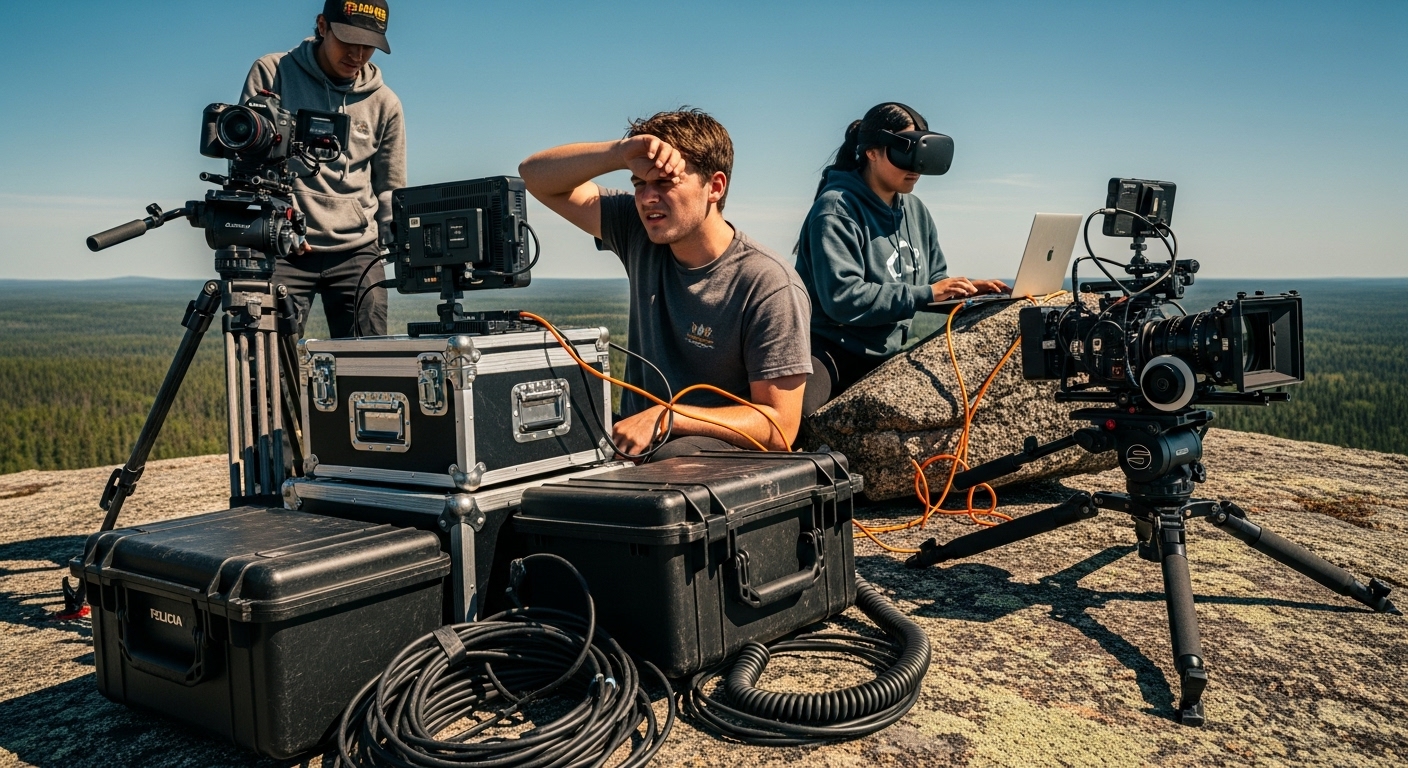
A white pickup truck with amber lights crunched over the gravel below, stopping exactly where they had parked their car, and a uniformed figure stepped out, shielding their eyes to look up at the ridge.
Share This Story


