The Render Farm in the Garage
A freezing garage in Northern Ontario turned into a high-tech editing suite, filled with the hum of overworked computers and the smell of stale coffee.
The progress bar was stuck at ninety-four percent. It had been sitting there for three minutes, which in rendering time is an eternity, but in my current state of caffeinated panic, felt like a geological epoch. My eyes felt like they were packed with sand. I blinked, trying to clear the blur, but the blue light of the monitor just burned deeper.
I looked at the time in the corner of the screen: 02:14 AM. The deadline for the trans-pacific digital exchange was 4:00 AM our time. That gave us less than two hours to finish rendering the point-cloud data of the Revell site, stitch it into the VR walkthrough, and upload the whole massive package to a server in Gansu Province. And that was assuming the internet connection, currently being battered by a Northern Ontario blizzard that was burying my Honda Civic in the driveway, didn’t decide to cut out completely.
"It’s not frozen," Sarah said. She didn’t even look up from her laptop. She was sitting on a milk crate wrapped in a duvet, typing furiously. The clicking of her mechanical keyboard was the only thing louder than the wind rattling the aluminum garage door.
"It hasn't moved in three minutes," I said, tapping the desk. A half-empty can of lukewarm energetic drink wobbled. "The GPU is throttling. I can hear the fans dying."
"It’s thinking. The texture map for the granite outcrop is huge. You insisted on 8K resolution for a rock, Tony. A rock."
"It’s not just a rock," I muttered, leaning back in the squeaky office chair I’d salvaged from the dump. "It’s the containment barrier. The texture matters. If the guys in Lanzhou are going to understand why this place is perfect for the repository, they need to see the grain. They need to feel the stability."
Sarah stopped typing and looked at me. Her toque was pulled down low over her eyebrows. "They have the Beishan site. They know what stability looks like. It’s the same crystalline bedrock. That’s the whole point of this project, isn't it?"
She was right, of course. That was the pitch we’d written in the grant application: 'Two Sites, One Future.' We were trying to build a bridge between the youth here in the Melgund Township area and the students at Lanzhou University. We were both sitting on top of billion-year-old rock that was being scouted to hold the most dangerous waste humanity had ever produced. It was heavy stuff. But right now, the heaviest thing in the room was the file size.
The Heat of the Hardware
The garage smelled like burning dust and overheated plastic. It was a specific scent, the smell of consumer electronics being pushed way past their warranty limits. We had three towers running in parallel, a makeshift render farm that Mike had jury-rigged together with ethernet cables and duct tape. The heat coming off the back of the towers was the only thing keeping the room above freezing. The actual heater, a sad little ceramic cube from Canadian Tire, had given up the ghost an hour ago.
Mike slid out from under the main desk, a screwdriver in his teeth. He spat it into his hand. "I rerouted the airflow. Should drop the temp on card two by five degrees. If we’re lucky."
"Is that enough to stop it from crashing?" I asked.
"It’s enough to keep it from catching fire," Mike said, wiping grease on his jeans. "Probably."
He stood up and cracked his back. Mike was a big guy, and he took up a lot of space in the small garage. He walked over to the window and scraped a circle in the frost. "Snow's piling up. Plow hasn't been by. If the power goes, we’re hooped."
"Don't say that," I said. "Don't even think it."
I turned back to the screen. The bar jumped. Ninety-five percent. I let out a breath I didn't know I was holding. "Okay. It's moving. We need to prep the intro video. As soon as this is done, we drop it in the timeline and export."
Sarah stood up and shed the duvet. She was wearing a hoodie with the logo of a local band that broke up three years ago. She walked over to the green screen we had stapled to the back wall. It was wrinkled and lit unevenly by two clamp-lights I’d bought at the hardware store, but with enough tweaking in post, it looked professional.
"Script?" she asked, holding out a hand.
I handed her the tablet. "Keep it casual. We’re not the nuclear scientists. We’re the artists. We’re the ones asking the questions."
Sarah scanned the text. "You wrote 'vitrification' in the first paragraph. That’s a five-dollar word, Tony."
"It’s accurate!" I argued, spinning my chair around. "Lanzhou University is doing huge work on vitrification of high-level liquid waste. If we don’t mention we know that, we look like amateurs. We need to show them we’ve done the reading. We know about the hydrogeological tests. We know about the multi-barrier systems."
Sarah sighed and stepped onto the mark—a piece of gaffer tape on the concrete floor. "Fine. But I’m saying it my way. If I sound like a textbook, nobody’s going to watch it."
Mike moved behind the camera, a battered Blackmagic Pocket Cinema we’d pooled our savings to buy used off eBay. He checked the focus. "You’re a bit hot on the left side. Adjusting aperture."
I put on my headphones to monitor the audio. The room tone was terrible—the hum of the computers was a constant drone—but we could filter that out later. Hopefully.
"Rolling," Mike said.
Sarah looked into the lens. Her expression shifted. She didn't look tired anymore. She looked intense, focused. She looked like she belonged here.
"Hi everyone," she said. Her voice was steady, cutting through the background hum. "We’re the Revell Project team, reaching out from Northwestern Ontario. It’s minus thirty outside right now, and we’re sitting on top of the Canadian Shield. We know you guys are over near the Beishan site in Gansu, dealing with the granite and the Gobi heat. Different worlds, right? But the rock... the rock is the same."
She paused, and I gave a thumbs up. It was good. Natural.
"We’ve been reading about the work coming out of your School of Nuclear Science and Technology," she continued, glancing briefly at the tablet but mostly keeping eye contact with the lens. "The way you’re looking at how radionuclides migrate through soil... it’s the same questions we’re asking here. We’re not scientists, but we’re using VR to visualize those timelines. To see what this place looks like in ten thousand years. We want to share our data with you. Let’s figure out how to tell this story together."
"Cut," Mike said.
"That was it," I said, grinning. "That was the take. We use that."
"The 'radionuclides' bit was a mouthful," Sarah said, stepping off the mark. "But I think I sold it."
"You sold it," Mike confirmed. "Checking the render."
We all huddled around the main monitor. The progress bar was at ninety-nine percent. The fans were screaming.
"Come on," I whispered. "Come on, you piece of junk."
The screen flickered black. My heart stopped. For a second, I thought the power had cut. Then, the desktop reappeared, and a file named `REVELLBEISHANCOLLABV04FINAL.mp4` sat on the desktop.
"Yes!" Mike punched the air.
---
The Upload Window
The relief was short-lived. Now came the upload. The file was two gigabytes. On our connection, on a good day, that was twenty minutes. In a blizzard, with the lines icing up? It was a gamble.
I dragged the file into the transfer window. The estimated time fluctuated wildly. 30 minutes. 2 hours. 45 minutes.
"It’s the latency," I said, watching the speed graph dip into the red. "The storm is messing with the node down the road."
Sarah pulled up a chair next to me. "While we wait... did you look at the drone footage they sent last week? The test clips?"
"Yeah," I said, eyes glued to the upload bar. "Why?"
"The landscape," she said quietly. "I dropped their footage into our engine. Just to see. I overlaid the Beishan topography with the Revell scans."
She opened a separate window on the second monitor. It showed a wireframe mesh. One layer was red, the other blue.
"Look at the fracture density," she pointed at a cluster of lines. "This is their site. This is ours. The structural integrity of the crystalline rock is almost identical. It’s weird, isn't it? Geologically speaking, these two places are cousins. Separated by an ocean, but... the bones of the earth are the same."
I looked at the mesh. It was beautiful, in a stark, scientific way. It looked like a nervous system. "That’s why they picked them. High stability. Low permeability. The perfect place to bury something you never want to see again."
Mike walked over with three fresh mugs of coffee. "You guys ever think about the time scale? Like, really think about it? We’re making a video that will last maybe... what? Ten years? Fifty if we archive it well?"
He set the mugs down. "But the stuff we’re talking about... the fuel bundles... they have to stay there for millennia. The people managing the Revell site, and the people in Gansu... they aren't just building a warehouse. They’re building a monument to 'do not touch'."
"That’s the ethical part," Sarah said, taking a sip. "Lanzhou is looking at AI authorship and cultural impact. We read that paper. If we use AI to generate the warning signs for ten thousand years in the future... whose culture is that? Ours? Or the AI's?"
I watched the upload bar creep past fifty percent. "That’s what we ask them. In the next video. We ask them how they handle the 'Deep Time' problem. How do you communicate danger to a civilization that doesn't exist yet?"
"Maybe we don't," Mike said. "Maybe the rock does it for us. If the engineering is good enough, nobody needs to know it’s there. It just... sleeps."
The wind slammed against the side of the garage, shaking the walls. The lights flickered—once, twice. We all froze, staring at the modem lights.
They held steady.
"Close one," I whispered.
"We need to visit," Sarah said suddenly. "If this project works. We need to go there. To Gansu."
I looked at her. "And fund it how? We can barely afford coffee."
"Grants," she said, shrugging. "If we prove we can collaborate remotely, the next step is in-person. Imagine filming the transition. From the boreal forest to the Gobi desert. The visual contrast would be insane. Green and grey to red and gold. But the story is the tech. How they use AR for scene simulation. We could learn a lot from their virtual production setup. It sounded way more advanced than this." She gestured around the garage.
"Their School of Nuclear Science has actual labs," Mike added. "Not just a garage with a space heater."
"Hey, this garage has character," I defended.
"This garage has mice," Sarah countered.
The upload hit eighty percent. We were getting close.
I opened the chat window for the project group. A message was waiting from the other side. It was a simple thumbs-up emoji, followed by a string of text in Mandarin.
I copied it into the translator. "Waiting for the packet. The storm here is sand, not snow. Stay warm."
I smiled. "They’re online. They’re waiting."
"Sand storm versus snow storm," Mike mused. "Symmetry."
I thought about the students on the other side of that connection. Were they huddled in a lab somewhere, watching a progress bar too? Were they worrying about their render times? It was strange to feel this close to people I’d never met, bound together by the shared reality of nuclear waste research. It wasn't exactly a typical hobby for twenty-year-olds.
Most of our friends were leaving town. Going to Toronto or Winnipeg. Getting away from the emptiness of the north. But here we were, doubling down. Digging in. Because there was something happening here. The intersection of this massive, global scientific effort and our small, local lives. It felt important. It felt like we were witnesses.
"Ninety-five," Sarah announced. She leaned in closer to the screen.
"Don't jinx it," I said.
The speed dropped again. 500 KB/s. 200 KB/s. The graph turned yellow.
"Come on," I urged the unseen electrons. "Push it through."
The garage seemed to get quieter. Even the wind died down for a second. We were suspended in that final percentage point, the digital limbo where projects go to die.
Then: Upload Complete.
The green checkmark appeared.
I slumped back in my chair, the tension draining out of me so fast it left me dizzy. "Done. It’s sent."
Mike clapped a hand on my shoulder. "We did it. Northern Ontario to Northwest China. Direct line."
Sarah didn't celebrate immediately. She was looking at the map on the other screen, the wireframe of the Revell site. She reached out and touched the monitor, tracing the line of a fault that didn't exist, a safe path through the digital rock.
"It’s gone," she said. "Now they see what we see."
I closed the upload window and looked around the garage. It was messy, cold, and uncomfortable. But we had made something. We had reached out across the world and touched another group of people who understood the specific, weird weight of living next to a repository.
"Let’s go get some actual food," Mike suggested. "The Tim's on the highway is open twenty-four hours. I need a bagel."
"Yeah," I said, standing up and stretching. My back popped. "Bagel sounds good."
I moved to shut down the computer. As I hovered the mouse over the 'Shut Down' button, a notification popped up from the email client. It was an automated receipt from the Lanzhou server.
File received. Integrity check: Passed.
It was a small thing. Just a bit of metadata. But it felt like a handshake.
We grabbed our coats. I zipped up my parka, feeling the cold seep in from the door before we even opened it. Mike grabbed his keys. Sarah wrapped her scarf around her face.
I killed the lights. The garage plunged into darkness, save for the standby LEDs of the monitors, glowing like red eyes in the corner.
As we walked out into the snow, the wind hit us hard. It was biting, wet, and fierce. I looked up. The clouds were thick, blocking out the stars, blocking out the northern lights. It was just a heavy, suffocating blanket of white.
I thought about the file we sent. The images of the rock. The cheerful narration about safety and the future. It felt good. It felt hopeful.
But as I locked the garage door, the metal bolt sliding home with a heavy, final thunk, I felt a sudden, irrational shiver that had nothing to do with the cold. I looked down at the ground, covered in fresh snow, and imagined the rock beneath it. The deep, silent, indifferent rock. It had been here for a billion years before us, and it would be here for a billion years after the waste was gone, after the servers had rusted, after the data had corrupted. We were just ghosts passing through, shouting into the void, hoping the stone would keep our secrets.
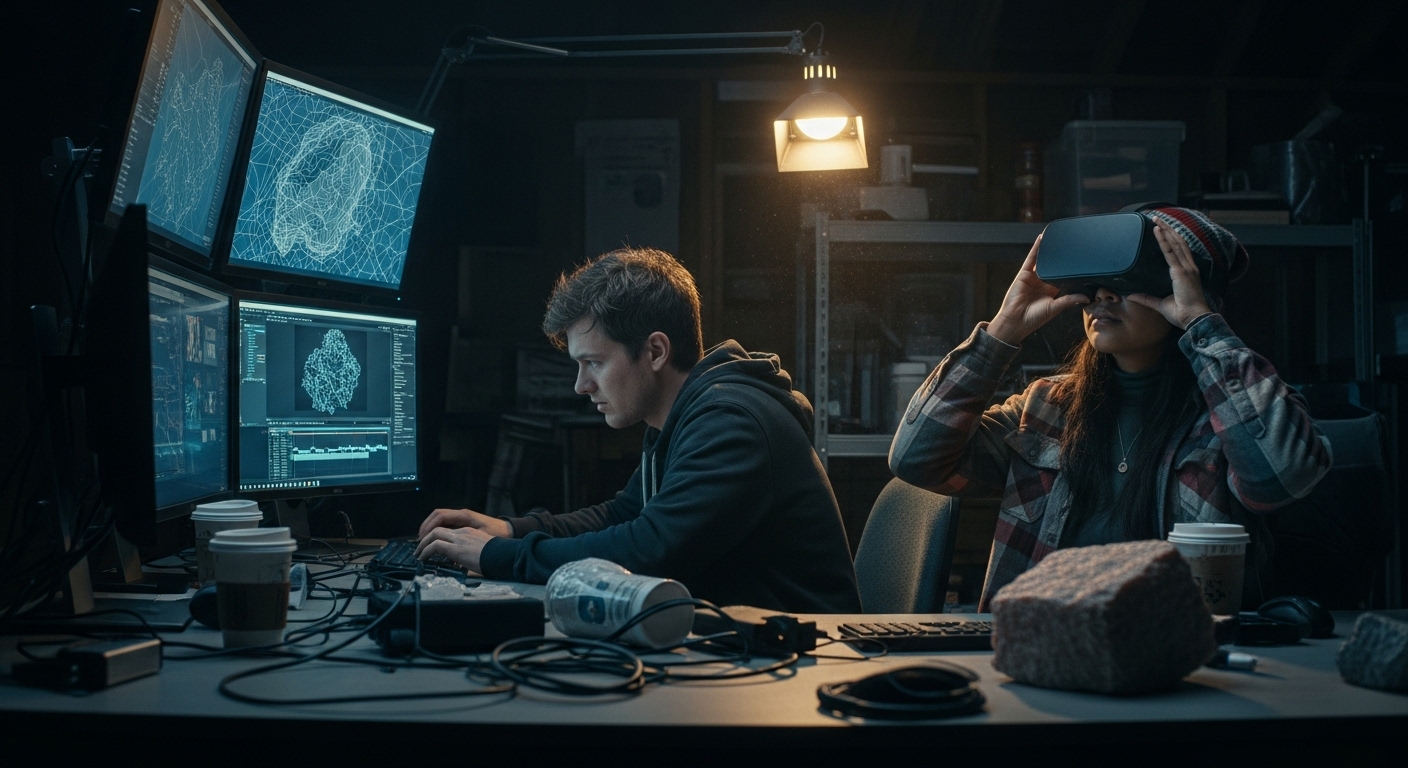
The upload bar hits 100%, but as the wind shakes the garage door, I can't shake the feeling that we've just opened a door to something much older and heavier than a video file.
Share This Story


