Cobalt Light and Cold Hands
The crisp bite of late autumn air gnawed at Lennie's exposed ears, slicing through the thin fabric of his hoodie as he navigated the damp, leaf-strewn pavements of downtown. Streetlights cast long, distorted shadows that danced ahead of him, making familiar buildings feel like looming, unfamiliar giants. The distant wail of a siren, a threadbare sound swallowed by the vastness of the city night, pulled at something tight in his small chest, an unacknowledged knot of both fear and curious anticipation.
The wind picked up, a raw, insistent sigh pushing dead leaves into tight, swirling eddies around Lennie's trainers. He hugged his arms tighter across his chest, the worn fabric of his backpack straps digging lightly into his shoulders. Each breath plumed white in the cobalt glow of the streetlamps, a fleeting ghost of warmth in the deepening cold. Nine years old, he knew this walk. He'd done it a hundred times, it felt like, from Aunt Clara’s to the hospital where his mother, Dr. Masterson, pulled these impossible late shifts. Usually, it was with his father, but tonight, his father had that cough, the deep, rattling kind that kept him glued to the sofa.
So, Lennie walked alone. The rhythm of his footsteps on the cracked pavement was the only sound for a block or two, a tiny drumbeat against the city’s vast, indifferent hum. He passed the old Exchange Building, its brickwork mottled with centuries of grime and stories he couldn't grasp. A bus rumbled past, a lonely, glowing rectangle in the gloom, its exhaust smelling faintly of burnt sugar and diesel. He pressed himself against a lamppost until its red tail lights winked out of sight.
His destination, the emergency entrance of the city’s largest hospital, felt a continent away. The walk was always longer at night, the shadows playing tricks, turning parked cars into hulking beasts, forgotten recycling bins into lurking figures. He kicked at a loose stone, sending it skittering ahead, a small rebellion against the quiet apprehension that settled in his gut like a cold lump.
A Sudden Stillness
It was just past the bakery, the one that never seemed to close, though the smell of fresh bread was long gone, replaced by the faint, lingering scent of grease and stale sugar. He was debating whether to cut through the small, poorly lit park or stick to the main street, when he saw it. Not a beast, not a shadow, but a shape. A human shape, slumped against the base of a brick planter box, motionless.
Lennie froze, his breath catching. His heart gave a hard thump, then another, a rapid, frantic rhythm against his ribs. He squinted. The light here was bad, a flickering orange glow from a sign across the street. But there was no mistaking the way the figure was draped, too still, too awkward. A man, maybe. Or a woman. Just… not moving.
His first instinct was to run, to sprint past, to pretend he hadn't seen. But then a small, reedy sound escaped the figure's lips, a kind of choked gasp, and Lennie found his feet rooted to the spot. He saw a flicker of movement, a hand twitching, then going limp again. A woman, he realized, her hair a pale tangle against the dark brick.
He didn't know what to do. His mother was a doctor. She would know. She would run to help. But he was just Lennie, nine years old, standing on a cold street corner with a stranger who looked… broken.
Then, from further down the street, the shriek. Not a distant, swallowed wail this time, but a piercing, insistent siren, growing louder, closer. Blue and red lights began to pulse, reflecting off the damp storefronts, painting the wet pavement in a frantic, urgent dance. Lennie watched, mesmerized, as an ambulance, then a second, pulled sharply to a halt just metres away. Its emergency lights strobed across the woman, making her appear to jump in and out of existence.
Two paramedics, quick and efficient, spilled from the vehicle. One, a man with a neatly trimmed beard and calm, focused eyes, took charge immediately. "Clear a path, please, folks!" Paramedic Miller, his nametag read. The other, a woman with practical, short hair, was already pulling on gloves, her movements fluid and practiced. They knelt beside the woman, their voices low, urgent, clipped.
Lennie, despite himself, crept closer, drawn by the stark reality of the scene. He could hear their words now, fragments: "...pulse weak... shallow breathing... pupils fixed..." He didn't understand most of it, but the tone, the rapid, decisive movements, spoke volumes. He saw Paramedic Miller press something to the woman’s chest, a hard, rhythmic compress, then heard a distinct crack. The sound made Lennie flinch, a sharp, unpleasant noise that echoed the chill in the air. The other paramedic was attaching wires, muttering readings into a portable radio.
"Get her on the board. We're losing her," Miller barked, his voice tight, but still controlled. It wasn't angry, not like when his dad yelled about spilled milk. It was a different kind of urgency, one that felt heavy, important. They wrestled the unconscious woman onto a rigid backboard, then onto a stretcher, their movements a strange, violent ballet.
---
Through the Glass Wall
Lennie didn't think, he just followed. The ambulance doors slammed shut, the siren re-engaged, a full-throated roar now, and it sped away, the flashing lights leaving lingering afterimages in his vision. He broke into a run, a half-skip, half-sprint, chasing the fleeting red glow. He knew where it was going. He knew where he was going.
He arrived at the hospital's emergency bay, chest heaving, the scent of damp leaves and cold tarmac replaced by the antiseptic tang of a medical facility. Another ambulance was already there, doors open, the same paramedics from the street corner now wheeling the stretcher in. Lennie slipped through the automatic doors, a small, forgotten figure entering a world of adult crisis.
The Emergency Room waiting area was a muted symphony of coughs, sniffles, and hushed conversations. But Lennie bypassed it, his eyes fixed on the entrance to the treatment area, marked by a set of swinging double doors. He pushed through them, finding himself in a brightly lit corridor, the air thick with the smell of alcohol wipes and something vaguely metallic. He peered around a corner, cautious.
Through a large glass panel, he saw it. The same woman, now stripped of her outer coat, wires snaking from her body to various machines that beeped and whirred. His mother was there. Dr. Evangeline Masterson, her face tight with concentration, her brow furrowed, was leaning over the woman, her gloved hands working with a terrifying precision. She wore a surgical mask, but Lennie knew the fierce intensity in her eyes, even from this distance.
He watched, hidden mostly by a stack of wheeled supply carts. A nurse, Nurse Thompson, stood calmly to his mother's side, handing her instruments, speaking in quiet, authoritative tones. Paramedic Miller was giving a rapid, clipped report to another doctor, his voice a low rumble. The room was a hive of activity, but it was organized chaos, a controlled storm. Every person moved with purpose, every action directed towards saving the life of the woman Lennie had seen collapse on the street.
Lennie felt small, insignificant, but also profoundly impressed. This was what his mother did. She stood between life and death. He saw the flicker of worry in her eyes, quickly masked by professional resolve. He watched the delicate dance of tubes and needles, the rise and fall of the patient's chest, aided by a machine, then saw a monitor’s numbers dip, then steady. The air felt thick, heavy with unspoken questions and the desperate hope for another beat, another breath.
He leaned his head against the cool glass, his own breathing ragged, mirroring the patient’s. He saw his mother make a quick, almost imperceptible gesture to Nurse Thompson, who immediately brought something new, a syringe, its contents glowing faintly under the bright lights. Dr. Masterson took it, her hand steady, injecting the fluid into one of the lines attached to the patient. The room held its breath, Lennie felt, along with everyone else.
The numbers on the monitor, for a moment, held steady. A wave of relief, faint but palpable, seemed to ripple through the room. Dr. Masterson straightened slightly, pulling off her gloves, her shoulders visibly relaxing a fraction. She exchanged a few quiet words with Nurse Thompson, who offered a small, tired smile. It looked like the immediate crisis had passed.
But then, just as Lennie started to relax, just as a small sigh escaped his lips, a sharp, piercing alarm shattered the fragile peace. A different machine, its screen a sudden violent red, began to shriek, a raw, insistent sound that made Lennie jump. The steady rhythm on the main monitor flatlined, replaced by a frantic, jagged line. Dr. Masterson, who had just turned away, spun back, her eyes wide, her face losing all trace of the calm professionalism that had settled there. "No!" she gasped, her voice choked, as the patient's chest suddenly went still.
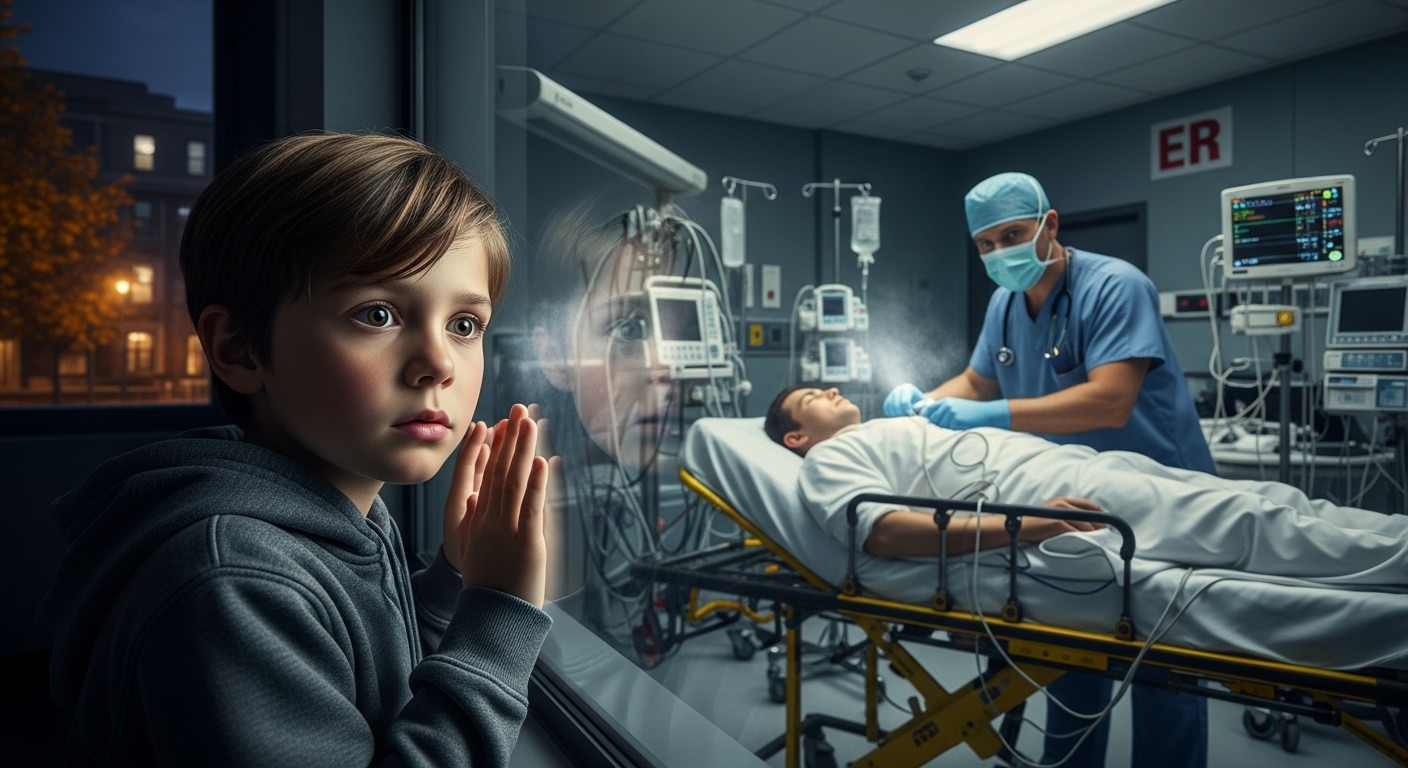
The room erupted into a renewed, desperate scramble, a cacophony of urgent shouts and frantic movements, as the flatline screamed its terrifying truth. Lennie watched, frozen, as his mother's hands flew to the patient's chest once more, the stark terror in her eyes betraying the impossible task now laid before her.
Share This Story


