Fluorescent Hum and a Wall of Noise
The air in the town hall annexe was thick with the smell of damp wool coats and stale coffee. Paula checked the microphone for the third time, tapping its mesh head and listening to the flat, unhelpful thump from the speakers. Outside, the November rain wasn't stopping, and neither was the relentless pinging of her phone, each notification a fresh wave of public panic she was supposed to somehow contain with a single press conference and a few hundred hastily printed fact sheets.
The sheaf of papers in Paula’s hands felt flimsy, pathetic. Each sheet was covered in neat columns of data, parts per million, chlorine levels, a dozen different test results from three separate labs, all confirming the same thing: the water in Havenwood was perfectly, boringly safe. The paper was real, the ink was real. But out there, in the digital storm, none of it seemed to matter.
“They’re ready for you, Dr. Villeneuve,” said the town clerk, a young man whose face was pale with a nervous sweat. He didn’t meet her eyes.
Paula nodded, smoothing the front of her blazer. It was a useless gesture. She felt like a general preparing to fight a phantom army with a handful of pebbles. For seventy-two hours, a single, unsubstantiated post on a local forum had metastasised. It claimed a containment failure at the old pulp mill upstream had leached neurotoxins into the reservoir. It was a lie. The mill had been decommissioned a decade ago, its holding ponds sealed in concrete.
But the lie was more interesting than the truth. It had a villain (the negligent council), a threat (invisible poison), and a hero: Corey. Corey, who ran the ‘Havenwood RealTalk’ channel from his garage, was the one who had “broken” the story. He wasn’t a journalist. He was a former real estate agent with a grievance and a webcam.
She walked into the main hall. The lights were too bright, the air too hot. A handful of local reporters were present, but most of the seats were filled with residents. Their faces were tight with anxiety, phones held up to record her. She saw the distrust in their eyes, the shared certainty that she was here to lie to them.
“Good evening,” she began, her voice sounding unnaturally loud. “My name is Dr. Paula Villeneuve. I’m the regional Public Health Officer. I want to address the concerns circulating about the town’s water supply.”
She laid out the facts. She explained the testing protocols, the triple-redundancy safety checks, the geological surveys of the old mill site. She held up the lab reports, pointing to the columns of numbers as if their sheer density could anchor the conversation in reality. For a moment, she thought she might be getting through. There were nods. A few people lowered their phones.
Then a man in the third row stood up. “So if the water’s so safe,” he called out, his voice laced with theatrical scepticism, “why did my neighbour’s dog get sick? Corey said the animals would be the first to go.”
“Sir, I can’t speak to an individual veterinary case,” Paula said, her patience already fraying. “But there has been no increase in reported animal sicknesses at any local clinic. We’ve checked.”
“Because you’re covering it up!” a woman shouted from the back. “Corey warned us you’d do this! He said you’d have your ‘official’ data!”
The name, again. Corey. He wasn't even in the room, but his presence was suffocating. Every counter-argument she had prepared was useless because he had already pre-emptively discredited it. He had built a narrative where she was the antagonist, part of the conspiracy. Her evidence was just proof of her deception.
The meeting dissolved into a mess of accusations and shouting. Her data was useless. Her authority was meaningless. They trusted a man in a garage more than a decade of her education and experience. She ended the press conference, her words swallowed by the noise.
---
An hour later, Paula was parked across the street from a tidy bungalow with peeling paint on the porch. The garage door was slightly ajar, a strip of bright, artificial light cutting through the rainy dark. Corey’s studio. She hadn’t planned this, but leaving his name hanging in the air, unanswered, felt like a surrender. Her phone buzzed again. It was a link to his current livestream. Title: ‘LIVE: The Town Hall Deception - They’re Lying to You’.
She got out of the car, pulling her coat tight, and walked across the wet asphalt.
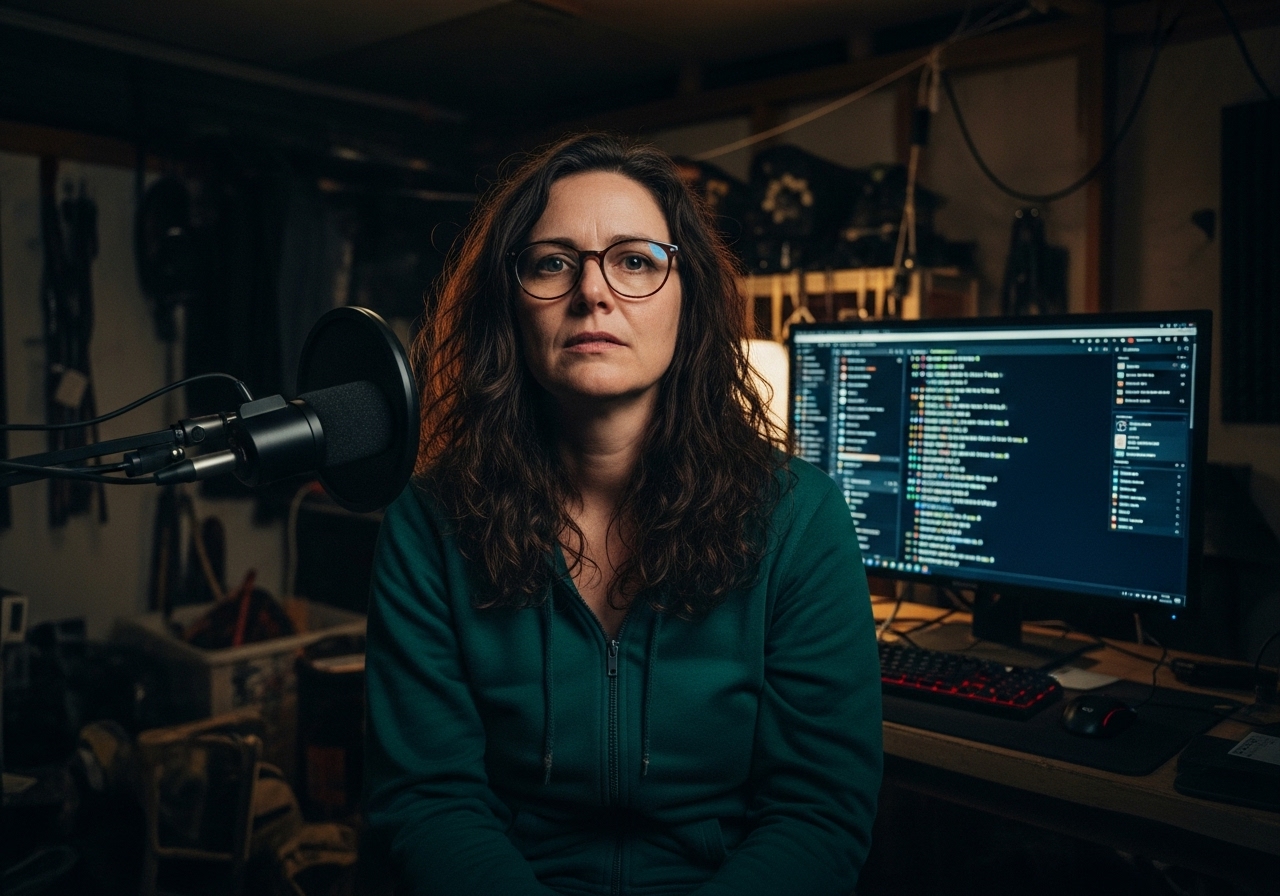
The garage was crammed with audio equipment, lighting rigs, and a green screen. Wires snaked across the floor like tripwires. Corey sat at a desk, facing a camera mounted on a tripod. He was younger than she expected, with an earnest, intense face that was currently twisted in a look of righteous fury as he spoke into a microphone.
“...and she stands up there, folks, with her doctored papers and her condescending tone, and she tells you not to believe your own eyes,” he was saying. “She tells you that poor Mrs. Gable’s prize-winning roses dying on the vine is just a coincidence.”
Paula stepped into the light. “The Gable property uses a private well, Corey. It’s not even connected to the municipal supply.”
He flinched, spinning around in his chair. For a second, a flicker of genuine panic crossed his face. He wasn't expecting a visitor. But it vanished as quickly as it appeared, replaced by a shark-like grin. He pointed a finger at her, then turned back to the camera.
“Well, look what we have here, folks! The source herself! Dr. Villeneuve, come to shut down the truth. You’re live on Havenwood RealTalk, Doctor. Got anything to say to the people you’re poisoning?”
He gestured to a large monitor mounted on the wall next to him. It showed the livestream, and alongside it, a torrent of comments scrolling past at an impossible speed.
Paula stepped forward, ignoring the camera. “This isn’t about truth, Corey. This is about fear. You’re terrifying people for clicks. You have no evidence, no data, nothing but vague anecdotes you twist into a conspiracy.”
“The people have the evidence!” he boomed, his voice modulating for his audience. “They see the discoloured water in their tubs! They smell the chemicals!”
“They see it because you told them to look for it,” she shot back. “It’s tannin from the autumn leaves, the same as every year. The smell is the seasonal increase in chlorine, a standard and perfectly safe procedure you’ve framed as something sinister.”
She looked at the monitor. The comments were a blur of rage.
`Liar!`
`Get her, Corey!`
`She's glowing! Look at her skin! She's radioactive!`
`Recall the whole council!`
He saw her looking. “They don’t believe you, Doctor. Why is that?”
“Because you’ve given them a simple story with a clear villain,” she said, her voice dropping, tired. “It’s easier than understanding water treatment protocols. It’s more compelling than parts per million.”
“Or maybe they’re just smarter than you give them credit for,” he said, leaning into his microphone. “Maybe they know when they’re being lied to by the so-called experts who’ve failed them time and time again.”
He was good. He was a performer. He took her arguments and effortlessly folded them into his narrative. She watched the scrolling comments, feeling a profound sense of despair. She was trying to put out a forest fire with a water pistol while he stood behind her with a flamethrower. Each fact she presented was just more fuel for his conspiracy. The argument wasn't about water anymore. It was about who you trusted, and the people of Havenwood had made their choice.
As she stood there, caught in the glare of his lights, her phone vibrated with a notification from the town's emergency alert system. It was a boil water advisory. Her own office had just contradicted her.
Share This Story


