The Hum of Doubt
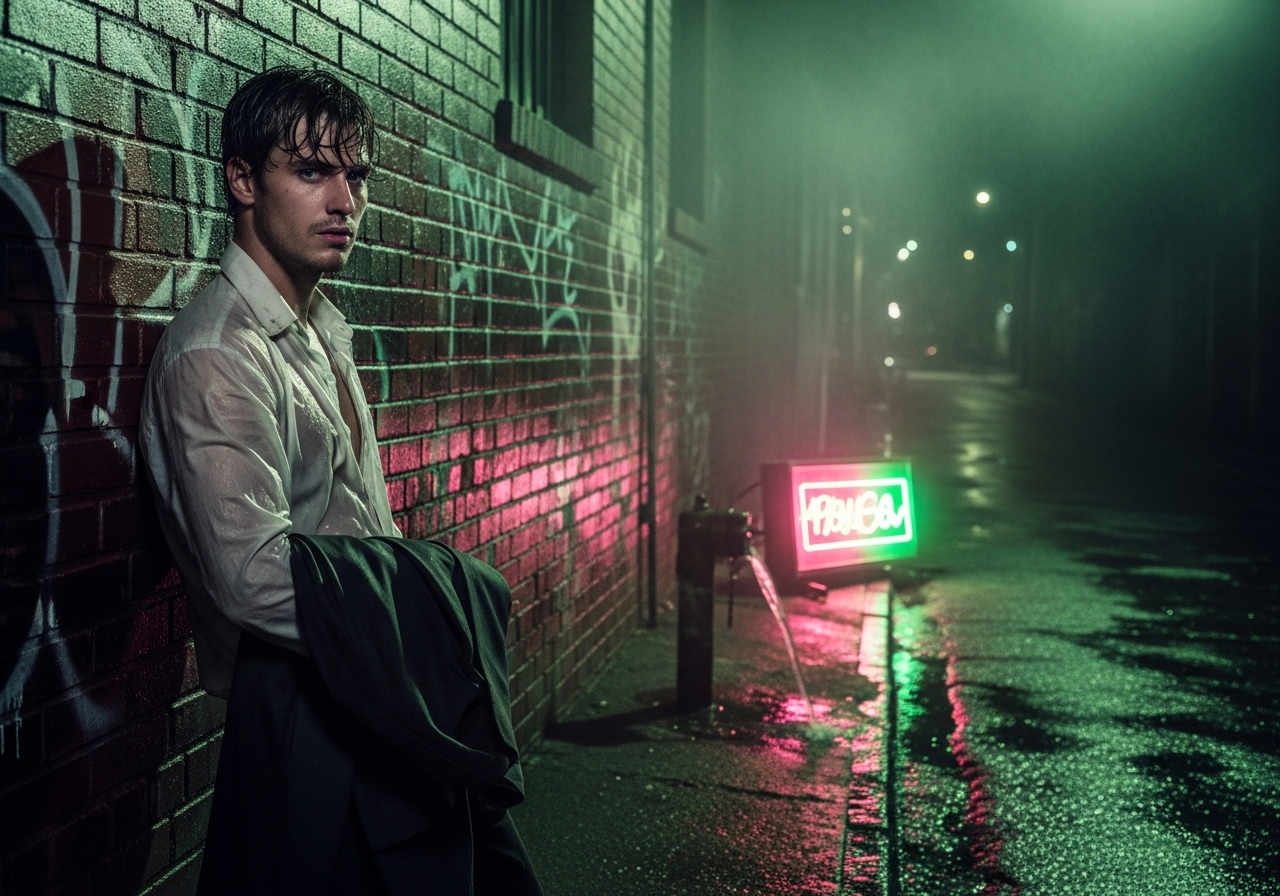
The asphalt shimmered under the faint, sickly glow of a busted neon sign, exhaling the day's accumulated heat back into the already thick, humid air. It was a summer night that felt less like a season and more like a heavy, wet blanket draped over everything. A broken fire hydrant wept a thin stream down the gutter, carrying with it a faint, cloying scent of stale rubbish and something metallic, almost like old blood. Above, a single, tired cicada sawed away at the silence, its song a frayed thread in the oppressive stillness of the back alleys. Simon, leaning against a graffiti-scarred brick wall, felt the grit of it through his thin shirt, the fabric already sticking to his skin.
Simon watched the dribble from the hydrant, mesmerised by its stubborn path, how it dodged a discarded crisp packet, then pooled briefly around a flattened chewing gum before vanishing into a drain grate. His cheap suit jacket, slung over his arm, did little to mitigate the sweat trickling down his spine. Twenty-two years old, and already he felt the world owed him a perpetual shrug, particularly on nights like these, where the very air tasted of resignation. He pulled a pack of crumpled Embassy cigarettes from his breast pocket, extracting one with a practiced flick before lighting it, the flare brief and harsh against the deepening violet of the sky.
A shadow detached itself from the deeper darkness across the alley. No sound of footsteps, just a subtle shift in the air, a colder pocket moving through the mugginess. Simon didn’t jump. Didn’t even flinch. He just took a long drag, the cherry of his cigarette glowing like a tiny, angry eye.
“Took your time,” Simon muttered, the smoke curling around his words.
Mina stepped into a sliver of light from a distant streetlamp, her face partially obscured by the brim of a worn baseball cap. Her hoodie was up, despite the oppressive heat. She clutched a battered tablet to her chest. “Traffic. And I like to make an entrance. Keeps people on their toes.” Her voice was low, almost a whisper, but with an undercurrent of something sharp, like glass.
“I’m tired of being on my toes. My feet ache,” Simon said, stubbing out his cigarette against the wall, a tiny, satisfying hiss. He dropped the butt into a nearby bin, a rare concession to civic duty. “You got anything on Jinx?”
Mina hesitated, her eyes, dark and quick, scanning the alley. “Jinx,” she finally said, pronouncing it with a quiet reverence, “fell into The Feed. Hard.”
Simon pushed off the wall, the brick scraping against his shirt. “The Feed isn’t a place, Mina. It’s a mess of algorithms and half-truths. People don’t ‘fall into’ a website. They browse it. They click.” He walked closer, close enough to see the tension etched around her mouth. “What is it this time? Another rabbit hole cult? The ‘Flat Earth is actually a giant sentient pizza’ brigade?”
A faint smile, humourless, touched Mina’s lips. “Worse. Jinx… he was good at finding patterns. Too good. They invited him in. Not to a cult. To a game.” She looked at her tablet, thumbing at the screen, though Simon couldn’t see what she was doing. “The decentralised network. It’s grown. No central server. No single point of failure. Just… a million tiny lies, reinforcing each other, spinning new truths.”
“So, the usual Tuesday,” Simon grumbled. “What’s the game?”
“They call it ‘The Loophole’,” Mina explained, her voice now a clipped series of statements. “A network of curated narratives. You don’t just read the news; you build it. Contribute a piece, a story, a deepfake image… you get points. You rise in rank. Your narrative gains traction. Becomes ‘real’.”
Simon ran a hand through his damp, dark hair. “Sounds like a forum. A particularly deranged forum.”
“It’s sophisticated. Self-correcting. Any narrative that gains enough consensus… it starts to manifest. Or so the believers say. The consensus shapes reality. A collective hallucination, powered by data.” Mina finally looked up, her gaze direct and unsettling. “Jinx believed it. He was building something. A story so compelling, so… true, it was going to break through.”
“Break through what?”
“The noise. The consensus. He thought he could out-lie the liars.” She shook her head. “No one has seen him in three days. His last message was a string of gibberish. Coded. I think. Or maybe… maybe he just snapped.”
Echoes in the Digital Well
The next day dawned with the city still baking, the air conditioner in Simon’s cramped office wheezing its last. He sat at his battered desk, a cold, forgotten cup of tea beside a stack of old files, staring at the screen. Mina had given him a portal, a back door into The Loophole. It was less a website and more an experience, a swirling maelstrom of conflicting headlines, AI-generated images, and user-submitted 'proofs'.
One headline screamed, 'Mayor Funds Secret Lizard People Cult with City Taxes!' Another, just below it, asserted, 'Mayor Is a Lizard Person, Cult is a Diversion!' The comments below were a labyrinth of logical pretzels, each user adding a new layer of absurdity, building upon the previous one. It was dizzying. Like trying to read a thousand conversations at once, all of them slightly off-key.
A small, almost imperceptible detail caught his eye: a recurring symbol, a pixelated eye with a tiny, stylised cog where the pupil should be. It appeared randomly, almost a digital watermark, on narratives that were gaining particular traction. Simon zoomed in, squinting. It was crudely rendered, yet insidious. A signature, perhaps. Or a brand.
His phone buzzed, a single, encrypted message. Mina. ‘Meet me. Oskar’s place. Corner of Gallow and Ninth. Midnight. Bring cash. Small bills.’
---
The air in Oskar’s apartment was thick with the scent of ozone, old paper, and something that smelled suspiciously like burnt sugar. Every surface was cluttered with an impossible array of obsolete electronics: ancient tube monitors, defunct modems, wires snaking across the floor like digital vines. Oskar himself was a small, wiry man with spectacles perched precariously on his nose, his thin hair sticking up in frantic tufts. He wore a rumpled velvet smoking jacket, stained with what looked like coffee and soldering flux, despite the summer heat. A miniature automaton, no bigger than a teacup, trundled across the floor, pausing to nibble at a loose cable before Oskar shooed it away with a gentle tap of his foot.
“Simon, my boy! Do come in, don’t mind Bertrand,” Oskar chirped, gesturing vaguely with a hand that held a soldering iron. “Always trying to reconfigure the network infrastructure. A digital beaver, really. What exquisite piece of modern decay do you bring me tonight?”
Simon offered a small, tarnished brass compass. “It’s old. Maybe… early 20th century. Found it in a pawn shop. Didn’t work.”
Oskar took it, examining it with the reverence of an archaeologist unearthing a lost artifact. “Ah, splendid! The beauty of broken things, Simon. They tell more honest stories than the ones that function perfectly. A lovely trade, a lovely trade. Now, to business. You wish to understand the inner workings of… The Loophole.”
Simon nodded. “How does it work? Really work. Beyond the user-facing nonsense.”
Oskar set the compass down carefully among a pile of circuit boards. He picked up a peculiar, intricate music box, wound it, and a tinny, slightly off-key melody began to play. “It’s about gravity, my dear boy. Not the physical kind, but the informational. Every interaction, every share, every click… it adds weight. And enough weight creates a singularity. A truth well-told, no matter how fabricated, eventually pulls everything else into its orbit.”
“So, Jinx was trying to make his own singularity?”
“Precisely. He found a vulnerability. A back door in the back door, if you will. A way to inject a meta-narrative. A story about the stories. He called it ‘The Great Unravelling’.” Oskar peered over his spectacles, his eyes twinkling. “He believed that by creating the ultimate, self-contradictory lie, he could expose the entire architecture. Collapse the whole tower of fibs.”
“Sounds… ambitious,” Simon said dryly, watching the music box spin. The tiny figures on top, a dancing bear and a solemn-faced astronaut, rotated in an odd, jerky rhythm.
“Ambitious, indeed! And dangerous. The architects of The Loophole, they don’t like competition. They don’t like dissenting narratives, not even meta-dissent. It’s bad for business. Bad for control.” Oskar paused, and the music box ran down with a final, mournful squeak. “Jinx was onto something that could break their hold. And they… well, they don’t play fair. Their game has real consequences, Simon. Real people. Real lives. People can be convinced to do… anything.”
Simon thought of the headlines, the bizarre, conflicting realities. He’d seen online communities turn into angry mobs over less. The absurdity of it, mixed with the inherent danger, twisted his gut. “Where is he now?”
Oskar shrugged, a gesture that dislodged a small shower of dust from his shoulders. “Caught in the current, I suppose. Somewhere in the deep waters of their engineered reality. You can try to pull him out. But be warned, Simon. Once you start swimming in those currents, it’s hard to tell which way is up. You might just become part of their narrative.”
A new, unread message blinked on Simon’s phone screen. Not from Mina. An unknown sender. A single, pixelated image: the eye with the cog for a pupil. And underneath it, a coordinate string. A location. Somewhere far from this sweltering alley, far from Oskar’s digital junkyard.
“They’re watching, aren’t they?” Simon asked, his voice barely a whisper.
Oskar merely smiled, a knowing, slightly unsettling grin. “Watching, creating, consuming. It’s all a grand performance, my boy. And the audience… well, the audience is always ready to believe the next act.”
The Unspoken Invitation
The coordinate string glowed faintly on Simon’s phone, a cold, precise promise against the backdrop of the city’s heat. He stared at it, then at Oskar, whose eyes, magnified by his thick lenses, seemed to hold a thousand unspoken stories. The city hummed around them, a low, constant thrum of power and lives lived, and lied. The air felt heavier now, not just with summer heat, but with the weight of unseen data, of whispers amplified into roars. Simon knew, with a chilling certainty that settled deep in his bones, that he was no longer just observing. He was in the show now, and he hadn't even bought a ticket. The game, whatever it truly was, had just sent him an invitation.
---
Simon clutched the phone, the coordinates a silent command, a digital breadcrumb leading him deeper into a maze where the walls were made of lies and the exit might just be another illusion. He was in, whether he liked it or not, and the only question now was who was pulling the strings, and if he would ever find his way out.
Share This Story


