The Flickering Hearth
The air in the community hall hung heavy and still, thick with the unseasonal humid warmth of a northern summer. A low hum vibrated from the ceiling-mounted projector, a sound that usually meant nothing, just the persistent background noise of the ‘Digital Hearth’ functioning as intended. Tonight, however, it carried an unnerving, discordant undertone, a frantic buzz suggesting something fundamental was off-kilter. The holographic display, meant to showcase local artists' digital work, pulsed with a sickly green, then shifted to an angry, pixelated red, casting a momentary, unsettling glow over the scarred linoleum floor.
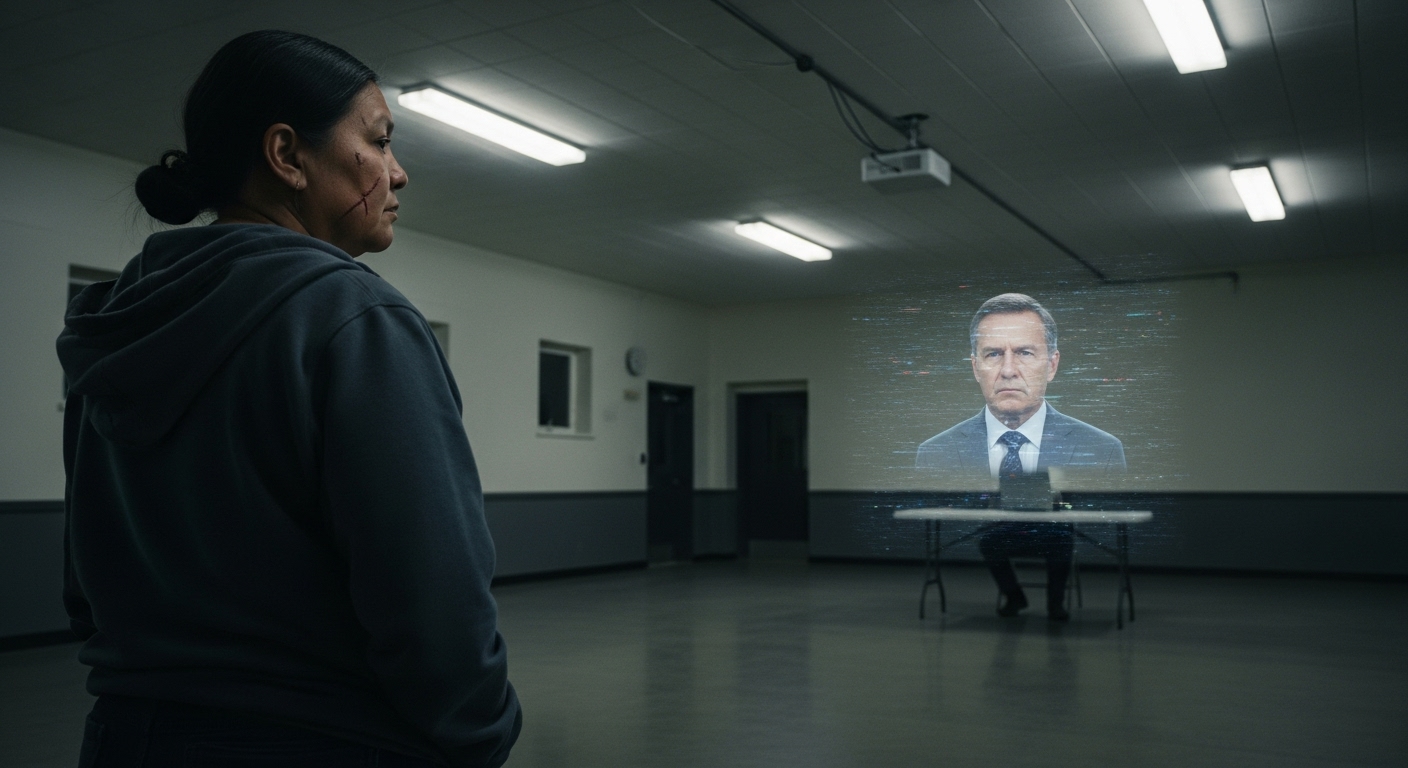
The Digital Hearth, usually a bastion of flickering, low-resolution warmth, was convulsing. I recorded the timestamp on my wrist-link: 20:37 local. A thin, reedy whine accompanied the visual distortion, a sound like a distant, tortured modem, echoing off the bare walls of the community hall. The holographic art display, currently a looping animation of stylised geometric patterns that resembled a badly rendered caribou, stuttered, pixelated, then bled into a vibrant, nauseating yellow before dissolving entirely into a shimmer of unformed light. A wave of static electricity prickled my exposed forearms, smelling vaguely of burning copper.
This was not standard operational procedure. My mandate was observation, a journalistic 'deep dive' into Project Aurora's 'Sustainable Northern Futures' initiative, specifically its arts and recreation component. A glitch this pronounced, however, was certainly worth documenting. I thumbed the recording function on my ocular implant, capturing the raw, untamed chaos of the failing projection.
The door from the adjacent administrative office slid open with a sigh of failing pneumatics. Nadia stepped out, her movements economical, her gaze immediately locking onto the sputtering column of light where the caribou had been. She was a woman of quiet strength, her dark hair pulled back in a practical braid, her work-worn hands betraying a life spent in physical engagement with this often-unforgiving landscape. A smear of grease smudged her left cheekbone, a testament to some recent, practical repair task. She was perhaps mid-thirties, older than I was, but with a gaze that suggested decades more experience. I noted the slight tension in her jaw, the way her shoulders seemed to carry an invisible weight.
“Another one,” she stated, her voice calm, yet edged with a weariness that bypassed mere fatigue. Her diction was precise, almost formal, a stark contrast to the casual drawl common in the southern sprawl. It was a common linguistic characteristic I’d observed in these remote outposts, a consequence perhaps of fewer interlocutors, forcing each interaction to carry more weight, more deliberate articulation. “The surge suppressor is failing again, I suspect. Or perhaps the main grid link from the Tower.”
“I am documenting the event for my report,” I replied, my own voice modulated to a low, neutral tone, my journalistic objectivity a practised shield. “The oscillation appears to be accelerating.”
She nodded, not looking at me, her eyes fixed on the flickering column. “Indeed. It seems the ‘robust digital infrastructure’ promised by Director Kenmore possesses certain… vulnerabilities, in a true Northern context. A minor inconvenience, certainly, for the pursuit of SDG-11, would you not agree?” Her tone held a subtle, dry inflection, a sardonic undercurrent that I recognised as a specific form of local humour.
I made a mental note. ‘Sarcasm indicator: high.’
Suddenly, the column of light solidified, resolving into the familiar, slightly too-smooth visage of Director Kenmore. His holographic form, usually projected with an unnervingly perfect clarity from the corporate hub in Toronto, shimmered and lagged, his movements just a fraction of a second behind his words. He was in his late fifties, I judged, his corporate-issue grey suit impeccable, his perfectly coiffed hair catching the phantom light of the projection. He appeared to be mid-sentence, his lips moving soundlessly for a moment before his voice, deep and resonant, caught up.
“—and thus, the continued expansion of the ‘Digital Hearth Network’ is paramount for fostering community capacity in these vital, yet geographically challenging, regions.” He paused, his projected gaze sweeping across the empty hall, before settling, with what I suspected was a pre-programmed pause for effect, upon Nadia. “Ah, Coordinator Nadia. And Mr. Steven, our esteemed observer from the Bureau of Inter-Regional Development. A pleasure, as always.”
Nadia offered a polite, almost imperceptible nod. “Director Kenmore. The Digital Hearth, as you can see, is experiencing some… technical difficulties. A common occurrence.” The word ‘difficulties’ hung in the air, weighted with unspoken frustrations.
Kenmore’s holographic smile remained fixed. “Minor perturbations, Coordinator. Our diagnostics indicate a localized energy fluctuation, nothing our automated repair protocols cannot address remotely. These are the growing pains of innovation. The very essence of SDG-11: to create resilient infrastructure. Your continued dedication to the arts and recreation programs, even in these isolated circumstances, is commendable. Your efforts are truly illustrative of the SDG’s core principles for sustainable communities.”
I felt a dull throb behind my eyes. The corporate lexicon, always so perfectly sterile, was particularly grating when overlaid on the flickering image of a man discussing ‘resilient infrastructure’ while his own digital presence struggled to maintain coherence. The summer heat pressed in, a humid, cloying blanket that made the thin, recycled air in the hall feel heavy, as if even the atmosphere resisted the digital intrusion. I could feel a bead of sweat tracing a path down my temple, a small, irritating discomfort that felt profoundly real.
“Director,” Nadia began, her voice retaining its formal composure, though I detected a slight hardening around her eyes. “While the concept of a ‘Digital Hearth’ for sharing local artistic expressions is noble, the practical realities on the ground present… challenges. Our internet bandwidth, for instance, remains inconsistent. Our young people require reliable, high-speed access not just for virtual galleries, but for remote learning, for accessing health services. And our Elders, they express a preference for hands-on crafts, for physical gatherings. They desire a truly sustainable space, a proper, well-maintained structure for traditional arts, not merely a projected one. The cost of maintaining these digital platforms often seems to detract from the funding available for tangible, immediate needs.”
Kenmore’s holographic head tilted slightly, a movement that was more a software effect than an actual expression. “Coordinator, we are keenly aware of the diverse needs within the community. Our ‘Sustainable Northern Futures’ initiative is comprehensive. The Digital Hearth is but one facet. We are investing in ‘e-learning modules’ for vocational training, ‘telemedicine nodes’ for healthcare accessibility. These are scalable, efficient solutions. Physical infrastructure, while valuable, represents a significantly higher carbon footprint and requires substantial, ongoing maintenance. Our digital solutions are designed for longevity, for minimal environmental impact, fully aligned with SDG-11’s emphasis on ecological responsibility and resource efficiency. We aim to leapfrog traditional development models, embracing a truly twenty-first-century approach.”
I scribbled furiously on my datapad, the cool glass of the screen a minor relief against the muggy air. Kenmore’s rhetoric, a perfectly polished blend of corporate doublespeak and SDG buzzwords, was a masterpiece of obfuscation. He spoke of ‘leapfrogging traditional development’ while the very system delivering his words was failing, unable to sustain itself in this harsh, remote environment. The satire of it was almost too blatant, too perfectly engineered for my report.
“A leapfrog, Director,” Nadia interjected, her voice carrying a quiet force, “that appears to land many of us in a chasm of unreliable connectivity and underfunded local initiatives. Our children still play in a recreation centre that requires constant repairs, a centre that could house genuine arts programming if the resources were not diverted to maintaining a virtual presence that often fails. Our elders, they value connection, physical touch, shared space. The digital hearth, for all its potential, cannot replicate the warmth of a literal one.”
The holographic Kenmore seemed to flicker momentarily, a subtle ripple across his pristine suit, as if Nadia’s blunt assessment had caused a momentary system strain. “Coordinator, I understand your sentiment. But we must look to the future. Our data models unequivocally demonstrate the efficacy of digital solutions in bridging geographical isolation. We are not simply providing technology; we are fostering digital literacy, preparing your community for the globalized, interconnected world. These are the tools of empowerment.”
I shifted my weight, the synthetic fabric of my trousers sticking uncomfortably to the plastic chair. My own connection to the local network was proving equally 'robust', oscillating between two and four bars of signal strength. The irony was almost palatable. It wasn't just Kenmore's projection that was glitching; the entire ecosystem of promised digital futures seemed to be suffering from a chronic, terminal latency.
“Empowerment, Director,” Nadia echoed, a faint, almost imperceptible tremor in her voice, “is difficult to achieve when the tools themselves are unreliable. What good is a virtual gallery if the connection drops every twenty minutes? What use are e-learning modules when a child cannot afford the power to run their terminal, or when the 'free' software requires a perpetual subscription that our local economy cannot sustain?” She clenched her hands briefly, a small, involuntary movement that spoke volumes. “These are the realities on the ground, not in your data models. Our community capacity grows when fundamental needs are met, when people feel secure, not when they are offered an illusion of connectivity.”
Kenmore’s face, for the first time, held a flicker of something beyond pre-programmed cordiality, a momentary tightening around the eyes that suggested genuine irritation. “Coordinator, let us not devolve into polemics. My team’s research, spanning comprehensive socioeconomic indicators and environmental impact assessments, provides a holistic overview. We are addressing systemic issues. The ‘Sustainable Northern Futures’ initiative is precisely designed to mitigate the very concerns you articulate, through innovative applications of advanced networked solutions.” He gestured with a perfectly rendered, but utterly insubstantial, hand. “Perhaps a review of the supplementary data packets would clarify our methodology.”
A small, almost imperceptible whirring sound emanated from the base of the holographic projector. On my wrist-link, a small icon flashed, indicating an incoming data stream. Kenmore was attempting to flood the conversation with 'clarifying' information, a common corporate tactic. Nadia merely raised an eyebrow, a silent, eloquent rebuttal. She had seen this play before. I imagined she had endured it countless times.
Then, a low, guttural thrum began, emanating from somewhere deep beneath the building, a sound that vibrated through the very floorboards. It was not mechanical; it had a deeper, organic resonance, like a beast stirring from a long slumber. The holographic Kenmore flickered violently, his face dissolving into a scramble of emerald and violet pixels, his voice cutting out with a sharp, crackling burst of static. The 'Digital Hearth' was not merely glitching; it was actively failing.
Nadia’s eyes, previously locked on Kenmore, darted to a small, wall-mounted air quality sensor near the entrance. Its digital readout, usually a placid green, had begun to flash an angry, urgent orange. My own wrist-link, which perpetually monitored ambient data, chimed with a warning I had not programmed. I accessed the overlay, pulling up the raw environmental statistics. Air particulate levels were spiking. Not dust, not typical summer pollen. Something else. Something metallic, almost acrid, smelling faintly of charged particles, like a thunderstorm brewing indoors.
“What is this now?” Kenmore’s voice, restored but heavily distorted, echoed from the struggling projection. His image was a kaleidoscope of broken data, a fractured mask of corporate authority. “Coordinator, please provide an immediate assessment. Our remote diagnostics indicate…” His words broke off, replaced by a series of garbled squawks, then silence. The column of light collapsed entirely, leaving only the dim, standard overhead fluorescent lights buzzing above us, and the unsettling thrum from below.
Nadia was already moving towards the air quality sensor, her face a mask of concern. She tapped the screen, her movements efficient. “This is not a surge suppressor, Mr. Steven. This is a containment breach. The subterranean energy conduit. I warned them about the thermal stress.” Her voice was tight now, stripped of its earlier, measured sarcasm, replaced by a raw, immediate worry. “They insisted the 'geothermal integration system' was entirely stable. Another ‘sustainable solution’.”
I looked from the dark space where Kenmore had been, to the flashing orange warning on the sensor, and then to Nadia, her silhouette stark against the muted light. The thrum grew louder, a deep, resonating hum that seemed to penetrate bone, carrying with it a distinct, almost sweet metallic tang. On my wrist-link, the numbers pulsed, red and insistent, detailing an environmental decay rate far beyond any projected model, a silent scream of dying land beneath the veneer of progress, and I knew, with a chilling certainty, that this was only the beginning.
The numbers on his wrist-link pulsed, red and insistent, detailing an environmental decay rate far beyond any projected model, a silent scream of dying land beneath the veneer of progress, and Steven knew, with a chilling certainty, that this was only the beginning.
Share This Story


