The Unfolding Atlas
Outside, the university campus was a monochrome study, stripped bare by the encroaching winter. A fine, glittering dust of snow, too dry to properly settle, danced in the sharp, cutting wind that funnelled between brick buildings. Inside, the long, echoing corridor of the Applied Sciences wing, usually a muted hum of distant lab equipment, felt strangely charged. Fluorescent lights, too bright for the late afternoon, hummed above, casting a stark, uncompromising glare on the polished linoleum, highlighting every scuff and shadow. The air, though warm, held the faint, acrid tang of ozone and old paper, a smell peculiar to institutions of learning where knowledge was constantly being pressed, folded, and redistributed.
Ingrid swore under her breath, a tiny, almost inaudible puff of exasperation. Her arms, already aching, were threatening mutiny. Three stacks of peer-reviewed articles, a dog-eared copy of 'Climate Futures for the Pacific Northwest', and a thermos of lukewarm, slightly bitter coffee teetered precariously. Each step down the too-long hallway felt like traversing a narrow, icy ridge. She was late, again, for a departmental meeting she honestly couldn’t remember agreeing to, and the snow-muffled quiet outside had seeped into the building, making her feel even more isolated, wrapped in her own frantic bubble.
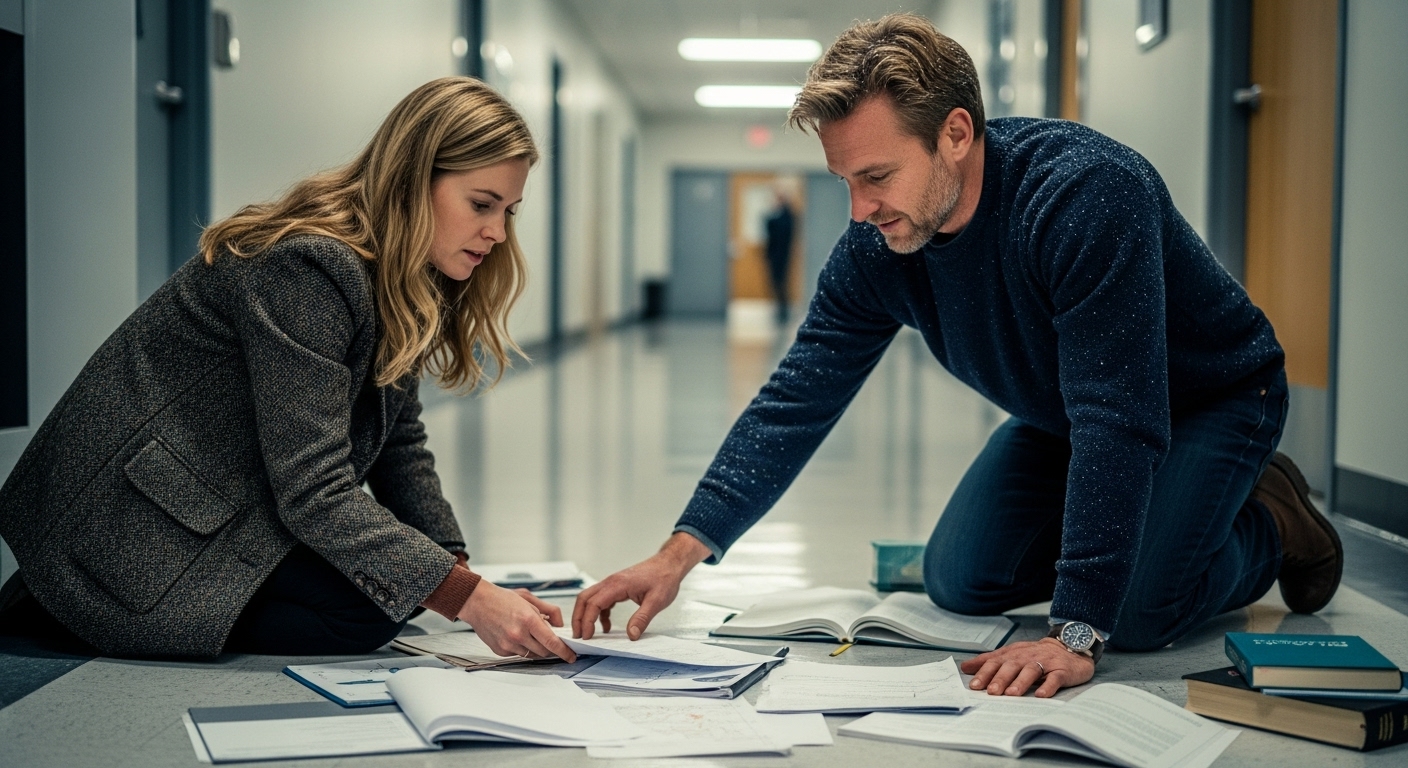
Then, a shadow. A blur of movement. A figure, equally burdened, equally distracted, rounding the corner from the stairwell. There was a sound—a choked, half-formed apology from her, a sharp intake of breath from him—and then the inevitable. A soft thud, a cascade of paper, the slosh of coffee (miraculously, still mostly contained), and the dull crack of a laptop hitting the floor. Time stretched, then snapped back into place. They were a tangled heap of limbs and scientific literature, a modern-day tableau of academic catastrophe.
"Oh, for… I am so, so sorry," a voice rumbled, deep and warm, pulling her out of the immediate shock. It was Erik Schulz, the new hot-shot in Climate Entrepreneurship. He was already half-crouched, sweeping up loose pages with a diligence that bordered on frantic. His dark hair, slightly damp from the outside chill, fell over his brow, obscuring eyes she knew were a surprisingly bright shade of hazel. He looked up, a sheepish grin battling a flash of genuine concern. "Ingrid, right? Dr. Nilsen?" He managed to sound both apologetic and vaguely charmed, even with his MacBook Pro lying face down like a wounded soldier.
"Erik. Professor Schulz. Yes, me. And honestly, it's entirely my fault. I was practically speed-walking through a library, which is a cardinal sin." Ingrid felt a blush creep up her neck, a hot counterpoint to the chill of the hallway. Her own papers, a chaotic explosion of graphs and footnotes, had settled around her like fallen leaves. One particularly stubborn sheet, detailing glacier melt rates, had somehow landed directly on his head, clinging like a paper toupee. She reached for it, their hands brushing, a tiny electric jolt that made her pull back a fraction too quickly. He chuckled, a low, pleasant sound.
"No, no, I was lost in thought, a dangerous place to be," he countered, retrieving his laptop with an exaggerated sigh of relief. It seemed unharmed. "And carrying far too much. Standard professor-brain, right? You get an idea, you hoard all the data." He picked up a page from her pile, scanning a headline. "'Coastal Erosion Patterns in Haida Gwaii.' Fascinating stuff. Is this what you're presenting on?" His gaze, when it met hers, was direct, curious, almost disarmingly so.
"Part of it, yes. For the departmental review committee. Not the most riveting crowd, but the work is… it's vital. Especially now, with the winter storms intensifying." Ingrid felt herself relax, a little. The awkwardness was still a flimsy membrane between them, but the shared language of their work was a warm, familiar current. "And you? What existential threat are you tackling with that impressive stack of books?" She gestured to his rescued pile, which included titles on sustainable economics and community resilience.
"Oh, just the usual. Trying to convince students that capitalism can be good if it's green. A fool's errand, perhaps, but a hopeful one." He grinned, and for a fleeting, impossible moment, the harsh fluorescent light seemed to soften, throwing golden highlights across his face. "Actually, I was putting together a module on understanding project context. For ECO-STAR. You familiar with it?" He started carefully restacking her papers, arranging them by what seemed to be his own intuitive, organised logic.
Ingrid raised an eyebrow. "I've seen the acronym on a few campus memos. Environment, Customer, Opportunity… something-something?" She leaned in, a wisp of hair escaping her bun, brushing her cheek. The faint, clean scent of his cologne—cedarwood and something else, sharp and metallic like winter air—mingled with the old paper smell. It was a strange, compelling combination.
---
A Shared Atmosphere
Erik smiled, a slow, unhurried unfurling of his lips that reached his eyes. "Precisely. And the first, the 'E'—Environment—is where so many projects fail if they don't get it right. It's not just the physical stuff, you know? The climate, the geography, the infrastructure. Though that's huge, obviously." He held up a paper detailing tide charts, then handed it to her.
"It's also about the social and cultural context. The local traditions, the histories, the community dynamics. How people interact with their land, their resources. Essentially, it's asking: 'Where are we, and what shapes this place and its people?'" He punctuated the last sentence with a gentle tap on a report about Indigenous land use policies, a thoughtful emphasis. "You, more than anyone, probably get that." He looked at her, his expression earnest, almost vulnerable.
Ingrid nodded slowly, her fingers tracing the edge of the report he'd just indicated. The surreal flicker of the hallway lights above seemed to warp the edges of her perception, making the moment feel both hyper-real and deeply intimate. "Absolutely. You can't just drop a solar farm somewhere without understanding the centuries of human connection to that land, the specific ecosystems, the local knowledge passed down through generations. It's… it's criminal to ignore that." Her voice, usually quite academic and measured, held a sudden, unexpected heat.
"Exactly!" Erik’s eyes lit up, a genuine spark. "Indigenous knowledge, particularly in the North, holds keys to climate adaptation that Western science is only just beginning to truly appreciate. Not in some 'spiritual guru' way," he clarified quickly, almost anticipating a common misconception, "but as practical, observational, deeply empirical knowledge cultivated over millennia. It’s about understanding the land in a way a satellite never could. And integrating that into the 'Environment' pillar of a project? That's true resilience."
A strange, comfortable silence settled between them, broken only by the distant whir of a ventilation system. Ingrid found herself studying the subtle crinkles around Erik's eyes when he smiled, the way his fingers, strong and capable, still held a couple of her stray articles as if they were precious artifacts. He didn't just understand her work; he amplified it, saw its full, intricate geometry. It was a rare, heady feeling, like finding a perfectly matched wavelength after a lifetime of static.
"You know," Ingrid said, her voice a little softer than she intended, "most people just nod politely when I start talking about holistic environmental frameworks. Or they ask if it's 'too complicated' for a grant application." She gave a small, self-deprecating laugh.
"Well, most people are missing the point, then, aren't they?" Erik countered, his gaze unwavering. He finished gathering the last of her papers, tapping the stack neatly. "I think it's the only point. And it sounds like we might have a lot more to talk about, beyond just the 'E' in ECO-STAR. The 'C' for Customer, for instance, is all about… well, who benefits, really. Who are we doing this for?" He held out her stack of papers, his fingers brushing hers again, this time lingering just a fraction longer.
The simple act sent a shiver, not of cold, but of unexpected warmth, through Ingrid. His words, his focus, had made the forgotten meeting, the spilled coffee, the general chaos of her day, fade into a distant, unimportant hum. All that mattered was the quiet intensity of his hazel eyes, the subtle curve of his smile, and the shared intellectual ground that had opened up like an unexpected spring beneath their feet.
"I… I think so too," Ingrid managed, her voice a little breathy. The light, the dust motes dancing in the air, the faint chemical smell of the hallway, all seemed to coalesce into a vivid, almost dreamlike backdrop for this sudden, undeniable connection. "Perhaps we should… continue this conversation. Properly. Without the threat of academic paper-piles collapsing on us."
Erik's smile widened, a genuine, joyful expression that dispelled any lingering academic stiffness. "I would like that very much, Ingrid. In fact, I insist. How about dinner? We can talk about ECO-STAR, the true cost of coastal erosion, and… whatever else comes up." He gestured vaguely, his eyes twinkling. "And perhaps a less precarious environment than this, eh?"
Ingrid felt a smile spread across her own face, unbidden and utterly genuine. "Dinner sounds… perfect, Erik. Absolutely perfect."
The thought of dinner, a real meal, a quiet conversation that wasn’t rushed or interrupted, settled over her like a comforting blanket. It was a nascent possibility, a fragile, hopeful thing shimmering in the sterile glow of the hallway. She looked at Erik, really looked at him, and saw not just a colleague, but a world of shared passion and potential, unfolding like a map of uncharted territories, beckoning her forward into the crisp, promise-laden winter evening.
As Ingrid walked away, the weight in her arms felt lighter, replaced by a strange, buoyant energy. She still had to face that departmental meeting, but now, the prospect of dinner, of delving deeper into Erik's mind and the intricacies of ECO-STAR, felt less like an obligation and more like the beginning of an entirely new, incredibly exciting project.
Share This Story


