Dust and Daffodils
The world had decided, quite abruptly, to reconfigure itself. One moment, I was contemplating a new biography on Churchill, the next, the very fabric of existence seemed to unravel into a cacophony of groans and splintering. Now, a fine, acrid dust hung in the air, tasting of old plaster and forgotten hopes, mingling with the faint, persistent scent of spring rain trying to seep through the newly formed gaps in the world. The only light was a fractured sort of pale grey, struggling through the newly formed apertures above, illuminating swirling motes that danced a macabre jig. My head throbbed, a dull, insistent rhythm against the frantic beat of my heart, and the pervasive gloom was occasionally punctuated by the creak of unseen stresses, a constant, unsettling reminder that our current predicament was far from stable.
“You’re… you’re actually making a joke right now?” Her voice, sharp and surprisingly clear through the dust-laced air, was laced with an incredulity that, under different circumstances, I might have found endearing. Under these circumstances, it mostly just confirmed my belief that I was, perhaps, not entirely suited to high-stakes survival scenarios.
“Well, what else is there to do?” I managed, my throat scratchy, tasting like a mouthful of dry wall. I tried to shift my weight, a mistake. A fresh shower of plaster rained down from a precariously angled ceiling panel, narrowly missing my head. I flinched, a truly elegant display of masculine courage.
She sighed, a sound that seemed to carry the weight of all humanity’s collective exasperation. “Panic? Try to find a way out? Not… whatever this is.” She gestured vaguely with a dust-smeared hand towards the chaos that was once, presumably, the main floor of the 'Literary Haven' bookstore. It was less a haven now and more a particularly aggressive abstract art installation.
My back ached, a deep, persistent throb right between the shoulder blades, a souvenir from whatever cosmic joke had decided to drop half a building on my Tuesday afternoon. “This,” I clarified, spitting out a tiny grit of something metallic, “is my coping mechanism. Wry observation. It’s better than the alternative, which is, I suspect, weeping uncontrollably while hugging a copy of 'Wuthering Heights'.”
A snort. Definitely a snort. “You think a copy of 'Wuthering Heights' survived?” Her eyes, I noticed, were a startling, clear grey, even through the grime that dusted her face and clung to her dark, slightly dishevelled hair. She was perhaps late thirties, like me, maybe a touch younger. Her sensible, practical jacket, now ripped at the shoulder, screamed 'sensible career woman who probably knows how to do taxes and rebuild an engine'. I, on the other hand, was wearing a slightly too-tight tweed blazer that had clearly seen better days, even before the structural integrity of the universe decided to give up the ghost. I was a marketing manager, for crying out loud. My most extreme outdoor activity involved finding a decent Wi-Fi signal on a patio.
“One can dream,” I muttered, trying to push myself up against a bookshelf that was no longer quite vertical. The spine of a particularly weighty tome, perhaps a dictionary or an encyclopedia of some forgotten art form, dug into my hip. “And besides, if it’s an urban disaster, it’s probably a psychological drama, not a romantic comedy. Though, with you, it could swing either way, I suppose.” The last part slipped out before my brain could censor it, a truly masterful display of social ineptitude.
She stopped, her head cocked, and a sliver of a smile, quick and fleeting, touched the corner of her lips. “Oh? And what makes you say that?” The subtext here was so thick you could carve it with a butter knife. It was a challenge, a dare, and a small, dangerous flicker of something else. This was Candice, I’d gathered from her earlier, more coherent mutterings. Candice, who was somehow still standing more upright than I was.
“Well,” I began, attempting to sound suave, which mostly resulted in more dust entering my lungs and a short, hacking cough. “The rapid descent into chaos, the unexpected proximity of strangers, the looming threat of further structural instability… definitely drama. The banter, the obvious unspoken attraction, the shared predicament…” I waved a hand vaguely. “That’s where the rom-com element usually kicks in. You know, ‘meet-cute amidst the rubble’?”
She raised an eyebrow, a tiny, almost imperceptible movement, but it conveyed volumes. “Unspoken attraction?” The question hung in the air, a daring balloon daring me to pop it. The scent of damp earth, newly churned, mixed oddly with something chemical, like static discharge, and the unmistakable, sweet perfume of some nearby cherry blossoms, trying to push through the concrete. Spring, apparently, was still happening outside, regardless of my personal catastrophe.
My cheeks, I realised, were probably coated in enough dust to hide any blush, which was a small mercy. “Speculation,” I said, trying to regain some semblance of dignity. “Purely observational. I’m a marketing professional; I analyse human behaviour. It’s my job.” It was a lie, of course. My job involved making sure people bought things they didn't need, not dissecting the nuances of attraction in a potentially fatal situation.
“Right,” she said, and the way she drew out the word suggested she believed me about as much as she believed in a pristine copy of 'Wuthering Heights' surviving this architectural indigestion. “So, ‘marketing professional’ Mason. Do your professional observations also extend to, say, noticing that the main exit is now just a rather impressive pile of very heavy things, and that this entire section might be… sagging?” She pointed a trembling finger towards a distant wall, where a distinct, new crack had appeared, spiderwebbing across the plaster like a malevolent vein.
---
Her words jolted me from my surprisingly pleasant mental meandering. Sagging. Right. The immediate, visceral reality of it hit harder than the dust cloud. The floor beneath my feet, already uneven, seemed to shift infinitesimally. A new wave of fear, cold and sharp, cut through the humorous bravado. My heart, which had just been doing a rather jaunty rhythm, now slammed against my ribs, a frantic drum against the encroaching silence.
“Sagging?” I repeated, the word tasting like ash. I pushed myself fully upright this time, wincing as a sharp pain shot up my spine. My tweed blazer felt suddenly heavy, a ridiculous costume for the apocalypse. “That’s… suboptimal. Very suboptimal.” I tried to sound witty, but it came out sounding more like a whimper.
“Suboptimal is an understatement, Mason,” she said, already moving, her movements surprisingly fluid despite the ankle-deep debris. She navigated around a shattered display case, ignoring the gleam of broken glass. Her focused intensity was almost hypnotic. “Look, that support beam.” She pointed again, this time to a thick, rusted I-beam that was clearly meant to be a foundational element, now bent at a grotesque angle, like a broken arm. “It’s compromised. Severely. We need to find another way, and quickly.”
My gaze followed hers, and a sick knot formed in my stomach. The structural damage was far more extensive than my initial, dust-addled assessment. The spring light, which had earlier seemed almost hopeful, now only highlighted the extent of our predicament, glinting off shards of glass and the metallic sheen of exposed pipes. The air, despite the dust, felt suddenly colder, carrying the unmistakable scent of damp concrete and the faint, bitter tang of burning insulation from somewhere deeper within the wreckage.
“Alright,” I said, trying to inject some authority into my voice, which mostly just cracked. “Another way. Which way? This place… it’s a maze, even on a good day.” The bookstore had been one of those multi-level, rambling affairs, all hidden nooks and unexpected staircases. Now, it was a death trap disguised as a forgotten architectural folly.
She didn’t answer immediately, her gaze sweeping around the cavernous, broken space. Her eyes narrowed, assessing, calculating. I saw a flicker of raw fear in them, quickly masked by a fierce determination. “Up,” she finally said, pointing towards a section of the ceiling that had partially collapsed, leaving a jagged, dark opening leading to what I assumed was the floor above. “That might be a service shaft, or a ventilation tunnel. It’s too narrow for a full collapse, maybe it leads somewhere stable.”
“Up?” I swallowed. My fear of heights was a quiet, private sort of terror, usually managed by simply avoiding tall things. Now, it felt like a cruel joke. “As in, scaling a pile of debris that looks like it could decide to rearrange itself into a more acute angle at any moment?”
“Do you have a better idea, Mason?” Her voice was firm, leaving no room for argument. She was already clambering onto a stack of fallen books, surprisingly sturdy ones, using them as a makeshift ladder. Her jacket, the sensible one, snagged on a broken piece of wood, but she didn’t even seem to notice. Her focus was singular, terrifyingly so.
I hesitated, glancing around one last time. The main exit was indeed impassable. The side walls looked equally dubious. The persistent creaking, that unsettling symphony of a building slowly giving up the ghost, seemed to intensify. A choice, then: remain here and await the inevitable, or attempt a precarious climb into the unknown. I watched Candice, her movements surprisingly agile, considering. A faint tremor ran through the floor. It wasn’t a choice, not really. It was a compulsion.
“Right,” I sighed, running a hand through my already filthy hair, dislodging more plaster. “Lead the way, Candice, architect of our improbable escape. Just… try not to step on any particularly brittle volumes.” I tried for humour again, but my voice was thin, reedy, betraying the frantic thumping in my chest. My hands, I noticed, were shaking slightly as I gripped the edge of a sturdy, though dust-coated, display shelf. My palms felt sweaty, yet strangely cold.
She paused, one hand already reaching for a dangling electrical conduit, which probably wasn't the safest choice. She turned her head, looking at me over her shoulder. A small, genuine smile, brief but impactful, touched her lips. “Don’t worry, Mason. I’ll try not to crush any first editions. Unless they’re blocking our way. Then, all bets are off.” Her tone was light, but her eyes held a spark of something intense, a shared understanding of the grim joke. For a fleeting second, the danger seemed to recede, replaced by an odd, thrilling camaraderie.
I took a deep breath, the air still thick with the odour of concrete and distant, burning electronics, but now also tinged with the faint, invigorating scent of spring rain on newly broken earth. “Excellent. My life is in your capable, if potentially literature-destroying, hands.” I pushed off the dictionary, feeling the crunch of broken glass under my boots, and began to scramble after her. My right knee scraped painfully against a rough edge, sending a jolt up my thigh. I almost stumbled, catching myself on a tilted metal rack, the metallic taste of fear suddenly sharp on my tongue.
We climbed, slowly, awkwardly, using what remained of the shelving, the fractured remnants of display tables, and the exposed rebar as handholds. My muscles screamed in protest, unused to such exertion. Each movement was deliberate, punctuated by the shifting of debris, the settling groans of the building. Candice was a few feet ahead, a beacon of focused energy. Her every move was precise, tested, a testament to a different kind of strength than my own, mostly intellectual, variety. I found myself watching the slight sway of her hips, the tense set of her shoulders, a strange blend of primal fear and an almost inappropriate curiosity swirling within me.
“You… you do this often, then?” I puffed, my lungs burning, as I hauled myself over a particularly large slab of what looked like a collapsed counter. My tweed blazer was now utterly ruined, a badge of honour in this utterly dishevelled new world. My fingers, I noticed, were already raw.
“Escape collapsing structures?” she grunted, her voice strained as she pulled herself into the dark opening above. “Not a regular Tuesday, no. But I am an architect. I know how these things are supposed to stand up. Gives me a slight edge in knowing how they’ll fall down.” She disappeared into the gloom for a moment, then reappeared, her arm extended. “Give me your hand.”
Her hand was strong, calloused, and surprisingly warm against my clammy, trembling one. The connection was electric, brief but potent, sending a jolt through me that had nothing to do with fear of heights or structural integrity. It was a human touch, solid and real, in a world that had suddenly become abstract and terrifying. I hauled myself up, using her strength, feeling the rub of her skin against mine, the roughness of her palm. It was a strange, intimate moment, suspended between life and… well, the other thing.
I landed beside her, breathing heavily, my face inches from a dusty, corroded ventilation grille. The air here was slightly less suffocating, but still thick with the metallic tang of static and damp concrete. A single daffodil, impossibly, had pushed its way through a crack in the concrete far above, swaying gently in a non-existent breeze, a defiant splash of yellow against the grey. Nature’s relentless optimism, I supposed. Or its utter indifference. Probably the latter.
“Right,” she said, her voice softer now, a little breathless. She peered into the dark tunnel ahead. “Looks like it goes… somewhere. Probably not to a quaint café serving artisan lattes, but somewhere.” Her eyes met mine in the dimness, and in them, I saw a reflection of my own exhaustion, my own fear, and perhaps, just perhaps, a shared, ridiculous spark of amusement.
“One can hope for a good coffee,” I replied, my voice raspy. My arm brushed hers in the narrow space, and a curious warmth spread through me, despite the chill. The air around us felt charged, not just with dust and the smell of fresh spring destruction, but with something else, something… nascent. I didn't know if this was supposed to feel… anything. Warm? Comforting? I just… didn’t feel alone, not for a second. It was two solitudes, briefly, tentatively, overlapping, an unexpected comfort in the face of absolute disarray.
We began to crawl, the space tight, smelling strongly of old air filters and damp concrete. My knees scraped against the rough surface, my shoulders ached, and every inch forward felt like a monumental effort. The darkness pressed in, occasionally broken by slivers of light from new cracks in the fractured world above. I could hear Candice’s ragged breathing just ahead, a steady, reassuring presence. My thoughts, usually a cacophony of marketing slogans and existential dread, were now reduced to the simple rhythm of crawl, breathe, push. But even in this stripped-down state, a corner of my mind was cataloguing her movements, the sound of her breath, the way her hair, now even more dishevelled, caught the faint light.
It was a strange sort of dance, this survival. A grotesque ballet of broken things and desperate people. We moved past what looked like a collapsed air conditioning unit, then a section of twisted pipework that hissed faintly, smelling faintly of something like chlorine and damp earth. The humour, which had sustained me earlier, felt thinner now, replaced by a growing, raw vulnerability. We were utterly dependent on each other, two flawed, ordinary humans pitted against the indifferent power of a crumbling city. The absurdity of my tweed blazer and her pragmatic jacket in this new reality was not lost on me, a small, dark chuckle bubbling in my throat.
Then, a faint, almost imperceptible tremor, distinct from the usual groans and creaks, vibrated through the metal of the tunnel. It was different. Deeper. More resonant. Candice stopped dead. I could feel her tension, a palpable wave of alarm. “Did you… did you feel that?” she whispered, her voice tight, strained, all traces of her earlier wit gone, replaced by a chilling seriousness.
I nodded, though she couldn't see me in the gloom. My stomach lurched. The tremor wasn’t random. It felt like a deliberate shift, a profound settling. The sounds around us, which had become a grim backdrop, suddenly felt louder, sharper, more insistent. The building was speaking, and it wasn’t saying anything good.
And it was then, just as a fresh wave of panic threatened to overwhelm the burgeoning, illogical lightness in my chest, that a deeper, resonant groan shivered through the very bones of the building, not from above or below, but from somewhere directly behind us, accompanied by the distinct, sickening sound of stressed metal twisting like old taffy. We weren't just trapped; we were balancing on the edge of something far worse.
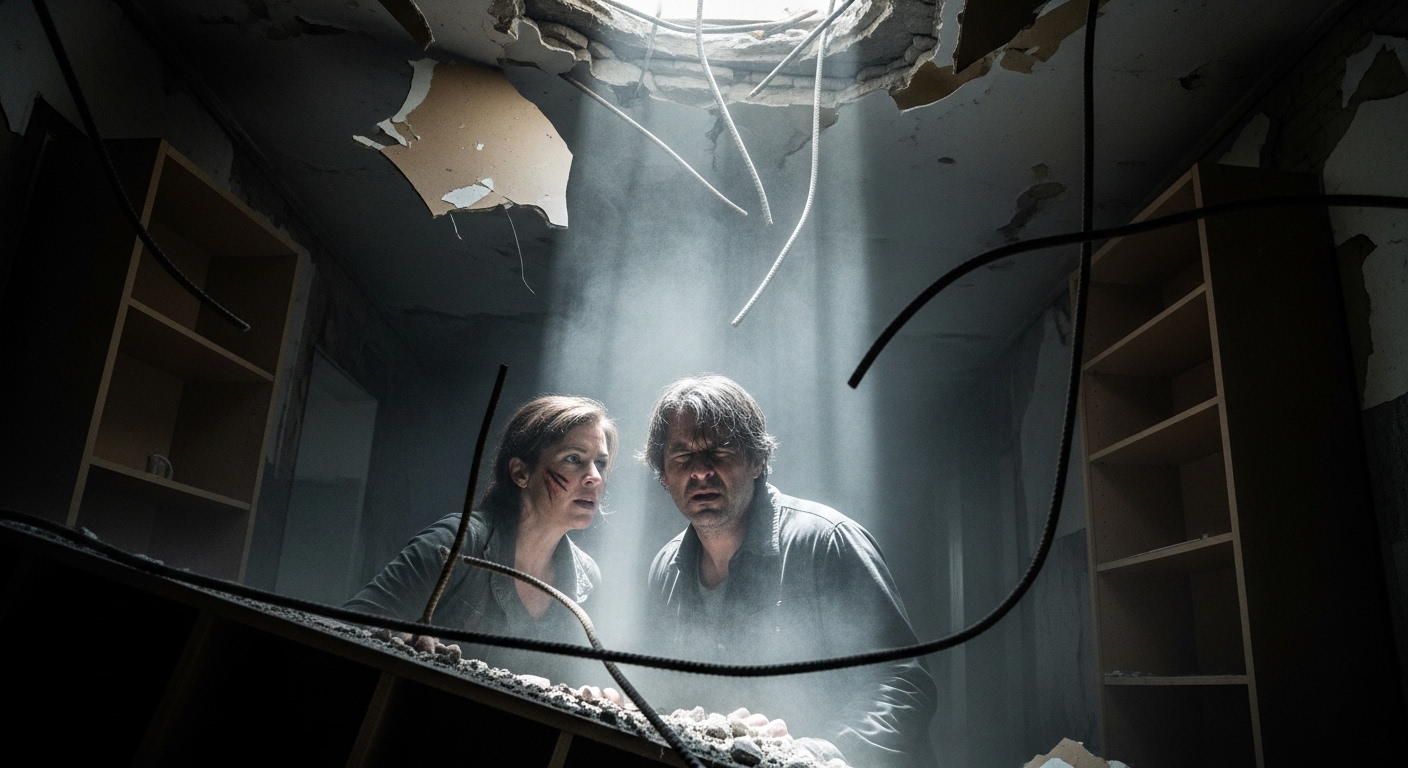
And it was then, just as a fresh wave of panic threatened to overwhelm the burgeoning, illogical lightness in my chest, that a deeper, resonant groan shivered through the very bones of the building, not from above or below, but from somewhere directly behind us, accompanied by the distinct, sickening sound of stressed metal twisting like old taffy. We weren't just trapped; we were balancing on the edge of something far worse.
Share This Story


