The Daily Infringement
Late autumn, inside the Willow Creek Seniors' Centre. The air is stale, the light anemic, and the hum of routine hangs heavy. Daniel Wallace, a creature of precise habits, arrives for his daily ritual, only to find his sacred space occupied by an unknown, formidable woman.
Daniel pushed the glass double doors of the Willow Creek Seniors’ Centre open, the brass handle cold even through the thin leather of his driving glove. A faint, almost imperceptible tremor ran through his knuckles. He noted the exact time on the large, slightly dusty clock above the reception desk: nine o’clock. Punctual, as always.
The usual creak of the old floorboards welcomed him, or perhaps merely tolerated his weight, much like the faded, floral wallpaper and the perpetually lukewarm coffee brewing in the corner. Outside, late autumn bit at his cheeks, a sharp, unpleasant nip, smelling of damp, decaying leaves and the promise of a hard frost. Inside, a familiar, slightly stale warmth, tinged with the faint smell of instant coffee, weak tea, and the pervasive bitter scent of disinfectant, wrapped around him like an ill-fitting blanket. He paused, just inside the threshold, taking a moment to shed his coat.
It was a heavy, tweed number, a gift from his daughter years ago, now smelling faintly of mothballs and old paper. He hung it on the empty wooden peg by the door – his peg, unofficially, by virtue of silent, unchallenged claim for the last decade – and carefully, precisely, tightened the knot on his grey wool scarf. Routine, he thought, was the last sturdy beam holding the rickety structure of his days together, and this morning ritual, the nine o’clock paper in the sunniest window seat, was paramount.
He shuffled towards the large, bay window overlooking the patch of ornamental kale that passed for a garden. His knees, always a bit stiff on a cold morning, gave a dull throb with each step. His eyes, already adjusted to the low, diffuse light of the entrance, narrowed almost imperceptibly as he drew closer. The chair. His armchair.
The one with the slightly flattened cushion that perfectly cradled his right hip, the one that offered a clear, unobstructed view of the meagre pedestrian traffic on Main Street. It was occupied. Not just occupied, but utterly usurped, as if by a conquering general. A woman, her back ramrod straight, sat there, a newspaper – his newspaper, the freshly delivered Willow Creek Standard, still pristine and uncracked – held aloft, practically obscuring her face. Her white hair, meticulously arranged in a tight bun that seemed to defy gravity, glinted under the anemic morning light that struggled to penetrate the window’s grime.
Daniel felt a familiar tightening in his chest, a little coil of indignation, cold and sharp as a surgeon’s scalpel. This wasn’t just a chair; it was a matter of egregious principle, a violation of the unspoken, sacrosanct laws of the seniors’ centre.
He stopped a few feet away, close enough for her to feel his presence, to perhaps catch the faint scent of his aftershave, a scent he’d worn since his thirties. He cleared his throat. It came out a little drier, a little more reedy than he’d intended. The woman didn’t stir.
The only sound was the almost imperceptible rustle of newsprint and the distant, polite murmur of the centre’s morning radio program – a dreadful local talk show he usually managed to avoid by immersing himself in the financial pages. He cleared his throat again, louder this time, a deliberate, gravelly rumble that usually garnered immediate attention.
Still nothing.
She might as well have been carved from the worn oak of the windowsill, an ancient, immobile sentinel. Daniel huffed, a short, sharp expulsion of air that made his moustache twitch beneath his nose. A loose thread on his scarf brushed his chin, tickling. He swiped at it irritably. “Excuse me,” he said, the words stiff, formal, like starched linen fresh from the laundry.
The newspaper rustled, then slowly, deliberately, lowered. A pair of keen, ice-blue eyes, set in a surprisingly unlined face for someone clearly past her seventy-fifth year, stared back at him over the rim of gold-framed spectacles. Her mouth, a thin, unsmiling line, tightened further, pulling the corners down. “Yes?” she asked, her voice clear, precise, and entirely devoid of warmth.
It was the kind of voice that could, Daniel thought, dissect a sentence with surgical accuracy, then reassemble it to prove your own grammatical deficiencies. He felt a sudden, inexplicable prickle of unease.
“That’s my chair,” Daniel stated, pointing a gloved finger, forgetting completely that he hadn’t yet removed his gloves. His hand felt clumsy, oversized. A small tremor went through it. The gesture felt aggressive, even to him, but he couldn’t back down now.
The woman’s left eyebrow, a perfect silver arc, rose infinitesimally, a slow, elegant movement that conveyed an almost unbearable condescension. “Oh? Does it have your name on it, then? A little brass plaque, perhaps, bolted to the armrest? I wasn’t aware the Willow Creek Seniors’ Centre had started assigning seating, Mr.…?”
She paused, clearly inviting him to provide his name, her gaze steady, unwavering. She lowered the paper to her lap, revealing the headline: 'Bridge Club Bake Sale Raises Record Sum'. It was, indeed, the Standard. His Standard. The one still rolled in its elastic band, untouched.
“It’s my chair,” Daniel repeated, his voice rising in pitch, a dangerous, reedy edge creeping in, like an instrument playing just slightly off-key. “Every morning. Nine o’clock. Always. For years. And that,” he added, jabbing a finger towards the newspaper now resting on her knees, “is my paper. I always read it first.”
A faint, almost imperceptible smirk touched her lips, a brief, fleeting shadow. “Oh, I see. So you’ve privatised the public seating and the communal news, have we? How utterly fascinating. And here I thought this was a place for community, for shared resources, not for… territorial declarations of an almost medieval nature.”
She folded the newspaper with a crisp, deliberate snap, the sound echoing a little too loudly in the quiet room, a small, aggressive percussion. Her hands, gnarled and spotted with age but still surprisingly elegant, placed it neatly on the small, scarred oak side table next to her. She even pushed it slightly towards him. An olive branch, or a challenge? He couldn’t tell.
“It’s about routine!” Daniel exclaimed, throwing his hands up in a gesture of exasperation that sent a jolt through his arthritic shoulder. He winced, a brief, involuntary tightening of his jaw. “It’s about… respect for what’s established. What’s known. This isn’t a free-for-all, Miss…?” He realised he didn’t know her name. He hadn’t bothered to learn the names of new people in years.
“Andrea Foster,” she supplied, her tone still cool, but with that hint of challenge. “And in those two years, Mr…?”
“Wallace,” Daniel grumbled, reluctantly, the name feeling too soft, too vulnerable in his mouth. “Daniel Wallace.”
“Mr. Wallace,” Andrea continued, a slight inclination of her head, as if he were a particularly difficult, yet not entirely hopeless, student. “And in those two years, Mr. Wallace, I’ve never seen you in this particular chair. Or with this particular paper, for that matter. Perhaps your routine is more… flexible than you believe?” She leaned back slightly, a picture of calm, while Daniel felt his blood pressure rising. He could feel a faint pulse throbbing at his temple.
Daniel sputtered, a small, ungraceful sound. “Flexible? I am a creature of habit, Miss Foster. A man of… steadfast principles. And this,” he gestured wildly, encompassing the entire, rather bland room with its beige walls and framed pictures of long-forgotten bake sales, “this whole arrangement, is my morning.
My quiet time before Mrs. Gable starts her incessant knitting circle chatter and Mr. Henderson tries to corner me about his prize-winning dahlias. It’s my… sanctuary.” He felt a flush creep up his neck, a heat he hadn’t felt in years, not since a particularly disastrous game of bingo where he’d accidentally called out 'B-9' instead of 'I-19', leading to a minor scandal. The shame, even decades later, still stung a little. His tie felt too tight.
Andrea Foster raised her hands, palms outward, a gesture of mock surrender, though her eyes remained sharp. “Oh, dear. It seems I’ve stumbled into a very delicate ecosystem. My apologies, King Daniel, for disturbing your… pre-Gable, pre-Henderson, pre-dahlia peace.” There was a glint in her eye now, a spark that wasn’t entirely hostile. It was… amusement. A wry, intelligent amusement that caught Daniel off guard. He hated being mocked, yet this felt different. Not malicious, but rather like being observed by a particularly clever bird.
---
Daniel stared, momentarily disarmed by the unexpected sarcasm. He hadn’t encountered such a direct, unvarnished challenge in ages. Most people at the centre either ignored him completely, preferring their own well-worn paths, or treated him with a placating, saccharine sweetness that grated on his nerves worse than fingernails on a chalkboard. They saw an old man, and that was that. Andrea Foster, however, was a different species entirely.
Her eyes, still fixed on him, held a surprising depth, a flicker of something that mirrored his own stubborn, solitary resolve, a loneliness he rarely acknowledged. He found himself, against his will, analysing the way a small wrinkle formed at the corner of her left eye when she arched her brow, a tell-tale sign of a past smile, or perhaps a long-held secret. He noticed the delicate, almost imperceptible tremor in her right hand as it rested on her lap.
He cleared his throat again, less forcefully this time. The air felt thick, heavy with unspoken things. “It’s not about being king, Miss Foster. It’s about… order. There’s enough chaos in the world without having to fight over a newspaper and a chair.” He looked at the Standard, still neatly folded on the side table. It felt less like a prize now, more like a crumpled flag of surrender, or perhaps a white flag of truce. His argument, so robust moments ago, felt suddenly thin, fragile. He saw his own reflection, a vaguely perturbed face, in the polished surface of the table, momentarily reminding him of his morning shave and the nick on his chin he’d almost missed.
“Indeed,” she replied, picking up the paper again, but not opening it. She tapped the front page lightly, the sound barely audible. “And I find great order in being able to read the local happenings without having to contend with… well, with the local happenings. A moment of quiet before the… cacophony of the day, as you so eloquently put it.” She offered him a small, almost imperceptible smile, just a slight upturn of the corners of her mouth that softened her features by a fraction. A crack in the formidable facade. He wondered what her life was like, what brought her here, to this specific centre, to this specific chair, at this specific time.
A beat of silence stretched between them, thick with unspoken observations, the faint hum of the fluorescent lights above providing the only background noise. Daniel found himself noticing the slight tremor in her hands as she held the paper, the way the light from the window caught a stray silver strand of hair near her temple, pulled tight from the bun.
He felt a ridiculous impulse to offer her a cup of lukewarm coffee from the urn in the corner. The impulse surprised him with its sheer unexpectedness. He usually recoiled from anything that resembled spontaneous human interaction, preferring to remain a quiet observer. His social energy reserves were low, always.
“The crossword is usually done by nine-thirty,” he found himself saying, the words escaping before he could properly censor them, a loose cannon of information. “Mrs. Henderson, usually. She’s surprisingly quick with the clues, considering her dahlia obsession.” He winced internally. Why was he sharing this utterly irrelevant detail? It was precisely the kind of small talk he abhorred, the kind that led to longer, more entangled conversations. His cheeks felt warm.
Andrea Foster actually chuckled. A low, soft sound, like rustling dry leaves, that seemed entirely out of place in the sterile, beige room. “Ah, so there’s an order to the chaos, then. The dahlia enthusiast also conquers words. Fascinating. And here I thought my own morning routine of solving the daily cryptoquote before breakfast was a singular achievement.” She looked at him with an expression that wasn’t quite a challenge, not quite amusement, but something in between – a shared understanding of petty triumphs. She tucked a stray strand of hair behind her ear.
“The cryptoquote,” Daniel muttered, a flicker of recognition in his eyes. “Difficult sometimes, aren’t they? All those substitutions. Gives you a headache if you’re not careful. All those ‘Q’s and ‘Z’s in the wrong place.” He hadn’t done one in years. Decades, maybe. Not since Mildred passed. The thought of Mildred, his late wife, was a dull, ever-present ache he usually kept carefully tucked away, like a folded, forgotten letter. But now, it surfaced, surprisingly, gently.
“Indeed,” Andrea said, her voice softer now, less combative, almost reflective. “Requires a certain… persistence. Like everything, I suppose.” Her gaze drifted past him, out the window, to the skeletal branches of an old oak tree, its last few russet leaves clinging on stubbornly, bravely, against the cold wind. The external air conditioning unit on the building’s side hummed faintly, a mechanical counterpoint to the quiet inside, a constant, low thrum.
Daniel shifted his weight from one foot to the other. His bad knee, the one that always flared up in damp weather, was starting to protest loudly, a dull, aching protest. He leaned against the doorframe, trying to alleviate the pressure. “Look,” he began, surprising himself with the sudden, awkward concession. “I… I didn’t mean to… to cause a scene. I’m just… particular.”
He gestured vaguely at the empty chairs around them, the expanse of the mostly deserted common room. Mrs. Gable’s knitting needles were now clicking softly from the far corner – she was here, then, her quiet, rhythmic presence a familiar, if sometimes irritating, hum in the background. Her presence, usually a source of annoyance, now felt almost like a comfort, a familiar landmark in a suddenly shifting landscape.
“Nor I,” Andrea replied, meeting his gaze again. There was a fragile truce in the air, a delicate, almost invisible thread weaving between them, like thin ice forming over a troubled pond. “It seems we both have our… territories. And our particular forms of morning solace.” She paused, then, with a slow, deliberate movement, she extended the folded newspaper towards him, her fingers brushing the edge of the crisp paper. “Perhaps,” she said, her voice almost a whisper, a sound barely louder than the hum of the air unit, “we could share it? I’m quite finished with the headlines, and I haven’t even glanced at the crossword. Far too early for such mental gymnastics, in my opinion.” Her lips twitched again, a ghost of a smile.
Daniel looked at the outstretched paper, then at her hand, the gnarled fingers, the pale skin. It was an invitation, tentative and utterly unexpected. He took it, his gloved fingers brushing hers, a fleeting contact that sent a peculiar, almost electric warmth through him. He mumbled a quiet “Thank you,” the words feeling foreign, unused. He hadn’t said ‘thank you’ for a casual gesture in so long.
She offered that small, almost-smile again, and this time it seemed to hold a genuine warmth. “You’re welcome, Mr. Wallace. Perhaps you could… enlighten me on the dahlia situation. I confess, I’m entirely ignorant of their plight. One hears such things, but never quite grasps the severity.” Her eyes, though still keen, had softened, reflecting a flicker of genuine interest.
He found himself smiling back, a slow, unfamiliar stretch of muscles that felt almost painful, as if his face had forgotten how. “Oh, it’s a plight, alright. Henderson’s been experimenting with a new hybrid, apparently. Something about a ‘Crimson Empress’ that’s not quite crimson enough. He’s convinced the local water supply is sabotaging his efforts.” He settled into the chair opposite her, one of the less comfortable ones, its springs groaning faintly under his weight, but it felt right. He unfolded the Standard, the smell of fresh newsprint oddly comforting, mingling with the faint scent of her perfume, something light, floral, unexpectedly pleasant.
---
The argument had dissolved, leaving behind a curious aftertaste, a mixture of initial embarrassment, followed by a strange, almost exhilarating lightness. Daniel, usually so rigid in his routines and his posture, felt a slight loosening in his shoulders, a subtle release of tension he hadn’t realised he’d been carrying.
He glanced over the top of the paper, pretending to scan the obituaries, watching Andrea. She had picked up a small, worn leather-bound book from her canvas tote bag, a collection of poetry, by the looks of it – something with a dark, minimalist cover. Her brow was furrowed in concentration, her lips moving silently as she read, as if tasting each word. He noticed the delicate silver chain around her neck, barely visible, with a small, unadorned pendant – a tiny, polished stone, perhaps a piece of amber. It caught the light occasionally, a warm, subtle glow.
He continued to read the headlines, or rather, his eyes skimmed over them, but his mind kept drifting, like a loose boat untethered from its moorings. He was acutely aware of her presence, the gentle turning of pages, the soft rustle of her coat as she shifted slightly in her chair, seeking a more comfortable position. It was a different kind of quiet than his usual solitary morning, a quiet now filled with a shared, unspoken understanding, a delicate, almost fragile companionship.
He found himself wondering what kind of poetry she read. Was it something romantic, full of passion? Tragic, echoing loss? Perhaps something absurdly modern? He imagined her in her youth, perhaps a vibrant, fiery woman, full of opinions and a quick wit, arguing fiercely but with a twinkle in her eye. It was an unsettling, yet not entirely unwelcome, thought, stirring old, dusty corners of his mind. He hadn’t thought about women like that in decades.
“The local council is considering a new by-law on leaf disposal,” he announced, the words coming out more like a question than a statement, a tentative probe into the silence. He wanted to break it, but not too abruptly, not to scare away this fragile new connection. He adjusted his glasses, a nervous habit.
Andrea lowered her book, marking her place with a finger, her gaze meeting his with a faint smile. “Oh? Another attempt to regulate nature, I presume? Last year it was the bird feeders – claims of pigeon overpopulation. The year before, garden gnomes – deemed ‘aesthetic pollution.’ One would think they’d find more pressing matters to discuss than the seasonal shedding of deciduous trees.” She gave a dry chuckle, a small, delightful sound. “What’s their grievance this time? Too many leaves in the gutters of democracy?” She even mimed a dramatic sigh.
Daniel snorted, a genuine, unforced sound, a real laugh rumbling deep in his chest. “Something about ‘aesthetic integrity’ and ‘fire hazards,’ I believe the official bulletin stated. Though I suspect it’s just Mrs. Peterson on Elm Street complaining, yet again, about Mr. Davies’ towering maple tree dropping its bounty onto her prize-winning petunias.” He folded the paper more tightly, focusing on a small smudge of ink near the classifieds, feeling oddly exposed in his honesty.
“Ah, Mrs. Peterson,” Andrea said, a knowing, almost conspiratorial tone in her voice, as if they were sharing a secret. “The scourge of Elm Street. I believe she once petitioned the library to remove all books featuring even a single mention of a squirrel. Claimed they encouraged ‘untidy outdoor habits’ and ‘moral laxity in arboreal rodents’.” Her eyes sparkled with mischief.
Daniel’s mouth dropped open slightly, his jaw feeling slack. “She did what?” He hadn’t heard that one. He had thought he was the curmudgeon-in-chief of Willow Creek, the undisputed king of local grievances. His own complaints felt almost trivial in comparison.
Andrea nodded gravely, though her eyes twinkled with undisguised amusement. “Indeed. A woman of… strong convictions. And even stronger opinions about the moral decay caused by rodentia. She had a rather compelling PowerPoint presentation, as I recall.” She watched him, a slow, thoughtful expression on her face, as if taking his measure. “You’re surprised, Mr. Wallace? I thought a man of ‘steadfast principles’ like yourself would be intimately familiar with the town’s more… colourful characters, the architects of its peculiar folklore.”
“I… I suppose I keep to myself, Miss Foster,” Daniel admitted, feeling a rare pang of vulnerability, a sudden, sharp ache of self-awareness. His voice was quieter now, a little rough. He hadn’t realised how much he hadn't known, how many layers of Willow Creek’s quiet, unassuming life he’d simply ignored, or perhaps deliberately avoided. He had built a wall of routine around himself, brick by careful brick, and inside that wall, the world had shrunk to the size of his armchair and the daily Standard, a neatly folded, predictable universe. He fidgeted with the edge of the newspaper, a small, unconscious gesture.
“A commendable trait, in its way,” Andrea murmured, her voice soft, almost sympathetic, devoid of judgment. “But sometimes, Mr. Wallace, the world outside those walls has rather interesting stories to tell. And sometimes, even a staunch recluse might find a chuckle, or perhaps even a little solace, in the absurdity of it all.” She closed her book, placing it back in her canvas bag, the gentle thud surprisingly loud in the now almost silent room. The light from the window had shifted further, casting long, elongated shadows across the worn linoleum floor. Mrs. Gable was now packing her knitting away, her departure signalled by the faint jingle of a plastic bag and the creak of her ancient orthopaedic shoes. The scent of disinfectant seemed to recede, replaced by something warmer, more human.
Daniel looked at her, really looked. The lines around her eyes, etched by years of living, spoke not just of age but of a life observed, experienced, and perhaps, occasionally, profoundly laughed at. He saw a flicker of loneliness there, too, a familiar echo of his own, a deep, quiet well. It was a strange, unexpected camaraderie, born from a territorial dispute over a newspaper and a chair, forged in the fires of shared irritation and unexpected amusement. His stiff neck felt a little less stiff.
“Perhaps,” Daniel said, the word feeling oddly light on his tongue, a hopeful whisper against the chill of the morning. He thought about Henderson’s Crimson Empress and her horticultural woes. He thought about Mrs. Peterson’s quixotic war on squirrels. He thought about the daily cryptoquote. And he thought about Andrea Foster, sitting opposite him, her presence a curious, unsettling warmth, a small, unexpected sunbeam cutting through the accustomed gloom. His hand, no longer gloved, rested on the newspaper, the paper that had started it all.
“Well, Mr. Wallace,” Andrea said, rising slowly, her movements stiff but imbued with a surprising grace. She picked up her bag, adjusting the strap on her shoulder. “It has been… an eventful morning. Perhaps tomorrow, the headlines will be less contentious. Or perhaps,” she added, a sly grin playing on her lips, a genuine, open smile this time that transformed her face, “you’ll be a little earlier, and secure your throne against all pretenders.” She winked, a quick, almost imperceptible flutter of her long, pale eyelashes.
Daniel chuckled again, a deeper, more resonant sound this time, one that felt like it had been trapped inside him for too long. “Perhaps, Miss Foster. Or perhaps… you’ll save me a spot. And maybe… maybe tell me more about this library petition. I confess, my curiosity is piqued. I’m quite intrigued by the sheer audacity of it all.” He stood up too, his bad knee giving a protesting groan that he ignored, for once. He wanted to prolong the conversation, just a little, to hold onto this fragile moment. He found himself straightening his cardigan, smoothing down his hair, an unconscious gesture of preening.
Andrea paused at the glass double doors, her hand on the brass handle, the cold metal no longer seeming so intimidating or alien. She turned, her blue eyes bright with a mixture of amusement and something else, something softer, more inviting.
A promise.
“I just might, Mr. Wallace. I just might.” She pushed the door open, letting in a gust of crisp, damp autumn air that ruffled the ornamental kale outside, and then she was gone, disappearing into the grey morning, leaving Daniel standing amidst the faded warmth, a slightly crumpled newspaper in his hand, and a feeling he hadn’t felt in a very, very long time.
A sense of… anticipation.
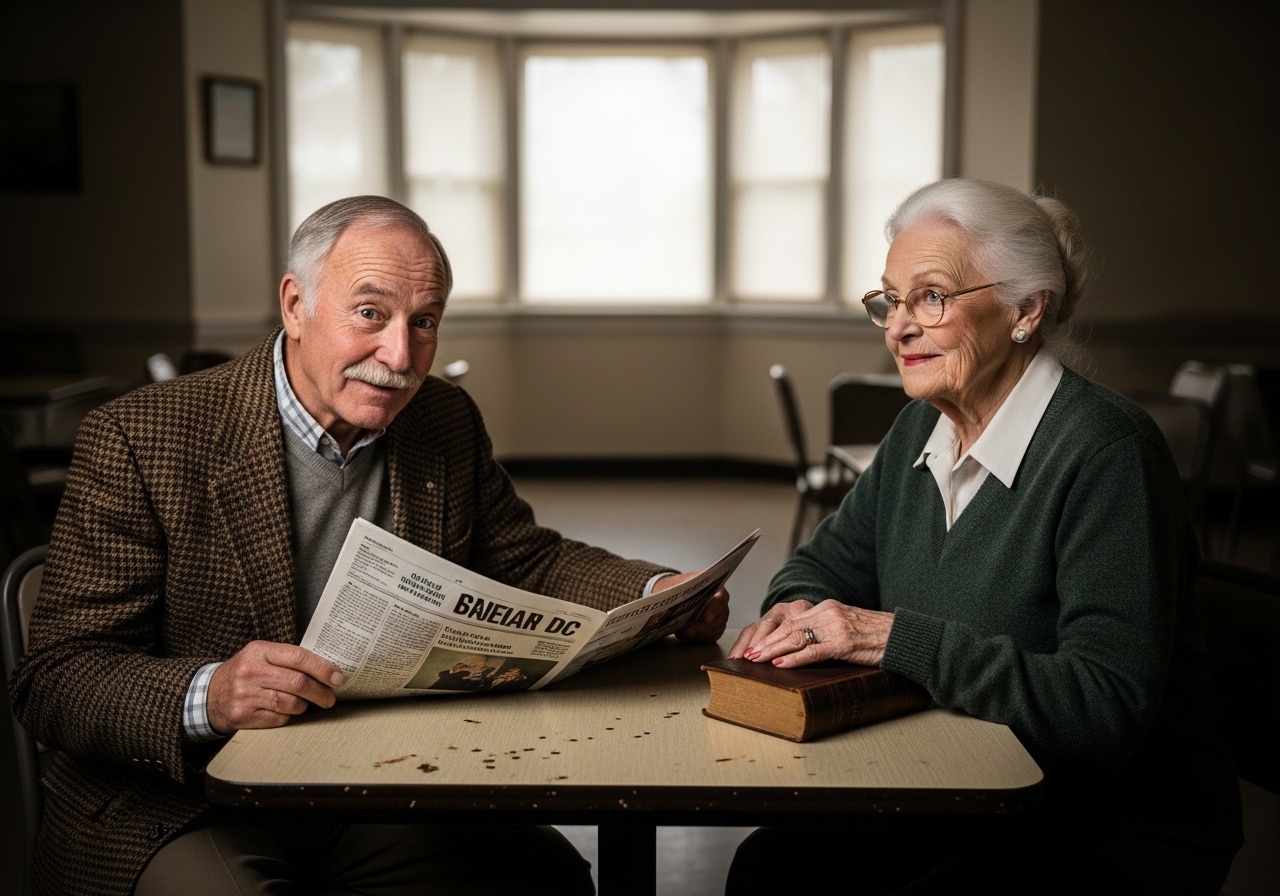
Andrea's departure left Daniel with a feeling he hadn't known in decades: anticipation, a flicker of something new kindled in the quiet, echoing room, making him wonder if the morning's disruptions were, in fact, an unexpected beginning.
Share This Story


