First Light Through the Dust
The city's breath, once a low, distant hum, had been ripped away, replaced by a terrible, grinding silence, punctuated by the groans of tortured steel. Dust, thick and caustic, hung heavy in the air, transforming the vibrant spring afternoon into a sepia-toned nightmare. Sunlight, once a warm caress, now struggled to pierce the particulate haze, casting a sickly, alien glow upon a world irrevocably altered. A pervasive sense of dread, cold and sharp, had settled deep within my chest, a physical weight pressing against my ribs.
A low thrum vibrated through the soles of my work shoes, a rumble that began deep beneath the city's concrete arteries before escalating into a guttural roar, rattling the polished glass of my corner office. The tremor, initially a curious shimmy, seized the entire high-rise in a violent, torsional spasm, wrenching steel and glass with a sound akin to a titan tearing at ancient bedrock. My coffee mug, a ceramic beacon of mundane routine, slid off my desk with a brittle clatter that was instantly swallowed by the symphony of grinding metal and shrieking structural fatigue. I stumbled, clutching at the edge of my drafting table, the solid oak groaning under my panicked grip.
The world outside the panoramic window—the meticulously arranged grid of buildings, the river glinting dully under a deceptively placid spring sky, the nascent green bursting from distant parkland—fractured into a jagged kaleidoscope. Glass, once a transparent barrier, spiderwebbed into a thousand razor-sharp lines before exploding inwards with a concussive force that threw me violently to the floor. My ears screamed, a high-pitched, insistent whine that drowned out the cascade of falling debris, the screams from other offices, the distant, impossible roar of collapsing infrastructure.
A jagged shard of something, probably drywall, scraped across my forearm, a hot, shallow furrow that bled instantly, a thin, bright line against the grey dust now coating everything. I pushed myself up, scrambling on hands and knees, my mind a blank, terrified canvas attempting to process an image of absolute, unimaginable devastation. The ceiling, or what remained of it, sagged like a torn sail, water pipes bursting with a hiss, spraying fine, cold mist onto the acrid, choking dust. The smell, a sharp, metallic tang of static electricity and burning plastic, clawed at the back of my throat.
“Jeff!” The voice was thin, choked, barely audible above the constant, terrifying groan of the building. It was Deirdre from accounting, or what I thought was Deirdre, crumpled by a filing cabinet, her face a pale mask of terror. I tried to move towards her, but the floor shifted again, a nauseating lurch that nearly sent me sprawling into a newly formed chasm where the corridor once was. A single, desperate thought hammered in my skull: Exit. Find an exit.
The air, thick with pulverized concrete and plaster, tasted like chalk and tasted like fear. Every breath was a struggle, each inhale a grit-filled rasp. I crawled, then stumbled, over desks overturned like fallen giants, over computer screens shattered into glittering constellations, towards what I hoped was the emergency stairwell. The building continued its agonising lament around me, a symphony of destruction, each creak and groan a promise of further collapse. My heart hammered against my ribs, a frantic, desperate bird trapped in a cage, urging me forward.
The stairwell entrance was barely recognisable. The fire door, once a solid, reassuring fixture, had been ripped from its hinges, twisted into a grotesque sculpture of warped metal. Beyond it, the concrete steps themselves had buckled, a precarious zig-zag descent into what looked like a subterranean maw. Light, a pale, milky wash, filtered down from somewhere above, illuminating dancing motes of dust and the stark, brutal reality of the wreckage. I gripped the twisted frame, my knuckles white, a desperate, animal instinct screaming at me to keep moving.
Then I saw her. A figure, silhouetted against the swirling dust, huddled on the third or fourth landing, just below the worst of the structural damage. Her head was bowed, hair matted with dust, shoulders shaking. She wasn’t moving. My own survival instinct, momentarily paramount, warred with a sudden, sharp pang of something else – a deep, almost involuntary human urge to connect, to help. “Hey!” My voice was a raw croak, hoarse from the dust and terror. “Are you… are you alright?”
She flinched, her head snapping up, startled. Her eyes, wide and dark, met mine. They were pools of shock, yet held a flicker of something stubborn, something determined, even through the fear. She was perhaps my age, maybe a few years younger, and the dusty, torn remains of what looked like a light spring coat clung to her. On her shoulder, incongruously, lay a sprig of cherry blossoms, still pink, miraculously intact, a cruel joke of nature against the grey devastation. “I… I think so,” she coughed, her voice thin, barely a whisper. “Just… the landing shifted. I can’t move my leg.”
I slid down the precarious incline of the damaged steps, careful to test each foot placement. The rebar jutted out at menacing angles, like fractured bones. The smell of wet earth and crushed blossoms, carried on a sudden, faint breeze from a newly formed crack in the outer wall, mixed oddly with the metallic scent of static electricity. “My name’s Jeff,” I said, extending a hand, which she took with a hesitant, dust-caked grip. Her skin was cold, clammy. “Lacey,” she replied, her gaze still flicking nervously around the groaning structure. “From the botanical gardens… on the 18th floor.”
The botanical gardens. I’d seen them from my office, a verdant, glass-enclosed paradise on the upper levels. Now, that paradise was undoubtedly a gaping maw of broken glass and pulverised greenery. The thought of it, the sheer scale of the obliteration, made my stomach clench. Her leg, I saw now, was pinned beneath a section of twisted rebar and a fallen concrete slab. It wasn’t a huge piece, but it was enough, the sheer weight of it pressing down, clearly excruciating. A deep, angry bruise was already blooming on her calf, a violent purple against her pale skin. “Can you… can you try to move it?” I asked, my voice betraying the doubt I felt.
She tried, a small, pained gasp escaping her lips. Her face contorted, a sheen of sweat breaking out on her forehead, immediately attracting more dust. “No,” she whispered, defeated, her head falling back against the grimy wall. “It’s… it’s stuck.” We were trapped. Not just by the chaos, but by this specific, immediate impedance. My architectural mind, now slowly attempting to reassert itself, began to calculate loads, angles, points of leverage. This wasn’t just a random act of destruction; it was a complex puzzle of impending doom.
“Alright,” I breathed, pushing against the slab with my shoulder, the effort sending a jolt of pain through my still-bleeding forearm. It was useless. The sheer mass. We needed a lever, something substantial. My eyes scanned the immediate vicinity. Broken office chairs, twisted metal frames, shattered monitors – nothing with the necessary rigidity. “We need something,” I muttered, more to myself than to her, the words tasting like ash. The building groaned again, a deep, resonant rumble that seemed to emanate from its very core, settling the dust in the air for only a moment before kicking up a fresh, choking cloud.
“There was… there was a crowbar,” Lacey said, her voice strained, pointing a shaky, dust-covered finger towards a darker recess of the stairwell, just out of my immediate sight. “Further down, where the railing snapped. I saw it when I fell.” My eyes followed her direction. A dark, jagged maw of rubble beckoned, leading deeper into the structural darkness. It wasn’t a safe path, but then, nothing here was. “Stay put,” I told her, the words feeling utterly inadequate, almost ridiculous in their casualness. “I’ll be right back.”
I moved, carefully, deliberately, each step a gamble. The air grew heavier here, colder. The rhythmic drip of a ruptured pipe somewhere above echoed eerily. My breath hitched in my chest, a small, involuntary spasm of fear. What if the whole thing just… went? What if this section, already compromised, decided to give way under my weight? My mind flashed to the brief moments I had with Deirdre, her face, her terror. Was she… gone? How many others? The questions were too vast, too terrifying to contemplate, so I pushed them down, focusing on the simple, visceral task at hand.
The crowbar was exactly where she said it was, half-buried under a small avalanche of plaster and insulation. It was heavy, cold, and reassuringly solid in my hands. I clutched it, the rough metal a comfort, a small fragment of utility in a world that had lost all sense of purpose. As I turned to head back, a sudden, sharp crack echoed from above, followed by a shower of small stones and a deeper, more resonant groan. A new fissure, wide and jagged, split the wall just metres from where Lacey lay, a spiderweb crack expanding with chilling rapidity.
“Jeff!” Her voice was shrill now, laced with a fresh wave of panic. “It’s moving! The wall!” My blood ran cold. The ornate writing I had seen on blueprints, the complex calculations, the reassuring diagrams, were all moot. This was raw, brute force. I scrambled back, adrenaline coursing through me, my earlier caution replaced by a desperate urgency. I reached her, my breath coming in ragged gasps, the heavy crowbar almost slipping from my grasp.
“Okay, okay,” I panted, kneeling beside her, the crowbar now poised. “On three. I’ll lift, you pull. Hard as you can.” Her eyes, dilated with fear, met mine again. This time, there was a raw, primal trust there, a flicker of hope that pierced through the suffocating gloom. It was a connection forged in extremis, immediate and absolute. We had known each other for perhaps ten minutes, yet in this crucible of disaster, a deeper, more profound understanding had already begun to form, unspoken, undeniable. My entire being was focused on this single, vital task.
One. Two. THREE! I heaved, grunting with the effort, muscles screaming in protest. The crowbar bit into the concrete, groaning, but the slab shifted, a fraction of an inch, just enough. Lacey cried out, a mix of pain and exertion, her leg wrenching free with a sickening squelch of flesh against concrete. She collapsed, panting, eyes squeezed shut, but her leg was out. A fresh stream of crimson tracked its way down her calf, but she was free. For a moment, we just lay there, breathless, chests heaving, the sounds of the dying building a constant, ominous refrain around us.
“Thank you,” she whispered, her voice thick with emotion, opening her eyes to look at me, a profound gratitude shining through the grit and exhaustion. “Thank you, Jeff.” My name, spoken by her in that moment, felt like a grounding anchor. I nodded, unable to speak, my own throat still raw. The small victory was intoxicating, a brief, fragile beacon in the overwhelming darkness. But it was fleeting. The air, already thick with dust, began to change. A new scent, subtle at first, then growing stronger, more insistent, began to permeate the broken stairwell. It was metallic, like burning copper, but also cloying, faintly sweet, with a distinct, unsettling note of damp earth. A shiver, colder than the chill in the air, traced its way down my spine.
---
The Unseen Predator
The initial relief, the sheer, visceral euphoria of Lacey’s freed leg, evaporated quicker than morning mist on hot pavement. The air was getting heavier, cloying. That scent… it wasn’t just the smell of destruction anymore. It was something else. Something active. My eyes scanned the immediate area, trying to find its source, but the dust and the fractured light made everything a blur of indistinct shapes and menacing shadows. Lacey coughed, a deep, wracking sound that brought tears to her eyes. “What is that smell?” she choked out, her voice barely a whisper, her hand rising instinctively to cover her mouth and nose.
My mind, the architect’s mind, began to frantically cycle through possibilities. What could be released? Gas lines. Industrial chemicals. The building itself was a repository of countless hidden dangers. The acrid tang grew, burning at the back of my throat. It felt… corrosive. My lungs burned with each forced breath, a raw, sharp pain that was rapidly eclipsing the pain in my arm. The faint, persistent sound of dripping water, now audible again, seemed to mock us, a rhythmic reminder of the constant decay and hidden dangers that permeated this new, terrifying reality. My head began to throb, a dull, insistent ache that pulsed behind my eyes.
I dragged myself closer to her, trying to shield her instinctively, foolishly, from the invisible assailant. Her eyes, wide and terrified, locked onto mine. There was a question there, unasked, but clear: Are we going to die here? I didn't have an answer. My architectural training had prepared me for structural integrity, for aesthetic flow, for the pragmatic demands of a bustling metropolis. It had offered no curriculum on surviving its collapse, no guidelines for an urban cataclysm. The irony, a bitter, sharp taste in my mouth, was almost overwhelming. The very structures I helped conceive were now trying to kill us.
The air, already difficult to breathe, thickened perceptibly. The taste in my mouth turned from chalky to distinctly metallic, as if I’d been chewing on old copper wiring. Lacey started to sway, her eyes fluttering. “Jeff,” she gasped, her voice weaker now, strained. Her hand, trembling, reached out, finding my arm, her fingers clutching desperately. Her grip was cold, tenuous. “I… I don’t feel so good.”
Panic, cold and sharp, lanced through me. This wasn’t just a structural threat; this was immediate, biological. We were being poisoned. My gaze fell upon the crack in the outer wall again, the one that had allowed the incongruous scent of wet earth and crushed blossoms to drift in. It was a narrow aperture, but outside it, the air, though still dust-choked, looked clearer, less… malevolent. A desperate, almost suicidal thought took root. Could we make it through? The gap was small, certainly too small for an adult to easily squeeze through, and the fall beyond it was unknowable, probably fatal.
“We have to get out of here,” I said, the words urgent, propelled by a sudden, fierce surge of adrenaline. “That smell… it’s getting stronger. It’s poison.” My voice, though raspy, had found a new resolve. Lacey’s head lolled against the grimy wall, her eyes barely slits. I shook her gently, trying to keep her conscious. “Lacey, hey! We have to move. Can you stand? Just lean on me.” The spring had promised renewal, life, but here, in the heart of the city's ruin, it delivered only the suffocating scent of death.
She pushed herself up, groaning, her body trembling with the effort, her weight heavy against me. Her injured leg buckled, but I caught her, wrapping an arm around her waist, supporting her. The crowbar, still in my other hand, felt like a lifeline. We staggered towards the fissure, each step a testament to sheer, desperate will. The wall groaned again, a deep, sickening lurch that sent more dust cascading down, the fine particles clinging to our damp skin. A cold bead of sweat trickled down my temple, stinging my eye. I blinked it away, refusing to let anything obscure my vision.
The fissure was wider than I had first thought, jagged and brutal, but still too narrow. A quick assessment, even through the haze of fear and the growing toxicity in the air, told me what I already knew: a human body, intact, would not fit. Not without further damage, not without carving new passage. My architect’s mind, usually so precise, was now a blur of frantic calculations, shattered stress loads. But this wasn’t about design; it was about survival. There was a section where the concrete had fractured in a slightly different way, a series of diagonal cracks radiating outwards from a central point of impact.
“I need to make this bigger,” I said, gesturing towards the fractured section with the crowbar. My voice was tight, strained. “We have to.” Lacey, barely conscious, nodded weakly against my shoulder, her breathing shallow and ragged. The faint, sickly sweet aroma of the gas was almost overwhelming now, filling every corner of the broken stairwell. My vision blurred at the edges, my head swimming. The floor beneath us felt less solid, more precarious, a constant, subtle shimmy suggesting further structural degradation.
I took a deep, burning breath, the acrid air searing my lungs, and brought the crowbar down with all my remaining strength against the weakest point of the fractured concrete. The impact reverberated up my arms, a jarring, bone-rattling shock, sending a fresh shower of dust and small stones flying. The crack deepened, widened, a terrible, grinding sound that spoke of material under unbearable stress. I hit it again, then again, each blow punctuated by a grunt of effort, my muscles screaming in protest, the fresh cut on my forearm throbbing with renewed intensity. The metal tasted like rust and fear. The spring, just outside, felt impossibly distant.
The air in the stairwell, heavy and oppressive, was now thick with the cloying, metallic scent of the gas. Lacey coughed, a weak, desperate sound, her body trembling against mine. I could feel her struggling for breath, her weight increasing. The urgency was absolute. I swung the crowbar one last, desperate time, putting every ounce of my dwindling strength into the blow. With a sickening crack, a large slab of concrete detached, crumbling inwards and downwards, opening the fissure just enough. A gust of relatively clearer, colder air rushed in, carrying with it the undeniable, fresh scent of spring rain and damp earth, a stark contrast to the poison that filled our makeshift tomb.
“Through here,” I gasped, pulling Lacey towards the newly widened opening. Her legs, weak and wobbly, refused to fully support her. I half-dragged, half-carried her, pushing her head and shoulders through the jagged gap first. It was a tight squeeze, the rough edges of the concrete scratching at her clothes, at her skin. I followed, grunting, my own body scraping painfully against the stone, the crowbar clattering somewhere below as it slipped from my grasp. We were out. Or at least, out of the immediate confines of the stairwell, onto a precarious, exposed ledge, hundreds of feet above what used to be a bustling street, now a vast, swirling tableau of smoke and ruin. The air was breathable here, colder, though still thick with dust and the distant, metallic tang of the disaster. But we were no longer suffocating. This was only the first step. The descent, the true challenge of survival, loomed below, a treacherous, uncertain path into the city’s broken heart. We had to find a way down. We had to get clear. And we had to do it together.
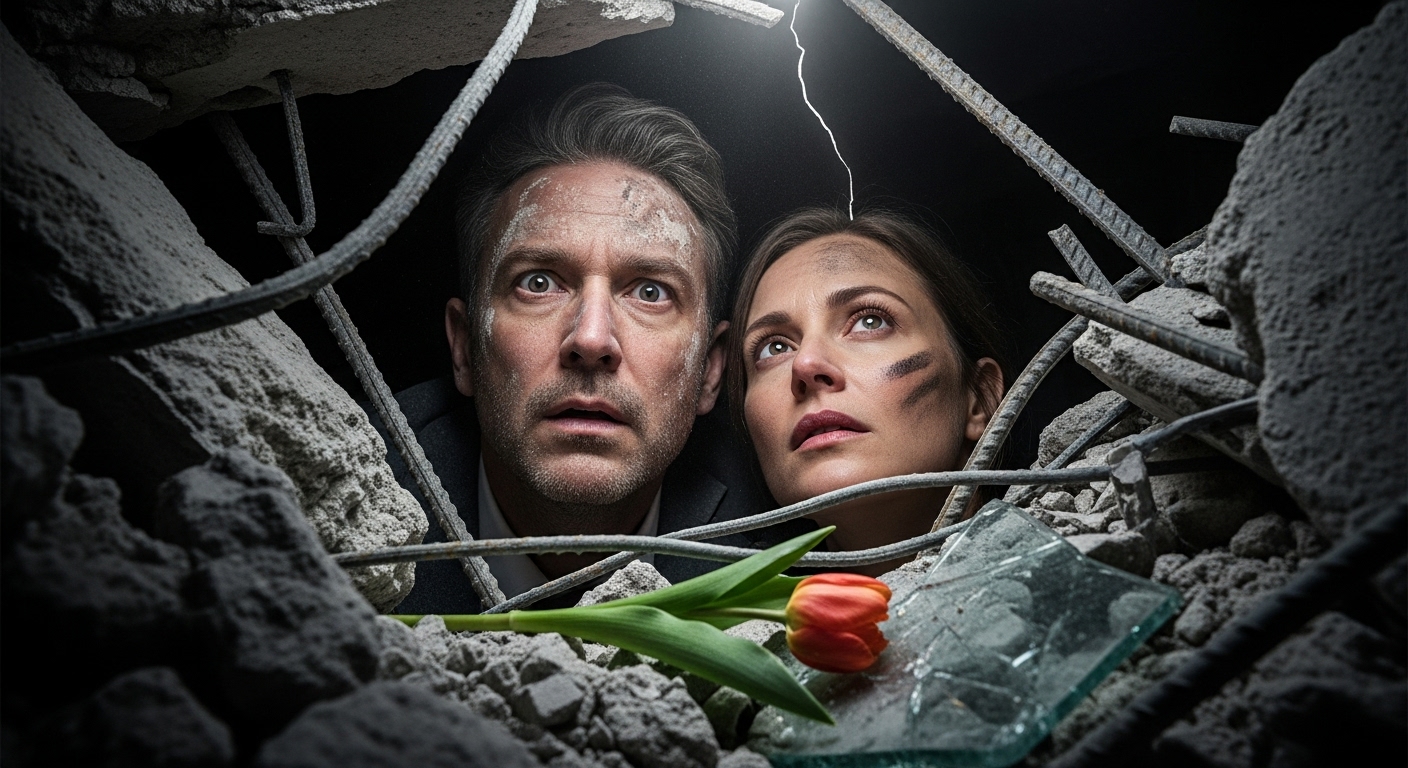
The faint, yet distinct, aroma of something acrid, almost like burning copper mixed with wet soil, began to permeate the air, growing stronger with each passing, terrifying second, a chilling confirmation of a new, unseen predator in their collapsing world. We needed to move, and quickly, before the very air we breathed became another, silent tomb.
Share This Story


