The Daily Paper's Unholy Custody
The smell of stale coffee and disinfectant hung heavy in the air of the Parkside Senior’s Centre. Afternoon light, thin and tired, stretched across the linoleum, highlighting dust motes dancing in the quiet hum of conversation. A forgotten cardigan lay draped over a chair, a testament to someone’s earlier, more animated presence. This was David’s sanctuary, or at least, his daily battleground against boredom, and it was about to be profoundly disturbed.
David shuffled into the Parkside Senior’s Centre, the familiar ache in his left knee announcing his arrival a full thirty seconds before his actual body did.
He hated afternoons. Mornings had the purposeful clatter of breakfast, the rush of a short walk before the chill really set in. Afternoons, though, were a swamp of empty hours, usually navigated by the soothing, if irritatingly modern, cryptic crossword in the local paper. He had a spot. His spot. The faded floral armchair by the window, where the sun, when it bothered to show its face, hit just right, warming his spine. And, crucially, it was always vacant.
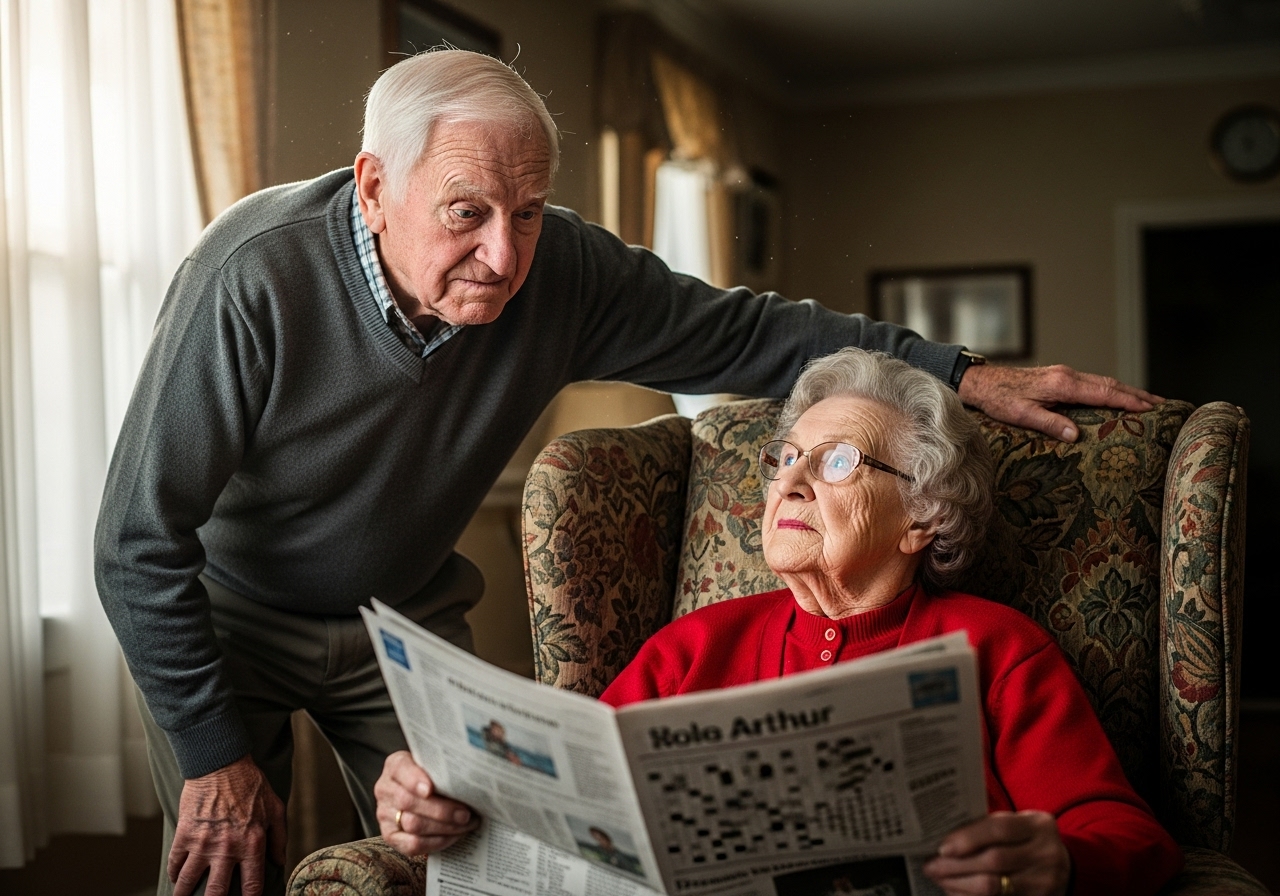
Today, however, the universe had clearly decided to personally inconvenience David Davies. The floral armchair was occupied. Not just occupied, but ensconced. A woman, whose back was to him, wore a surprisingly bright scarlet cardigan, her silver hair pulled back in a neat bun, stubbornly angled away from the door. And on her lap, folded open to the puzzle page, was his newspaper.
He paused, a tiny, almost imperceptible tremor running through his hands. This was a violation. A blatant, unprovoked assault on the sacred order of his day. His jaw clenched. He coughed, a dry, deliberate sound that should, by all rights, convey his displeasure. The woman didn’t stir.
“Excuse me,” David said, his voice a little raspier than he intended. He cleared his throat. “Excuse me.”
The scarlet back stiffened. Slowly, almost theatrically, the woman turned. Her face, though lined with the undeniable etching of decades, held a fierce, almost predatory intelligence in her sharp blue eyes. A pair of reading glasses perched on the end of her nose, giving her the air of a highly displeased owl. She looked him up and down, a slow, evaluating sweep that made David feel, suddenly, like a particularly uninteresting insect.
“Yes?” she said, her voice like sandpaper over velvet. “Can I help you, or are you just admiring the view?” She gestured vaguely towards the window with the newspaper, making him flinch as it crinkled.
“That’s… that’s my spot,” David managed, the words feeling utterly inadequate to express the cosmic injustice of the situation. “And my newspaper.”
She raised an eyebrow, a perfectly arched, silver line. “Your spot? Did you purchase the chair, dear? I don’t recall seeing a plaque with your name on it.” She sniffed. “And the newspaper, I believe, is a communal resource. Last I checked, the Centre doesn’t operate on a first-come, first-served basis for printed matter.”
David felt a flush creep up his neck. “It’s common courtesy,” he spluttered. “I always read the crossword at this time. Always. It’s… it’s a routine.”
“Routine,” she repeated, a ghost of a smile playing on her lips, but it wasn't a kind smile. “How thrilling. My routine, as it happens, involves sitting wherever I please and enjoying the quiet company of the day’s puzzles. And right now, that involves this particular chair, and this particular section of the paper.” She tapped a slender finger on the newsprint. Her nails were neatly filed, unpainted, practical. He hated them.
---
He stood there, shifting his weight. His knee throbbed. The low murmur of other conversations in the lounge seemed to amplify, as if everyone was suddenly listening. Mrs. Peterson, by the jigsaw table, paused, one piece shaped like a tiny, green dragon held aloft. David hated being watched, especially when he was losing an argument to a woman in a scarlet cardigan.
“Look,” he tried again, trying to inject a note of weary reasonableness into his voice. “I don’t want to cause a fuss. Just… five minutes. I only need to get the grid started.”
She tilted her head. “Oh, you only need to get the grid started? How very modest. And then, I suppose, the angels will descend and finish it for you? Or will you expect me to sit here, holding my breath, until you’ve satisfied your… grid-starting urge?” Her eyes twinkled, a truly infuriating glint.
“My name is David Davies,” he said, deciding a formal introduction might bring some decorum to this escalating absurdity. He extended a hand, then realised she was holding the paper and couldn’t shake it. He let his hand drop awkwardly to his side, feeling even more foolish.
“Mabel O’Connell,” she replied, not offering a hand, merely inclining her head. “And frankly, Mr. Davies, your name does little to impress upon me the divine right you seem to believe you possess over municipal furniture and newsprint.”
A ripple of suppressed chuckles drifted from the jigsaw table. David shot Mrs. Peterson a glare, which she met with an innocent, wide-eyed blink. He knew she was enjoying this. Everyone was. He felt a familiar heat rise in his chest, a mix of indignation and a strange, unfamiliar spark. It had been a long time since anyone had challenged him so directly, so… pointedly.
“Fine,” David huffed, pulling up a plastic chair from a nearby table, scraping it loudly against the linoleum. The sound made Mabel wince, a small victory. He sat, hunching over, glaring at her, then at the newspaper. “Are you going to solve it, or just stare at it?”
Mabel let out a sigh, long and exaggerated. “Patience, Mr. Davies. It’s a process. Not a race. And I rather think the answer to 6 Across is ‘loquacious’.” She pointed with her finger. “Ten letters. ‘Prone to much talking’?”
David leaned in, despite himself. He squinted at the clue. “Loquacious? No, no, that’s too obvious. It’s always a trick. ‘Prone to much talking’… what about ‘garrulous’?”
Mabel considered him, her sharp eyes appraising. “Garrulous,” she mused. “Seven letters. No, wouldn’t fit. And it’s not quite right. ‘Loquacious’ has a certain… lyrical quality, don’t you think? Like a verbose waterfall.”
“Verbose waterfall,” David scoffed, but a tiny twitch at the corner of his mouth betrayed him. “What rubbish. Puzzles are meant for precision, not poetry.” He grabbed the edge of the newspaper, tugging gently. “Let me see the grid properly.”
Mabel held firm, a surprising strength in her grip. “We can both see it, Mr. Davies. Unless your eyesight has decided to pack up and go home for the day?” She finally relented a fraction, shifting the paper so he could see. His hand, unexpectedly, brushed against hers. Her skin was dry, cool, faintly smelling of lavender soap and something else, something sharp and clean, like old paper.
---
“Alright,” he conceded, his voice softer, almost grudging. “Loquacious, then. But if it’s wrong, I’m blaming you.”
“As you wish,” Mabel replied, a small, genuine smile finally reaching her eyes. It transformed her face, softening the sharp angles, making her look, for a fleeting moment, utterly approachable. “Though I doubt your blame will alter the immutable laws of crosswords.” She filled in the letters with a tiny pencil, a delicate, practiced movement.
They fell into an uneasy rhythm. David grumbled about a clue regarding ‘aquatic mammals’ (it was ‘otter,’ naturally, and Mabel had known it immediately), while Mabel scoffed at his inability to recognise a classic literary reference. They traded insults disguised as helpful suggestions, their voices, though still edged, losing some of their initial hostility. Other seniors, initially tense, relaxed, resuming their hushed conversations, occasionally glancing over with amused smiles.
“Right, 14 Down,” David declared, pointing with a blunt finger. “‘A monarch’s playful decree’ – six letters, starts with ‘E’.”
Mabel tapped her pencil against her chin. “Playful decree… ‘Edict’ is too formal. ‘Enact’ is wrong. Hmm.” She leaned closer, her silver hair brushing his shoulder. A faint scent of her perfume, light and floral, registered in his senses. It wasn’t unpleasant.
“Emperor?” David offered, then immediately shook his head. “No, that’s a noun. It’s a decree.”
“Exult?” Mabel suggested, then chuckled, a low, melodic sound that surprised David. “No, that’s a verb of feeling, not a decree.” She looked at him, her eyes sparkling. “You’re thinking too linearly, Mr. Davies. Remember, it’s ‘playful’.”
His gaze lingered on her face, on the small crinkles around her eyes when she smiled, the way her lips pressed together in concentration. He realised, with a jolt, that he hadn’t had this kind of spirited, back-and-forth conversation in years. Not since Evelyn. A pang of something bittersweet, half-memory, half-new sensation, went through him.
“Edict,” he murmured again, this time almost to himself, the initial irritation completely forgotten. “No, ‘E’… ‘Edict’ is too… proper.”
“Exactly,” Mabel said, a conspiratorial note in her voice. “Think… something a bit more whimsical. Something a monarch might say to lighten the mood after a particularly tedious council meeting.”
He watched her. Her hand, holding the pencil, was steady. Strong, despite its age. He noticed a small, pale scar just above her knuckles, a faint memory of some long-forgotten scrape. It made her seem… real. Tangible. Not just a sharp-tongued obstacle.
“‘Enjoin’?” he tried, feeling a sudden surge of something akin to fun. He hadn’t felt this in so long. This mental sparring, this shared pursuit of a tiny, arbitrary truth.
Mabel shook her head slowly. “No, still too formal. Think simpler. More direct. More… a bit cheeky.” She paused, then her eyes widened. “Ah! I have it! ‘Edict’ is indeed too formal. What about… ‘Errand’?”
David blinked. “Errand? A monarch’s playful errand?” He considered it, then a low chuckle rumbled in his chest, startling himself as much as it startled Mabel. “A monarch’s playful errand! You absolute rogue! That’s brilliant!” The laugh was genuine, a deep, full sound that felt rusty, unused. It felt good. It felt… liberating.
Mabel’s cheeks coloured slightly, a pretty blush that belied her acerbic wit. Her smile widened, losing all its previous sharpness. “Thank you, Mr. Davies. I do try to inject a little ‘rogue’ into my daily puzzles.” She filled in ‘ERRAND’ with a flourish.
The crossword was almost done. The late afternoon light had shifted, casting long shadows across the floor. The centre was beginning to thin out. Mrs. Peterson had finally finished her jigsaw. David felt a strange lightness, an unfamiliar buoyancy in his chest. The initial anger, the irritation, had completely dissolved, replaced by… something else. Something warm. Something surprisingly pleasant.
“Well,” David said, clearing his throat, feeling a sudden awkwardness now that the puzzle was nearing its end. “That was… efficient. Thank you, Ms. O’Connell.”
“Mabel,” she corrected him, her voice soft. “And it was… certainly efficient, Mr. Davies. I confess, your initial… enthusiasm for the spot was rather bracing.” She met his gaze directly. There was a challenge there, yes, but also an invitation.
He found himself smiling back, a genuine, unforced smile that hadn’t graced his lips in years. “And your… lyrical approach to wordplay was… enlightening, Mabel.” He hesitated, then pushed a little further. “Perhaps… perhaps tomorrow, if the chair is available, we could… continue this shared endeavour?”
Mabel's smile widened. “Perhaps, David. Perhaps we could. Though I make no promises regarding the sanctity of your ‘spot’.” She folded the newspaper, handing him the now-completed crossword page. Their fingers brushed again, a lingering touch, much softer this time. A quiet current passed between them, a recognition of something unexpected, something fresh and fragile and utterly new.
He took the paper, his fingers still tingling from the brief contact. The crossword, once a symbol of his rigid routine, now felt like a shared adventure, a bridge unexpectedly built across years of solitude. He left the centre, the ache in his knee still there, but overshadowed by a different, much more profound sensation. The cold autumn air felt crisper, the world outside a little brighter.
“Good day, David,” Mabel called after him, her voice carrying across the emptying lounge. He turned. She was still sitting in the floral armchair, a tiny, knowing smile on her face, watching him go.
David walked away, the paper clutched in his hand, a strange flutter in his chest. He hadn’t realised how much he’d missed sparring with someone, how much he’d missed that spark, that feeling of being truly seen, until Mabel O’Connell, with her sharp wit and even sharper eyes, had quite literally stolen his chair.
Share This Story


