Beneath the Scratched Horizon
The old truck rumbled over cracked asphalt, the hum of the tyres a familiar drone against the backdrop of an endless summer sky. Dust, fine as flour, coated everything, clinging to the sparse, sun-drained evergreens that lined the highway. A humid stillness pressed down, thick with the scent of pine and something metallic from the engine, a silent promise of afternoon thunderstorms looming on the distant, bruised horizon. This stretch of road felt like a forgotten artery, leading to places no one truly remembered, where time moved differently, slower, more deliberately.
"Still think this is the right way, then?" Julia asked, her voice a dry lilt over the clatter of the old pickup. The passenger window, half-rolled down, let in a blast of hot, sticky air that tasted faintly of exhaust and sun-baked gravel. Her hair, already pulled back in a loose, struggling ponytail, felt like a heavy, warm scarf.
Jason didn’t look away from the road, a narrow track of crumbling asphalt that looked more like a deer trail than a proper highway. "Relax," he said, the corner of his mouth just barely twitching. "Got a map." He tapped the ancient, cracked dashboard where a worn-out, folded paper map sat, practically an artefact.
"A map," Julia deadpanned. "Right. The kind they used before satellites and… you know, actual signs." She plucked at a loose thread on her worn denim shorts, the fabric sticking to her legs. The truck’s suspension groaned over another pothole, jarring her against the seatbelt.
"Some places don’t need satellites, June," he replied, his tone softer, a subtle shift that made her insides tighten. "Some places just… are. You feel them out."
Julia glanced at him, his profile sharp against the glare of the windshield. His hands, tanned and strong, gripped the wheel with a casual competency. He’d always had that. A quiet confidence that she both admired and found utterly infuriating. How could someone be so surefooted when everything felt so precarious?
She picked at a loose bit of paint on the door handle. It was one of those days, she thought, where the air itself felt heavy with unspoken things. Like the humidity before a storm. They had been doing this for weeks now, these aimless drives, these long, quiet afternoons filled with half-jokes and meaningful glances that never quite landed. Always almost, never quite.
"I just don’t want to get stuck in some bog," she mumbled, more to herself than him. "Again."
"You liked the bog," Jason corrected, a genuine smile now, a flash of white teeth. "Admit it. You said it was ‘primordial’ and ‘deeply humbling’."
"I said it was boggy and I was regretting my footwear choices," Julia countered, a laugh catching in her throat. He was right, though. She had. Even soaking wet, pulling herself out of thick, sucking mud, there had been a strange, primal joy in it. But that was her, always finding the unexpected beauty, even in a mess. And that was him, always remembering the exact phrasing, the little details.
The truck finally veered off the main track, onto an even narrower dirt road, barely wide enough for a single vehicle. Branches scraped against the sides with a harsh, scratching sound that made Julia wince. "Easy on her, eh?" she muttered, patting the dashboard as if it were a loyal animal.
"She’s seen worse," Jason said. The dust plumed behind them, a silent cloud rising against the deep summer blue. The sun, a brutal disc, beat down, turning the scrub brush and scattered jack pines into shades of tired green and faded ochre. They were deep into the backwoods now, the kind of place where cell service died an unlamented death and the only sounds were the buzz of flies and the distant caw of a crow.
Julia leaned her head against the cool glass of the window, watching the blur of trees. She wondered, not for the first time, what Jason truly saw in these desolate places. Was it the quiet? The escape? Or was he, like her, searching for something unnameable, something that only revealed itself when the noise of the world faded into nothing?
Her chest felt tight. Always this tightness. Like a knot tied too carefully, too many times. She wanted to ask him, right then, what this was. This… whatever it was they were doing. But the words felt too large, too heavy for the humid air, too fragile to break against his easygoing façade. What if she asked, and he just laughed? Or worse, looked at her with pity?
Where the Current Stalled
They pulled to a stop beside a rusted, chained-off gate. Beyond it, a dirt track wound through overgrown saplings towards what looked like a series of derelict buildings. An old lumber mill, Jason had said. Abandoned decades ago. The air here was different, cooler, with a metallic tang mixed with the scent of stagnant water and decaying wood. The shade from a cluster of giant poplars offered a welcome respite from the sun’s glare.
"Here we are," Jason announced, cutting the engine. The sudden silence was profound, broken only by the chirr of crickets and the distant lapping of water. He hopped out, stretching, his movements fluid and unhurried. Julia watched him through the rearview mirror, a peculiar mix of longing and apprehension stirring in her gut.
She followed him, pushing through the thick growth of ferns and thistle. The path was barely discernible, reclaiming itself year by year. "God, the bugs," she complained, swatting at a mosquito already feasting on her forearm. "Did you bring repellent?"
Jason grinned over his shoulder. "Forgot. Adds to the authentic experience."
"You’re a sadist," she mumbled, but couldn’t help a small smile herself. His capacity for finding humour in discomfort was legendary. And sometimes, incredibly endearing.
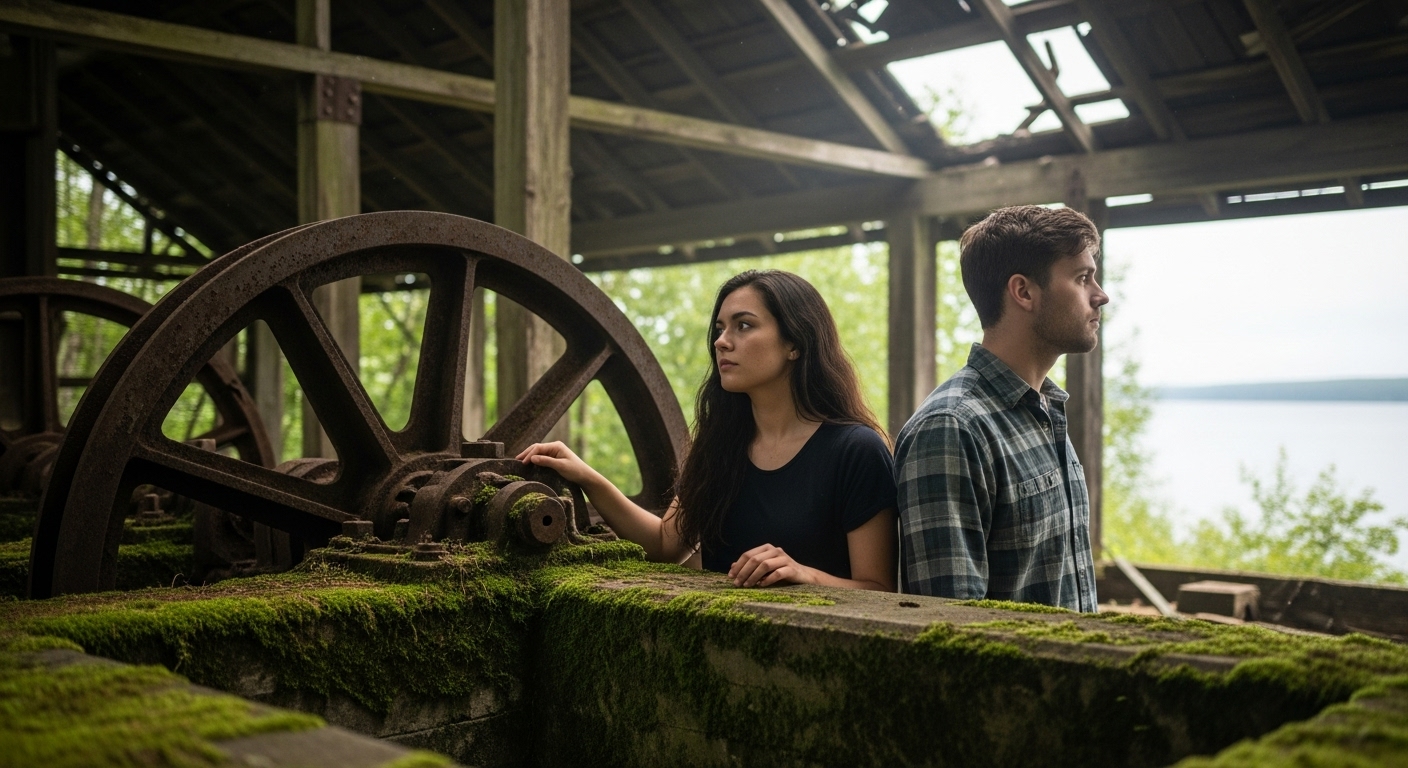
They emerged into a clearing where the skeletons of vast wooden structures stood, weather-beaten and grey. Giant, rusting machines lay half-buried in the earth, devoured by moss and vines. The air was thick with the ghost of industry, the spectral hum of saws and the faint memory of pine resin.
Julia walked slowly, her boots crunching on fallen leaves and splintered wood. She ran a hand over a moss-covered concrete foundation, the cool, rough surface a stark contrast to the oppressive heat. "It’s like… a forgotten giant," she whispered, awestruck. "Just swallowing everything."
Jason nodded, his gaze distant, taking in the grand scale of decay. "Always does," he said, his voice unusually soft. "Nature doesn’t care much for our plans."
He picked up a piece of smooth, water-worn stone, turning it over in his fingers. The gesture was so characteristic of him – a quiet contemplation, a seeking of patterns in the chaos. Julia found herself studying his hands, the way the light caught the fine hairs on his forearms, the slight callouses on his palms. A familiar ache, deep and persistent, settled in her chest.
"You think anyone ever comes back here?" she asked, her voice deliberately light, trying to deflect from the intensity of her observation.
"Maybe some old-timers, once in a while," he mused. "To remember. Or to make sure it’s still gone." He tossed the stone lightly from hand to hand. "Everything changes. You can’t stop it. Only watch it happen."
The words hung in the air, weighted with more than just the decay around them. Julia felt a sudden chill, despite the heat. Was he talking about the mill? Or them? She couldn’t tell. He rarely gave away his hand.
They explored further, moving into the shell of what must have been the main processing plant. Sunlight streamed through gaps in the roof, illuminating swirling dust and casting long, skeletal shadows. Wooden beams, thick as tree trunks, leaned at precarious angles. Julia felt a strange sense of reverence, standing in the heart of something so utterly consumed by time.
"Imagine the noise," she said, trying to conjure the sounds in her mind. "The yelling, the saws, the smell of fresh-cut lumber. Life."
Jason stopped beside a massive, rusted flywheel, still attached to its gears. He reached out, touching the cold metal. "Yeah," he said, his voice almost a murmur. "Life. And then… this. Just quiet."
He turned to her then, his eyes, the colour of deep lake water, meeting hers. For a moment, the banter, the easy deflection, melted away. There was a raw, searching quality in his gaze, a vulnerability she rarely saw. Her breath hitched, a small, involuntary gasp. The air thickened around them, charged with an electricity that hummed just beneath her skin. This was it, she thought. The moment. The question, finally, about to be asked or answered.
Her heart hammered, a frantic bird trapped in her ribs. She wanted to reach out, to close the small gap between them, to finally know. But her feet felt rooted to the cracked concrete. A tiny, irrational fear clawed at her throat: what if the answer wasn't what she wanted? What if it meant changing everything, and she wasn't ready? What if he wasn't ready?
Then, as quickly as it had appeared, the moment dissolved. Jason blinked, a subtle shift, and the guarded expression slid back into place. He looked past her, towards a crumbling wall. "Think there’s bats in here?" he asked, his voice returning to its casual, almost flippant tone. "Sounds like it’d be a good spot for them."
The spell was broken. Julia felt a deflate in her chest, a profound disappointment that was also, strangely, a relief. "Probably," she replied, forcing her voice to match his lightness. "Wouldn't surprise me. Everything finds a home in the ruins."
---
They spent another hour wandering the site, the air growing heavier, the sky darkening with distant thunderheads. They found an old boiler room, its massive furnace looking like the gaping maw of some prehistoric beast. They climbed a rickety set of stairs to a catwalk that swayed precariously, giving them a sweeping view of the decaying complex and the flat, grey expanse of the lake beyond.
The conversation drifted, light and inconsequential, covering everything and nothing. Julia found herself laughing, genuinely, at one of Jason’s dry observations about the ingenuity of mice, but the ache in her chest remained, a constant, dull throb. Every shared glance, every brush of elbows, felt like a loaded question, constantly deferred.
On the drive back, the first fat drops of rain began to fall, splattering against the windshield. The scent of wet earth and impending storm filled the truck cab. Jason turned on the wipers, their rhythmic squeak the only sound for a long while.
Julia watched the rain thicken, blurring the outlines of the pines. She thought about the mill, the way life had once pulsed there, and how quietly it had all faded. She thought about Jason, sitting beside her, a presence both solid and elusive. His hand rested on the gear stick, close enough to touch, but she didn’t. She couldn’t. It felt too much like a betrayal of the unspoken agreement they had, this comfortable, frustrating limbo.
He cleared his throat. "Good trip, June?"
She considered her answer, chewing on her lower lip. "Yeah," she finally said, truthfully. "It was. Thanks."
He nodded, his gaze fixed on the road, slick and gleaming under the rain. He didn't press. He never did. And that, she realised, was part of the problem. Part of the draw. He gave her space, always, even when she desperately wanted him to close it. He was a puzzle she kept trying to solve, knowing the pieces would never quite fit, but unable to stop trying. The rain intensified, drumming a quiet, relentless rhythm on the roof. She closed her eyes, the melancholic quiet settling deep within her, a familiar companion.
She didn't know if this feeling, this suspended anticipation, was love. It felt more like a slow, quiet unraveling. A constant negotiation with a heart that insisted on feeling too much, for someone who might just prefer the solitude of ruins.
She looked at him through the gathering dusk, his profile shadowed, and wondered if he felt it too – this delicate, dangerous equilibrium, just waiting for a single word to send it crashing down, or perhaps, finally, to make it real.
Share This Story


