The Slow, Unforgiving Pull
The air hung heavy, thick with the scent of wet earth and something sharp, almost like burning copper, that clung to the back of Ethan's throat. Below the skeletal branches of oaks, where new, sickly-bright green buds fought through the grey, the ground dissolved into a sucking mire. His boots, heavy with accumulated muck, protested with each withdrawal, making a sound like a wet kiss breaking. A cold drizzle, fine as mist, settled on his face, mingling with sweat that wasn't from exertion alone.
The ground gave way again, and Ethan's left boot plunged knee-deep into cold, silty water. A choked grunt escaped him, the sound swallowed by the oppressive quiet of the marsh. He yanked, muscles screaming, the thick, adhesive mud fighting back with perverse glee. When the boot finally emerged, it was plastered in black, slick ooze, rivulets dripping onto his already soaked trousers.
“Bloody hell,” he muttered, more to himself than the indifferent trees. The scent was stronger here, a metallic tang layered over the swamp gas and decaying leaves. He tried to place it. Not iron. Something sharper. A chemical burn, almost. His heart hammered a frantic rhythm against his ribs, a drumbeat of urgency and a fear he refused to acknowledge. He told himself it was the chill, the exertion. It was a lie. It was Sandy.
He pushed through a curtain of low-hanging, thorn-laden branches. Each snagged at his jacket, tugging, whispering. They were the colour of bruised fingers, with tiny, almost transparent green shoots clinging stubbornly to their tips. Spring. A cruel joke, really. Everything trying to bloom while his insides felt like winter rot.
He checked the compass, its needle wavering slightly before settling, pointing west. West, deeper into this God-forsaken bog. His brother, Leo, had called it a fool’s errand. “Let the dead lie,” Leo had pleaded. But Mara wasn’t dead. Not yet. Or, if she was, Ethan needed to know. He needed to make Sandy pay.
A faint glint caught his eye, low to the ground. He squatted, the damp chill immediately seeping into his bones. A discarded tin, half-buried in the mud. He dug it out with a gloved hand. Old, rusted, but the label was still faintly discernible through the grime: a brand of tinned peaches Mara used to love. His stomach knotted. Not just any peaches. Her peaches. He knew her habits, her exact preferences. The brand, the way she'd peel the label almost entirely off before opening it. This was hers.
He ran his thumb over the faint, peeling remnants of the label. A tiny, almost imperceptible scratch, a small, jagged 'M' carved into the tin's base. His breath hitched, a cold knot tightening in his chest. She always did that. Marked her territory, even on something as mundane as tinned fruit. He stared at it, the small, innocent detail screaming in the suffocating silence. He was close. Too close.
A branch cracked somewhere to his left, loud in the stillness. Ethan froze, dropping the tin. His hand instinctively went to the heavy wrench tucked into the back of his belt. The air prickled. Not fear, he told himself, not exactly. It was a jolt of adrenaline, a cold awareness that he was no longer alone in his hunt. He was being hunted, too. Or watched. Same thing.
He waited, straining his ears. The drizzle intensified slightly, pattering on the broad leaves of skunk cabbage nearby. He heard nothing else. Just the drip, drip, drip of water from the branches, the slow, unsettling gurgle of the marsh. He felt the weight of unseen eyes, a pressure on his scalp. He knew Sandy played games. This was one of them.
He moved again, slower this time, each step a deliberate, controlled effort against the mud’s pull. He kept low, weaving through the dense undergrowth, the wet leaves slapping his face. The trees here grew thicker, their trunks warped and twisted, resembling grasping claws reaching for a grey, indifferent sky. He noticed the lack of bird song. Unsettling. Even in these bleak corners, spring brought a cacophony of life. Not here. Only the hum. A low, vibrating hum that he hadn’t consciously registered until now. It was subtle, almost a part of the marsh’s silence, but persistent. Electrical? Or something else?
He pushed through a final thicket of brambles, thorns tearing at his jacket, and stopped dead. Before him, nestled in a small, relatively dry clearing, was a structure. Not a cabin. Too large, too angular. It looked like an abandoned pumphouse, or maybe an old hydro station, forgotten and left to decay. Blackened bricks, many cracked, formed its walls. A corrugated iron roof, rusted to the colour of dried blood, sagged in the middle. The single, boarded-up window gaped like an empty eye socket.
The hum was much louder here. It vibrated through the soggy ground, up through the soles of his boots. He could feel it in his teeth. And the smell… that sharp, metallic tang was overwhelming now, almost acidic. It burned in his nostrils. He took a shallow breath, trying not to gag.
The ground around the structure was strangely devoid of foliage. Bare earth, disturbed, as if something heavy had been dragged repeatedly across it. He saw faint, regular indentations, like tracks. Too wide for a quad bike. Too shallow for a truck. His stomach churned. He focused on the smallest detail, trying to make sense of the chaos. A few loose nails glinted on the ground, beside a splintered plank. Human detritus.
He edged closer, hugging the line of stunted trees that bordered the clearing. His heart was a frantic woodpecker against his ribs. He could hear something now, from inside the structure. A low, rhythmic thud. Like a dull hammer blow. Or a pump. The hum pulsed with it, a sickly heartbeat. He tried to rationalise it. Old machinery. Yes. That made sense. But why here? Why now? Why did it feel so wrong?
He crept towards the boarded window. The wood was old, rotting. A narrow gap, less than an inch wide, ran vertically between two planks. He pressed his eye to it, careful not to make a sound. The inside was dark, but a faint, pulsing reddish light illuminated something in the centre of the room. He couldn’t quite make it out. Shapes, shadows, shifting with the pulse.
The hum intensified, rising in pitch, a whining drone that made his skull ache. The thudding grew louder, faster. He pulled back, his breath catching in his throat. This wasn't a pumphouse. This was… something else. Something Sandy had built. Something Sandy was operating. His revenge wasn't just about finding Sandy. It was about stopping him.
He heard a distinct click. Not from inside the structure. Behind him. He spun around, wrench clutched tight, adrenaline surging through his veins like ice water. Nothing. Just the wind sighing through the marsh grass, the endless drip of water. His eyes scanned the treeline, every shadow, every cluster of thorns. He saw nothing. Not a flicker. But the feeling of being watched was overwhelming now, a physical pressure on his skin.
He felt a chill, colder than the spring air, crawl up his spine. He wasn't alone. He'd never been alone since he'd entered this place. Sandy was here. Watching. Waiting. He knew it with a certainty that settled in his bones like permafrost. Sandy was playing. And Ethan was the mouse in his trap. A flicker of movement. There. A flash of dark fabric, deep within the tangled grey of the bare branches, just at the edge of his vision. Too quick. Gone. He couldn’t be sure. Was it Sandy? Or just the wind playing tricks? His gut tightened. This wasn't right. The air was getting thicker, the metallic smell heavier. The hum, a sickening drone, seemed to be vibrating inside his head now.
He felt a sudden, sharp sting on his wrist. He flinched, pulling his arm back, his gaze darting down. A thin, almost invisible filament, stretched taut between two thorny branches, had cut a shallow line across his skin. He hadn't seen it. Almost perfectly camouflaged. A tripwire? He looked up, his eyes wide. Another, higher up, across the path he'd just cleared. And another, a glint of faint silver in the gloom, woven between the lower branches ahead.
This wasn’t just a hideout. It was a snare. A carefully constructed web, designed to funnel him, to capture him. Sandy hadn't fled. He'd laid bait. And Ethan, blinded by a hunger for retribution, had walked straight into it. The hope, a fragile thing, flickered, threatened by the growing dread. He could still turn back. Cut his losses. But Mara… he saw her face, laughing, then fading, always fading. No. He wouldn’t leave. He couldn’t.
He took a slow, deliberate step back, his eyes sweeping the area, searching for the source of the tripwires, for any sign of Sandy. The humming from the shack intensified, a grinding, whining sound now, like gears struggling. The reddish light pulsed faster, casting erratic, grotesque shadows. It was almost a heartbeat, irregular, strained. The metallic scent turned sickly sweet, cloying. He didn’t know what was in that shack, but he knew it was active. And it was waiting. For him. He tried to gauge the distance to the nearest thicket, a denser patch of conifers that might offer cover. But the ground, slick with new rain and mud, was treacherous. And the wires… they were everywhere now, a silent, deadly spiderweb glinting faintly in the dim light.
A small, wet plop sounded directly in front of him. He looked down. A fresh, bright red drop, almost luminous in the grey light, had fallen onto the black mud. Not from above. From the ground. The mud was churning, slowly, subtly, in a small circle, less than a foot across. Bubbles, viscous and dark, began to surface, bursting with a soft, sickening pop. The surface shimmered. He took another step back, heart thudding against his ribs. The ground was alive. It was moving. He felt a sickening lurch in his stomach. The hum from the shack rose to a shrill, piercing whine. The mud in front of him wasn't just bubbling. It was pushing upwards, a dark, glistening mound beginning to form, silently, impossibly, like a slow-motion birth from the earth itself. He knew, with a sudden, bone-deep certainty, that turning back was no longer an option. The marsh had closed around him. And Sandy was just beginning to play.
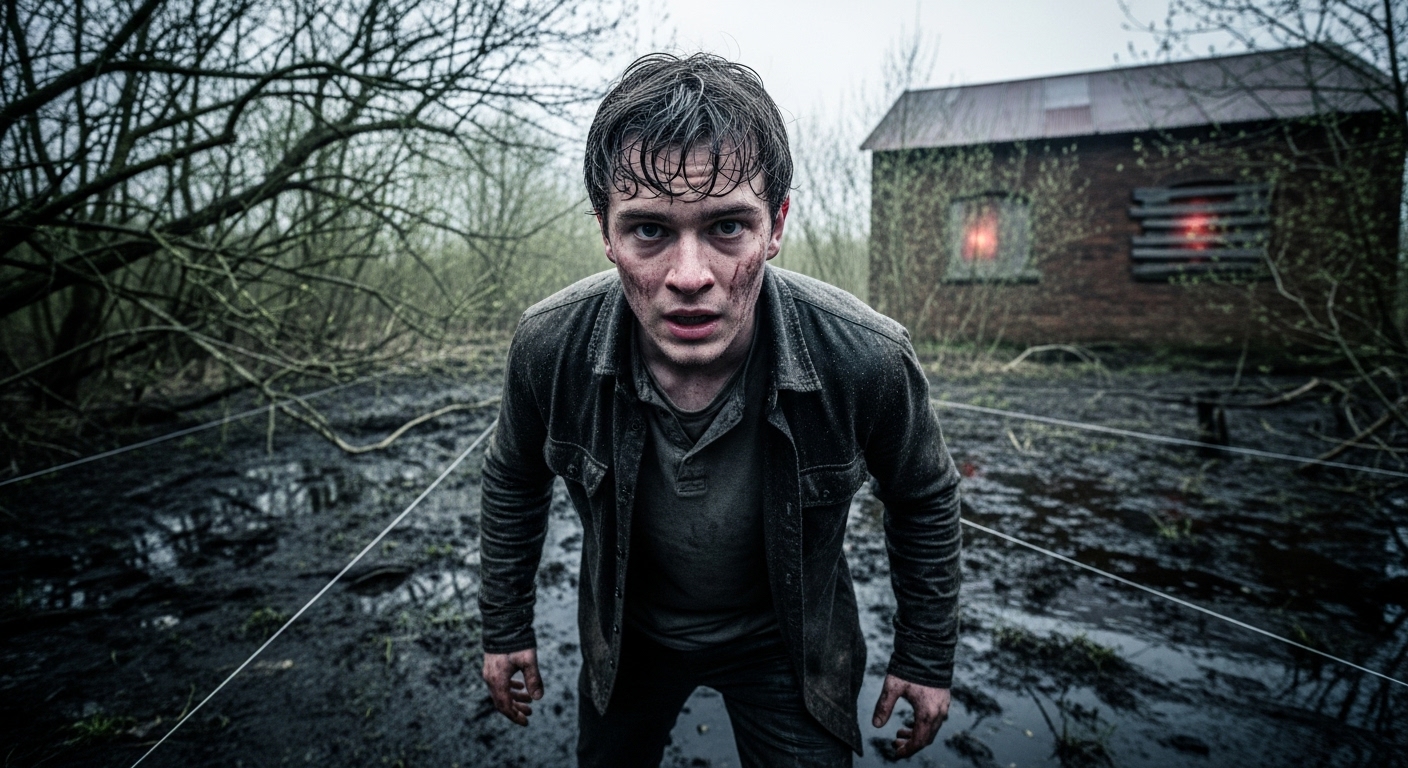
The dark, glistening mound from the mud continued to push upwards, a silent, impossible birth from the earth, as the shack's hum reached a piercing shriek. He knew turning back was no longer an option, the marsh had closed around him, and Sandy was just beginning to play.
Share This Story


