Coffee and Wet Leaves
A group of teenagers and a researcher gather in the basement of a community center on a cold autumn evening to discuss a new project.
The radiator in the corner was making a sound like someone choking on a penny. It was a rhythmic, metallic gasping that cut right through the drone of Sarah’s voice and settled somewhere behind my left eye. I focused on the scuff marks on the linoleum floor—black rubber burns that looked like frantic hieroglyphs left by the shoes of whoever had been here before us. Maybe the AA group from Tuesday nights. Maybe the seniors’ bingo league. In this town, everything eventually ended up in the basement of the Rec Hall, smelling of stale urn coffee and that specific, heavy dampness that comes off wet wool drying in a windowless room.
“Capacity building,” Sarah said, writing the words on the whiteboard. The marker squeaked, a high-pitched protest. She underlined it twice. “This is the core of what we’re trying to do. It’s not just about doing a project. It’s about leaving something behind that works without us.”
I shifted in my plastic chair. It was orange, molded in the eighties, and had a crack that pinched the back of my thigh if I leaned too far right. Across the circle, Maddy was picking at the fraying cuff of her hoodie, her eyes glazed over. She didn't look like she was building capacity. She looked like she was building a tolerance to boredom.
“Okay, but what does that actually mean?” Tyler asked. He was sitting next to the door, his leg bouncing with a nervous energy that made the water in the pitcher on the table tremble. Tyler was always near the exit. I’d noticed that about him lately. Ever since the incident at the quarry last month, he treated every room like a cage.
Sarah capped the marker and turned to us, her smile tight, practiced. She was from Thunder Bay, which technically made her a local in the grand scheme of the province, but here, three hours west into the shield, she might as well have been from Mars. She wore a blazer over a t-shirt, trying to strike that impossible balance between ‘professional academic’ and ‘cool youth mentor.’
“It means,” Sarah said, leaning back against the wobbly table, “that we don’t just come in, extract data from you, and leave. That’s the old way. Extractive research. Like mining. We take the gold—your stories, your data—and we leave you with the hole in the ground.”
“We have plenty of holes in the ground already,” I muttered. I didn’t mean for it to be loud, but the room was small, and the radiator chose that moment to go silent, so my voice hung there, flat and cynical.
Maddy snorted, a sharp exhalation of breath. She looked up, her dark hair falling over her face. “He’s right. That’s basically the town motto. ‘Welcome to Slate Falls: Mind the Gap.’”
Sarah nodded, undeterred. She seemed to thrive on our cynicism, like it was a validation of her presence. “Exactly. That’s why we’re using YPAR. Youth Participatory Action Research. The whole point is that you guys are the researchers. You’re not the subjects. You determine the questions. You gather the data. You decide what to do with it.”
I looked at the handout she’d slid across the table earlier. The paper was warm from the photocopier upstairs. Empowerment through Inquiry, the header said in a font that tried too hard to be whimsical. I traced the letters with my thumb, smudging the ink. The concept felt slippery. In school, research meant copying paragraphs from Wikipedia and changing every third word so Mr. Henderson didn’t fail you for plagiarism. It was passive. It was something done to a topic. This felt different. Dangerous, maybe.
“So,” Tyler said, his leg still vibrating. “We research… us? Ourselves?”
“You research your community,” Sarah corrected gently. “Your reality. We want to look at how we can support the arts here. But not just ‘let’s paint a mural.’ We need to understand the barriers. Why isn’t there a youth center? Why are the music programs getting cut? And we do that through dialogue. Through art itself.”
The wind picked up outside, rattling the high, narrow windows that looked out onto the parking lot at ground level. All we could see were tires and boots splashing through puddles. It was October, the time of year when the Canadian Shield turns hostile. The granite rocks sweat frost, and the birch trees look like skeletal fingers clawing at the grey sky. It gets dark at five, and by six, the town feels like it’s holding its breath, waiting for the snow to bury it.
I had this feeling again—the one I’d been waking up with for weeks. A tightness in the chest, a sense that I was missing something obvious. I looked at Tyler. He was staring at the whiteboard, but his eyes were wide, too white around the irises. He looked scared. Not nervous. Scared.
“Participatory research,” I said, testing the weight of the words. “So we have the power?”
“In theory, yes,” Sarah said. “We co-create the knowledge. It’s about shifting the power dynamic. Usually, universities or government bodies hold the power. They decide what’s true about a community. They look at the statistics—unemployment, addiction, dropout rates—and they write the story. But statistics are just skeletons. They don’t have flesh. You guys… you live the flesh and blood of this place.”
“Gross,” Maddy said, but she was listening now. She’d stopped picking at her sleeve. “So we get to tell them they’re wrong?”
“Or you get to tell them why things are the way they are,” Sarah said. “And you propose the solution. That’s the ‘Action’ part of YPAR. It’s not just studying the problem. It’s trying to fix it.”
Fix it. The words seemed to float up to the water-stained ceiling tiles and dissolve. How do you fix a town that’s slowly being strangled by distance and apathy? The mill closed three years ago. The highway bypass diverted the tourist traffic. Now we were just a waypoint between Winnipeg and Thunder Bay, a place to get gas and cheap coffee.
“And the arts part?” I asked. “Where does that fit in? Are we knitting our way to economic recovery?”
Sarah laughed, a genuine, startled sound. “Not quite. We use arts-based methods to gather the data. Photovoice, for example. You take photos of your daily lives—things that represent barriers to your well-being, or things that represent strength. Then we discuss them. We decode them. An image can say things that are too dangerous to say out loud.”
Too dangerous to say out loud. My eyes flicked to Tyler again. He had stopped bouncing his leg. He was frozen, staring at the phrase Participatory Research on the board like it was a threat. What had happened at the quarry? I hadn’t been there, but the rumors were weird. Not the usual fight. Something about seeing someone who shouldn't have been there. Or something that shouldn't have been there.
“I like photos,” Maddy said quietly. She pulled a beat-up DSLR out of her bag. It was old, a Canon with a cracked lens hood, but she handled it like it was made of glass. “People lie. Pictures don’t.”
“Pictures lie all the time,” I argued, the contrarian in me flaring up. It was a defense mechanism. If I argued, I didn't have to hope. “It depends on the angle. The lighting. What you crop out.”
“That’s the point,” Sarah said, pointing a finger at me. “The framing is the data. What you choose to show us tells us what matters to you. What you crop out tells us what you’re afraid of.”
The room went quiet again, save for the radiator starting its metallic coughing fit. What was I afraid of? Being stuck here forever, probably. Turning into my dad, sitting on the porch watching the trucks roll by on the Trans-Canada, drinking lukewarm beer and talking about the weather like it was a personal enemy.
“We need to build a plan,” Sarah said, breaking the tension. “We have budget for equipment. Cameras, art supplies, recorders. But we need a focus. If we’re talking about capacity building for the arts, what is the first step?”
“Space,” Tyler said. It was the first time he’d spoken in ten minutes. His voice was rough, like he hadn’t used it all day. “We have nowhere to go. Everything is locked. The school gym is locked after four. The park is full of needles. The old cinema is boarded up. We can’t build anything if we don’t have a floor to stand on.”
“Space,” Sarah wrote on the board. “Physical space. Okay. That’s a major theme in rural research. The shrinking of public commons.”
“It’s not just shrinking,” Tyler said, his voice rising slightly. “It’s being… taken. Watched.”
I leaned forward. “Watched by who, Ty?”
Tyler looked at me, his eyes darting to Sarah, then back to the floor. “By the town. By… everyone. You can’t do anything without someone knowing. You try to start a band, the cops shut you down for noise before you plug in. You try to paint a wall, you get fined. They say they want ‘youth engagement,’ but they want us to be invisible.”
“So, surveillance is a barrier,” Sarah interpreted, translating his raw anxiety into academicspeak. She wrote Surveillance/Policing of Youth Bodies on the board. It looked clinical. Sterile. It didn’t capture the way Tyler was sweating in a room that was barely sixty degrees.
“It’s about trust,” Maddy said, turning her camera over in her hands. “Capacity building relies on trust, right? If the community doesn’t trust us, and we don’t trust them, then the arts are just decoration. We’re just putting lipstick on a pig.”
“Participatory research requires relational accountability,” Sarah said, nodding. “That’s an Indigenous methodology concept, actually. We are accountable to the relationships we build. If we start this, we have to follow through. We can’t promise a youth center and deliver a pamphlet.”
I looked at the window again. A pair of headlights swept across the glass, illuminating the dust motes dancing in the stagnant air. For a second, I thought I saw a face pressed against the glass, looking in. Just a flash. Pale, distorted by the rain. I blinked, and it was gone. Just the reflection of the fluorescent lights buzzing overhead.
My heart did a stupid, fluttery thing against my ribs. I rubbed my chest. Calm down, Kieran. You’re losing it. It’s just a meeting about art.
“So how do we do this?” I asked, forcing my voice to be steady. “Step one.”
“Step one is the inquiry group,” Sarah said. “That’s us. We meet weekly. We discuss. We learn the methods. Next week, we look at Photovoice. I want you all to take five photos this week. The prompt is: Where do I belong? and Where am I not allowed?”
“Where am I not allowed,” Maddy repeated. A slow smile spread across her face. “I can work with that.”
“Is it safe?” Tyler asked. The question hung there, heavy and wet.
Sarah paused, the marker hovering over the board. “Is what safe, Tyler?”
“Taking photos. Asking questions. People here… they don’t like questions. They like things quiet. If we start poking around, asking why the old cinema is boarded up, or why the funding for the skate park disappeared… people get angry.”
“That’s why we do it together,” Sarah said, her voice firm. “Safety in numbers. And we have institutional backing. The university is behind us.”
“The university is five hundred kilometers away,” I pointed out. “If the sheriff decides to harass us for loitering while we’re taking photos, a letter from the Dean isn’t going to stop him from tossing us in the back of a cruiser.”
“We’ll establish protocols,” Sarah said, though she looked a little less confident now. The reality of small-town power dynamics was harder to navigate than a grant application. “We’ll talk to the council. We’ll make this official. We’re framing this as ‘Economic Development through the Arts.’ They love economic development. It’s the magic word.”
“Buzzwords,” I said. “Capacity. Development. Empowerment. It’s all just code for begging for scraps.”
“Maybe,” Sarah admitted, dropping the facade for a second. She looked tired. “But it’s the language we have to speak to get the resources to change the language. We play the game to break the game. That’s the subversive part of YPAR.”
Subversive. I liked that word better. It tasted like rebellion. It tasted like spray paint and secret meetings.
“Okay,” I said. “I’m in. I’ll take the photos.”
“Me too,” Maddy said.
Tyler hesitated. He looked at the door, then at us. He took a deep breath, and I could see him physically wrestling his fear back down into his gut. “Yeah. Okay. But… if I see something weird, I’m deleting it.”
“Fair enough,” Sarah said. “Consent is key. Even your own.”
We spent the next hour hashing out the details. We talked about consent forms—pieces of paper that promised confidentiality, which seemed laughable in a town where everyone knew everyone’s license plate number. We talked about ethics. Sarah explained that we had to be careful not to traumatize our participants—or ourselves. We talked about the ‘arts’ part. Maddy wanted to do a collage. Tyler wanted to record soundscapes—the noise of the highway, the silence of the library, the specific, grinding sound of the snowplows.
I found myself getting drawn in, despite my better judgment. There was something seductive about the idea of dissecting the town. Taking it apart piece by piece to see how it worked, or why it didn’t. It felt like we were detectives at a crime scene, but the crime was just… existence. The crime was the slow, dull ache of being seventeen in a place that had no use for you.
“Capacity building is a process, not an outcome,” Sarah said, wrapping up. She was wiping the board, the words turning into grey smears. “It’s about the skills you learn right now. Critical thinking. Negotiation. Technical skills with the cameras. Even if we never get that youth center, you guys are leaving this room different than you entered it.”
I looked at my hands. They looked the same. Bitten fingernails, ink stain on the thumb. But my brain felt different. Buzzing. The vocabulary she’d given us—extractive, participatory, relational accountability—felt like tools. Or weapons. I wasn’t sure which yet.
We packed up around eight. The building was silent upstairs; the admin staff had gone home hours ago. The only sound was the hum of the vending machine in the hallway.
“Next week,” Sarah said, zipping up her laptop bag. “Same time. Bring your photos.”
We walked out into the hallway together. The linoleum was waxier here, reflecting the green exit signs. The air smelled of floor cleaner and old paper.
“You guys need a ride?” Sarah asked.
“I’m good,” Maddy said, hefting her camera bag. “My mom’s outside.”
“I’m walking,” Tyler said quickly, pulling his hood up. “I live close.”
“I’ll walk with you, Ty,” I said. “I’m going that way.” I wasn’t, really. I lived on the other side of the creek. But I didn’t want him walking alone. He was too jumpy.
Tyler looked at me, surprised, then nodded. “Okay.”
We pushed through the heavy double doors and out into the night. The cold hit us like a physical slap, smelling of wet asphalt and rotting pine needles. It was pitch black, the streetlights few and far between. The parking lot was empty except for Sarah’s hatchback and Maddy’s mom’s truck idling near the curb.
We waved to Maddy as she hopped in the truck, then turned toward the road. The town was quiet. Unnaturally quiet. Usually, there was a distant hum of the highway, or a dog barking. Tonight, just the wind hissing through the spruce trees.
“You okay?” I asked Tyler after we’d walked a block. Our breath plumed in front of us, ragged clouds of steam.
“Yeah,” he said, his hands shoved deep in his pockets. “Sarah’s nice. She means well.”
“But?”
“But she doesn’t get it. She thinks we can just… ask questions. She thinks ‘capacity’ is something you build. Around here, capacity is something you hoard. If you have power, you keep it. You don’t share it with a bunch of kids with cameras.”
“We’re not just kids with cameras,” I said, trying to believe it. “We’re… co-researchers. We’re subverting the paradigm.”
Tyler laughed, a dry, cracking sound. “Subverting the paradigm. You sound like her.”
“Better than sounding like my dad.”
We walked past the old cinema. The marquee was empty, the plastic cracked. The windows were boarded up with plywood that had turned grey and warped with age. I looked at the alleyway beside it. Darkness pooled there, thick and absolute.
“That’s where I want to take a photo,” Tyler whispered, stopping.
“The alley?”
“The door. The side door. It’s always locked. But last week… I saw it open.”
“So? Probably maintenance. Or squatters.”
“No,” Tyler said, shaking his head. He looked pale under the yellow wash of the streetlamp. “I saw… suits. Men in suits. In Slate Falls. On a Tuesday night. Going into the condemned theater.”
I felt a chill that had nothing to do with the wind. “You’re messing with me.”
“I’m not. That’s why I asked about safety. If we start taking pictures of places we’re not allowed… what if we find something we’re not supposed to?”
I looked at the theatre. It loomed over us, a brick tomb of memories. I remembered seeing Avatar there when I was kid. Now it was just a rot in the middle of Main Street. Or a hiding place.
“Then that’s the research,” I said, though my stomach twisted. “That’s the data. If there are suits in the theatre, that’s… relevant to community capacity. Who owns the space? Who’s using it?”
Tyler looked at me like I was crazy. “You really want to poke the bear, Kieran?”
“I’m tired of being scared of the bear,” I said. “I’m tired of not knowing what’s going on in my own town. YPAR, right? We have the right to know.”
Tyler stared at the alley for a long moment, then turned away. “I’m taking a photo of the skate park. It’s safer.”
“Suit yourself,” I said. “But I’m taking the alley.”
We split up at the corner of Elm and Second. I watched him walk away, his shoulders hunched, disappearing into the shadows of the overhanging maples. I turned toward the creek, my mind racing.
Capacity building. It sounded so sterile in the basement. So academic. But out here, in the dark, it felt different. It felt like arming yourself. We were gathering intelligence. We were mapping the territory.
I reached into my pocket and pulled out my phone. The camera was garbage compared to Maddy’s DSLR, but it would do. I walked back toward the theatre, my footsteps crunching on the gravel shoulder. The wind bit at my ears.
I stood in front of the alley. The darkness seemed to breathe. I raised the phone, the screen glowing bright and accusatory in the gloom. Where am I not allowed?
I snapped the picture.
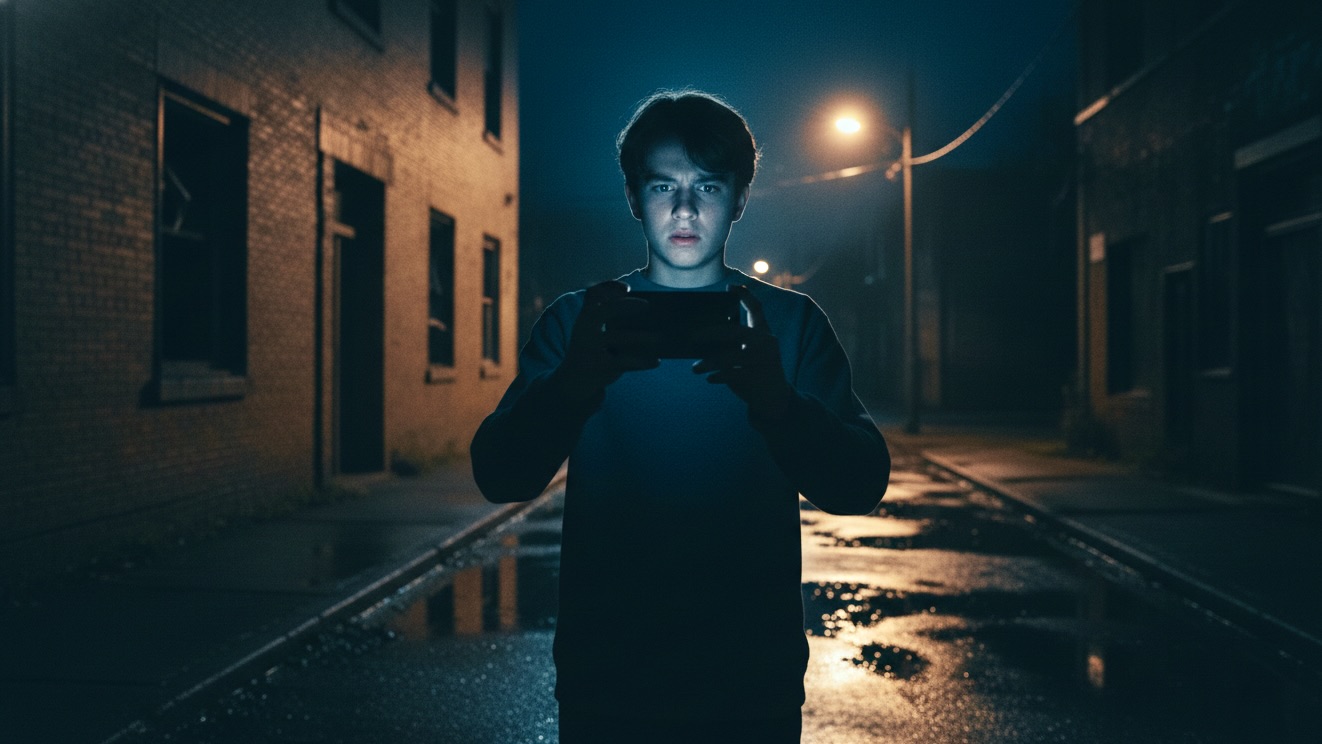
I snapped the picture, and for a split second, the flash illuminated something standing deep in the alley that definitely wasn't a shadow.
Share This Story


