The Reckoning on the Sand
Lena and Sam walk along a desolate, windswept beach at dusk, their conversation revolving around the dystopian 'Collective Contribution Initiative' and its oppressive social credit system, which dictates every aspect of their lives.
“…and then Mrs. Gable, right? She actually suggested we solve the coastal erosion problem by, get this, teaching seagulls to carry sand back to the dunes. With little backpacks. She said it with a straight face, Sam, like it was a stroke of genius.” Lena stopped, her breath catching in the salty air, a laugh threatening to crack the tension in her chest. She dug the heel of her worn sneaker into the wet sand, watching the foam creep up, then recede. It was a cold, late afternoon, the sky bruised purple-grey, the color of an old wound. The kind you pick at, even though you know it won’t heal faster.
Sam didn't laugh. He just shoved his hands deeper into the pockets of his faded hoodie, hunching his shoulders against the wind whipping off the churning North Sea. He was staring at something far out, a tanker probably, a dark smear on the horizon. “She has to, Lena. Her SIS is already in the red. You saw the bulletin last week. Her son’s, too.” He kicked at a piece of bleached driftwood, sending a spray of fine grit into the air. It landed on Lena’s cheek, gritty and cold. She didn’t bother wiping it off.
“Yeah, but seagulls? With backpacks?” The absurdity of it was a bitter, metallic taste on Lena’s tongue. “It’s like they want us to come up with stupid stuff so they can just, what, say we’re all trying? So the Ministry of Perpetual Progress looks good? It’s all a show, Sam. You know it is.” She walked again, a quick, jerky stride, her eyes scanning the sand for anything interesting, anything to distract from the gnawing dread. A stray plastic bottle, sun-bleached and half-buried, caught her eye. Some forgotten piece of humanity, discarded. Like them, sometimes.
Sam caught up, his voice lower now, almost lost to the wind. “You can’t talk like that. Not out here. Not anywhere.” He glanced over his shoulder, a nervous tic. No one else was on the stretch of beach, just the two of them and the relentless roar of the waves. Still, the glance. It was a habit, a reflex, ingrained in everyone now. The omnipresent whisper that someone, somewhere, was always listening. Or calculating. Or judging. The Societal Impact Score, the SIS, had been the silent, insidious invader into every corner of their lives for the last three years, ever since the ‘Great Re-Evaluation’ and the launch of the Collective Contribution Initiative.
“Who’s gonna hear us? The crabs?” Lena tried for flippancy, but her voice cracked on the last word. She knew he was right. They had those new sound-dampening drones now, quiet as hell, the ones that could pick up a whisper from half a mile away, filtering out the ocean roar. Or so the official propaganda videos claimed, always with a chirpy, AI-generated voice explaining how it was for ‘community safety and optimal resource allocation.’ Bullshit. It was for thought policing, pure and simple. For keeping everyone in line, constantly striving for a higher SIS, just to avoid… well, no one really knew what ‘avoid’ meant, but everyone felt it, a cold, empty spot in their gut.
She remembered the time her neighbor, Old Man Davies, had his SIS dip below the red line. He’d grumbled too much about the mandatory 'Community Connection' hours, missed a few 'Positive Outlook' sessions. Didn’t contribute enough 'Innovative Solutions' to the local 'Resource Optimization' forum. One day, his house was just… empty. No explanation. His kids, who lived in the next district, just said he’d gone to a 'Rural Re-Adjustment Zone.' No one ever heard from him again. The official line was always vague, always reassuring, always hollow.
“What’s your latest score, anyway?” Sam asked, his voice barely audible over a particularly strong gust that sent sand whipping into their faces. Lena squinted, tasting salt and grit. She wiped her mouth with the back of her hand. Her score. The number that now defined them. It fluctuated, daily, hourly, based on everything from participation in community forums to how many positive emoji reactions their online 'Civic Engagement Updates' received. It was a digital leash, tightening with every misstep.
“Mine dipped after the municipal infrastructure audit,” Lena said, kicking a piece of tangled seaweed. It was thick and rubbery, smelling of low tide. “I, uh, I questioned the projected efficiency metrics for the new bio-luminescent paving slabs. You know, how they’d perform with consistent exposure to brine. Seemed like a fair point to me.” She mumbled, almost to herself. She’d spent hours on that report, genuinely trying to find a flaw, to improve something. But ‘questioning’ wasn't 'contributing.' It was dissent, even if framed as constructive criticism.
“And?” Sam prompted, his eyes still on the horizon, but his attention was fixed on her. He knew the unspoken implications. A dip wasn't just a dip. It was a slippery slope. A sign. A flag. It meant more mandatory ‘re-education’ modules, more targeted ‘Community Engagement Opportunities,’ which really meant digging ditches or clearing invasive species by hand, all while being monitored for ‘positive attitude.’
“And my score dropped twelve points. Said I exhibited ‘sub-optimal collaborative ideation.’ Twelve points, Sam. For asking a question about a paving slab.” She shook her head, a short, sharp movement. The wind tugged at her hair, making it stick to her face. She pulled it back, tucking it behind her ears, her fingers cold and clumsy. “It’s insane. It’s absolutely insane. We’re supposed to fix the world, but only if we do it their way, with their fake smiles and their stupid, meaningless jargon. What’s the point? If everything we say, everything we do, is just to game their stupid system, then what are we even doing here?”
Sam stopped walking, his breath hitching, and for a terrifying second, Lena thought he was going to snap, to finally break under the pressure. But he just bent down, picked up a perfectly smooth, grey skipping stone, and tossed it into the incoming wave. It skipped twice, then vanished. “The point,” he said, his voice flat, emotionless, “is to survive. You think you’re smart for seeing the holes in their plan? They want you to see the holes. They want you to feel like you’re smarter than them. That’s how they trap you. They make you think you’re resisting, when you’re actually just giving them more data points.”
Lena stared at him. His eyes, usually crinkling at the corners when he smiled, were hard, opaque, reflecting the bruised sky. It was a chilling thought, one that had been lurking in the back of her own mind, like a shadow she couldn't quite shake. The idea that their entire performance of dissent, their quiet rebellion, was just another measurable input for the system. Another statistic. Another way to categorize and control them. It was a perverse genius, a level of manipulation so subtle and pervasive that it made her stomach clench with cold dread.
“No, that’s… that’s ridiculous,” Lena said, but even as she said it, she heard the tremor in her own voice. The sand felt cold beneath her feet, even through her shoes. The air tasted heavy, not just of salt, but of something metallic, like an old coin left out in the rain. “They can’t be that smart. It’s just… bureaucratic incompetence. Overzealous middle managers. People trying to look good to their superiors, like always.” She wanted it to be simple. She wanted it to be something she could understand, something she could fight. Not this shapeless, all-consuming entity that fed on their very attempts to defy it.
Sam just looked at her, a faint, almost imperceptible smirk playing on his lips. “Is it? Think about it. Everyone’s so busy trying to optimize their contributions, trying to hit their weekly quota of ‘meaningful civic engagement points,’ that no one’s actually doing anything meaningful. Everyone’s just performing. It’s a giant, elaborate theater production, and we’re all just… unpaid actors, desperate to keep our parts.” He gestured vaguely at the expanse of the beach, the vastness of the ocean, the hazy outline of the city further down the coast. “Look around, Lena. The trash isn’t getting cleaned up. The water’s still full of microplastics. The air smells like burnt hair near the power plants. But our ‘Societal Impact Scores’ are all meticulously tallied. And that’s what matters.”
He was right, of course. The beach was a testament to their collective failure, or rather, the failure of the CCI to actually solve anything. There were plastic bags snagged on rocks, fishing nets tangled with seaweed, bottle caps glinting amongst the shells. Every week, the 'Coastal Conservation Brigade' (mandatory for anyone with an SIS below 650) would descend, cameras rolling, smiling faces, picking up a few choice pieces of litter, then leaving the rest for the next week's performance. It was a Sisyphean task, made worse by the performative aspect. No one cared about the actual clean-up, only the documentation of their efforts for their scores.
A dull ache throbbed behind Lena’s eyes. She pushed her fingers into her temples, feeling the slight grittiness from the wind. “So what do we do then? Just… play along? Become good little cogs in their stupid, pointless machine?” Her voice was thin, reedy, like a broken kite string. The idea was suffocating. To accept this farce, to live their lives as a never-ending audit of their worth, it felt worse than anything they could do to Old Man Davies.
“What else is there?” Sam asked, his shoulders slumping a little. The bravado, the detached cynicism, seemed to drain out of him, leaving behind a weariness that Lena hadn't seen before. He finally looked at her, his eyes hollow. “You really think they’d let you… opt out? What happened to the ones who tried to just, you know, live their lives? Before the CCI? The ‘unengaged elements,’ they called them. They’re gone, Lena. All of them. And no one even asks where.”
The wind picked up, colder now, biting at their exposed skin. Lena shivered, pulling her thin jacket tighter. The sun was beginning its descent, a weak, pale orange disc sinking into the grey-purple clouds. The ocean surface turned a deep, bruised indigo, reflecting the heavy sky. Each wave crashed with a dull roar, the sound amplified by the increasing silence between them. Sam had articulated the unspoken terror: the system wasn't just about control; it was about absolute, unquestioning conformity. And the penalty for not conforming was erasure.
“I just… I can’t live like this,” Lena whispered, the words barely audible. She watched a small, grey bird peck at something in the wet sand, oblivious to their existential crisis. A part of her envied its simple existence. Eat, fly, survive. No scores. No performance reviews. No mandatory 'Positive Outlook' sessions.
“Can you not?” Sam countered, his voice sharp, pulling her back. “Because you are. We both are. Every day. Every interaction. Every thought you have, you filter it through the lens of ‘how will this affect my SIS?’ You posted that ‘thoughtful inquiry’ about the paving slabs, didn't you? You didn’t just grumble to yourself. You put it out there. You participated. That’s what they want.”
He was right, again. She had posted it. She had even meticulously cited some outdated civil engineering principles she’d found in an old library book, hoping to make her ‘contribution’ seem legitimate, valuable. Hoping to game the system from within. But had she really been gaming it, or just feeding it more of herself? Had she, in her attempt to expose the absurdity, become another part of the absurd machinery?
A wave, larger than the others, surged up the beach, closer than they expected. Lena gasped, jumping back, her sneakers sinking into the softer, drier sand further up. Her heart hammered against her ribs, a frantic, irregular drum. She tasted the salt spray on her lips, sharp and cold. Sam didn't flinch. He just stood there, letting the wave wash over his shoes, the water seeping into the worn canvas.
“My dad,” Sam started, his voice a low monotone, staring at the grey expanse of the ocean. “He’s been working on that 'Automated Algae Filtration Project' for six months now. You know, for the harbor clean-up.” Lena nodded. Everyone knew about it. It was supposed to be the flagship 'Green Initiative' for the entire coastal region, lauded in every weekly 'Civic Progress Report.'
“He told me… he told me it’s a failure,” Sam continued, his voice barely a whisper, as if he was afraid the wind itself had ears. “The algae they’re using, it’s not compatible with the local salinity levels. It just… dies. And then it clogs the filters. Makes the water even worse. He’s tried telling them, submitting reports, actual data. But they just tell him he’s ‘lacking optimal solution-oriented perspective.’ They keep funding it. They keep reporting ‘significant progress.’ And he keeps collecting his data, knowing it’s all for nothing.” Sam finally turned, his gaze meeting Lena's, and in his eyes, she saw a flicker of something she hadn't seen before: not just fear, but a profound, bottomless exhaustion. A resignation that chilled her to the bone.
Lena remembered her own father, a carpenter. He used to love shaping wood, making intricate joints, the smell of sawdust filling their small garage. Now, his 'Societal Contribution' involved meticulously documenting his 'material optimization rates' for prefabricated housing units, using a government-issued scanner that tracked every single scrap of wood, every nail. He talked less about the craft, more about the daily upload metrics for his 'Efficiency Score.' His hands, once strong and calloused from honest work, were now prone to tremors when he held the scanner too long. The joy had drained out of him, replaced by a hollow-eyed diligence.
“So, what happens when they finally realize it’s all a lie?” Lena asked, her voice cracking. “When the sea levels keep rising, and the water’s still toxic, and the fish are all gone? What then?” She imagined a future where the beaches were just vast, empty stretches of plastic and dead marine life, meticulously cataloged by drones, while citizens debated the optimal shade of blue for their 'virtual oceanic restoration simulations.'
Sam just shrugged, a small, dismissive gesture that spoke volumes. “They won’t. They’ll just move the goalposts. Re-evaluate the metrics. Announce a new, even more groundbreaking ‘Global Environmental Harmonization Initiative’ that requires even more ‘active citizen participation.’ They’ll blame the ‘sub-optimal engagement’ of the masses, or the ‘negative thought patterns’ that are disrupting the collective consciousness. They’ll find a way to make it our fault, Lena. It’s always our fault.” He picked up another stone, smaller this time, and spun it between his fingers, watching it turn over and over.
The air grew colder, and the faint, salty scent of the ocean was now mixed with something else, a faint, acrid smell from the distant city, like burning plastic or overheated electronics. Lena’s teeth chattered, whether from the cold or the conversation, she couldn’t tell. She thought about Old Man Davies, the ‘Rural Re-Adjustment Zone.’ She thought about the endless reports, the forced enthusiasm, the constant surveillance. She thought about the seagulls with backpacks.
“I just don’t know how much more I can take,” Lena confessed, the words a raw, torn sound in her throat. She looked at Sam, really looked at him, searching for something, any sign of shared defiance, shared hopelessness. But his face was a mask, his eyes distant. He was already retreating, she realized, pulling himself back into the protective shell of compliance, of feigned indifference.
He finally stopped spinning the stone. He held it in his palm, then closed his fingers around it, a tight, white-knuckled grip. “You take it,” he said, his voice flat, resolute, “because you have to. Because the alternative… the alternative isn’t an option. Not for us. Not for anyone who wants to stay visible.” He squeezed the stone harder, his knuckles almost glowing white in the fading light. “And maybe,” he added, his voice dropping to a near whisper, “maybe if we play the game well enough, if we contribute enough, if we keep our scores high enough… maybe we can find a way to change it. From the inside.”
Lena stared at him, the silence between them stretched taut, brittle as old glass. The wind howled, a mournful sound, and the waves crashed with increasing ferocity. Change it from the inside? Was he truly deluded? Or was this his new, desperate strategy, a performance even for her? The sand beneath her feet felt like quicksand, pulling her down, threatening to swallow her whole. She could feel the chill seeping into her bones, a cold, empty feeling that wasn't just from the weather.
Suddenly, Sam held out his hand, opening his fingers. The small, grey skipping stone rested in his palm. It wasn't smooth anymore. It was sharp, jagged, split cleanly in half. He had crushed it. Lena looked at the broken stone, then at his hand, raw and red, then back at the ocean, an endless, churning expanse under the dying light.
“What was that for?” she asked, her voice small, almost lost to the wind. Sam just closed his hand again, clenching the sharp fragments, his face unreadable in the deepening gloom. He turned and started walking back the way they came, towards the distant, glittering lights of the city, leaving Lena standing alone, the bitter tang of salt and something else, something like metallic dust, coating her tongue, wondering if he had just shown her a way out, or a warning of what happens when you try to break free.
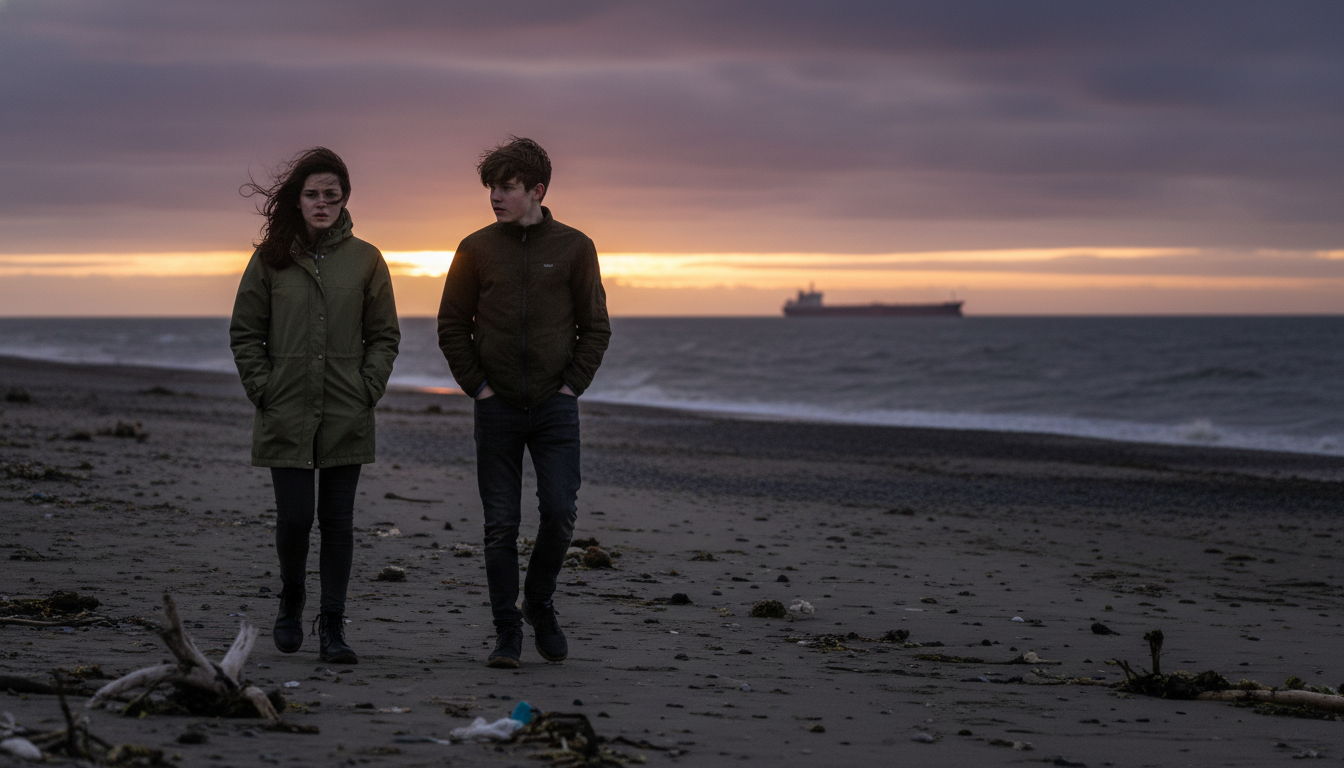
He turned and started walking back the way they came, towards the distant, glittering lights of the city, leaving Lena standing alone, the bitter tang of salt and something else, something like metallic dust, coating her tongue, wondering if he had just shown her a way out, or a warning of what happens when you try to break free.
Share This Story


