The Unseen Currents
The lingering chill of a prolonged spring permeated the recreation hall's foundations, seeping into the forgotten basement where the air hung heavy with a heavy gauze of airborne dust and disuse. Outside, a pale, anemic sun struggled to warm the thawing permafrost of Colony 7, its light filtered through the thick, atmospheric processors that kept their distant world breathable. Here, beneath the grey, utilitarian surface, three young adults moved with a slow, deliberate cadence, their task a quiet rebellion against the overwhelming apathy that seemed to settle on everything these days.
The damp, persistent chill of a Colony 7 spring clung to the recreation hall's foundations like a second skin. It bled into the forgotten basement, where the air hung thick, a heavy gauze of airborne dust, stale metal, and the earthy, fungal scent of disuse. Outside, the anemic sun, a pale disc in the filtered sky, struggled to melt the stubborn permafrost, its weak light diffused further by the atmospheric processors humming a perpetual, low thrum across the settlement. Below ground, within the utilitarian concrete shell, Will, Stefanie, and Sol moved with a slow, deliberate cadence, their individual rhythms merging into a quiet, almost ritualistic ballet.
Will, twenty-two, worked a stubborn patch of dried adhesive from a wall, the chemical tang of his solvent mixing with the basement's ambient decay. His shoulders ached. The recreation hall, a relic from the First Wave, felt less like a hub and more like an archaeological dig of forgotten ambitions. He thought of the endless, identical grey corridors stretching through the colony’s habitat modules, the synthetic taste of the nutrient paste at dinner, the faint, high-pitched whine of the life support system that was their constant companion. This project, this 'gallery and museum' for their meagre history, felt less like progress and more like an elaborate exercise in futility. A slow, quiet unravelling. Why bother? What was there to preserve but a legacy of barely enduring?
Stefanie, nineteen, knelt by a stack of corroded storage crates, a small, worn sketchbook clutched in her left hand. Her right meticulously brushed away decades of grime from a rusted latch. She wasn't sketching now, but the ghost of an image, an abstract form born of the colony's harsh geometry and the planet’s relentless indifference, still burned behind her eyes. Sometimes, she hated the raw, unyielding practicality of their lives. Hated how every resource, every thought, every scrap of imagination, had to serve survival. This project… it was a sliver of something else. Something vital, perhaps. Or perhaps just another distraction from the hollow ache of being. The scent of ozone, faint and distant, drifted down a ventilation shaft, a phantom limb of the larger colony’s forgotten systems.
Sol, twenty, stood near a workbench, a fine-grit abrasive in his gloved hand. He ran it over a salvaged piece of panelling, his movements precise, almost obsessive. His eyes, usually distant and heavy-lidded, focused intently on the swirling patterns of dust and light. He didn’t speak much, not since… well, not since the last supply run failed to return. There were whispers, of course. Failed relays. Asteroid fields. But Sol just kept working, the rhythmic scrape of the abrasive a steady, dull counterpoint to the thrum of the processors, the quiet hum of his own internal static. He imagined the smooth surface beneath his touch, a clean slate. A quiet, terrifying hope.
"Still here," Will mumbled, his voice raspy from the dry air, though he'd been careful to use his rebreather.
Stefanie grunted, not looking up. "Seems that way."
Sol only nodded, his gaze fixed on the panel. The dust motes in the shaft of weak utility light danced like tiny, disoriented stars.
---
A sudden, sharp crack echoed through the space, making all three flinch. Will had leveraged a crowbar against a section of wall near the furthest corner, a part that always felt hollower than the rest. The concrete facade, brittle with age and the planet’s subtle seismic shifts, gave way with a puff of fine, ancient dust. Behind it wasn't the expected structural void or pipework, but a narrow, unlit passage, barely wide enough for one person. The air that rushed out was colder, somehow thinner, carrying a faint metallic tang they hadn't noticed before.
"Well," Stefanie said, a breathy sound. "That's new."
Will peered into the gloom, a tiny lamp from his belt cutting a weak beam. The passage stretched only a few metres before opening into a smaller, secondary chamber, completely sealed off. This wasn't part of the recreation hall's blueprint. This was something older. A utility access tunnel perhaps, for a module that had been decommissioned, forgotten. The walls here were a different composite, darker, rougher. Older. The silence emanating from it felt heavier, almost sentient.
Sol moved closer, his usually steady hands hovering near the entrance. He reached into the passage, his fingers brushing against something cool and smooth. He pulled it out, slowly. It was a data-slate, encased in a rugged, almost artisanal sheath of what looked like treated hides, probably from one of the few indigenous fauna species they had managed to domesticate for survival. The screen, surprisingly intact, flickered to life at his touch, displaying a faded, handwritten log entry. Date: Cycle 1. Day 134. Author: Unidentified.
"What is it?" Will asked, leaning in, his weariness momentarily forgotten.
Sol scrolled with a gentle thumb. The entries were terse, almost cryptic. Records of early atmospheric tests, soil samples, temperature fluctuations. But interspersed with the scientific data were personal observations. The sky is too grey. We miss the green. Will we ever see a real rain again? The script was jagged, hurried. The melancholy of a distant, nascent despair bled through the sterile text.
Stefanie reached for it, her fingers brushing Sol's. "It's… an original. First Wave." Her voice was soft, laced with a reverence Will rarely heard. "Someone's personal journal, embedded."
"Private property," Will muttered, his brow furrowed. "Should we…?" He trailed off. The colony had strict protocols for historical preservation, but this felt different. Too intimate. Too raw. It felt less like history and more like prying.
Sol didn't answer. He simply kept scrolling, his eyes scanning the endless lines of text, each word a ghost from a past none of them had truly lived. He stopped at one entry, his thumb freezing. Day 365. Solstice. They took her today. Said the pathogen was stable. She wouldn’t feel it. Lies. Saw her eyes. Empty.
"What is it?" Stefanie pressed, sensing the sudden tension radiating from Sol.
He handed the slate to her, his hand trembling imperceptibly. Stefanie read the entry, her breath catching. The name wasn’t important, but the feeling was. The stark, cold, desperate pragmatism of the early colony, the sacrifices demanded. This wasn’t the sterile, heroic narrative they were fed in their youth. This was gut-wrenching.
"This," Stefanie whispered, her eyes wide, tracing the jagged letters on the screen, "this is what the museum needs. Not just tools. Not just official logs. The real stories. The messy ones. The ones that hurt." She looked at Will, her gaze insistent. "We show this. All of it. The truth of what it took."
Will’s mouth tightened. "The truth? Stefanie, the community… they don't want that. They want hope. Resilience. Not… this." He gestured vaguely at the slate, at the opened passage, at the suffocating melancholy radiating from the words. "It’s too much. It would shatter the illusion." He knew how fragile their collective spirit was. The old wounds were barely scabbed over.
Sol stepped back, leaning against the cold, rough composite wall of the forgotten chamber. His face was a mask, but his shoulders hunched, a sudden, unfamiliar tremor running through him. The air in the sealed passage seemed to grow colder, denser, pressing in. He thought of his parents, their quiet resignation, the way they never spoke of the First Wave, of the things they left behind. He thought of the empty seat at their table, the one that had been there for three Cycles now. And then, at the bottom of the data-slate’s entry, barely visible due to a faint pixel distortion, a small, hand-drawn symbol caught Stefanie’s eye. A broken circuit, with a single, unblinking eye in its centre. It was a symbol she’d seen somewhere before, sketched in chalk on a forgotten pipe in the deeper, older levels of the colony’s infrastructure. A warning? A signature? Or something else entirely? A shiver ran down her spine, colder than the basement air.
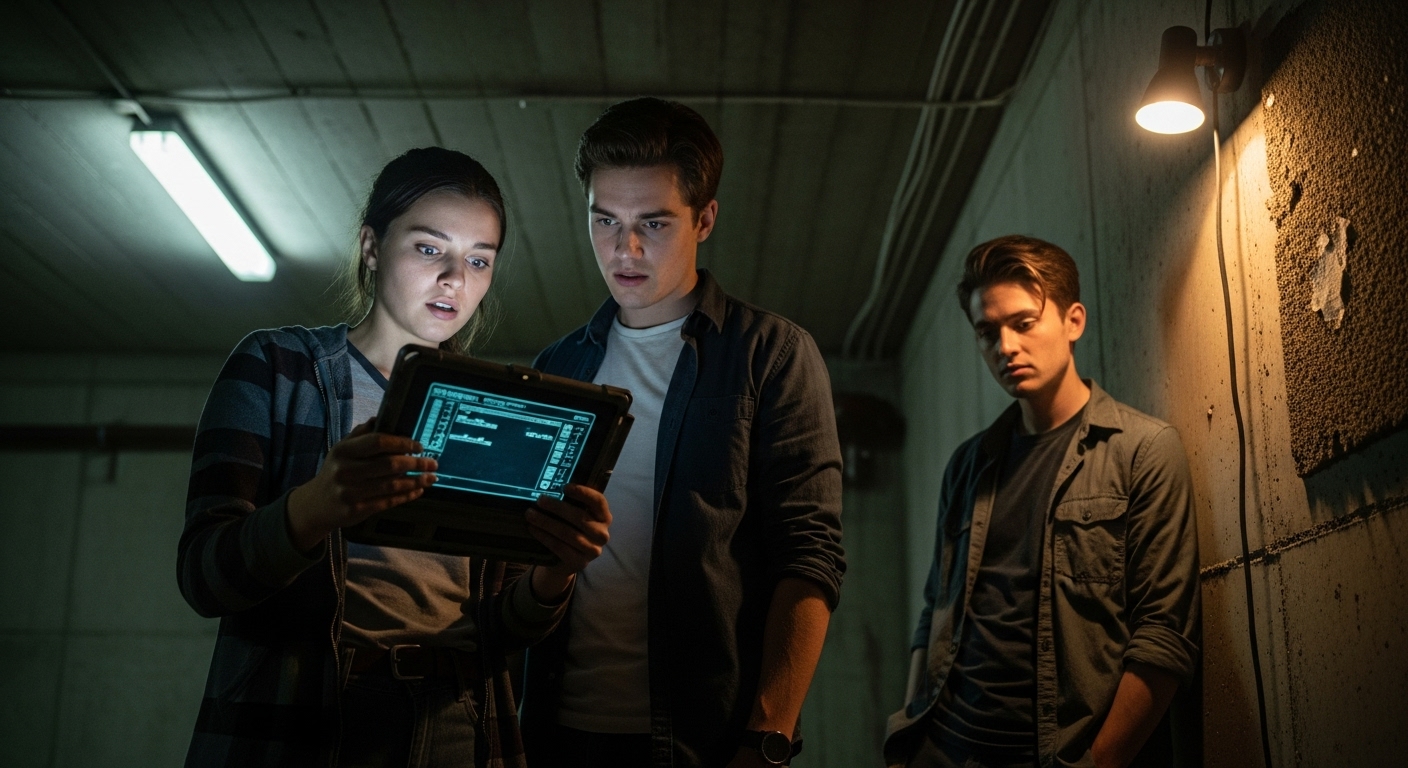
A shiver ran down her spine, colder than the basement air. What did that symbol mean? And why had it been hidden away, etched into the despairing records of a lost past, hinting at a truth far more unsettling than mere historical hardship?
Share This Story


