The Rustle of Unread Pages
The afternoon light, thin and pale, struggled through the window, painting the familiar living room in shades of muted ochre. Outside, the maple tree, once a riot of crimson, was shedding its last, stubborn leaves, each descent a silent, slow-motion surrender to the inevitable. Inside, the only sound was the shallow, papery breath of Herman, a rhythm Joan knew better than her own heartbeat, now a fragile drum against the backdrop of their quiet, winding down life.
The light, a weary gold, barely brushed the edge of the worn armchair where Herman sat. A broadsheet, its pages crisp with the day's unread news, was tented on his lap, a forgotten ambition. His hands, gnarled and spotted, rested on the paper's edge, still as carved wood. Joan watched him from across the room, the pattern of her own breath mimicking the slow, shallow rise and fall of his chest. Sixty-two years. The number hung in the air, a heavy, polished stone she often turned over in her mind, feeling the smooth cool weight of it.
She thought of the maple outside, its last leaves clinging like old coins to skeletal branches. They’d raked those leaves together for decades, the smell of burning sugar and damp earth thick in the October air. Herman, always the one for a proper pile, a mountain of rust and amber for Eddie to jump into, his laughter sharp and clear as the first frost. Now, the leaves simply gathered, a silent, swirling drift against the foundation.
A flicker, a ghost of a smile, played at the corner of Herman’s mouth. Was it a memory taking hold, or just a muscle’s random twitch? Joan couldn't tell anymore. The hardest part wasn't the forgetting—it was the not knowing what he was forgetting, what specific pieces of their intricate, shared world had simply, irrevocably, gone silent. She’d tried, at first, to prompt, to nudge, to remind. But the blank look, the polite, empty smile, had become too much to bear. She had learned to let the ghosts walk alone.
Where Branches Bend
She remembered Eddie's birth, the sterile scent of the hospital ward, the weight of the tiny, squalling bundle in Herman’s arms. He’d looked paler than winter snow that day, his eyes wide with a kind of fear she’d never seen before or since. “He’s got your eyes, Joan,” he’d whispered, his voice thick, rough with new emotion. Now, sometimes, Herman mistook Eddie for his own brother, Henry, long dead and buried under a patch of green lawn in Ohio.
The ache of those mistaken identities was a dull throb in her chest, a constant pressure beneath her ribs. It wasn't just Herman who was losing things; it was her, too, slowly losing the Herman she had built her world around, piece by careful piece. Each forgotten name, each misplaced memory, was a small, quiet amputation. Yet, she still found herself scanning his face, searching for a spark of the sharp-witted man who could fix anything with a wrench and a wry joke.
The silence in the room stretched, punctuated only by the distant hum of the old refrigerator and the whisper of Herman's breathing. She felt an urge to do something, anything, to break the quiet, to anchor herself in the tangible present. Her gaze fell on the chipped ceramic mug on the side table, his mug, the one with the faded bluebirds. It was a small, familiar landmark in a landscape that was increasingly shifting.
---
She pushed herself up, the familiar creak of her knees a counterpoint to the house’s steady groans. The kitchen linoleum felt cool and smooth under her worn slippers. The kettle sighed, a thin, wavering wisp of steam rising like a question mark into the air. Two mugs, hers and his. Always his, with the chip near the rim, a tiny imperfection she’d come to love. She poured the tea, strong and dark, the scent of bergamot a small, comforting anchor.
The ritual was a comfort, a daily tether to a life that had once been so robust, so full of shared conversation over morning coffee and evening tea. Now, the conversations were mostly her own, silent soliloquies performed for an audience that was only intermittently present. Still, the act itself held weight: the warmth of the mug, the steam against her face, the familiar clink of the spoon. These were things that remained, even as other things dissolved.
Carrying the mugs, one in each hand, she returned to the living room. Herman was exactly as she'd left him, the newspaper still untouched, a silent monument to a day unread. "Herman?" she said, her voice softer than she intended, a slight tremor she couldn't quite control. His eyelids fluttered, a slow, deliberate motion, like a moth struggling to wake. His eyes, once quick and observant, were like ponds at dusk, reflecting little.
"Oh. Joan. Is it… morning?" His voice was a dry rasp, thick with sleep or disuse.
A Small Spill
"Tea, love. Just like you like it," she said, placing his mug carefully on the small side table next to him. She nudged it closer, ensuring it was within easy reach. He looked at it, then at her, a moment of recognition, a small flicker of the Herman she knew, before it was swallowed again by the quiet haze.
He picked it up, his grip uncertain, the porcelain rattling slightly against the saucer. A thin stream of amber liquid ran down the side of the mug, a small, dark river tracing a path over his knuckles. "Thank you, darling. Is Eddie coming over later?" he asked, his gaze fixed on the tea.
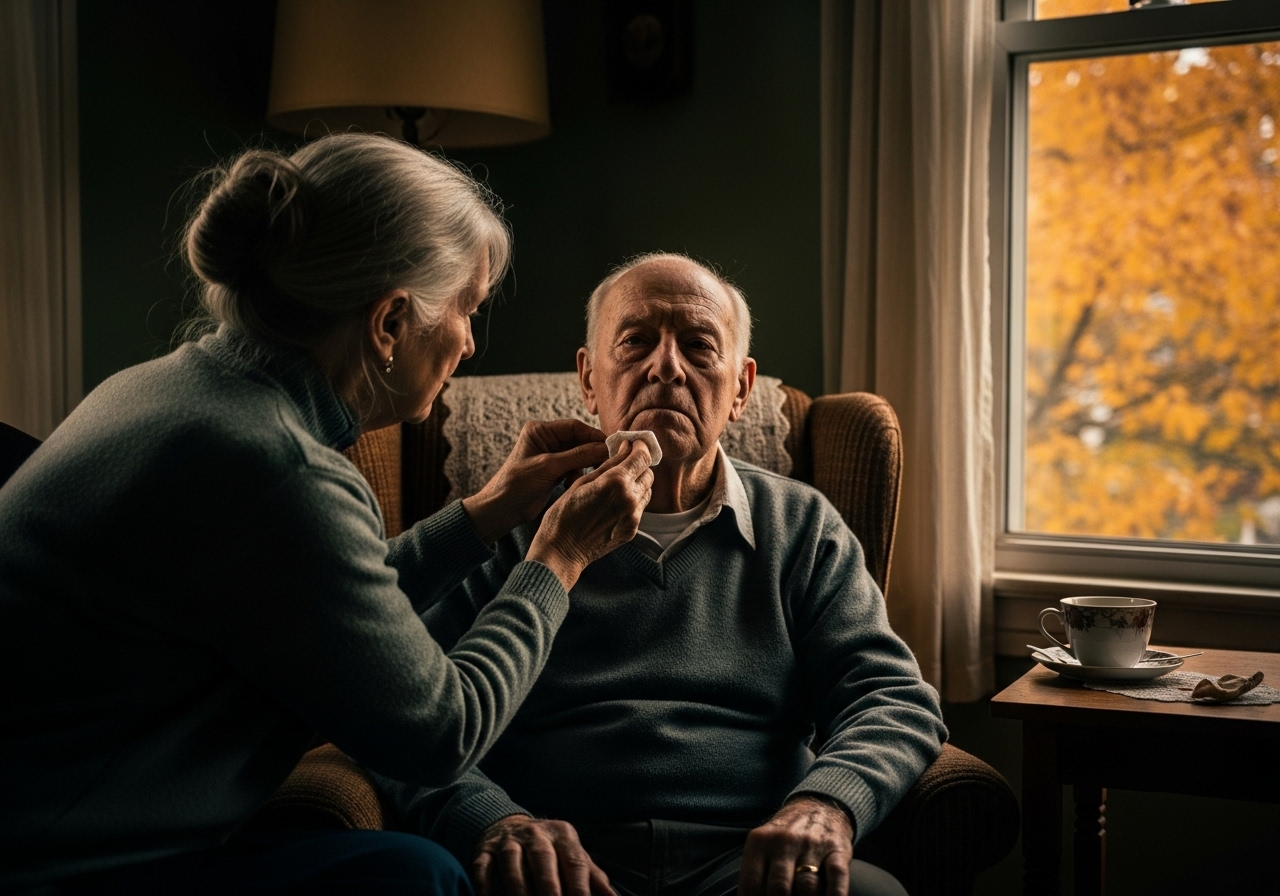
"He called," Joan replied, her voice steady despite the small, familiar ache. She pulled a napkin from her pocket, folded neat, and gently dabbed the tea from his hand, a small, tender ballet they performed almost daily. "He'll be by after work. He said he'd bring those apples from the orchard."
A faint smile, more genuine this time, touched his lips. "Ah, good. Good. Always liked Eddie's apples. That boy… he knows his apples." He took a careful sip, the liquid tracing a small, dark line down his chin. She dabbed it again, her fingers brushing the soft, papery skin of his cheek, feeling the faint stubble.
The autumn light continued its slow retreat, deepening the shadows in the corners of the room. A chill began to seep in from under the door. Joan felt a strange, detached calm, as if she were watching a play unfold, a story whose ending was already written. Herman settled back, his gaze now fixed on the window, on the bare branches of the maple, as if searching for something in the gathering twilight.
A phone buzzed from the kitchen, a sharp, insistent sound. It was Eddie, she knew. He would ask how Herman was, how her day had been. She would give him the usual answers, edited for kindness, for hope. But as the wind outside picked up, rattling the windowpane like a restless spirit, Joan knew, with a certainty that chilled her to the bone, that some part of her, and of them, was about to be swept away, just like the last, stubborn leaves on the maple tree, carried into a landscape that was rapidly becoming unrecognizable.
---
She walked towards the insistent buzz, the sound of the phone feeling like a summons, a harbinger. The shadows in the living room lengthened, swallowing Herman whole, leaving only the faintest outline of his form against the fading light, a silhouette against the encroaching darkness. And for a moment, just a fleeting moment, Joan felt truly, utterly alone, suspended between a past that was eroding and a future she couldn't bear to name.
And for a moment, just a fleeting moment, Joan felt truly, utterly alone, suspended between a past that was eroding and a future she couldn't bear to name.
Share This Story


