The Shimmering Grid
A scorching summer day in a decaying urban landscape in late 2025. Two figures, a runner mid-race and her coach, grapple with the physical and societal fallout of a world teetering on collapse, and whether kindness still has a place.
The air itself was a liquid shimmer, refracting the broken skyline into a hallucination of jagged teeth against a sky too bright, too washed out for this hour. Dust, heavy and fine, like powdered rust, coated everything. The heat was a living thing, crawling under the skin, sticking to the lungs. Each breath drawn in the runner's chest felt like inhaling hot sandpaper, the ragged edge of it catching, dragging, a raw sensation that mirrored the city's own unraveling.
Her knees screamed with every impact on the buckled asphalt. The soles of her worn trainers slapped a rhythm: push, burn, push. The relay band, a thin strip of tattered fabric, felt impossibly heavy on her wrist, a lead weight, yet it was the only thing that kept her from simply collapsing into the shadow of a skeletal billboard. She passed an overturned bus, its windows blown out, the interior a sun-baked crypt. A plastic toy, faded and melted, lay half-buried in a drift of grit, a relic of a softer world.
She forced her eyes to lift, searching for the next marker. Somewhere ahead, through the haze, the next exchange point. The coach would be there. He’d be waiting, a silhouette against the impossible light, his gaze a physical push. She needed that push. Needed it more than the water that sloshed in the small, warm pouch on her back.
A sharp, metallic tang, like old blood mixed with static, pricked her nose. It was the city's summer scent now, an aggressive perfume of decay and something indefinable, almost electric. She felt it everywhere, clinging to her sweat, a premonition, a promise. This wasn't a race anymore. It was an extraction.
The coach, a figure of solid muscle and etched lines around his eyes, seemed to materialize out of the heat haze by the remains of a rusted streetlamp. His hair, once dark, was now liberally streaked with gray, but his stance was still an immovable anchor. He held a grimy cloth, slightly damp, and a small, uncapped bottle of electrolytes. He didn't smile.
“Rough stretch,” he said, his voice raspy, a low rumble against the city's oppressive hum. He wiped a hand across his own brow, pushing back the sweat-soaked strands. His eyes, though, were sharp, missing nothing of her trembling legs, the dark circles under her eyes, the desperation tightening her mouth. “You’re losing time.”
She didn't need to be told. The burning in her quads, the flutter behind her ribs, it was all a screaming clock. She stumbled the last few feet, grabbing the cloth, dabbing it against her face. The water was lukewarm, tasted faintly of minerals and plastic. She sucked it down, forcing herself to swallow. “Everyone is,” she choked out, her throat raw. “The air… it’s worse than yesterday.”
“It's always worse than yesterday, kid,” the coach said, a ghost of a wry smile finally touching his lips, but it didn't reach his eyes. His gaze flicked past her, down the empty street, then back to her. “Still, that last sprint, that was… you found it, didn’t you? That extra gear.”
“Found it, lost it,” she gasped, leaning her hands on her knees, trying to pull air deep into her lungs, but it felt thin, insufficient. “What's the point, anyway? Just… pushing ourselves into the ground for what? Bragging rights? When half the grid’s… starving?”
He knelt, checking her ankle. His touch was firm, professional, yet carried an unspoken weight. “The point,” he began, his voice dropping, “is the push. Is finding that gear. The point is… not letting go of what we can still do, not just what we've lost. You see it out there, don’t you? The way people… they just… they’re like static electricity, ready to spark, but mostly just pulling away.”
She straightened, ignoring the faint ache in her ankle. “More like static cling. Everything sticks to you, but no one wants to actually help. Saw a kid earlier, maybe… six? Dropped his pack. No one stopped. Everyone just… walked around him.” Her voice was tight with something she didn't want to name: despair. Or maybe just frustration.
“And you? Did you stop?” he asked, his eyes suddenly intense, drilling into hers. The question hung in the shimmering air, heavier than the dust.
She looked away, down at her scuffed trainers. “I… I was racing. My leg. I couldn't.” The words felt like ash in her mouth. A lie, maybe, or a convenient truth. The truth was, the impulse had been there, a flicker, quickly extinguished by the roar of the competition, the survival instinct that had become second nature.
“See?” he said, not with judgment, but with a weary understanding. “That’s the thing, isn’t it? The easy slide. The little nudges, day by day, that turn us… narrower. Before, you’d have seen ten people stop. Now, you see one. And then maybe zero.” He paused, letting the silence settle, punctuated only by her ragged breathing and the distant, unsettling clang of something metal. “It’s like the city’s got this fever. Makes everyone turn inwards.”
A distant sound, a whirring, grew louder. Another runner, fast, gaining. Her rival for this leg. The coach’s head snapped up. “She’s on you. Two minutes, tops.” His voice was urgent now, the philosophical tangent gone, replaced by the immediate reality of the race. He handed her the electrolyte bottle. “Drink. You got this. One more stretch.”
She took a long swig, the metallic-mineral taste coating her tongue. “But is it… fixable?” she asked, the words tumbling out before she could stop them, desperate for an answer, any answer. “This… this turning inwards. This… lack of. Kindness.” The word felt fragile, almost alien on her tongue, like a delicate thing that shouldn't exist in this hard-edged reality.
The coach’s gaze softened, just a fraction, a fleeting moment of something almost tender. “Fixable?” He repeated, as if tasting the word. “Maybe not. Maybe it’s not about ‘fixing’ the whole damn thing. It’s about… remembering what it was like. Remembering what it felt like to actually… care about something beyond your own two feet. And then, maybe, trying to do one small thing that doesn’t just serve yourself.”
The rival runner was closer now, a blur of motion, her breath a loud rasp. The world outside the coach and the runner began to fracture and speed up, the surreal haze amplifying the urgency. Broken windows seemed to stare with empty eyes, a discarded doll on a pile of rubble seemed to grin. The sun felt heavier, pressing down on her skull.
“Like what?” she demanded, desperate for a tangible answer, a specific action, not just a feeling. She started to jog in place, her muscles protesting. The exchange point was a few hundred meters ahead, marked by a faded red flag tied to a twisted rebar.
“Like giving someone a good fight,” he said, his voice surprisingly calm, though his eyes darted to the approaching runner. “Even when you’re dead on your feet. Like not letting them just… walk over you. That’s a kind of kindness, too. Showing someone what it means to still fight, to still have grit, when everything else is crumbling.” He slapped her shoulder, a sharp, bracing contact. “Now go.”
She exploded forward, a burst of raw, primal energy, fueled by the metallic taste in her mouth and the coach's words. The other runner was close, too close. She could hear her ragged breathing, the slap of her shoes. The sheer audacity of the competition in this broken world, the refusal to lie down and die, was a strange, potent cocktail. It was a language they all understood, a brutal, honest form of communication.
She pushed harder, her arms pumping, her chest burning. The red flag seemed to recede, then lurch forward. Her vision tunneled, the edges blurring, the city becoming a streaking watercolor of gray and rust and impossible light. Was this kindness? This relentless, self-destructive drive to win? To prove something, anything, in a world that had forgotten what proof even meant? Or was it just the last gasp of a dying ethos, a desperate clinging to a game that no longer mattered outside these crumbling streets?
A sudden surge of adrenaline, cold and sharp, cut through the heat exhaustion. She saw it then. Not the finish line, not the next marker, but a small, almost imperceptible shift in the air, a ripple in the shimmering heat just beyond the flag. It looked like nothing. It looked like everything. A ghost of a memory, perhaps. Or a promise. It wasn't about the medal they wouldn't get, or the glory no one truly remembered. It was just… the run. The simple, brutal, beautiful act of putting one foot in front of the other, even when everything told you to stop. The kindness of not stopping, perhaps. The kindness of still trying. Or the desperation.
She lunged, arms outstretched, the tattered relay band flapping against her wrist. The world tilted. The heat pressed down, a hand on her back, urging her forward, or pushing her down. Her lungs burned. Her legs were liquid fire. She heard a shout, indistinguishable from the roaring in her ears. Was it the coach? The other runner? A phantom from the past? It didn’t matter. She was flying, or falling. The flag was a red smear. The exchange point was a fuzzy target, and then—
She was past it. Or almost. She wasn't sure. The world spun in a silent, deafening spiral, the last vestiges of her strength unraveling like cheap thread. She felt a hand, or thought she did, a fleeting contact, cool and firm. Or was it just the wind, finally catching her, finally letting her fall?
The coach was there, or wasn't. The world was a jumble of heat and dust and the ghost of a touch, and she was still running, even as her legs buckled, even as the ground rushed up to meet her. The conversation, the race, the city, all of it dissolved into a single, overwhelming sensation: the absolute, undeniable pull of gravity.
The question remained, suspended in the shimmering heat, waiting for an answer no one seemed capable of giving: was the race a testament to enduring human spirit, or just another act of futile, self-serving desperation in a world that had forgotten how to share?
She landed hard, her body absorbing the impact, the world going dark for a fraction of a second before the blinding light returned. The gritty taste of the asphalt was in her mouth, mixed with the metallic tang of blood. She felt a vague pressure, a weight, on her hand. The relay band. Or just her own numb fingers, still clenching.
And then a sound. Close. A gasp? A sigh? A rustle of fabric. Someone was there. Someone had always been there. Or perhaps, no one was. The heat, the silence, the sheer impossible weight of the summer air was all that remained. She wasn't sure if she had passed the band, if she had made the exchange, if anyone had even been there to receive it. All she knew was the ground, rough and unyielding beneath her, and the distant, surreal hum of a city that continued its slow, inexorable decay. And that hum… it felt both desolate and, strangely, persistently alive.
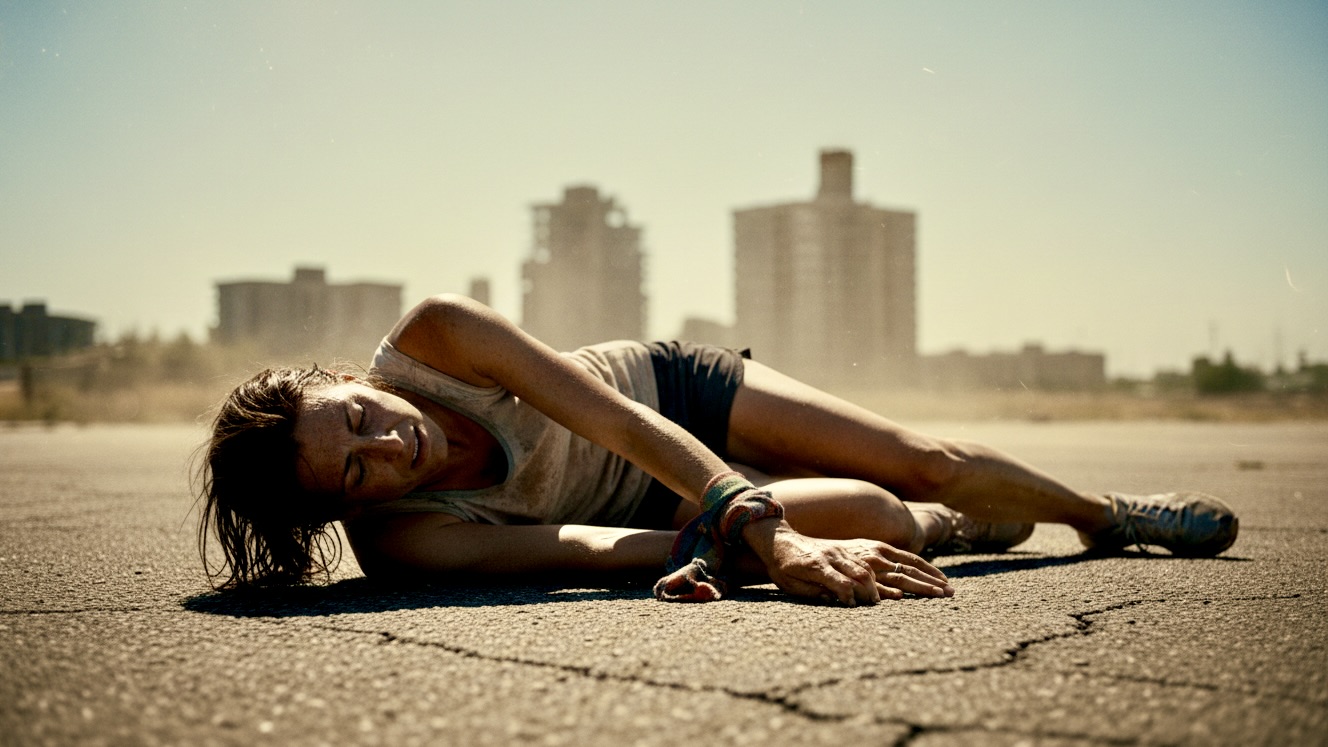
She wasn't sure if she had passed the band, if she had made the exchange, if anyone had even been there to receive it. All she knew was the ground, rough and unyielding beneath her, and the distant, surreal hum of a city that continued its slow, inexorable decay. And that hum… it felt both desolate and, strangely, persistently alive.
Share This Story


