The Churning Guts of Portage Avenue
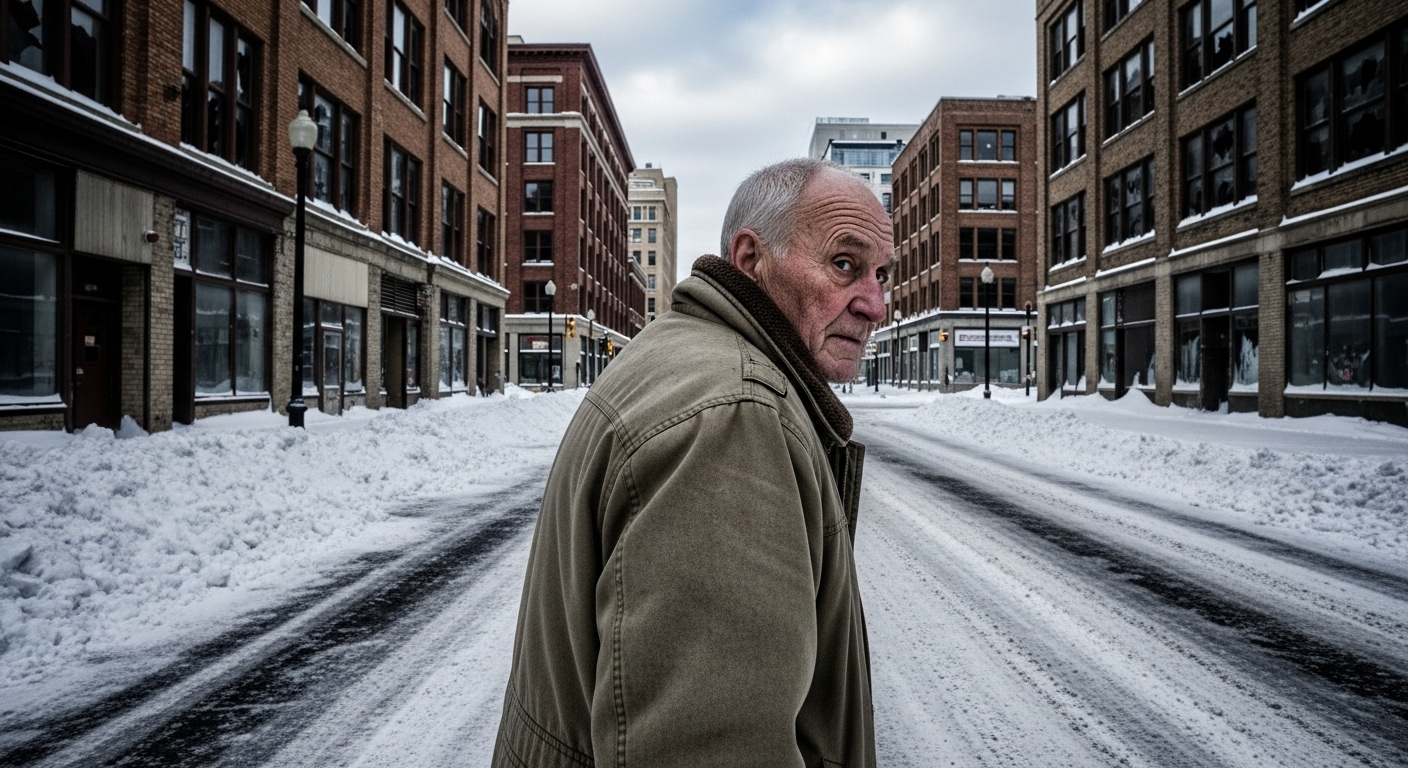
The wind, a razor blade honed on the prairies, sliced through the gaps in the buildings, turning the open spaces of downtown Winnipeg into a gauntlet. Snow, old and new, lay heaped against everything, burying cars, shopfronts, and memories under a relentless white shroud. Above, the sky pressed down, a bruise of grey, promising more, always more. It was a city carved from ice and despair, and Andrew Foster, a man older than most of the ruins, walked its silent, unforgiving streets, each step a testament to a stubborn refusal to break.
“Another one?” I heard myself say, the words more a rattle in my throat than a question. The wind snatched them, worried them, then flung them into the grey expanse of Portage Avenue. No answer, of course. Never an answer out here, not really. Just the crunch of frozen snow under my boots and the brittle whisper of ice against defunct windowpanes.
My breath plumed, thick and white, then vanished. My gloved fingers, stiff even inside the heavy wool, fumbled with the zipper of my ancient parka. The cold gnawed. It always did. Winnipeg winters, even before… before the Grey, they were relentless. Now? They were executioners, stripping everything back to bone and bare rock. It had been seven years since the Grid went down, seven winters since the last proper trial, seven years since I watched a man, innocent or not, disappear into the maw of what they called 'justice' now.
Seven years since I'd failed him.
The memory tasted like rust on my tongue. The chill wasn't just in the air; it had settled deep in my bones, a permanent resident, a testament to all the things that had been lost, including, perhaps, a piece of myself. The weight in my coat pocket – a worn leather case file – pressed against my hip, a constant, physical reminder of the current, impossible task.
I kicked at a snowdrift, a mindless gesture. The heavy, insulated boot made little impact. Just a spray of fine, cold powder. The street, usually bustling with traffic and the hollow echo of city life, was a canyon of silence. The Eaton’s building, or what was left of it, loomed ahead, a skeleton picked clean. Its once-grand windows were dark sockets, reflecting nothing but the bruised sky. Across the street, the old Bay store was little better, a monument to a forgotten age of commerce and consumption. Dust on the glass, not from neglect, but from the grinding attrition of a world that had forgotten how to clean.
My mind drifted back to the last courtroom I’d stood in, a makeshift affair in the shell of a university lecture hall. No robes, no wigs, just threadbare coats and desperation. The ‘judge’ – a former history professor named Davies, now a self-appointed arbiter of the dwindling community’s rules – had sat at a salvaged desk, his face grim under the flickering light of a jury-rigged lantern. The ‘jury’ was a dozen people pulled from the meagre population, their eyes hollow with hunger and fear.
I’d argued for the defendant, a young woman, hardly more than a girl, accused of hoarding medical supplies. Antibiotics. Penicillin, scavenged from a pharmaceutical warehouse. The prosecution, such as it was, painted her as a thief, a danger to the collective, someone who put her own survival above the greater good. Her infant daughter had been sick. Dying. She’d hidden the vials. Who wouldn't? The logic, the humanity of it, had been clear to me. But humanity was a luxury, a relic, in those days. It still was.
Davies had hammered his fist on the desk, a sound like a distant gunshot. “The rules are clear, Foster! Shared burden, shared sacrifice. No exceptions.”
“Her child, Davies! What kind of justice is this that condemns a mother for trying to save her child?” My voice had cracked, something it hadn’t done since I was a green junior lawyer. I could still feel the burn in my throat.
He’d stared at me, his eyes cold. “The only kind left, Foster. The kind that keeps us all from tearing each other apart.”
She’d been exiled. Sent out into the frozen wastes beyond the Red River, her child tucked in her arms, both wrapped in thin blankets. I watched her go, a knot of impotent fury and despair twisting in my gut. The image of her small, retreating figure, disappearing into the white, haunted my steps. It still did. Every winter, every sharp gust of wind, brought her back. The chill wind carried the ghost of her plea, the silent terror in her eyes. I had failed her. I had failed the most fundamental tenet of my profession, the very reason I'd spent decades in stuffy courtrooms, fighting for the broken and the accused. It was a wound that hadn’t healed, a permanent ache under my ribs.
I pulled my scarf higher, the coarse wool scratching my chin. The scent of woodsmoke, thin and acrid, mixed with the sharp, clean smell of fresh snow. A wisp of smoke curled from a makeshift chimney atop one of the shorter buildings, a sign of life, however fragile. People huddled in pockets, clinging to warmth and whatever scraps of community they could find. They called them 'holds' now, these fortified islands in the urban wasteland. The old hold, the university, had been shattered last year when the North End scavengers had pushed too hard. Too many people, too few resources, too much desperation.
My boots crunched over what felt like shattered glass, tiny, sharp slivers under the fresh powder. Years ago, it might have been a window from a boutique, now it was just another layer of urban detritus. My eyes scanned the facades, instinctively searching for movement, for danger. The world was full of it now, the two-legged kind mostly. Hunger made people desperate. Desperation made them cruel. The law, my law, was just a whisper now, a ghost haunting the corners of a brutal, new reality. But even ghosts could be tenacious.
A Glimmer of Warmth
A flicker of light caught my attention, a low glow from a boarded-up storefront. The old convenience store. It had been Maria's for as long as I could remember. One of the few original businesses still clinging on. I pushed open the heavy canvas flap that served as a door, and the warm, stale air, thick with the smell of burning wood and brewing tea, enveloped me. A small bell, still miraculously intact, jingled overhead. The sound was a surprise, a fleeting echo of a gentler time.
Maria looked up from behind her counter, her face a web of wrinkles, her hair pulled back in a severe bun. She was even older than me, but her eyes were still sharp, observant. They held the kind of weary knowledge that only came from outliving everything you once knew. She wore three sweaters under a thick, quilted jacket, her hands calloused from chopping wood and hauling water. "Andrew," she said, her voice raspy, a faint smile touching her lips. "Thought you were lost to the wind." She gestured towards a steaming mug on the counter. "Tea. Black. Just how you like it."
I shuffled forward, my joints protesting the sudden change from the biting outdoor cold. "Never lost, Maria. Just… thinking." I picked up the mug. The ceramic was warm, almost painfully so, against my cold fingers. The heat seeped into my palms, a small, profound comfort. The tea was strong, bitter, perfect. "Another 'reckoning' meeting this afternoon, then?" I asked, my voice low. The 'reckoning' was the new term for the informal tribunals, where the council tried to sort out disputes, crimes, and the ever-present question of who deserved what.
Maria scoffed, a dry, rustling sound. "Always. This time it's that fracas over the fuel from the old tanker at the railyard. Cole's crew wants it all. The North Enders say it's their territory. Davies is already looking like a man about to declare a blood feud." She leaned forward, her voice dropping to a near whisper. "Saw some of Cole's men patrolling the Exchange District earlier. Heavily armed. More than usual. Trouble brewing, Andrew. More than just a few barrels of fuel."
I nodded, taking a slow sip of the tea. The flavour was earthy, fortified with whatever dried herbs Maria managed to forage. The sugar was long gone from these parts, replaced by a bitter acceptance of scarcity. Cole. A former security guard, now self-appointed 'enforcer' for the Central Hold. He was a brute, opportunistic, but smart enough to understand the new power dynamics. He collected loyalty, and debts, with equal ferocity. His law was the swing of a pipe, not the turn of a phrase.
"Any word on the… on the old cases?" I asked, knowing what she knew. The whispers of accountability, of revisiting the decisions made in the early days of the Grey, when chaos reigned. When the lines between survival and barbarity blurred. Some called it justice. Others called it revenge.
Maria’s eyes narrowed. "Only that Davies is getting bolder. He thinks… he thinks it's time to 'honour' the fallen. To make examples." She paused, her gaze fixed on something beyond my shoulder, something only she could see. "Be careful, Andrew. Old ghosts are rising. And some of them carry very sharp knives."
I shivered, despite the tea's warmth. "I always am, Maria. Just trying to keep a few more of us from disappearing into the snow." I knew what she meant by 'honour the fallen'. It wasn't about remembrance; it was about laying blame. And in this world, blame was a death sentence. It could be for acts of desperation, acts of cruelty, or just for being on the wrong side of a council decision years ago. The 'reckoning' wasn’t about fairness, not really. It was about order, a brutal attempt to impose some semblance of structure on the chaos, to stop the rot from spreading further. But sometimes, in trying to stop the rot, you cut away the healthy flesh too. I’d seen it.
The bitter memory of the young mother stung again. Her name… I still remembered it. The way her hands trembled when she signed the plea. The tears that froze on her cheeks as they led her away. My failure was a millstone around my neck, and every step I took through this frozen city was a dragging of that weight. What good was a lawyer in a world without law? What good was justice when survival was the only verdict that mattered?
But then I remembered the promise I’d made, to no one in particular, but to the ghost of my old self. That I wouldn’t give up. That I would keep trying to carve out a sliver of fairness, however small, however fleeting. It was the only thing I had left to hold onto, the only reason my feet still moved, one after the other, through the endless snow.
---
A New Kind of Frost
I left Maria's, the cold biting harder now that I was warmed. The wind had picked up, howling through the skeletal high-rises. I pulled my scarf even tighter, hunching my shoulders against the onslaught. My destination was the old City Hall building, a place where a new kind of power, a fragile and often arbitrary one, had taken root. That’s where the 'reckoning' would take place.
My route took me past the remains of the Millennium Library. Its glass front was mostly gone, a gaping maw revealing shelves of water-damaged, frozen books. A testament to knowledge, now rendered useless, brittle pages crumbling in the unforgiving cold. I remembered taking my son there, years ago, before the Grey, when he was small. He’d loved the children’s section, the bright colours, the stories. Now, even the thought felt like a betrayal. His face, a bright memory, flickered and faded against the backdrop of this desolation.
The thought of him was another kind of cold, deeper than the winter wind. He hadn’t made it through the first winter after the Grey. Pneumonia. No medicine. Not a trace of what the young mother had tried to hoard for her own. Another failure, a raw, gaping hole in my chest that the cold only seemed to exacerbate. My breath hitched. I squeezed my eyes shut for a second, feeling the familiar prick of tears, quickly frozen on my lashes. No use. Nothing changed anything. He was gone.
I opened my eyes, the world a blur for a moment, then sharpening into the bleak, familiar details. The grey concrete, the dirty snow, the endless, empty sky. My footsteps echoed, unnervingly loud, on the deserted pavement. The silence of the city was a living thing, a predator. You could almost feel it watching, waiting.
A glint caught my eye, off to the right, near the old theatre. A flash of metal. I stopped, hands still shoved deep in my pockets, trying to appear nonchalant. But my heart had begun a slow, heavy thrum against my ribs. Three figures, dark against the snow, emerged from the alley beside the theatre. Not scavengers. Their gear was too uniform, too well-maintained. They carried heavy axes, glinting dully in the dim light, and a short, crude-looking rifle slung across the lead figure’s back. Cole's men, just as Maria had warned. But these were further afield than usual. Patrolling, she’d said. Or staking a claim.
Their movements were fluid, predatory. They weren't just walking; they were hunting. Their eyes, even from this distance, seemed to bore into the shadows, searching. They didn't appear to have seen me yet, tucked as I was against a snow-laden abandoned bus stop, partially obscured by a mound of frozen waste. I held my breath, the cold air burning in my lungs. I was an old man, a lawyer, not a fighter. Running wouldn't help. Confrontation would be suicide. I pressed myself deeper into the dirty snow, trying to disappear, become part of the urban decay.
They moved slowly, deliberately, their heavy boots making the same muted crunching sound as mine had. A shiver, colder than any wind, ran down my spine. This wasn't just about fuel, or the North Enders. There was a new tension in the air, a scent of something fresh and dangerous, mingling with the woodsmoke and the wet dust. These men weren't just enforcing Cole's hold; they were extending it, claiming territory that had, until now, been neutral ground.
The lead figure stopped. His head tilted, as if listening to something only he could hear. His eyes swept across the street, pausing, for a fraction of a second, on my position. My breath froze in my throat. Had he seen me? Or was it just a random, unsettling glance? I didn’t move, didn't even blink. My old man's heart hammered, a frantic drum against my ribs. This was a different kind of danger than a legal argument, a much older, more primal kind.
He grunted something to his companions, a guttural sound lost to the wind. They turned, veering off down a side street, disappearing into the labyrinth of broken buildings. I let out a long, slow breath, a shaky plume of vapour. My legs felt like jelly. They were moving faster now, cutting a path through deeper snow, not just patrolling, but on a mission. This wasn’t just about the current fuel dispute; this was about something more. Something bigger. Something that shifted the precarious balance of power in this ruined city.
My mind, despite the lingering terror, began to churn. Maria’s words. 'Old ghosts are rising. And some of them carry very sharp knives.' Cole, expanding his reach. Davies, preparing to 'make examples.' The fuel dispute was a symptom, not the disease. And what was the disease? Power. Control. The relentless, brutal struggle for what little remained.
The City Hall building, stark against the grey sky, was just ahead. The 'reckoning' would begin soon. But I had a sudden, sinking feeling that the true reckoning had already begun, out here in the snow-choked streets, far from any makeshift courtroom. And it wasn't just a verdict on the past; it was a judgment being passed on the future. My hands, still cold despite the tea, tightened into fists. This wasn't just about my past failures or the current dispute. This was about survival, yes, but also about the fragile, desperate hope that some semblance of justice could still exist. Or, perhaps, be resurrected. I walked on, each step a deliberate push against the gathering dread. The ice creaked under my feet. A fresh, icy wind whipped around the corner of the building. It carried with it the distant, faint sound of a siren, a sound I hadn't heard in years, a metallic wail that seemed to carry an unspoken promise of more trouble, more chaos. Not a rescue. Never a rescue. Something else. Something new and deeply unsettling. A warning. A declaration. My old lawyer's intuition, dulled by years of trauma, sparked to life, a cold, painful jolt. The reckoning was not just coming to the others. It was coming for all of us.
I gripped the worn leather of the case file tighter, feeling the cold seep through it, a different kind of chill than the wind. Somewhere in this frozen, broken city, a reckoning was indeed coming. And I had a feeling, a cold, bitter certainty, that it wouldn’t be the only one, or the last.
Share This Story


